Showing posts with label mythology. Show all posts

Friday, January 11, 2019

Arty Farty Friday Rabbit-hole (ending on a rainy day in Spain.)


The search for a painter born around this time of year, with fascinating background or life story brought little of interest. My yawns caused me to stumble down an internet rabbit-hole while skimming through the biography of 17th century French painter Jean-Baptiste van Loo (14 January 1684 – 19 December 1745).

One of van Loo's best known paintings is shown in the small image below:
"Triumph of Galatea", and...ooops! Down the rabbit-hole I fell!

A better, larger image of the work is available here.


From Mental Floss website

4. "Galatea," which means "she who is milk-white," refers to three women in mythology. Of the three, the most well-known was the wife of King Pygmalion of Cyprus. Another was a Sicilian nereid, or sea nymph, who was in love with Acis, the son of Faunus and a river nymph. The final Galatea was the wife of Lamprus; she prayed to Leto that her daughter be turned into a son.

5. Jean-Baptiste van Loo's "Triumph of Galatea" is likely a representation of the Galatea who loved Acis. According to the story, the cyclops Polyphemus was jealous of Acis and thus killed him with a boulder. Galatea was distraught over the murder of her love, and so she turned his blood into the river Acis (in Sicily). However, no sources appear to document the inspiration or source of "The Triumph of Galatea."
Alrighty then - but what about Pygmalion? That word brings forth memories of Audrey Hepburn, Julie Andrews, Rex Harrison.

Pygmalion, a play by George Bernard Shaw, named after a Greek mythological figure. In ancient Greek mythology, Pygmalion fell in love with one of his sculptures, which then came to life. The general idea of that myth was a popular subject for Victorian era English playwrights, including one of Shaw's influences, W. S. Gilbert, who wrote a successful play based on the story called Pygmalion and Galatea that was first presented in 1871. Shaw would also have been familiar with the burlesque version, Galatea, or Pygmalion Reversed.

Shaw's play has been adapted numerous times, most notably as the musical My Fair Lady and its film version.
See Wikipedia HERE and HERE.


Who'd've thunk it? Jean-Baptiste van Loo, via Galatea, down a rabbit-hole off-shoot, to this:


Tuesday, December 11, 2018

Perceiving Christmas Through Its Wrapping


To perceive Christmas through its wrapping becomes more difficult with every year.
~E.B. White, "The Distant Music of the Hounds".
At this time of year, when we receive a greetings card with illustration of a nativity scene, I remember a dear old boss of mine -my first ever boss, Mr H. He'd say, tongue firmly in cheek, if we received such a greetings card in the office, "Oh my, they've even started bringing religion into Christmas now - whatever next?!"

In some ways it really is a pity that Christianity got itself tangled up with the season formerly known as Yule, instead of making for itself a festival closer to the date of Christ's real birthday, inasmuch as that could have been established. The idea of goodwill and peace at what we call Christmas does reflect the true Christian message, even so, the traditions of the season do not necessarily stem from that message - it's a bit like putting the cart before the horse. Traditions of giving, loving and helping others pre-date Christianity by thousands of years.

In Europe, and later in the USA, traditions rooted in the pagan Norse and Celtic Yule, from long before the time of Jesus, have persisted over many thousands of years. Yule represented the moment when the days would again become longer, when light would return to the land, and people had reason to be thankful as spring was on its way, with the birth of new animals, and the softening of the soil for planting. Such winter festivals exist in most other parts of the world too, each with their own motifs and traditions, all rooted in the past.

What follows appeared on this blog some 8 years ago - time for a re-run! Sources originally linked are, unfortunately, no longer available.

Our western traditions and their roots:

Giving to the Needy- This tradition may have come from the Saxons who had 2 tables at the door of the banquet hall during their feasts. One was for all to take food, and the other was to leave alms for the poor. This meant to symbolize the unity of all human lives and to remind the Saxons that what one gave was returned 3-fold. Even today it is a Christmas custom to give food to the needy, and for this act of kindness we can thank the Saxons.....~Tala~ (Robin Paladino)

Gift Giving- seems to originate from the Winter Solstice holiday, Saturnalia (which honored the God Saturn) which was long established by the Romans before they invaded Britain and was celebrated for several days around 17th December. It was a time when Masters waited on servants at mealtime, gifts of light were given, particularly candles. Other traditional gifts included coins, honey, figs, and pastry. Gifts were also given in honor of loved ones who had died during the previous year. Early Roman explorers carried this tradition throughout Europe.

Feasting- had several purposes: to acknowledge the return of the season of growth, to give physical expression to the hope for abundance in the year to come, and finally to alleviate boredom and depression. As Christianity gradually usurped Pagan ways of worship, the custom of Advent (a month long fast before Christmas) reflected the times when people had to survive on eating very little. It became custom to feast on the 25th and to mark this day with acts of hospitality and generosity. The rich were expected to open their doors for all, and this could well have been the precursor to the tradition of helping those less fortunate.

Yule Log- is a small log of usually oak, with a flattened bottom that is decorated with evergreen and holly, after it is inscribed with symbols that represent wishes and what you want to bring into your life in the coming year. It is burned on Yule, after it is charged, or "wished upon". It is kept in the house all year to protecT inhabitants from illness AND adverse conditions; it is used the following year to light the new Yule log. Some Yule logs today are similar, except for 3 holes drilled down the center, to place candles, as many people today do not have working fireplaces. Cakes in the shape of Yule logs are a 20th century nod to this tradition.

Christmas Trees- were originally Yule trees. The Celts believed they stood for the everlasting life because the trees did not "die" in the winter. They stood for protection, prosperity and were the symbol of renewal and the hope for the sun to make the earth green again. Because of their massive height, they were a symbol of eternity. It was from these beliefs that the decorating of Yule trees, now known as Christmas trees, evolved. Yule trees were decorated with images they wished the coming year to bring for them: nuts for fertility, love charms for happiness, fruit for a successful harvest, and coins for wealth.

Lights- on houses and Christmas trees is a modern version of the Pagan custom of lighting candles and fires to "lure back the sun." The Saxons may have been the first to put candles on Yule trees.

Red candles- symbolize the fire and heat of the returning sun.

Wreaths- signify the "wheel of the year," a circle with no beginning and no end. (See image at top of post)

Pine cones are the male aspect of fertility, and the fruit signifies the female aspect. They were initially used by Scandinavian Pagans 4,000 years ago.

Mistletoe- symbolized peace, prosperity, healing, wellness, fertility, protection and rest. It was placed around the fire and helped women to conceive. It was believed to be an aphrodisiac (magickally, not medically, as it is poisonous); if left hanging up all through the year, it would bring good luck. It was also dubbed the "golden bough" by the Druids. Kissing under the mistletoe has its origins in Norse mythology and a story about Baldur, a son of Odin and goddess Frigg. Long story short: a dart fashioned from the little mistletoe plant was used to murder Baldur in front of all the gods who loved him dearly. Frigg was devastated, her tears became the berries of the plant. It was decreed that mistletoe would never again be used as a weapon and that she would place a kiss on anyone who passed under it. Legal matters were sealed beneath its boughs. A couple who kissed beneath the mistletoe bough were announcing their intent to get married. They would kiss under it again after the official ceremony, to further seal their vows.

Holly- symbolizes the old solar year, the waning sun, and good luck.

Jingle bells- were used by the Norse to herald in the dawn after the long dark night. They also used them to ritually frighten away the powers of darkness that they felt reached their peak at Yule.

Santa/Father Christmas has multi-cultural roots with characteristics of Saturn (Roman Agricultural God), Cronos (Greek God known as Father Time), The Holly King (Celtic God of the dying year), Father Ice/Grandfather Frost (Russian Winter God), Thor (Norse Sky God, who rides the sky with a chariot drawn by goats), Odin/Wotan (Scandinavian/Teutonic all-father who rides the sky on an 8-legged horse), Frey (Norse Fertility God), Tomte (a Norse land spirit known for giving gifts to children at this time of year). Santa's reindeer can be viewed as forms of Herne (the Celtic Horned God), and Frau Holde (a Goddess from Germany believed to ride on the wind in a sleigh on Yule eve, and give gifts to her followers.

Saturday, February 24, 2018

Saturday & Sundry Mostly Useless 'Porphirical' Facts

Porphyry. What does that word mean to you? I'm imagining an apathetic shrug coming from my passing reader. I'm vaguely familiar with one facet of the word's meaning: it's the name of an astrological House System. More on that in a mo.


Wikipedia's page for 26 February lists that date as a Christian Feast Day in honour of
Porphyry of Gaza. Hmm, thought I, can't see a venerated and sainted Bishop of the Greek Orthodox Church lowering himself to play around with astrological houses. Saint Porphyry was bishop of Gaza from 395 to 420, known for Christianizing the recalcitrant pagan city of Gaza, and demolishing its temples. He died on February 26, 420.
(See here)


It was another Porphyry - Porphyry of Tyre - who gave astrologers another House System to play with. He was a prominent Neoplatonic philosopher who flourished in the late 3rd century CE. He is primarily known as the student of the founder of Neoplatonism, Plotinus, although he was regarded as an important philosopher in his own right in Late Antiquity. He occasionally made references to astrological doctrines in his philosophical works, and there is at least one surviving text on astrology that was attributed to him: an introduction to Ptolemy’s Tetrabiblos, which mainly consists of a series of definitions of basic astrological concepts. Most of the definitions were copied verbatim from a lost work of definitions by Antiochus of Athens.

In the House system known as Porphyry, each quadrant of the ecliptic is divided into three equal parts between the four angles. This is the oldest system of quadrant style house division. Although it is attributed to Porphyry of Tyre, this system was first described by the 2nd-century astrologer Vettius Valens, in the 3rd book of his astrological compendium known as The Anthology.
(See here)

Ooooh kaay.

But Porphyry is more - much more.

The term porphyry, from Ancient Greek, means "purple". Purple was the color of royalty, and the "imperial porphyry" was a deep purple igneous rock (formed through the cooling and solidification of magma or lava. ) with large crystals of plagioclase. Some authors claimed the rock was the hardest known in antiquity."Imperial" grade porphyry was thus prized for monuments and building projects in Imperial Rome and later. (See here)

Also


In Greek mythology, Porphyrion was a giant, one of the sons of Uranus and Gaia. After the Olympian gods imprisoned the Titans in Tartarus, Porphyrion was one of twenty-four anguipede giants who made war on Olympus. During the Giant's revolt on Olympus, Porphyrion attempted to strangle Hera. An arrow from the bow of Eros inspired Porphyrion with lust for Hera, and he tore her robes and would have forced her, but an enraged Zeus shot him with a thunderbolt.


There's more.... there's


Porphyrius the Charioteer (also known as Calliopas) who was a renowned Roman charioteer in the 5th and 6th centuries AD. In the time of Porphyrius, Roman chariot-racing was at its height. Charioteers were celebrities, and Porphyrius is famous for having seven monuments built in his honor in the Hippodrome. These monuments serve as a glimpse into the history of the time, and into the life of Porphyrius. The age of Porphyrius is often referred to as the age of the Byzantine Charioteer.
(See here)


Still more...it's an island!

HERE

Porphyry Island is an island in Unorganized Thunder Bay District in northwestern Ontario, Canada. It is the last island in a chain stretching south west of the Black Bay Peninsula in Lake Superior. It is located about 6 kilometres (4 mi) from Edward Island Provincial Park, 13 kilometres (8 mi) from Sleeping Giant Provincial Park, 14 kilometres (9 mi) east of Silver Islet, Ontario, and 42 kilometres (26 mi) east of the city of Thunder Bay.
The island and nature reserve take their name from the characteristic quartz and feldspar crystals, or porphyries found in the volcanic rocks. (See here).


Wednesday, July 15, 2015

Nebulous Neptune

 Neptune Calming the Tempest  (Rubens, 1635)
I suppose it's fitting that the origins of the god Neptune's astrological connection to the seas is a wee bit nebulous. Astrological Neptune is known for nebulousness. Custom and practice does seem to have made it a relevant connection - sometimes.

While reading something else on Roman festivals in general I noticed this from The Roman Festivals of the Period of the Republic by William Warde Fowler at Google books HERE. Clicking on the segments will bring up clearer images.


And from crystalinks.com HERE:
Neptune is the god of the sea in Roman mythology, a brother of Jupiter and Pluto. He is analogous but not identical to the god Poseidon of Greek mythology. The Roman conception of Neptune owed a great deal to the Etruscan god Nethuns. Originally he was an Italic god paired with Salacia, possibly the goddess of the salt water. At an early date (399 BC) he was identified with Poseidon, when the Sibylline books ordered a lectisternium in his honour (Livy v. 13).

In earlier times it was the god Portunes or Fortunus who was thanked for naval victories, but Neptune supplanted him in this role by at least the first century BC, when Sextus Pompeius called himself "son of Neptune".

Neptune was associated as well with fresh water, as opposed to Oceanus, god of the world-ocean.

Like Poseidon, Neptune was also worshipped by the Romans as a god of horses, under the name Neptune Equester, patron of horse-racing.

Neptune was also considered the legendary progenitor god of a Latin stock, the Faliscans - ancient Italian people - who called themselves Neptunia proles. In this respect he was the equivalent of Mars, Janus, Saturn and even Jupiter among Latin tribes.

  Neptune Sending a Deluge to Troy, by Antonio Tempesta (17th century).

And there's this from tribunesandtriumphs.org:
.....In searching for the mythological sense of the fable, we must again have recourse to Egypt, that kingdom which, above all others, has furnished the most ample harvest for the reaper of mysteries. The Egyptians, to denote navigation, and the return of the Phoenician fleet, which annually visited their coast, used the figure of an Osiris borne on a winged horse, and holding a three-forked spear, or harpoon. To this image they gave the name of Poseidon, or Neptune, which, as the Greeks and Romans afterwards adopted, sufficiently proves this deity had his birth here. Thus the maritime Osiris of the Egyptians became a new deity with those who knew not the meaning of the symbol.


So, Roman Neptune took on characteristics of Greek Poseidon, Greek Poseidon took on characteristics of an Egyptian depiction. What happened in astrology, though, to Neptune's link with horses and "stock" - why weren't these attached to Neptune, as well as a connection to the sea?

Wednesday, June 10, 2015

JUNO

June is the month named for Roman goddess Juno, her Greek equivalent was Hera. In mythology she was wife (and sister) of Jupiter (Roman)/Zeus (Greek). She tried to tame her unfaithful, freedom loving spouse away from his adventures, back to matrimonial duties.

The Peacock Complaining to Juno by Gustave Moreau, 1881


First verse of a poem titled Jupiter on Juno, by A.D. Hope from the book Antechinus

Juno is the goddess of marriage and childbirth. She is also considered the protector of women. She was devoured by her father Saturn, and rescued by her brother Jupiter, who she married. She is primarily known for being the wife of the father of all gods. She is jealous and stern, frequently quarreling with her husband over his numerous affairs, not to mention his illegitimate children.

She is usually portrayed as a majestic woman, often wearing a crown or a scepter to show her position as Queen of the Olympus. The peacock, an animal which she holds sacred, is one of her most characteristic symbols.

Juno is featured in works of art such as Tintoretto´s “Origin of the Milky Way”, as well as the painting above, titled “The Peacock Complaining to Juno” by Gustave Moreau. She is also feautured in ancient literary works, such as Homer´s “Iliad” and “Odyssey”
.
Source: “Gods and Heroes in Art”, by Lucia Impelluso. Hat-tip HERE.

In astrology asteroid Juno (glyph shown, right) takes its attributes from the myths associated with that goddess - notably her position as patroness of marriage. Where asteroid Juno is found in one's natal chart is said to indicate attitude to marriage, marriage partner, etc.

Juno, right now, is at around 22 degrees of Leo.

I don't usually pay much attention to asteroids in astrology, the astrological scene is complicated enough, using all possible combinations available, without adding further content. But, as it's Juno's special month now, I took a a peek at my natal chart, with Juno added, at Astrodienst in the Extended Chart Selection segment. When I was born Juno was at 20 Capricorn, around a degree from natal Mercury, and a few degrees from the descendant angle (depending on exact time of birth of which I'm not certain). Do interpretations for this placement fit me?

There's a fairly clear consensus among on-line astrology sites that Juno in Capricorn translates as a native preferring the solid, upstanding, traditional-type partner, a good earner, reliable, trustworthy etc. Ideally will require a partnership to be legalised by marriage. May gravitate towards an older partner.
Juno conjunct Mercury : likely to be attracted to partners with good communication skills, witty and fluent. Communication will have to be clear and honest, and within any relationship an absolute priority.

Hmmm- well from that little lot I can pick two items which fit or have fitted in the past, and some which do not fit at all.

Sure, I have always paid little or no attention to age. I lived with a much older partner for 30+ years - without "benefit" a marriage certificate. Who needs that - a piece of paper? Husband and I have that piece of paper now, because US authorities wouldn't have allowed me to live with him here without it.

Close relationship is the most important thing in my life, always has been - possibly a need created by being an only child, lacking companionship of siblings in childhood. So Juno close to a chart angle works well. I've always been attracted to good writers, or at least writers who can pull a decent sentence together, a touch of wit thrown in is the cherry on top; and/or to those who can paint and draw well.

Juno in Capricorn interpretations indicating that any partner would be required to be solid, upstanding, "a good earner" doesn't fit me at all...not at all! Being severely independent I've always been able to fill that role for myself. It appears that, in my case, Aquarius Sun and Aries Moon cancel out some of Juno's indications.

Anyone interested can easily discover their natal Juno position at the link above, free of charge. Or, alternatively, there's a Juno ephemeris HERE, covering years 1900 to 2015. Finding interpretations from a variety of websites is just a matter of typing "Juno in........(whatever zodiac sign)" into Google's search box.

Friday, October 17, 2014

Arty Farty Friday ~ The Elusive Maximilian Pirner

Maximilian Pirner, born February 13, 1853, Schüttenhofen, Bohemia (Czech: Sušice). Died April 2, 1924, Prague. A Czech painter, member of the Vienna Secession and associated with the Czech Secession art movements. Pirner's usual themes were classical mythology, for example: Medusa (1891), Hekate (1901); also the macabre: Sleepwalker (1878), Daemon Love (1893), and Allegory of Death (1895). He also sketched or painted a number of of female figures, many of them nudes.

Described by one critic as having achieved "mastery of the sinuous line". Pirner also had his detractors. One contemporary critic, while acknowledging Pirner's talent, considered him an "over-sophisticated mystic."
(Information from Wikipedia).

That's all they wrote (in English)! There's a dearth of accessible information on this artist. The only other tid-bit I found is the fact that Pirner taught art - somewhere. A student mentioned in an article "was accepted to the class of drawing and painting of Max Pirner (1854-1924), an acknowledged artist of neo-romantic, philosophical inclinations".

A few of his paintings, then his natal chart.

Please click on images for larger or clearer views.


 Hekate
Hekate, a goddess in Greek religion and mythology, most often shown holding two torches or a key, and in later periods depicted in triple form. She was variously associated with crossroads, entrance-ways, dogs, light, the Moon, magic, witchcraft, knowledge of herbs and poisonous plants, necromancy, and sorcery. In the post-Christian writings of the Chaldean Oracles (2nd-3rd century CE) she was regarded with (some) rulership over earth, sea and sky, as well as a more universal role as Saviour (Soteira), Mother of Angels and the Cosmic World Soul. She was one of the main deities worshiped in Athenian households as a protective goddess and one who bestowed prosperity and daily blessings on the family. (Wikipedia)


 Medusa
In Greek mythology Medusa was a monster, a Gorgon, generally described as having the face of a hideous human female with living venomous snakes in place of hair. Gazing directly into her eyes would turn onlookers to stone. Medusa was beheaded by the hero Perseus, who thereafter used her head as a weapon until he gave it to the goddess Athena to place on her shield. In classical antiquity the image of the head of Medusa appeared in the evil-averting device known as the Gorgoneion. (Wikipedia)


 Empedocles
Empedocles (c.490 – c.430 BC) was a Greek pre-Socratic philosopher and a citizen of Agrigentum, a Greek city in Sicily. Empedocles' philosophy is best known for being the originator of the cosmogenic theory of the four Classical elements. He also proposed powers called Love and Strife which would act as forces to bring about the mixture and separation of the elements. These physical speculations were part of a history of the universe which also dealt with the origin and development of life. Influenced by the Pythagoreans, he supported the doctrine of reincarnation. (Wikipedia)


 Jupiter a Jehova

 Allegory of Death

 The Sleepwalker

 Homo Homini Lupus
Homo homini lupus est is a Latin phrase meaning "man is a wolf to [his fellow] man." First attested in Plautus' Asinaria (195 BC, "lupus est homo homini"), the phrase is sometimes translated as "man is man's wolf", which can be interpreted to mean that man preys upon man. It is widely referenced when discussing the horrors of which humans are capable. (And ain't that the truth!!)


Born February 13, 1853, Schüttenhofen, Bohemia (Czech: Sušice). The chart is set for 12 noon, as no birth time is known.


Pirner had much Aquarius about him, a cluster of four personal planets in that sign, allied, by sextile, to Jupiter in its own sign of Sagittarius. So, his philosophical and intellectual sides are clearly marked, and connected to Venus (the arts). Pluto, Uranus and Saturn (could be nickamed the Terrible Trio) are antagonistically aligned to the cluster of Aquarius planets. How this might have manifested in the artist's life and personality remains unknown, other than, perhaps, critics' adverse commentary on his work.

Natal Moon would have been either in late Aries or early Taurus. I think early Taurus (ruled by Venus) would be a better bet, from the very little we know of him. Neptune (imagination) in its own sign, Pisces sextiles Saturn in Taurus, which, being translated could mean that his mystical creative imagination (Neptune) was helpful to his work and career (Saturn).

Wednesday, June 25, 2014

Down the Rabbit-hole with Saturn & Myth

Down the internet rabbit hole, keeping out of the sun and heat, I came across, via an astrology forum, a long video narrated and compiled by David Talbott:
Symbols of an Alien Sky. The video is a hour and 20 minutes long, so not for the faint-hearted. At the link provided, rather than directing straight to YouTube, there's more information and some illustrations. There are, apparently, two further video episodes on the topic, I haven't yet investigated those.

Just watching a few minutes of the video gives some idea of its content. I watched it in full, was as intrigued as I was many, many years ago, when I read Erich von Däniken's first book Chariots of the Gods. With his subsequent books my fascination turned to cynicism though, perhaps the same might happen in this case. Sometimes, when an imaginative author finds a fascinating theme, which might in fact have some ghostlike validity, the author tends to keep flogging the horse with follow-ups until it's....well - dead.

For anyone unable to watch the video, there are articles available on the "Saturn Myth" at its heart - basically it proposes that long, long ago Saturn was Earth's sun, and the configuration of planets was different from the orbits we know today. Three examples of such articles: HERE, HERE, and HERE. Numerous others appear on line, both supporting and rubbishing the theory.

The video mentioned above concentrates on how ancient petroglyphs in many countries of the world can be seen to match proposals put forward, and how world myths might have grown up out of planetary events far back in time, beyond current human knowledge.


David Talbott's ideas, which closely follow theories of Immanuel Velikovsky propose that Saturn, Mars and Earth were once in the far, far distant past in alignment, and outside of the current Sun's heliosphere, probably for millions of years with Earth inside Saturn's plasma sheath. When the Saturnian system entered the Sun's Heliosphere, Saturn began flaring, Venus was ejected from Saturn and the ring system was born and the beginning of the breakup, and much of Human mythology began. Things ripped apart, planets found new orbits by exchanging electrical discharges until it settled into the system of planetary orbits we know today. Our current understandings of physics and cosmology are, apparently not yet advanced enough to fully understand these things. Proposals involve the addition of electrical factors ("The Electric Universe".) The planets, it is thought, were held in alignment electro-statically countering effects of gravity. The breakup left the system electrically "dead", gravity took over as primary system force.

Just as I'd wished to believe what Erich von Däniken proposed about early space travel and visits from other worlds, I'd love to believe what David Talbott and others propose about the origin of certain world mythologies, religions and the formation of our current planetary configuration. I've often pondered about the origin of myths. Was there more to it than, in the case of our best-known Greek variety of myth, sages and philosophers getting together to concoct a set of fictional stories of gods and goddesses for the delectation of listeners and readers, with maybe just a hint of moral or philosophical truth embedded? Were those sages actually carrying on, in different form, more acceptable, accessible and likely to survive as religion or myth, tales of planetary change and catastrophe handed down from...from whom though? Perhaps the origin of such knowledge was lost, along with much else, in the burning of the Ancient Library of Alexandria, but some special knowledge, known to a select few, had been passed on by word of mouth?

Tuesday, June 03, 2014

Bellona, Goddess & Asteroid

 Standing Bellona by Andrea Schiavone (c. 1535)
We can never go far before bumping into yet another Roman festival! Today, June 3rd was celebrated in ancient Rome as the festival of Bellona, goddess of war, identified variously as wife, sister or companion of their war god Mars. Bellona is usually shown wearing a plumed helmet and armor, armed with sword and spear and carrying a shield; sometimes she carries a flaming torch.
"She is described as loud and active, barking orders or war-cries, Her weapons clanging as She runs. She is credited with inspiring violence, starting wars, and goading soldiers into battle; Virgil described Her as carrying a bloodstained scourge or whip. She was believed to make wars and battles go well for those who invoked Her."
(For more see HERE)

Bellona was sufficiently honoured in Rome to have a temple dedicated to her on the Capitoline Hill. Meetings relating to foreign wars were conducted there.
More at Wikipedia
(Illustration from HERE.)


There's a large main belt asteroid named after Bellona, it's #28 in the asteroid list. It was discovered by R. Luther on March 1, 1854; the name was chosen to mark the beginning of the Crimean War.

Using Astrodienst's Extended chart Selection it's possible to discover where Bellona lay at one's time of birth. When I was born it was at 22 Capricorn conjunct my natal Mercury within a degree. What that could mean, if anything, would be to add an energetic Mars-like flavour to the mix. But there are so many asteroids spinning around, I doubt there's much astrological significance other than the curiosity of it all.

On 31 May 2014, if my cack-handed research is correct Bellona was at 19 Aries, so ought to be feeling right at home! (See here.)

Friday, January 31, 2014

Arty Farty Friday ~ Gerald McDermott

American illustrator, film maker and author of children's books, Gerald McDermott was born on this day, 31 January, in 1941. He died in December 2012 at age 71. I knew nothing about Gerald McDermott, or his work, but in searching around the net have discovered he was an interesting personality, and good subject for this Arty Farty Friday, anniversary of his birth.

Writers paying tribute to him after his death have described him as "dream weaver, tale spinner, portrayer of visions, interpreter of the human spirit"; "had an unusual talent for reaching both kids and adults".

In another tribute article by a friend of McDermott's, Doug Cushman, after recounting some happy times together in Paris....
"But most of all he was a storyteller. He was one of the few artists living that continued the venerable tradition of passing on the old stories from generation to generation. He captured the heart and soul of each myth he illustrated. His writing process was jotting down a few lines of the myth and then walking around the room reciting them over and over again, changing the words slightly here and there and listening to them until they was distilled down to only a few, grasping the heart of the myth in its simplest form. Then he’d create the art, borrowing symbols and images from the myth’s culture. But there would always be some part of Gerald in there, some wink or nod that said, “This is serious stuff, but not too serious. Let’s have some fun.”
Gerald McDermott was born in Detroit, Michigan. His gravitation to art came early. At age 4 his parents, surprised by his blossoming artistic ability enrolled him in classes for children at the Detroit Institute of Arts. The rest of his education and career is outlined in a Profile piece by Priscilla Moulton.

He married fellow artist, Beverly Brodsky, in 1969; shortly after after they moved to the South of France for some years. McDermott was avidly interested in world mythologies. He created animated short films based on folklore, became a friend and colleague of mythologist and writer Joseph Campbell, eventually he became the first fellow of the Joseph Campbell Foundation.

Books written by Gerald McDermott include: Anansi the Spider: A Tale from Ashanti; Raven: A Trickster Tale from the Pacific Northwest; Arrow to the Sun: A Tale from the Pueblo; and Daughter of Earth. All include McDermott’s super illustrations, typically dominated by bright, stylized forms, and inspired by indigenous art. One obituary tells that, “his grasp of the cultural heritage behind his stories was impeccable, yet his books were never weighed down by his depth of knowledge. Every story is distilled to its essence; each one has a vein of humor that makes it accessible to even the youngest readers. And his artwork! Always stunning.”

A quick look at a 12 noon version of his natal chart. No birth time is available so Moon and ascendant will not be as shown.


A Grand Trine links the generational trine between Uranus and Neptune with Venus, planet of the arts, all in Earth signs. This manifests in his creativity, the blend of Neptune and Uranus (new ways of looking at old stories) linked to his talent for painting. Saturn and Jupiter conjoined in Taurus (ruled by Venus) reflect his work(Saturn) in the publication of many books(Jupiter). His gravitation to illustrate myths of other nations might be represented by Mars in Sagittarius (the foreign travel sign)in helpful sextile to his natal Sun.

A few examples of his art from his book covers. At YouTube there are several examples of his short animated films based on the book illustrations.


When Pluto wrongly takes Proserpina to be his bride in the Underworld, Ceres, mother of Proserpina and goddess of the Earth, withdraws into a cave to mourn and refuses to permit crops to grow.
Sources include:
Publishers Weekly.com
SLJ.com
NCCIL.org

Thursday, January 02, 2014

Bit of a Kick and Prance & A Shout Out for Lawrence Lessig

What to write about?
It's 2 January.
Wikipedia tells that it's "the 9th day of Christmas", when a lover sent
"9 ladies dancing"
to the adored.

Note: re post title: "kick and prance" is London Cockney rhyming slang for "dance".

Dancing....Terpsichore....Terpsichore - one of the nine Greek muses, in this case muse of dancing and choral music. She was daughter of Zeus and Mnemosyn - goddess of memory (from whence comes our word "mnemonic').

I was ignorant of the word Terpsichore for many years. It was in listening to Frank Sinatra's recordings that I first heard it, in the Jimmy Van Heusen/Sammy Cahn song "Come Dance with Me":
........Hey there cutes, put on your Basie boots and come dance with me
Come dance with me, what an evening for some Terpsichore
Pretty face, I know a swingin' place, come on dance with me
Romance with me on a crowded floor...............
Also, by the by, there's an asteroid bearing the name Terpsichore: See website Dancestrology where an attempt is made to discover Terpsichore the asteroid's astrological meaning.

Back to the 9th day of Christmas, 2 January, and HERE a more spiritual interpretation is put on Nine Ladies Dancing :
...the nine Fruits of the Holy Spirit: 1) love, 2) joy, 3) peace, 4) patience, 5) kindness, 6) generosity, 7) faithfulness, 8) gentleness, and 9) self-control. (Galatians 5:22-23).


Back to hard reality....and something well worth a shout-out: see fellow-blogger David Macadam's post at The Oligarch Kings yesterday, 1 January: New Hampshire Rebellion.

Every effort, of whatever type, could help bring about the changes we so badly need. It won't happen quickly, it might not even happen in this decade, but every voice raised, every line of text written supporting the changes needed will drift off into the great public consciousness and build, and build until critical mass is attained.

I'll repeat the video from David's post here, but please do go read his whole piece then do whatever possible to spread the word in your own way. Thank you!


Tuesday, July 16, 2013

Argus Panoptes & The Surveillance State

A phrase used in an essay by Alfred W. McCoy, professor of history at the University of Wisconsin-Madison, featured at Common Dreams yesterday: Surveillance Blowback: The Making of the U.S. Surveillance State, 1898-2020 prompted several good comments, one especially caught my eye, when the commenter quoted a phrase from these brief paragraphs of Prof McCoy's long essay:
Writing for TomDispatch four years ago during Obama’s first months in office, I suggested that the War on Terror has “proven remarkably effective in building a technological template that could be just a few tweaks away from creating a domestic surveillance state -- with omnipresent cameras, deep data-mining, nano-second biometric identification, and drone aircraft patrolling ‘the homeland.’"
That prediction has become our present reality - and with stunning speed. Americans now live under the Argus-eyed gaze of a digital surveillance state, while increasing numbers of surveillance drones fill American skies. In addition, the NSA’s net now reaches far beyond our borders, sweeping up the personal messages of many millions of people worldwide and penetrating the confidential official communications of at least 30 allied nations. The past has indeed proven prologue. The future is now.
Commenter "Aleph Null" said:
The author's phrase "Argus-eyed gaze of a digital surveillance state" raises the hope that the digital surveillance state can be defeated, as was Argus, the hundred-eyed giant appointed by Juno to keep watch over her rival Io (temporarily inhabiting the body of a cow). Jove sent Mercury, the trickster, to lull Argus to sleep with a magic wand and a story about panpipes. Mercury's next trick was to lop off Argus' head, which went rolling down the hillside. Juno caught it and arranged Argus' eyes into the tail of her favorite bird, the peacock.

Perhaps this myth pertains to our time. Argus' job was keeping track of Io, which today connotes the Input and Output of computer systems. Snowden is the magic wand of courage, and Greenwald is telling the story. The fact that the surveillance state is sleepwalking explains the idiotic antics over Evo Morales' flight, which have further alienated most of Latin America. The demise of Argus arises from the enduring suspicion world citizens retain for the US and all its national and corporate minions. The modern totalitarian Argus can only see in the darkness of concealment, and now the jig is up.

Another commenter ("theoldgoat") responded and expanded on the myth and analogy:

Wonderful post! Taking a look at Wikipedia on Argos, one finds that Argos was Hera's servant and guardian of Io (seduced by god-husband-Zeus who turned her into a heifer to escape detection!). Io is situated within the symbolic dynamics of the natural world and directly connected to the dimensions of Gaia.

I'd expand on your interpretation of Io connoting the binomial reductionistic vision of life to input-output of the computer information dynamic - to the commodification of life: everything measured as relativistic resource for "consumption".

There is a reciprocal mortification (rendering lifeless) in conceptualization and resulting usury, setting up a cycle of devolution. We tend to limit the concept of usury to a monetary transaction. But before any transaction is the mortification of living dimensions rendering them 'invisible' to be reduced to the monetary.

Notable is Hera functioning within the possessory scope of the patriarchal god-symbol of Zeus. Is it any wonder womens' rights are such a target right now!

Depictions of the Argus Panoptes myth can be found on Greek pottery, as above. There's a modern painting of the myth by Andre Durand at his website.

Back to real life, and the essay linked at the top of this post. The last three paragraphs are especially spooky - even if you don't have the time, or inclination, to read the whole essay, please read these.

Daniel Ellsberg in a recent talk said:"There's the infrastructure for a police state here that has never existed in the history of the world................You may think you have nothing to hide, but how sure are you that your congressman has nothing to hide?"

The executive branch has access to blackmail leverage over the legislature, the judiciary, and the media, subverting the structure envisioned by the US constitution. The Carlyle Group (parent of Booz Allen where Edward Snowden was last employed) will have blackmail leverage over the executive branch. Something to keep in mind from now on, because this isn't going away any time soon, or any time at all, without a long and determined fight. Hermes isn't on hand to do the deed these days, sad to say.


Tuesday, March 26, 2013

Talk of the Devil.......

In some recent "news" History Channel's current series "The Bible" has been criticised for their depiction of Satan. Apparently the actor involved has a passing resemblance to President Obama. Alright.....I'll stop myself from expanding upon that thought just now, and instead will wander along the secondary pathway it opened up: where did commonly held ideas of the physical appearance of Satan / the Devil originate?

An immediate thought shot me back to a novel I read last year: Arthur C. Clarke's Childhood's End. Oddly the part of the book which has most clearly remained in memory was the explanation of why humans have kept the commonly accepted picture of "the devil" or demons embedded in communal memory - the winged horned cleft-footed nasty - you know the one. Towards the closing chapters of Childhood's End it is explained by Rashaverak (one of the alien Overlords) to Jan, a character who has spend many years away from Earth and arrives back to find it much changed, and not much longer for the universe. The average Overlord, by the way, is much taller and more strongly built than a human, with large wings, horns on its head, and a barbed tail. Their appearance had, for many centuries, remained hidden from humans. Rashaverak revealed why the Overlords look so much like the Devil to the human eye. The reason is not, as many humans had guessed, that the Overlords had visited Earth in the past. Instead, it was a kind of collective precognition: the human race had a vague premonition, a foreshadowing, of its ultimate demise, and a creature looking like the Devil would be involved. That creature, it turned out, was Karellen, the Overlord.

The real explanation (or is it?) is that the horns and tail are derived from pagan lore which had, in turn, come about via Greek and Roman mythology: the Satyr, the god Pan provided horns, hooves and tail; the pitchfork he's often depicted carrying likely came from the two-pronged sceptre of Pluto, the King of Hell. Pagan gods were routinely demonised by the early Christian church in an effort to entice new converts, as well as restraining those already within "the flock" from falling back into the old ways.

Hat tip to Book Drum for the illustration.

Reverting to that mentioned in the first paragraph: this isn't the first time, actually it's probably one of many times, a President/Prime Minister has been linked to thoughts of Satan. In a rather different thought pattern Frankie Boyle, a Scottish comedian, once said of Britain's then Prime Minister: "For 3 million pounds you could give everyone in Scotland a shovel, and we could dig a hole so deep we could hand her over to Satan in person".

The Devil pulls the strings which make us dance;
We find delight in the most loathsome things;
Some furtherance of Hell each new day brings,
And yet we feel no horror in that rank advance.

~ Charles Baudelaire.


Friday, March 15, 2013

Arty Farty Friday 15 March

15 March 44 BC : Julius Caesar was murdered on the Ides of March.
Typogravure of a 19th century painting by Karl von Piloty:


Julius Caesar, the "dictator for life" of the Roman Empire, murdered by his own senators at a meeting in a hall next to Pompey's Theatre. The conspiracy against Caesar encompassed as many as sixty noblemen, including Caesar's own protege, Marcus Brutus. Caesar was scheduled to leave Rome to fight in a war on March 18 and had appointed loyal members of his army to rule the Empire in his absence. The Republican senators, already chafing at having to abide by Caesar's decrees, were particularly angry about the prospect of taking orders from Caesar's underlings. Cassius Longinus started the plot against the dictator, quickly getting his brother-in-law Marcus Brutus to join.

Caesar should have been well aware that many of the senators hated him, but he dismissed his security force not long before his assassination. Reportedly, Caesar was handed a warning note as he entered the senate meeting that day but did not read it. After he entered the hall, Caesar was surrounded by senators holding daggers. Servilius Casca struck the first blow, hitting Caesar in the neck and drawing blood. The other senators all joined in, stabbing him repeatedly about the head. Marcus Brutus wounded Caesar in the groin and Caesar is said to have remarked in Greek, "You, too, my child?
From This Day in History.


Nearer to our own time:

Janet Leach was born 15 March 1918 in Grand Saline, Texas, USA died 12 September 1997. She was a studio potter working in later life at St Ives, Cornwall in England. In 1956 she married Bernard Leach, a famous British studio potter. Janet was a potter in her own right before meeting Bernard and her independent spirit ensured that her work was quite different from much of her husband's in style. She never felt the need to pay reverence to her husband's work, was sometimes even critical of it. In return her own work was not always valued within the St Ives Studio, much of it remained hidden. David, Bernard Leach's son from one of his previous marriages, stated before his father's death: "Janet must be the one person who has worked closely with him for a number of years without being visibly influenced. She is so strong in herself that she has maintained more independence than anyone else who has been as close to that dangerous fire, my father!"

See more about Janet Leach HERE and HERE


Aldo Giorgini, artist and scientist, pioneer in computer graphics, was born in Voghera, Italy on 15 March 1934. He was one of the first computer artists to combine software writing with early printing technologies, leaving an aesthetic legacy in the field of the digital arts. He died in 1994.


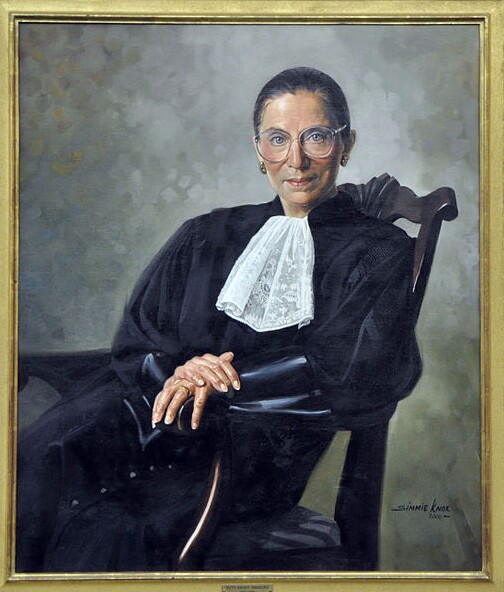
Ruth Bader Ginsburg United States Supreme Court Justice was born on
15 March 1933, in Brooklyn, New York. Simmie Knox, under commission of the United States Supreme Court painted this portrait of her. She is the second female justice (after Sandra Day O'Connor) and the first Jewish female justice. She is generally viewed as belonging to the liberal wing of the Court. Before becoming a judge, Ginsburg spent a considerable portion of her legal career as an advocate for the advancement of women's rights as a constitutional principle. (Wikipedia)


Finally - another link to the date, and - stretching things a bit to achieve arty-fartyness - a famous ceiling painting by Caravaggio (the only ceiling painting by him).

The date:

Every 248 years Pluto moves inside Neptune's orbit for about 20 years. The period January 23, 1979 to March 15, 1999 was the last time Pluto's very eccentric orbit carried it inside the orbit of Neptune. During that time, Neptune became the outermost planet in the solar system.

For 35 interesting facts about Pluto, see Random Facts, HERE


The painting:


The fresco, features Jupiter, Pluto and Neptune as allegorical representations of alchemy. The artist used his own body and facial features as model for the figures. Jupiter stands for sulphur and air, Neptune for mercury and water, and Pluto for salt and earth. The fresco was commissioned by Cardinal Francesco Maria Del Monte for the ceiling of a small second-floor alchemy lab of his hunting lodge in 1597.

On his eagle, Jupiter swoops down towards Neptune and Pluto, who are standing at the opposite edge of the ceiling, as if he were making the sky light up with a crystal ball. Any interpretation of the gathering of the gods, seen, unusually, from below, must shift between mythology (the gods, identified by the animal associated with each: an eagle for Jupiter, a sea stallion for Neptune and the three-headed dog Cerberus for Pluto); astrology (zodiac signs can be seen on the globe), and alchemy.
Hat tip to Guia Bargigli at THIS BLOG for clear representations, information and interpretation of the painting.