Showing posts with label revolution. Show all posts

Wednesday, March 21, 2018

Mid-week Meanderings

This post will stand until the weekend. I shall be otherwise engaged. Currently I have something serious on my plate - some surgery. More on this later on, perhaps.

Anyway, a few odds and ends:


On the environment....
"Your descendants shall gather your fruits." (Virgil)
(Note: no doubt it was implied anyway, within this ancient wisdom that: "whether the fruits be nourishing or poisoned is up to you.")


"And Man created the plastic bag and the tin and aluminum can and the cellophane wrapper and the paper plate, and this was good because Man could then take his automobile and buy all his food in one place and He could save that which was good to eat in the refrigerator and throw away that which had no further use. And soon the earth was covered with plastic bags and aluminum cans and paper plates and disposable bottles and there was nowhere to sit down or walk, and Man shook his head and cried: "Look at this Godawful mess."
Art Buchwald, humorist.


On future potential for revolution - here, there and everywhere:

A poem, by Otto Rene Castillo who was a Guatemalan revolutionary.

One day
the apolitical
intellectuals
of my country
will be interrogated
by the simplest
of our people.

They will be asked
what they did
when their nation died out
slowly,
like a sweet fire
small and alone.

No one will ask them
about their dress,
their long siestas
after lunch,
no one will want to know
about their sterile combats
with "the idea
of the nothing"
no one will care about
their higher financial learning.

They won't be questioned
on Greek mythology,
or regarding their self-disgust
when someone within them
begins to die
the coward's death.

They'll be asked nothing
about their absurd
justifications,
born in the shadow
of the total life.

On that day
the simple men will come.

Those who had no place
in the books and poems
of the apolitical intellectuals,
but daily delivered
their bread and milk,
their tortillas and eggs,
those who drove their cars,
who cared for their dogs and gardens
and worked for them,
and they'll ask:

"What did you do when the poor
suffered, when tenderness
and life
burned out of them?"

Apolitical intellectuals
of my sweet country,
you will not be able to answer.

A vulture of silence
will eat your gut.

Your own misery
will pick at your soul.

And you will be mute in your shame.


On different elemental matters:

In "The Night Sky" by Richard Grossinger, some food for thoughts astrological:

In 1869, the Russian chemist Dmitri Mendeleev discovered that the chemical properties of the elements (My note: this refers to the non-astrological elements)are periodic functions of their atomic weights, i.e. of the number of protons in their nuclei. When he arranged the then-known elements in a series, he found that there were familial resemblances among elements at regular numerical intervals. For instance, carbon, silicon and tin lie in a series for which the member between silicon and tin was then apparently missing. This was later found to be germanium. Fluourine, chlorine, bromine and iodine constitute another family. Then there's a group of lithium, sodium and potassium; another of nitrogen phosphorus, arsenic and antimony; and so on. Nature contains a hidden periodic function which is basic to form and order in the world. (My note: There are "families" in astrological elements too, at regular numerical intervals - the Fire family Aries, Leo, Sagittarius, the Air family Gemini, Libra, Aquarius etc.) All the other elements are based on the simplest one, hydrogen with its single proton, which is also - we were to find out - the fuel of the stars.

Mendeleev's periodic table, and the reality that lay behind it gave a new basis for understanding the history and evolution of matter. Mathematical relationships determined the seemingly limitless display of forms in nature, from plants and animals to stars and galaxies. It was hauntingly Pythagorean, as Heisenberg would remind us.

The echo of astrological elements and modes and the way they were arranged by ancient astrologers is discernible. They had no knowledge of periodic tables and suchlike, as far as we know.

I have confidence that astrology is more than mere superstition. It's something rooted in the very nature of the universe. Oh - it's rough and ready, imperfect and encumbered with a plethora of unnecessary accessories, but beneath it all there is a gem - just waiting to be discovered.

Saturday, August 24, 2013

Abbie Hoffman - He Made His Own Revolution

Among events listed at Wikipedia for 24 August, through history, is the following"

24 August 1967 – Led by Abbie Hoffman, the Youth International Party temporarily disrupts trading at the NYSE by throwing dollar bills from the viewing gallery, causing trading to cease as brokers scramble to grab them.

More about that incident from a chapter from Hoffman's autobiography. See HERE.

It reminded me of an old post of mine from early in 2010 dealing with Abbie Hoffman's natal chart, an edited version of the old post follows:


Described as flamboyant and colorful, Abbie Hoffman emerged from 1960s counterculture, prominent in demonstrations against the war in Vietnam, he founded the "Yippies" (Youth International Party). His trademarks were sharp satirical humour and a flair for organisation. These were effectively used on behalf of many causes, including civil rights, anti-war and ecology.


Snips from HERE:
At the end of the 1960s Abbot Howard "Abbie" Hoffman became an American celebrity and the wild-and-woolly face of youth activists protesting U.S. involvement in Vietnam. A graduate of Brandeis University with a Master's degree in psychology from the University of California at Berkeley, Hoffman was a co-founder of New York's "Yippie" movement, a loosely-organized anti-war group called the Youth International Party. Their 1967 anti-establishment pranks included dumping dollar bills (mostly fake) onto the floor of the New York Stock Exchange and surrounding the Pentagon in an attempt to levitate it.

After a street fight with police during the 1968 Democratic National Convention in Chicago, Hoffman and his cohorts were arrested and charged with conspiracy to incite a riot. The trial was a media sensation, and the so-called Chicago Seven (originally there were eight, including Black Panther Bobby Seale) spent more than a year mocking the court of Judge Julius J. Hoffman with shenanigans that resulted in more than 150 contempt citations. In the end it all amounted to acquittals and convictions overturned, and Hoffman became known more as the guy who wrote Steal This Book (1971) or the guy who was arrested for wearing a shirt that looked like the American flag (1968).

Hoffman was arrested in 1973 on drug charges, but he skipped bail and spent the next seven years on the lam, going by the name of Barry Freed. In the early 1980s he resurfaced and, after a little jail time, embarked on a career as an organizer, activist, author and lecturer. At the age of 52 he was found dead of what a Pennsylvania coroner called a "massive overdose" of phenobarbital. His books include Revolution for the Hell of It (1968), Woodstock Nation (1969), Soon to be a Major Motion Picture (1980) and Preserving Disorder: The Faking of the President (1988, with Jonathan Silvers).

The coroner ruled Hoffman's death a suicide, saying the amount of the overdose suggested that an accident was unlikely.


Abbie Hoffman was born in Worcester Massachusetts on 30 November 1936 at 1:30 AM (Astrodatabank).


Sun, Mercury and Jupiter in Sagittarius (Jupiter's rulership). Jupiter, planet of excess and philosophy; I guess one could say that political activism consists of expanding philosophical ideas to their limit - to excess.

Two tight oppositions: Jupiter/Moon and Saturn/Neptune reflect inner on-going conflict which may eventually have contributed to his bi-polar disorder.

Uranus, the rebel planet, not unexpectedly has a part to play here. There's a Yod (Finger of Fate) configuration linking the sextile between Sun and Mars (Mars in a strong position, close to the ascendant) via two quincunx aspects of 150 degrees to Uranus. Astrologers consider that the sextiled planets' attributes are channelled through the planet at the apex of the Yod, in this case what could be more appropriate than Uranus? Sun(self) & Mars(energy and aggression) chanelled through Uranus (rebellion/revolution).


Uranus is also part of a loose Grand Trine with Venus/Neptune forming a circuit of harmonious connection between rebellion, dreams/imagination and well, Venus? Venus can represent emotional contracts such as marriage, love affairs. Hoffman's love affair was with rebellion.


“The only way to support a revolution is to make your own.”

“Revolution is not something fixed in ideology, nor is it something fashioned to a particular decade. It is a perpetual process embedded in the human spirit.”
― Abbie Hoffman

Question: Where is our Abbie 2013-style? Is it, perhaps, Edward Snowden ?

Monday, July 08, 2013

Surfing the Waves of Revolution ?

Andrew O'Hehir's piece at Salon yesterday , The Age of Revolution: 1989 to 2013 and Counting, - "From the Berlin Wall to Cairo, we live in an era of anti-authoritarian revolution that may transform the world" had me rifling through the ephemeris and my saved astrology links to discover whether 1989 was part of the Uranus-Pluto cycle we hear so much about these days.

For background, a few snips from Mr O'Hehir's interesting essay:
.......But if you can separate the populist and/or military coup against Morsi’s government from short-term political or ideological questions, it fits into a much larger historical pattern that is global in scale. We live in an age of revolution, and specifically of anti-elite, anti-authoritarian revolution. It’s an age that began in earnest with the fall of the Berlin Wall in 1989 and shows no signs of slowing down. Edward Snowden, who on Friday was reportedly offered asylum by both Nicaragua and Venezuela, is in his own way a soldier in that revolution, one who has exposed the secrets of the world’s greatest imperial power and made it look both foolish and vulnerable. That’s the thread that connects this week’s explosive news out of Egypt to the bizarre episode of the Bolivian president’s airplane, which was forced to land in Vienna (almost certainly at the behest of someone in Washington), based on false rumors that Snowden might be on board. Screw national sovereignty – the most powerful nation on earth is hunting a computer nerd! In other words, both these things are driving powerful people crazy.

Indeed, historians of the future – assuming there are any – may well compare our era to the great wave of social and political revolutions that transformed Europe in the middle of the 19th century, and ultimately led to the sweeping away of the old aristocratic order. What the conclusion of our current revolutionary wave will look like, and whether it will sound the death knell for the dominant liberal-capitalist world order, I have no idea. But I feel certain that a lot of people in boardrooms, executive suites and presidential palaces are wondering the same thing.

Comments below the article were interesting, at least they were when they didn't descend into the usual skirmish between right and left, or snarks by the grammar/spelling police. One brave soul (cckelsey) even dared to say:
There are those who have studied astrology who suggest that Uranus-Pluto alignments correlate with emancipatory humanitarian impulses across the collective. From what I understand, we are in one of those alignments that will run through this decade though it is not as pronounced as the periods that offered the French Revolution and 1960's. From what I've seen presented, these periods tend to swing into Saturn-Pluto alignments which often offer authoritarian backlash.
That was put down immediately by:
Agent C: @cckelsey I hope you're trying to be funny.
Sigh! Double sigh!!

Commenter Graham Clark said (among other things):
Well heck, if we're going to allow for the twenty years of status quo between the dissolution of the Soviet sphere and the Arab Spring, we might as well go back another twenty and say the new "age of revolution" started in 1968.

He was right - and the 1960s do link back to Uranus-Pluto.

I couldn't see any Uranus-Pluto link in 1989, but there was a fairly rare triple conjunction of Uranus-Saturn-Neptune - in Capricorn that year. The conjunction linked the cycles of Saturn/Uranus (approx. every 45 years), Saturn/Neptune (approx. 35 years), and Uranus/Neptune (approx 172 years).

Looked at from one perspective, the period 1989 to the present (and onward) can be seen as a revolutionary age, still ongoing, for its full flavour hasn't reached the USA yet. While 1989 isn't part of a "matched set" of astrological aspects, it's another piece in the jigsaw puzzle - and fits right in, showing that certain points in the outer planets' cycles do indeed correlate noticeably with mundane events here on Earth. We ride the varied waves of time along with the planets.

From section 87 of one of the most often consulted favourite books sitting on the shelf under my desk: Carl Sandburg's The People, Yes ~
The people learn, unlearn, learn,
a builder, a wrecker, a builder again,
a juggler of shifting puppets.
In so few eyeblinks
In transition lightning streaks,
the people project midgets into giants,
the people shrink titans into dwarfs

Faiths blow on the winds
and become shibboleths
and deep growths
with men ready to die
for a living word on the tongue,
for a light alive in the bones,
for dreams fluttering in the wrists . . .

Sleep is a suspension midway
and a conundrum of shadows
lost in meadows of the moon.
The people sleep.

Ai! ai! the people sleep.
Yet the sleepers toss in sleep
and an end comes of sleep
and the sleepers wake.
Ai! ai! the sleepers wake! . . .

Friday, January 20, 2012

Arty Farty Friday ~ Gustave Courbet: Enfant Terrible

Opening paragraph of an excellent piece from The Smithsonian, Larger than Life by Avis Berman on French 19th century painter Gustave Courbet:
Painter, provocateur, risk taker and revolutionary, Gustave Courbet might well have said, "I offend, therefore I am." Arguably modern art's original enfant terrible, he had a lust for controversy that makes the careers of more recent shockmeisters like Jeff Koons, Damien Hirst and Robert Mapplethorpe seem almost conventional. As a rebellious teenager from a small town in eastern France, Courbet disregarded his parents' desire for him to study law and vowed, he wrote, "to lead the life of a savage" and free himself from governments. He did not mellow with age, disdaining royal honors, turning out confrontational, even salacious canvases and attacking established social values when others of his generation were settling into lives cushioned with awards and pensions.

Courbet is reported to have said or written:
"I am fifty years old and I have always lived in freedom; let me end my life free; when I am dead let this be said of me: 'He belonged to no school, to no church, to no institution, to no academy, least of all to any régime except the régime of liberty."

Courbet was a realist painter - and realist in every sense of the word. He painted the reality he saw around him, not only the reality of the bourgeoisie, but the reality of ordinary people - those we have recently labelled "the 99%".

Gustave Courbet's era offered ample outlet for his revolutionary nature. He was involved in the 1848 revolution in France, the Paris commune in 1871 and was one of the founders of an artistic movement many of his contemporaries found shocking.

Investigating events of 1848 swiftly brings to mind a somewhat milder yet comparable set of events nearer to our own time. Europe was then in the throes of several vatieties of revolution. In Britain the Chartist movement (a working class labour movement) was thriving. Marx and Engels had published the Communist Manifesto. In France protesters forced the abdication of King Louis-Philippe. However, an attempt at setting up a Constituent Assembly to represent France's poor failed amidst counter-revolution and the slaughter of thousands at the barricades. Eventually Napoleon III, after being elected president of the French Republic, proclaimed himself Emperor after a coup in 1851.

Gustave Courbet, a man whose temperament was well-suited for his times. He was born in Ornans on 10 June 1819. Time of birth given by Astrodatabank is 3:00 AM.


I was half expecting to see rebellious Uranus conjoined to a personal planet - it isn't, but Uranus is conjunct Neptune, planet of creativity and opposing his communicative Gemini Sun. We needn't look very much further to seek the source of his revolutionary spirit. But there is more... Jupiter in Aquarius (rulership sign of Uranus) is in close harmonious trine to Sun in Gemini - another link to rebellion and the avant garde.

Moon in commonsense, business-like Earthy Capricorn harmoniously trines Venus, planet of the arts in its home sign of Taurus. In spite of his revolutionary traits, for most of his life Courbet managed to surf disapproval and maintain a reasonable lifestyle, reflection, perhaps, of this balancing Earthy input from Moon and Venus.

It wasn't until he, as head of the Arts Commission, was amongst those who destroyed the Vendôme Column, that his rebellious nature overcame commonsense and led him astray. The Column was a monument to Napoleon I, a symbol of the French revolution of 1789, later seen more as a symbol of French militarism and imperialism. After the defeat of the Paris Commune and the massacre of thousands of those who had taken part in it, Courbet was arrested and sentenced to six months imprisonment. Later the government fined him 300,000 francs to pay for the rebuilding of the Column. As he could not afford this vindictive fine he fled to Switzerland where he lived out the rest of his life, painting (and drinking heavily) until his death in 1877. In 1919 his remains were returned to Ornans where he was interred in the local cemetery. (See HERE).....And HERE re Franco-Prussian War).

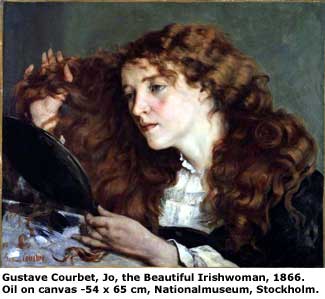
Courbet's paintings include landscapes, nudes (some erotic), portraits, self portraits, and many scenes of ordinary people doing what ordinary people did.

Below: Considered to be one of Courbet's masterpieces, from 1850: Burial at Ornans. French critics were not impressed. It was, they claimed "too big and the figures were too ugly". It measures 21 feet by 10 feet -huge! It was customary for paintings of this size to be of religious or mythological subjects, and certainly not a peasant funeral in rural France.....the very idea!!


Sleeping Spinner


The Stone Breakers


Jo


The Source


The Draughts Players


The Guitarrero, Young Man in a Landscape


Les Demoiselles des bords de la Seine
Two young women resting at the edge of River Seine. Not women of the elegant bourgeoisie, but two very ordinary gals, one of whom has removed her dress and relaxes in her petticoat.


Courbet painted himself - lot! A collection of his self portraits can be seen at the blog Fifty Two Pieces

Three examples, top to bottom
: A Desperate Man; Man with Leather Belt; Man with Pipe.


Monday, November 22, 2010

Ooh Ahhh! A Revolutionary Call From Cantona.

Apart from the tune at the end of the post, I'm giving Music Monday a rest today and focus instead on the natal chart of someone in the news this weekend, a former soccer player for some of the most successful soccer teams in England: French-born Eric Cantona. He appears to be at the center of a revolutionary call to the people of France, and elsewhere, to remove their money from the banks. A YouTube video of him explaining his advice has "gone viral" - whatever that means.


Here it is.


Monsieur Cantona - pronounced to rhyme with "Oooh ah Cantona!!!" the chant used by soccer fans in my old stomping grounds of Manchester and Leeds where he played the "beautiful game" to perfection. His current actions are no surprise. He has always been something of a rebel. From a biography HERE

One of the most flamboyant players ever to play the game, Eric Cantona’s antics off the field often seem to outshine his brilliance on the field. Eric’s career started with the small French side Auxerre, and from there he moved on to first division team Marseille for a fee of £2.3 million.

It was during his stay at Marseille that Eric’s temper began to surface. Having been substituted in a friendly against Torpedo Moscow, Eric ripped off his jersey and threw it to the ground in disgust. Marseille imposed a short ban for his actions. Around the same time, Eric found himself banned form the French National Team for insulting the coach on French TV........ Not long after all this, Eric was loaned to Bordeaux, but he moved on to Montpeiller...........at another club, this time Nimes. ......and while at Nimes Eric found himself called before the French Football Association for throwing a ball at a referee during a match. When the French FA handed him a one month ban for his actions, Eric called them all idiots and the FA raised the ban to 2 months. This didn’t sit well with the spirited Cantona, and he decided in retaliation to retire early from the game that he loved.

Eric was convinced to come out of retirement and move to England...... he joined Leeds,and in his second year with the team helped them win the league title. Ironically, Eric found it hard to remain in the first team with Leeds and soon found himself offloaded to Manchester United where his legendary status continued to grow. He helped lead Man United to championship after championship. It was with ManUnited that he made his biggest mistake – the legendary “Kung Fu” kick.

In a 1995 game against Crystal Palace, Eric ran into the stands and kicked a fan forshouting racial slurs at him. He was dealt a heavy fine and sentenced to serve 120hours of community service plus a 9-month ban from the game. Eventually Ericrejoined Man United and helped them win several more championships, but his retirement in 96-97 surprised everyone. Many people felt he could have played many more years.
Following his retirement from football, Cantona took up acting. He had a role in the 1998 film Elizabeth, starring Cate Blanchett, and the 2009 film Looking for Eric. In 2010, he debuts as a stage actor in a French play directed by his wife, Rachida Brakni.


He was born in Marseille, France on 24 May 1966. Astrodatabank has his birthtime at 12:30 AM, with their best AA rating - thought to be reliable. I'm glad, because that birth time makes his rising sign rebellious Aquarius. What's more, Aquarius's ruler, Uranus was tightly conjunct Pluto in 1966 - that's a generational phenomenon, not specific to Cantona, but still significant because his rising sign's ruler is involved. His Sun/Mercury/Mars cover the last degrees of Taurus and first few of Gemini. These three conjoined planets reflect rather aggressive tendencies(Mars) aligned with a need to communicate them.

Moon in sentimental Cancer, with Saturn in gentle Pisces in sextile to his Taurus planets, indicate a strong underlying compassionate streak, which could well be the basis of his call to rebel against the banks.

Revolution calls for a fighting spirit, but there has also to be compassion for those most affected by societal wrongs.

His words: Sometimes you get submerged by emotion. I think it's very important to express it - which doesn't necessarily mean hitting someone.
Eric Cantona

How wise, or effective Cantona's call will be in reality isn't clear, but I have to admire his fighting spirit, and his ability to inspire. If there is ever to be any change in the status quo in Europe or the USA, it'll take many more well-known raised voices, such as Cantona's, to drum up response from a largely complacent populace.