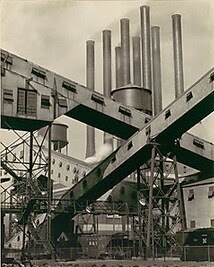
We're back to the 1920s and 30s once again for today's featured artists. That was the time when people born during fertile Pluto in Gemini era (1882-1914) came into their own and began showing the world their arty or literary skills.
(Snip from
HERE)
American life was dramatically transformed in the years following the Great War, as urbanization, industrialization, mechanization, and rampant materialism altered the environment and the way people lived. American artists responded to this dizzying modern world with works that embraced a new brand of idealized realism to evoke a seemingly perfect modern world. The twenties saw a vigorous renewal of figurative art that melded uninhibited body-consciousness with classical ideals. Wheareas images of the modern body were abundant, artists represented American places and things as distilled and largely uninhabited arrangements of pristine forms.
Two American artists from the era described above were James Ormsbee Chapin and Charles Sheeler. Both were born in July with Sun in Cancer, their styles were quite different - almost opposite in fact.
James Ormsbee Chapin (father of jazz musician Jim Chapin and grandfather of folk singer Harry Chapin) born on 9 July 1887 in West Orange, New Jersey. He studied art in New York, later he became an award winning pupil at the Royal Academy in Antwerp.
 |
| Ruby Green Singing |
From
HERE
"The artist’s sensitivity for mankind is evident in his famous series of paintings depicting the Marvins, a farm family who lived near the artist in rural New Jersey during the 1920′s and 30′s. His insightful and heroic depiction of “Ruby Green Singing” (a young black singer) is the single most popular painting held in the Norton Museum in West Palm Beach, Florida. His late work created during the 1960′s and 70′s exhibits the depth of the artist’s concern about war and society’s injustices. Americans such as writer Robert Frost, composer George Gershwin and financier John D. Rockefeller collected Chapin’s work."
Human warmth, heroism, and complex character in ordinary people were hallmarks of Chapin's paintings. A story from an album by his grandson, Harry Chapin, a storyteller and songwriter who died tragically at a very young age, is about his grandfather, James Ormsbee Chapin:
"My grandfather was a painter. He died at age eighty-eight, he illustrated Robert Frost's first two books of poetry and he was looking at me and he said, 'Harry, there are two kinds of tired: there's good-tired, and there's bad-tired.'
He said, 'Ironically enough, bad-tired can be a day that you won. But you won other people's battles, you lived other people's days, other peoples agendas, other people's dreams and when it was all over there was very little "you" in there, and when you hit the hay at night, somehow you toss and turn--you don't settle easy.'
He said, 'Good-tired, ironically enough, can be a day that you lost. But you don't have to tell yourself, 'cause you knew you fought your battles, you chased your dreams, you lived your days, and when you hit the hay at night, you settle easy--you sleep the sleep of the just, and you can say "take me away."' He said, 'Harry, all my life I've painted. God, I would've loved to be more successful, but I painted and I painted, and I am good-tired and they can take me away.' "
(Hat-tip to
Trowel and Paintbrush Blog)
 |
| George Marvin and Daughter Edith |
 |
| Robert Frost in New Hampshire |
 |
| Child at Window |
 |
| Nine Workmen |
 |
| Folk Singers (Homage to Joan Baez) |
 |
| Street Market, New York |
Quite different in "feel" and style was the art of Charles Sheeler, born in Philadelphia four years earlier than Chapin, on 16 July 1883. He studied art in Pennsylvania and during trips to Europe where he was particularly influenced by Italian Masters and French modernists. Marcel Duchamp's work played an important role in his understanding of the essential structure of forms. He took up photography, with focus on architectural subjects, which in turn influenced his later paintings. He moved to New York in 1919, where the skyscrapers, icons of the city, lent precise geometric form to his paintings, His style eventually became known as "precisionist", featuring the drama of light and shadow seen from unusual perspectives.

Commissions to photograph the Ford Motor Company’s plant at River Rouge, Michigan (1927-28), brought him international acclaim for his pristine views of American industry, both photographic and in paintings. During the 1930s, Sheeler focused his attention on developing a style based on strong geometric order for subjects of American industrial life . (Information from
HERE )
Photography is nature seen from the eyes outwards. Painting is nature seen from the eyes inwards. (Charles Sheeler)
Sheeler's view of industrialization was a positive one, as it was for most during the machine age, which seemed to promise unbounded prosperity. Sheeler wrote:
"Every age manifests itself by some external evidence. In a period such as ours when only a comparatively few individuals seem to be given to religion, some form other than the Gothic cathedral must be found. Industry concerns the greatest numbers––it may be true, as has been said, that our factories are our substitute for religious expression. "
Hat-tip to
Studio and Garden Blog
 |
| Windows |
 |
| River Rouge Plant |
 |
| Red Against the Light |
 |
| Pertaining to Yachts and Yachting |
 |
| Staircase in Doylestown |
 |
| Steel-Croton |
ASTROLOGY
Both charts are set for 12 noon as birth times aren't known.
James Ormsbee Chapin born 9 July 1887 in West Orange New Jersey.
Charles Sheeler born on 16 July 1883 in Philadelphia, Pennsylvania.
Thinks: A test for an astrologer: look at both artists' work then decide which chart belongs to which artist. Happily, as a humble blogger and astrological dabbler only, I get to know which is which - otherwise that test could prove very difficult indeed!
Whether the two guys were as different personality-wise as their works suggest can't be known. From the paintings there's a natural warmth and empathy coming from Chapin, and cool, sophisticated and deliberate exactitude from Sheeler.
Where to find that difference in their natal charts? Moon positions are not accurate as shown, but Sheeler's would certainly have been in Sagittarius, whatever his birth time. Chapin's Pisces Moon is also likely in the right sign, and accounts for his softer "feel", a much better blend with his Cancer Sun than Sheeler's Fire-sign Moon.
Rising signs are unknown, but could well account for some differences in style and approach.
Sheeler's Sun and Jupiter are in helpful sextile to Uranus (and Neptune - photography) - maybe this reflects his creative gravitation towards, and optimistic feel for, all that was new in the American landscape.
What else? Maybe that Gemini Saturn/Mars/Pluto conjunction in Sheeler's chart, in semi-sextile to his Mercury/Venus in Cancer, was a "hardening" factor? You can certainly feel Saturn in his paintings. But then, Chapin's Sun is conjunct Saturn - so.....
I'm going to leave it at that. Perhaps friendly commenters will assist with their own thoughts on the matter.
 James Ormsbee Chapin (father of jazz musician Jim Chapin and grandfather of folk singer Harry Chapin) born on 9 July 1887 in West Orange, New Jersey. He studied art in New York, later he became an award winning pupil at the Royal Academy in Antwerp.
 Quite different in "feel" and style was the art of Charles Sheeler, born in Philadelphia four years earlier than Chapin, on 16 July 1883. He studied art in Pennsylvania and during trips to Europe where he was particularly influenced by Italian Masters and French modernists. Marcel Duchamp's work played an important role in his understanding of the essential structure of forms. He took up photography, with focus on architectural subjects, which in turn influenced his later paintings. He moved to New York in 1919, where the skyscrapers, icons of the city, lent precise geometric form to his paintings, His style eventually became known as "precisionist", featuring the drama of light and shadow seen from unusual perspectives.