Showing posts with label 1960s. Show all posts

Monday, June 10, 2019

Has America "fallen out of love with itself"?

"Has America fallen out of love with itself? In the 60's I think we all loved America and its cars and its landscapes and its dance and its music. Has this ended for good?"

The above question, posed at Quora, proposes an interesting concept. I wasn't in the USA in the 1960s. From my home in the UK I had no knowledge of how the people of the USA were feeling, in general, at that time.

Perhaps, if the USA has "fallen out of love with itself", that is part of the process of a new country struggling to grow up. I suspect that there's still a long way to go before full maturity sets in for the USA. Even when maturity is reached, sometimes a country can begin to slide back into a period of decline and incompetence - take, for instance, the current Brexit debacle in the UK.

Here are snips from three answers with differing points of view on the Quora question, though these do not fully answer whether the USA has really "fallen out of love with itself". Has it? Perhaps more eyes have been opened courtesy of the internet. People now have access to much more information than they had in the 1960s. Wool can still be pulled over eyes, manipulation and propaganda still take place - for sure - but there's more opportunity for critical thinking and in depth research than there ever was in decades past.


Part of answer by Robert Martin Pollack
Yes it has. What you witnessed in the 60’s was one last outburst of creativity fueled by people who grew up in the twilight era of the republic. It was an era where people could still connect with each other and it was safe to interact with others. Hitchhiking was relatively safe and it was even possible for girls to hitch rides without being molested or raped. One could go to concerts and hear great music and see light shows for a reasonable amount that was affordable to just about anyone. This was still a wealthy country and people had disposable income so there were large numbers of places that had live music and where you could dance. Since then everything has become very atomized. All the places where people used to go to enjoy themselves and relax have been driven out of business. The few that remain are so expensive they are beyond the reach of the average person who now just barely has enough money to survive. If you ever take public transportation, everyone has the same bristly attitude - don’t you dare try and talk to me.

Ross Driedger answered:
Wait, what?! Are you kidding me? There were protests against the war in Vietnam, one of those led to the shooting deaths of four students by the Ohio National Guard (Kent State shootings). Woodstock was decried as immoral by many social conservatives (all that rock music, nudity and free love — Damned Hippies!). Racism was systemic, overt and rampant, even more than it is today.
People were terrified that the Soviet Union could, at any moment, launch a nuclear strike against the USA.
And Evelyn Elwell Uyemura wrote:
Maybe your memory is a bit hazy.
In the 1960s there were riots in many major American cities, Civil Rights and anti-war demonstrations on a regular basis, and an entire “counter-culture” that rejected all the values and trappings of American life.

(And much of the most popular music was British, not American!)

Thursday, February 06, 2014

Fruits of Earlier Times

I read an interesting article by Ira Chernus, at Smirking Chimp, yesterday:
When Did "the '60s" Begin?
When, exactly, did the era of radical ferment we remember as "the '60s" begin? Exactly one half-century ago, PBS tells us in its recent documentary titled "1964," kicking off a year when we'll celebrate the 50th anniversary of a host of memorable events....(which Mr Chernus lists) and goes on to say "Connect the dots, the PBS show's talking head historians all say, and you'll see a year that changed America forever. "The 60s" had begun!

There's just one problem with this story: Hardly anybody in 1964 was connecting the dots.
And later
That's what historians do: look back and see things that people at the time couldn't see. It's a job well worth doing. But it's equally important that we don't confuse the early seeds of a major political, social, and cultural change with the substance of the change itself............................

Historians face a methodological problem here. If you're going to decide that the key to understanding any historical era is to track down its roots -- as '60s scholars so often do -- where do you stop? Everything that happened in 1964 -- or any other year, for that matter -- was the fruit of things that happened earlier. It's well known by now that the roots of "the '60s" really lie in the supposedly so opposite era of "the '50s."

In fact, just out of curiosity, I took a look at the year 1950, to see whether I could build a case for it as the year "the '60s" really began. It turned out to be a quick easy job. In 1950:
(he lists again)

He ends with:
For historians the conclusion is this: We absolutely should trace the sources of change as far back as we can. But we should also make a clear, careful distinction between when the earliest root of any change took hold and when that change became truly significant for society at large.

For society at large the conclusion is this: Never forget how rapidly big changes, sometimes for the better, can happen. And never forget that the sources of the next big change are already gathering all around us.


While reading the article I kept thinking of a brief archived post of mine about something an astrologer had called "culture lag". It related to another way of "connecting the dots", or sometimes forgetting to do so. Here's the post:
Astrologer Bill Sheeran's article:
Generational Themes draws attention to an important point. Groups of individuals born with outer planets Uranus, Neptune and Pluto in similar positions are thought to have common characteristics, as a generational set. What we have to bear in mind though is that the people born into any given generational group have no perceptible effect on the world at large until they achieve adulthood. Not until some point well into adulthood will any member of a generation reach a position of influence or power (of one sort or another). Mr Sheeran calls this "culture lag".
Thus there is what I call a culture lag between the initial emergence of astrologically associated themes, and a flowering of expression of the same principles decades later. In my opinion, this explains why an author might write a book which is very much of its time, but being of its time it is inherently novel and therefore radical. It may have initial impact, and then slide out of view. But years later, many of those born when it was being written will experience a resonance the contents. Astrologically, the book and those born when it was written have something in common. The later generation ‘get it’, and the writer’s work re-emerges into popular consciousness.
I've tended to overlook this rather obvious fact at times, crediting the astrology of a certain era as significant in that era's "flavour", or in what was popular then. It must take a few decades, though, for things on the ground to catch up with what the generational planets indicated at a given time.
Mr. Sheeran ends his article thus:
This way of looking at the issues is a bit simplistic - there are many inter-related factors involved in unravelling the picture. But I do think it is important, especially in mundane or collective level astrology work, to bear in mind this culture lag aspect of astrological dynamics. Apart from anything else it helps to make sense of the tensions which can arise between generations. Or illuminate political dynamics.

“The seeds of the past bear fruit in the present.”
~ Patrick Rothfuss, "The Wise Man's Fear"

The illimitable, silent, never-resting thing called Time, rolling, rushing on, swift, silent, like an all-embracing ocean-tide, on which we and all the universe swim like exhalations, like apparitions which are, and then are not.... ~Thomas Carlyle.

Monday, January 20, 2014

Music Monday ~ Lost in the '60s - again.... with a tambourine

Why have I gone back into that 1960s time slip I found myself in some days ago? Well, I noticed in a list of events for 20 January through the years that on this day in 1965 The Byrds recorded the master take of Bob Dylan's "Mr Tambourine Man"....after hearing the first few bars of the song, once again I slipped back. Dylan's own version of the song, and that of The Byrds are posted at the end of this ramble.
Wikipedia: snips.
The master take of "Mr. Tambourine Man" was recorded on January 20, 1965, at Columbia Studios in Hollywood, prior to the release of Dylan's own version. The song's jangling, melodic guitar playing (performed by McGuinn on a 12-string Rickenbacker guitar) was immediately influential and has remained so to the present day.................
The single reached number 1 on the Billboard Hot 100, and number 1 on the UK Singles Chart, making it the first recording of a Dylan song to reach number 1 on any pop music chart.

Dylan began writing and composing "Mr. Tambourine Man" in February 1964, after attending Mardi Gras in New Orleans during a cross-country road trip with several friends, and completed it sometime between the middle of March and late April of that year after he had returned to New York. Nigel Williamson has suggested in The Rough Guide to Bob Dylan that the influence of Mardi Gras can be heard in the swirling and fanciful imagery of the song's lyrics

The song has a bright, expansive melody and has become famous in particular for its surrealistic imagery, influenced by artists as diverse as French poet Arthur Rimbaud and Italian filmmaker Federico Fellini.... Interpretations of the lyrics have included a paean to drugs such as LSD, a call to the singer's muse, a reflection of the audience's demands on the singer, and religious interpretations. Dylan sings the song in four verses, of which The Byrds used only the second for their recording.

Bob Dylan's lyrics:

Hey ! Mr Tambourine Man, play a song for me
I'm not sleepy and there is no place I'm going to
Hey ! Mr Tambourine Man, play a song for me
In the jingle jangle morning I'll come followin' you.
Though I know that evenin's empire has returned into sand
Vanished from my hand
Left me blindly here to stand but still not sleeping
My weariness amazes me, I'm branded on my feet
I have no one to meet
And the ancient empty street's too dead for dreaming.

Hey ! Mr Tambourine Man, play a song for me
I'm not sleepy and there is no place I'm going to
Hey ! Mr Tambourine Man, play a song for me
In the jingle jangle morning I'll come followin' you.

Take me on a trip upon your magic swirlin' ship
My senses have been stripped, my hands can't feel to grip
My toes too numb to step, wait only for my boot heels
To be wanderin'
I'm ready to go anywhere, I'm ready for to fade
Into my own parade, cast your dancing spell my way
I promise to go under it.

Hey ! Mr Tambourine Man, play a song for me
I'm not sleepy .....etc.

Though you might hear laughin', spinnin' swingin' madly across the sun
It's not aimed at anyone, it's just escapin' on the run
And but for the sky there are no fences facin'
And if you hear vague traces of skippin' reels of rhyme
To your tambourine in time, it's just a ragged clown behind
I wouldn't pay it any mind, it's just a shadow you're
Seein' that he's chasing.

Hey ! Mr Tambourine Man, play a song for me
I'm not sleepy....etc.

Then take me disappearin' through the smoke rings of my mind
Down the foggy ruins of time, far past the frozen leaves
The haunted, frightened trees, out to the windy beach
Far from the twisted reach of crazy sorrow
Yes, to dance beneath the diamond sky with one hand waving free
Silhouetted by the sea, circled by the circus sands
With all memory and fate driven deep beneath the waves
Let me forget about today until tomorrow.

Hey ! Mr Tambourine Man, play a song for me
I'm not sleepy and there is no place I'm going to
Hey ! Mr Tambourine Man, play a song for me
In the jingle jangle morning I'll come followin' you.


Listeners decide for themselves meanings of any song lyrics - in the same way someone gazing at a painting in an art gallery decides what meaning, if any, there is for them in the piece of art under perusal. With this song, I'm quite happy just to float along in the haze of lovely imagery without attributing much meaning at all.

I found a long and interesting comment (dated 2006) on a website where an old discussion had been ongoing about the meaning of these lyrics - I though it worth hauling out, at least in part because the website was unstable, jumping around and hard to control - on my computer anyway. Let's give a clip from the comment some fresh air:


Part of long comment from "bluemeawayy" in 2006

First off, all of Dylan's songs are ambiguous. Ambiguity it what makes something art. For example, to say you're less pretty now that you are older is literal, however, to say "Rough winds do shake the darling buds of May" is art. It is artful in its ambiguity. And do to this ambiguity there can certainly be many personal interpretations. But I assure you it is not simply a metaphor for drugs.

Dylan rarely commented on the meaning behind his lyrics in order to keep the ambiguity and ability for personal interpretation alive. However, he always insisted that this song was not about drugs and often was very offended by that assumption. In his most recent autobiography he states that this song was inspired by his experience at Mardi Gras.

For anyone that knows anything about Mardi Gras; it is the celebration that leads up to Ash Wednesday and Christian Holy day that marks the beginning of Lent. The party was historically intended to be one last blow out before basically giving up our bad habits for the forty days of Lent.

For anyone who has been to Mardi Gras, it is quite a strange scene come Tuesday night at midnight. At midnight, when Wednesday and lent technically begin the streets clear out. The bars however will remain open as long as there are customers. So for basically a week there is none stop parties in the street until all hours of the night/morning (basically they dont stop). On Tuesday, however, you can walk into a bar at 10:00 pm with Bourbon Street buzzing like crazy and walk out anytime after midnight and the street, once packed and crazy for an entire week, is empty, completely desolate. Rosary beads appear over all the grave stones in the cemeteries, everyone goes home for the beginning of the religious observance of Lent.

If you are not expecting this, this can come as quite a shock. And the scene is quite eerie. This is what happened to Dylan he walked into a pub with the street packed and walked out, surprised to find it completely empty, except for a costume (french quarter of New Orleans/Mardi Gras...the clown with the tambourine is actually literal) wearing musician with a tambourine........Tambourine (let alone anything) in such an eerie empty place.

As for the rest...

But as Dylan himself put it "I'm not going to write a fantasy song. Even a song like 'Mr. Tambourine Man' really isn't a fantasy. There's substance to the dream."

"Well, songs are just thoughts. For the moment they stop time. Songs are supposed to be heroic enough to give the illusion of stopping time. With just that thought. To hear a song is to hear someone's thought, no matter what they're describing. If you see something and you think it's important enough to describe, then that's your thought. You only think one thought at a time, so what you come up with is really what you're given. When you sit around and *imagine* things to do and to write and to think - that's fantasy. I've never been much into that."

So in a sense the rest of the song is merely his thoughts at the very moment that he experienced that very eerie scene.

"Mr. Tambourine Man," like the other material Dylan was developing in early 1964, was emblematic of his escape from the shackles of topical songwriting into more abstract imagery, often suggesting a search for liberation from both external and internal prisons.

"And for the sky there are no fences facing" -- he's longing for freedom and a break from the restraints imposed by the lull that popular music had fallen into. Artistic expression should have no fences around it.

That quest was quite apparent in another of the songs he worked on during his journey, "Chimes of Freedom," its call for the abolition of repression not tethered to any specific political or social movement. "Mr. Tambourine Man" went yet further, evoking not just escape from bondage but an altered state of perception, with its plea for transportation through mystical ships and corridors of time to a land of diamond-studded skies. A use for music not previously conceived of. Remember this is before the psychedelic movement really. None of the music of the time could really transport you to an altered reality to escape the despondence of the one you currently were living in.

Inspired by the faint happy jingle jangles of a ragged clown playing a tambourine in the middle of a deserted Bourbon Street, while feeling nearly sick with exhaustion Dylan thought about escaping, past the frozen leaves and crazy sorrow to a place with diamond skies, a place where you could dance with one arm waving free, where all your memories and the unfortunate fate of your life was out of sight.


Monday, January 13, 2014

Music Monday ~ Back to Be-in, Love-in and the '60s

Music Monday this week peeks into tomorrow, 14 January, then back to 1967. On 14 January in 1967 the "Human Be-in" took place in San Francisco, prelude to the Summer of Love to follow a few months later.

JANUARY 14, 1967 Human Be-In (1:30)

Tens of thousands meet in San Francisco's Golden Gate Park for a "Gathering of the Tribes" that puts the city's hippies in the national spotlight. Organizers Michael Bowen and Allen Cohen (also the co-founders of the Oracle newspaper) call the event a Be-In -- a clever reference to the successful sit in protests of the civil rights movement.

"A union of love and activism previously separated by categorical dogma and label mongering will finally occur ecstatically when Berkeley political activists and hip community and San Francisco's spiritual generation and contingents from the emerging revolutionary generation all over California meet for a Gathering of the Tribes for a Human Be-In. ...


Music will be played by all the Bay Area rock bands, including the Grateful Dead, Big Brother and the Holding Co., Quicksilver Messenger Service, and many others. Everyone is invited to bring costumes, blankets, bells, flags, symbols, cymbals, drums, beads, feathers, flowers...

The Human Be-In is the joyful, face-to-face beginning of the new epoch.

-- The San Francisco Oracle, Vol. 1, Issue 5, p. 2
(see HERE)


It's all part of history now. See here for more detail.
In January 1967, in England, still in my twenties, I was ignorant of what was going on five and a half thousand miles away. The new music eventually seeped through on the radio, first in a trickle then in a tsunami, and hung around for years.

Two songs that immediately spring to my own mind from that long-gone era:

From USA artist -


From UK artists - I've always loved this one -


I've been finding myself in an unplanned '60s time-slip - kind of - these last few days. First, in preparing this post, then reading a book which covers 1958 to 1963 and the present (Stephen King's "11/22/63"), then watching a DVD yesterday evening I picked up in the rental store due to the starry cast list, without having an idea of its theme - The Company You Keep (Redford, Sarandon, Nolte, Sam Elliot, Julie Christie, Chris Cooper)- it turned out to be based on events a year or so after the Summer of Love, and surmising, fictionally, on present-day fates of a set of well-matured members of The Weather Underground.

In the book "11/22/63" mentioned above the author says on numerous occasions, "the past harmonizes". I'm finding, also on numerous occasions, that so does the present!

Monday, July 08, 2013

Surfing the Waves of Revolution ?

Andrew O'Hehir's piece at Salon yesterday , The Age of Revolution: 1989 to 2013 and Counting, - "From the Berlin Wall to Cairo, we live in an era of anti-authoritarian revolution that may transform the world" had me rifling through the ephemeris and my saved astrology links to discover whether 1989 was part of the Uranus-Pluto cycle we hear so much about these days.

For background, a few snips from Mr O'Hehir's interesting essay:
.......But if you can separate the populist and/or military coup against Morsi’s government from short-term political or ideological questions, it fits into a much larger historical pattern that is global in scale. We live in an age of revolution, and specifically of anti-elite, anti-authoritarian revolution. It’s an age that began in earnest with the fall of the Berlin Wall in 1989 and shows no signs of slowing down. Edward Snowden, who on Friday was reportedly offered asylum by both Nicaragua and Venezuela, is in his own way a soldier in that revolution, one who has exposed the secrets of the world’s greatest imperial power and made it look both foolish and vulnerable. That’s the thread that connects this week’s explosive news out of Egypt to the bizarre episode of the Bolivian president’s airplane, which was forced to land in Vienna (almost certainly at the behest of someone in Washington), based on false rumors that Snowden might be on board. Screw national sovereignty – the most powerful nation on earth is hunting a computer nerd! In other words, both these things are driving powerful people crazy.

Indeed, historians of the future – assuming there are any – may well compare our era to the great wave of social and political revolutions that transformed Europe in the middle of the 19th century, and ultimately led to the sweeping away of the old aristocratic order. What the conclusion of our current revolutionary wave will look like, and whether it will sound the death knell for the dominant liberal-capitalist world order, I have no idea. But I feel certain that a lot of people in boardrooms, executive suites and presidential palaces are wondering the same thing.

Comments below the article were interesting, at least they were when they didn't descend into the usual skirmish between right and left, or snarks by the grammar/spelling police. One brave soul (cckelsey) even dared to say:
There are those who have studied astrology who suggest that Uranus-Pluto alignments correlate with emancipatory humanitarian impulses across the collective. From what I understand, we are in one of those alignments that will run through this decade though it is not as pronounced as the periods that offered the French Revolution and 1960's. From what I've seen presented, these periods tend to swing into Saturn-Pluto alignments which often offer authoritarian backlash.
That was put down immediately by:
Agent C: @cckelsey I hope you're trying to be funny.
Sigh! Double sigh!!

Commenter Graham Clark said (among other things):
Well heck, if we're going to allow for the twenty years of status quo between the dissolution of the Soviet sphere and the Arab Spring, we might as well go back another twenty and say the new "age of revolution" started in 1968.

He was right - and the 1960s do link back to Uranus-Pluto.

I couldn't see any Uranus-Pluto link in 1989, but there was a fairly rare triple conjunction of Uranus-Saturn-Neptune - in Capricorn that year. The conjunction linked the cycles of Saturn/Uranus (approx. every 45 years), Saturn/Neptune (approx. 35 years), and Uranus/Neptune (approx 172 years).

Looked at from one perspective, the period 1989 to the present (and onward) can be seen as a revolutionary age, still ongoing, for its full flavour hasn't reached the USA yet. While 1989 isn't part of a "matched set" of astrological aspects, it's another piece in the jigsaw puzzle - and fits right in, showing that certain points in the outer planets' cycles do indeed correlate noticeably with mundane events here on Earth. We ride the varied waves of time along with the planets.

From section 87 of one of the most often consulted favourite books sitting on the shelf under my desk: Carl Sandburg's The People, Yes ~
The people learn, unlearn, learn,
a builder, a wrecker, a builder again,
a juggler of shifting puppets.
In so few eyeblinks
In transition lightning streaks,
the people project midgets into giants,
the people shrink titans into dwarfs

Faiths blow on the winds
and become shibboleths
and deep growths
with men ready to die
for a living word on the tongue,
for a light alive in the bones,
for dreams fluttering in the wrists . . .

Sleep is a suspension midway
and a conundrum of shadows
lost in meadows of the moon.
The people sleep.

Ai! ai! the people sleep.
Yet the sleepers toss in sleep
and an end comes of sleep
and the sleepers wake.
Ai! ai! the sleepers wake! . . .

Monday, March 11, 2013

Story of a '60s Radical

Another of our cheapo junk store DVDs - watched it the other night. The title had attracted me, and, with Cissy Spacek and Henry Winkler starring, how bad could it be? It turned out to be quite good, for a 1975 TV movie. It afforded a look at the USA during the 1960s and early 70s through the eyes of the lead character, Katy/Katherine. A little Google action threw up the fact that this TV film has been alternatively titled, and was known originally as Katherine - that title wouldn't have attracted this buyer nearly as much!

The story is factually based on the experiences of Diana Oughton, a girl from an old-established, very well-heeled, well-connected Michigan family. She was a stereotypical upper-class conservative-leaning university student in the beginning, turning sharp left in her loyalties after experiences teaching abroad. Back in the USA she eventually became part of The Weathermen, a violent revolutionary group. She was dead by age 28 after blowing herself up while constructing a bomb. That was the real character - more on her at Wikipedia and a good essay from 1970 at UPI Stories.

Interestingly (to me), Diana Oughton's birthdate was 26 January 1942. (Astrodatabank entry.) She was a far, far more extreme Aquarius Sun than yours truly (27 January different year, but close). She had three personal planets and ascendant in Aquarius, and three in Gemini: very Airy power-house of an intellect. She could've done, and been, just about anything she wished. It was a sad waste, but the times were wild and unpredictable, and she fit right in, sad to say.

A sidelight: I noticed on a couple of websites ( one here) indications that Diana Oughton was the girl friend of Bill Ayers who had connection to the writing of one of Barack Obama's books of memoirs (ghost-written some would have it). There is speculation that Diana was a large part of a composite of female characters described, in the book Dreams From My Father, as Obama's "New York girl friend".

The film, made for TV, strayed only slightly from the facts - mainly in the exact way the leading character died. It was rather odd in format, but it worked. There were frequent flashbacks and occasional faux interviews. Acting was good - I failed to recognise Henry Winkler, even though I'd seen his name on the DVD cover. I'm not sure whether his character, who fled to Canada to avoid being drafted to Vietnam, was meant to relate to anyone in real life.

We enjoyed the film. I'm always fascinated to discover what went on in the USA in the 1960s. Across the Universe, a favourite of mine, afforded a view of events, but from the perspective of an English lad, during a similar time span in the USA (with the added attraction of Beatles' music). I was in England, mostly unaware of dramatic, often tragic, turns of events in the USA. I had no TV, didn't read the newspapers much, and was going through dramas of my own, first from a bad marriage, then from jobs which entailed moving around the country every six months or so. It's only recently that I've fully caught up! Events in the US during that amazing period were more dramatic than many works of fiction from the same decade.

If a passing reader should happen upon a copy of The Radical or Katherine as it's titled in some cases, I can confirm that it'd be well worth a dollar, or even two.

Thursday, January 12, 2012

Back to the Future Fashion?

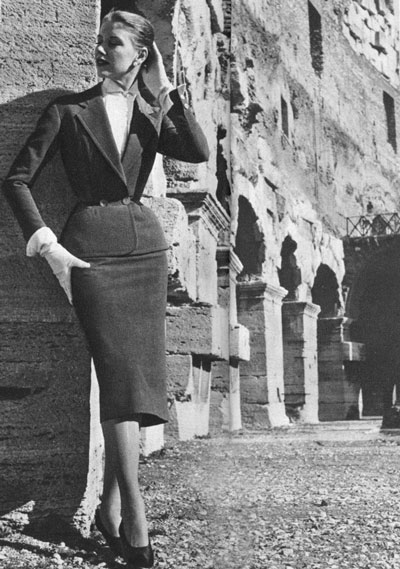
Some photographs, one is shown at left, from fashion designer Jil Sander's ad campaign for spring/summer 2012 rang a bell in my memory bank. More than one bell, in fact.

The bell ringing nearest the surface: early 1960s fashions in Mad Men, the TV series we're in the midst of watching on DVD. See below....Christina Hencricks as Joan; and full cast.


Deeper down a bell rang reminding me of a post from the past which had touched on a possible resurgence of 1960s fashions. A little digging revealed a post of mine from 2008, an extract follows.

Deepest-seated ringing bell of all: my own experiece of 1960s fashions.

Back in 2008 I'd spotted an article by Judy Licht: "The Frill of It All" . The writer had seen hints of an upcoming trend in fashion harking back to the 1950s and 60s.

"Another Fashion Week here in New York, another frenzy. But hidden in all the hairspray, hubbub and hilarious air kisses are clues not only to what we'll be wearing next season, but what that says about us as a society right now, what we're feeling, and where we may be heading. Fashion historians have long known that clothes are just as accurate a barometer of the culture for which they're created as any political or literary histories.........

Everybody is craving comfort clothes....... the kind that reminds everyone of the late fifties and the early sixties, the last time, it seems, when everything was truly right with the world. The last age of innocence.

With an economy that seems scary, but still a bit of an enigma; an election that for the first time in decades seems to be providing an unknown factor (i.e., choices), everyone wants it to be simple again. ..................... great trilby hats and slim single breasted suits for men..they've embraced the sheaths, the full skirts, swing coats and sweaters that screamed oh so subtle under-the-girdled-sex, for-women."

"Sweaters and under-the-girdled sex", said Judy Licht...she obviously hasn't experienced the reality, which had more in common with suits of armour and chastity belts!


Well now, that article appeared just before the 2008 election, after eight years of Republican rule with George W. Bush at the helm. Here we are, four years on, another election year, this one seeming not to offer the "choices" Ms Licht had noted in 2008. Are we seeing another hint of a yen for early 1960s fashions? We could still be wanting to be reminded of (as Ms Licht put it) "the last time when everything was truly right with the world". I see that as questionable in respect of the 1960s - but I do understand what she was getting at.


Any re-birth of circular skirts with stiff petticoats, or the hobbling sheaths and too-tight pencil skirts which required contortionist-like skills for the wearer to be able to sit down at all, nevermind elegantly, will not be greeted with open arms by 2012's "woman in the street". Matching shoes, gloves and handbag? Not a chance! Comfort clothes? Trust me, I'm old enough to know from bitter experience that those were not comfort clothes! Your friendly neighbourhood blogger, at right, in the early 1960s, in Rome, remaining as comfortable as I could manage. I did possess a couple of those "poured-into" dresses, but photographs have not survived.

Back to astrology ~~~ In 2008 I wrote:

Two of the outer planets, thought to influence the collective: Uranus (change, inventiveness, novelty) and Neptune (imagination, creativity, dreams) - correspond with the ingredients involved in fashion trends.

Using tropical zodiac, and covering the period mentioned in Judy Licht's article: from early 1950s to 1956 Uranus was in Cancer, Neptune in Libra. From 1957 to 1962 Uranus was in Leo, Neptune in Scorpio.

The 1950s followed a decade of grinding restrictions affecting almost everything, including clothing in Europe and, to a lesser extent in the USA. In Britain people were allocated "clothing coupons" a form of rationing. When World War 2 was over, the fashion industry re-grouped, and by 1950 it seemed like party-time for them. Uranus moving from comfortable, homely Cancer into more extrovert and showy Leo, and Neptune slipping from elegant Libra to passionate Scorpio heralded some style changes during the later part of the period in question.

Circular skirts and easy little dresses, (a la Doris Day) characterise the easy, homely "apple-pie" phase, of Cancer/Libra, followed by Audrey Hepburn's and Jackie Kennedy's sleeker, more sophisticated looks during the phase of Leo/Scorpio.


Now, in 2012, Uranus is in Aries and Neptune in the last reaches of Aquarius, ready to move into Pisces. The atmosphere is somewhat different from the way it was in 2008 - when I wrote:

I'm surprised that fashion needs to look backward for inspiration during this astrological atmosphere. Neptune and Aquarius in mutual reception (in each other's ruling sign) ought to be breeding creativity of the highest kind. Why would fashionistas want to look back to this era? It's a mystery......I suspect it will be a short-lived affair

A trend wasn't established in 2008. Maybe the election of Barack Obama to the presidency blew away all need for "comfort clothes". With benefit of knowing that President Obama's reign has not been startlingly different from that of his predecessor, will a yen for the 1960s catch on in 2012?

I'd not be surprised to see a return to longer skirt lengths. Neptune in Pisces might bring on some pangs of nostalgia, if nostalgia can be experienced by those whose memories don't reach far enough back to recall the originals. I cannot see young women nowadays willingly wearing the kind of foundation garments needed to make 1960s fashions look the way they did then, but we might possibly be about to see a return to generally more graceful styles.

Wednesday, June 25, 2008

"Beehive" and Planets in the '60s.

On Friday, after Thursday's citizenship interview, we drove from Oklahoma City the 20 or so miles northward to Guthrie, and decided to stay overnight. Guthrie was the original state capital, and retains some lovely Victorian red brick architecture - fairly uncommon in this part of the world, and looked on, quite rightly, as something to preserve and treasure. For entertainment, Friday night, we had a choice of a drive-in movie or a visit to the local theatre, currently in the midst of a run of the musical "Beehive". I've always fancied experiencing a drive-in movie, a typical, now almost vanished, 20th century American pastime. It was so hot and humid though, we'd have needed to keep the car's the air conditioning running all the time. We opted for a theatre visit instead.

I'd never heard of "Beehive" the musical. It's a 40-song revue, a tribute to female pop stars of the 1960s. A cast of six amateur, semi-professional and professional female singers entertained us for a couple of pleasantly nostalgic hours. The show's songs usher the audience through girl groups of the early sixties: Shirelles, Chiffons, Shangri-las and the like, then solo artistes Lesley Gore, Connie Francis etc. to some female singers who skipped across the Atlantic from Britain on the coat tails of The Beatles :Lulu, Dusty Springfield, and Petula Clark. A sombre rendition of "The Beat Goes On" follows, with narration recounting how the innocence and froth of the very early 1960s was replaced by songs about civil rights and political activism. On to the divas of that era, most still with us today, mature versions of their '60s selves: Aretha Franklin, Diana Ross, Tina Turner and last but not least Janis Joplin. By this time the beehive wigs had been swapped for long and straggly or straight and smooth.

The six Guthrie gals were great, especially the ones singing Janis Joplin and Diana Ross. The only weak part of the show, I thought, were the costumes. But heck, this isn't Broadway, it's just a medium-sized country town, and an independently run theatre, the gals probably had to sew their own. Hair-dos weren't really quite extreme enough either, the costume department must have had to make do with standard off-the-peg wigs.


It was nice to see the ladies having it all their own way for once !

Did 1960s astrology reflect the swing away from a fairly innocent, old fashioned style into something completely different, then on to more politically motivated music ? Well, the outer planets are the only ones which might tell a tale here. Neptune was in Scorpio and Pluto in Virgo right through the decade. Uranus shuffled a little between Leo and Virgo, but remained in Virgo most of the time. So there was an underlying base of passionate emotion (Scorpio) tempered with a more earthy sensibility (Virgo). Most of the shift was provided by Saturn, whose orbit takes 84 years, spending around 7 years per sign. Saturn moved from commonsense, old fashioned earthy Capricorn, where it was more or less in tune with the other three outer planets into airy Aquarius in 1962 until early '64 - just the time the Beatles erupted onto the scene in the USA and changed popular music forever! Saturn then moved on to compassionate Pisces, and by the end of the 60s into aggressive Mars ruled Aries, coinciding with the tragic events of 1968. (See earlier blog about 1968 here).

Here's an advertising clip for a "bigtime" version of the show. The hair and costumes may leave Guthrie's in the shade, but I suspect the voices were as good, maybe even better, here in Oklahoma.


Sunday, April 15, 2007

Across the Universe


We went to the cinema last night, saw "Perfect Stranger", it was not bad, not wonderful either. What gave me goosebumps and has remained in my mind, was a trailer shown before the main feature.

A movie called "Across the Universe", due to be released at the end of September is being advertised already. It was this trailer which touched a nerve for me. The movie is set in the 1960s with Beatles music threaded all the way through it.

During the 1960s I wasn't a hippie or a Beatles fan. My own life was in some turmoil, living through and getting rid of a bad marriage, so I had other things on my mind.

Since I met HeWhoKnows and came to live in the USA I've become a "Born Again Beatles Fan". Surprisingly, for such an avid jazz fan, HeWhoKnows practically idolises the Beatles, as do most of his family. I've been indoctrinated, I guess, because as soon as the trailer began last night with deafening strains of "Hey Jude", and a lad with a Liverpool accent, I got goosebumps, even more so as the trailer progressed into the Vietnam war era.

I remembered that in the late Maya del Mar's piece "The Road to 2012", which I linked to the other day, she had said that the years around 2011 will be
a "breakthrough time of the revolution begun with the Uranus-Pluto conjunction in the 60’s. During this period, the seeds planted in the 60’s can break through to expression. Those people born during the 60’s will have special parts to play."

I wonder if this movie will be an overture to the coming years, a "ghost of revolutions past" pointing the way to revolutions to come. I wonder if the producers and director were 1960s babies with the echo of those years imprinted in their very being.

"Words are flowing out like endless rain into a paper cup
They slither wildly as they slip away across the universe
Pools of sorrow waves of joy are drifting through my open mind
Posessing and caressing me ... jai guru deva om
Nothing's gonna change my world"
(
Lennon-McCartney, "Across the Universe")