Showing posts with label Neptune. Show all posts

Tuesday, February 05, 2019

Two Eccentric (?) Sun Aquarians

I came across this pair separately while searching for something else, I couldn't resist featuring them this week, especially as they both have Sun in Aquarius birthdays.

Billy Meier born February 3 1937 in Bulach/ZH, Switzerland

Bob Lazar born January 26, 1959 in Coral Gables, Florida, USA
I have been known to scoff at the idea that Sun in Aquarius, especially when aided and abetted by other planets and/or sensitive points in that sign, necessarily has attributes connected to Uranus: eccentricity, the unexpected, interest in all that is futuristic. Unless there are clear aspects and connections to Uranus in a natal chart, I (with Sun in Aquarius myself) tend to lean towards the traditional ruler of Aquarius, Saturn. I like to think that Aquarius is the Airy version of Saturn with an inventive turn of mind, socially conscious and with great respect for logic; while Capricorn is the Earthy version, business oriented, regimented, disciplined. These two guys might just persuade me otherwise though!

In addition to the Wikipedia links above, here are nutshell and rather more friendly explanations of who they are and why they are well-known, at least among certain segments of society.

Billy Meier- Supposed life-long contactee with the 'Pleidians', humanoid life forms who fly in 'Beamships'. Has provided hundreds of beautiful photos of their craft, which all have stood up to professional analytical scrutiny, as well as rheims of technical info provided by the extraterrestrials, which has also stood up to scientific scrutiny. For someone with one arm and no access to a photolab or computer facilities (most of the photos were taken in the 70's) with education at a fifth grade level, it is difficult to believe that this is a hoax. However, because of the potential implications and outrageousness of the story, it is also difficult to believe that this is real!


Bob Lazar
- A 'Mad Scientist' who invented such crazy contraptions as a rocket powered car. He was drafted by the US government to work for them at Area 51, or more specifically the 'S4' facility a few miles from it. At S4, he claimed, there are 9 UFO's being studied in an 'amateurish' fashion by the US military under the highest secrecy level (Bob had a clearance about 30 levels higher than the President). He was chucked out after taking some friends to see a test of one such craft, and went public to ensure the authorities didn't kill him.

Above clips are from:

http://www.abovetopsecret.com/forum/thread31491/pg1


So...I'm investigating their natal charts for similarities - just for the hell of it. Without exact times of birth what can be gleaned from the noon charts, below, is limited. The rising signs of this pair would be most enlightening!

After pondering on the two charts for a while, I have not been struck with the thought that either one was "the chart of a real nut job". "Crazy like a fox" could be nearer the mark though.

Both men have mentally oriented Aquarius Suns, neither of their natal Suns is in tight harmonious aspect to Uranus, planet of eccentricity, but Lozar's is in rather wide opposition to it.

Neptune, planet of imagination and dreams, is more of a significant feature in Meier's chart. Neptune in Virgo trines his Mercury/Jupiter conjunction in Capricorn, and sextiles natal Mars, and possibly Moon in Scorpio. Meier has Saturn in Pisces, the sign ruled by Neptune, and it lies in sextile to Mercury and Jupiter in Capricorn. I certainly see Meier as more of an imagination-led character than Lozar, but still with a certain innate business sense, courtesy of his Capricorn planets.

Bob Lozar, with additional emphasis on Aquarius from Venus and Chiron, along with natal Sun, also has some strong Capricorn emphasis from Mercury and Saturn. So, again, a grounding and business-related quality is present. Mars from Taurus adds more "feet on the ground" flavour, further emphasised by a trine to his Capricorn Mercury. In Lozar's case Neptune, king of imagination, is in close square to Aquarius Sun - so not as harmonious to his nature as in the case of Billy Meier.

Conclusion from limited detail available: It isn't possible for anyone to know for sure whether there have ever been concrete, real-life happenings and reasons behind the stories the two men have told, or whether all has grown from pure imagination. Both men do know, full well, when they are onto a good thing, though! They have not been shy to continually embroider and continue their stories, whether in the cause of fame, fortune, or fear of loss of face.

 Billy Meier


 Bob Lazar

Saturday, March 10, 2018

Saturday and Sundry Thoughts on Neptune, Halfway Through a Transit of Pisces

Mysterious Neptune is currently around halfway through its transit of Pisces, its home sign in modern astrology. When Neptune entered Pisces, in the spring of 2011, I was wondering whether, during its sojourn, we might see a revival or "re-working" of something even more mysterious than we're accustomed to experiencing (which is mysterious enough, at any given time!)

Neptune, astrologically, has keywords attached relating to aspects of its name: the sea, water, liquids, oil, then, for some reason, illusion, creativity, film, photography , and delusion, fog, mist, mystery - maybe because the sea sometimes brings fogs and mists to its coastlines; fog or mist can cloud judgment, lead to some type of addiction, or illusion.
During the 1960s, for the whole decade Neptune was transiting Scorpio, one of the three Water signs where Neptune is said to "feel most at home". What happened then? Neptune's "influence" was made clear in the prevalence of hippie culture and fairly widespread ingestion of mind-altering substances among members of the young generation. Some iconic music came forth from that decade, and that's no coincidence I feel sure.

In Pisces Neptune will be feeling even more "at home", this transit will last until early 2025. With Pluto travelling through Capricorn and Uranus in Aries the outer planetary "atmosphere" is different now from the way it was in the 1960s..

Pisces, the zodiac sign ruled by Neptune in modern astrology - I think of it as gentle, non-threatening, sweet rather than bitter, sensitive but not clingy, emotional but not paranoid. That's a stripped down version, various possibilities and potentialities are there. Keywords such as spiritual or religious, dreamy, prone to addiction, creative.....on and on have been attached to Pisces the sign.

What, to date, in Neptune's journey through Pisces has become significantly related to this Watery, foggy transit? It will not become perfectly clear until there's benefit of full hindsight, but it's worth taking stock at this half-way mark of the transit. "Fake News" is a definite candidate! What else? Underhand dealings inherent in the 2016 presidential primaries and general election. Suspicions of Russian meddling in the run-up to the election. The result of the election, though a shocking surprise to many is hardly Neptunian - more Uranian - unexpected, eccentric, and not in a good way! Investigations, currently undertaken by Robert Mueller, in the hope of uncovering secret Neptunian-type dealings, past or present, of POTUS and/or members of his administration. Though Pluto in Capricorn could be seen as a better reflection of that investigation, suspected past Neptunian doings are the reasons driving it.


Perhaps ever-growing concern about the oceans is in line with Neptune in Pisces. Encroachment on land due to rise of sea level consequent on climate change; increasing worries about plastics and other garbage fouling up sea and shores, poisoning fish; destruction of coral reefs. The ongoing mystery of lost flight MH370 - still no sign of the crashed plane thought to be on the seabed of the Indian ocean.

Heightened concern about drugs (very Neptunian) - not new this, it never abates. Currently the "opioid epidemic" is being labelled "the most perilous drug crisis ever". In the United States, the epicenter of the opioid epidemic, overdose deaths have quadrupled since 1999, killing 91 people every day. Pharmaceutical pain relief is an essential clinical tool, but with physicians writing some 240 million opioid prescriptions to Americans every year, the potential for addiction is enormous.(See HERE)

Neptune's earlier transits through Pisces have been investigated by several writers online. A reliable source of such data is astrologer Steven Forrest's website here:
Timeline of dates and notable events under the transit of Neptune in the sign Pisces. Though interesting, I'm undecided as to how much of astrological use can be gleaned from this. During each of Neptune's trips through Pisces other patterns, made by the slow-moving outer planets, would have been different and would have to be factored in to any conclusions reached about Neptune-in-Pisces-related events.

During Neptune's previous transit of Pisces, 1847-1862, not long after the planet was discovered, there was a surge of interest in spiritualism in Britain and Europe.

Spiritualist churches were founded, and spiritualism's attendant mysteries were on the the minds of many. At that time Uranus and Pluto were either in, or about to move into, Taurus. Though Taurus and Pisces are quite different "flavours", both have a strong creative side; Neptune in Pisces would not have been overly watered down by the other outer planets' transits.


 Looking back
The Neptune-Pisces transit before 1847-62 was during 1664-1698. Neptune was undiscovered at this time, but the planet was there! Though we have dry, factual history books to guide us, we can't imagine quite as clearly the general atmosphere of those times. I don't see that religious wars and expulsion of Hugenots relate to Neptune in Pisces. Religious wars had been more or less continuous for centuries. Witch trials seem to relate to the opposite of Neptune in Pisces. The other two outer planets during mid to late-17th century moved: Taurus and Cancer were quite friendly to Pisces; Gemini and Leo, less friendly to Pisces. Perhaps the witch trials reflected the tone of those moves?

One more step back in time: 1520 - 1534: Factually: Martin Luther condemned as heretic, excommunicated...Henry 8th cutting ties with church of Rome...Religious Peace of Nuremburg...Calvin's Protestant movement in France...etc. All religion all the time! Religion is traditionally Pisces territory, though I'd have said more linked to Pisces' traditional ruler, Jupiter than to Neptune. But religion is...well... something of a mystery itself isn't it, and therefore overseen by Neptune also! During that 16th century span the other two outer planets were in Taurus and Capricorn in the early stage, and had moved to Cancer and very early Aquarius by the end of the transit. Neptune's Pisces position didn't blend at all well with Pluto in logical Capricorn and early Aquarius, but got along reasonably well with Uranus in Taurus and Cancer (though not as well while Uranus traversed Gemini). So religion and its mysteries won some and lost some!

Beyond that time, I believe Neptunian mists become much too dense, and Neptunian mysteries too "far out", to allow translation into 21st century language.


Thursday, February 22, 2018

Of Neptune

Modern ruler of zodiac sign Pisces is Neptune. Before 1846, and discovery of Neptune, both Pisces and Sagittarius had been ruled by Jupiter.

Enquiring minds would like to know exactly why Neptune was so called, who decided on that name for the new planet, who defined the characteristics allocated to it, and why it was decided to assign to it rulership of Pisces. Skyscript offers some information on the question of naming this planet, but it doesn't completely satisfy my annoying need for clarity.
Partial answer, according to Wikipedia:
After Neptune was discovered, the Bureau des Longitudes proposed the name Neptune and the familiar trident for the planet's symbol.
Another source (here) offers this:
The naming of Neptune couldn’t follow the cosmogony of Greco-Roman myth because Uranus, the planet inside Neptune’s orbit, was named after the father of creation so astronomers chose to name this newest member of Sol’s planetary family after the ruler of the sea.
Elsewhere we are told that Neptune's symbol, or glyph, represents, rather than Neptune's trident, "the crescent of personality pierced by the cross of matter".

I'm tempted to respond petulantly: "Whatever!"

How Neptune came to represent the list of characteristics/keywords we regularly trot out remains just another of astrology's little mysteries - appropriately Neptunian. For the most part it works out quite well. "Ours not to reason why"!

Neptune takes around 165 years to circle the Sun, and will remain in each zodiac sign for around 14 years. Its significance, then, is generational rather than individual. How Neptune links to the faster-moving personal planets (or not) is key to whether Neptunian characteristics might manifest clearly in a personality.


Ingrid Lind in her little book Astrology and Commonsense, long out of print, had this to say about Neptune's role in a natal chart:
Like Uranus, this planet has no traditional sign rulership but has affinity with the sign Pisces. Keywords: nebulousness, impressionability.

As keywords suggest, Neptune is unreliable and elusive. In a strong chart, where its contribution is disposed of by an otherwise steady and forceful personality, much benefit may be derived through the prominence of the Neptunian quality in such matters as charm, personal magnetism, poetry, inspiration or spirituality. In an otherwise weak chart, or one lacking in "roots" or commonsense, even a well-aspected Neptune must be read with distrust as it will tend to manifest in sensationalism or escapism. It really takes a strong and sane man to control the Neptune in him. Where people of genius are excused the uncontrolled exhibition of artistic temperament, in the lesser men it is usually regarded at least as a bore.

Neptunian qualities show clearly in musician or actor as sensitivity of interpretation and sense of audience. In fact, the subtle difference between genius and technician lies in the former's power to use this elusive element in his makeup.

Not all, of course, who have Neptune strong show artistic or literary talent, let alone genius; but occupations to do with the sea, liquids, drugs, anesthetics and entertainment (providing sensation for others) offer the Neptune quality a wide range. It is interesting to note that all these occupations involve danger or harmfulness in excess.
The outer planets have gathered individual and specific interpretations as a stone gathers moss. Most seem to fit pretty well. However, I often think that, because outer planet cycles are so long, and natal charts of humans or other entities (for example, national charts) receive a significant visit/transit from each quite infrequently, if at all in a lifetime, or in recorded history, that when such a transit does occur it will inevitably be a signal for something special, something noticeable. These transits could also be expressed simply, and possibly more accurately, as indicating "change of some sort", without recourse to the specific interpretations that particular outer planets have gathered.

Monday, September 25, 2017

Movie Monday ~ Requiem for a Dream & Hippopotamus

For our double bill, one evening last week, I picked two films from the Netflix collection pretty much at random, by title and without prior research. I thought them unlikely candidates for slash-bang, or police procedural themes - of which we've had our fill. As it turned out, though the films had very different themes, styles, and locations, there was a gauzy link between them... well, I saw one!


Requiem for a Dream, at times proved quite hard to watch, theme and style are raw and brutal!

Directed by Darren Aronofsky, the film is set in Brooklyn Beach, New York, and is worth enduring to wonder at the superb, academy award-winning performance by Ellen Burstyn. The theme of Requiem for a Dream is addiction - to various types of drug. I'll say no more, the full plot is available at the Wikipedia link above.


The second movie of our double bill : The Hippopotamus. This one, in contrast to the first, is set in a snobby, snooty region of southern England, it's an adaptation of a novel by Stephen Fry.

Nutshell: Lead character Edward "Ted" Wallace is an alcoholic washed-up poet and theatre critic. He has been fired from his newspaper job, accepts a lucrative commission from his terminally ill goddaughter to investigate rumours of miracle healings at Swafford Hall, country mansion of Wallace's old friend Lord Logan. Synopsis available at Wikipedia.

Roger Allam plays Wallace, does a lot of narrating (probably words culled directly from Fry's novel) in a beautifully modulated plummy accent, an accent quite different from his more ordinary southern English, used in his role, in Endeavour, as Detective Inspector Fred Thursday.

So...where's that promised "gauzy" link then? Well, it's Neptunian in nature (waxing astrological!) Addiction is traditionally thought to link to Neptune, as are things considered to be "miraculous". Requiem for a Dream is totally Neptunian, The Hippopotamus less so, but bear in mind that its lead character is an alcoholic and the film's theme leans on supposed miraculous healing powers of a young man.

Nutshell: Requiem is brutal but well-meaning and superbly acted. Hippopotmus is stylised and fun - though I'm not sure it is capable of being fully appreciated by any but those with a good grasp of English fads and foibles.

Thursday, April 07, 2016

Astrology's Hints about Women in Power ?


In the interests of fairness and balance I guess I should post something exclusively about Hillary Clinton, rather than forever mentioning her in comparison to Bernie, during this primary season.

Poking around in my blog archives I found this, it was an ever so slightly off-topic snip found in a post about Evita, the woman, Eva Peron and the musical show based on her life. Extract from the post follows:


I came across something loosely linked to the Eva Peron story at British astrologer Marjorie Orr's website in a forum there. [Note: I'm sorry, but the link I posted in 2008 is now defunct].

Under the heading "USA anti-women", Marjorie Orr discusses women in power. I took the liberty of copying an extract. [Sadly the full context, as part of a discussion, is lost due to link being no longer live.]

The extract is interesting on another level - Clinton-wise! But that's another story, still to be told. I wonder if anyone will write a musical about that story, in years to come?


Marjorie Orr:
"What also seems relevant is Saturn Neptune. I was surprised when I did the research for my book the Astrological History of the World to find that Saturn Neptune is significant in women's rise to greater influence - for astrological reasons I still can't quite fathom - but it certainly was around in periods of women coming to power and workers demanding their rights. Perhaps Saturn Neptune's drive in its best aspect for a fairer society - with emotional Neptune eroding the masculine (Saturn) power base. There was a Saturn Neptune conjunction when Elizabeth I was crowned (Taurus) and again when Elizabeth II was crowned (Libra); a Saturn Neptune square when Queen Victoria was crowned and a wide square when Maggie Thatcher was elected PM. Indira Gandhi became the first Indian woman PM on a Saturn Neptune trine and Benazir Bhutto became the first woman to be Pakistan's PM on a Saturn Neptune conjunction (Capricorn).

Looking at the charts of these countries which have produced women rulers they all have strongish Saturn Neptune aspects natally. The UK 1066 has a Saturn Neptune trine; the UK 1801 has a very central Saturn Neptune square. Both the India 1877 and 1947 charts have Saturn Neptune sextiles as does Pakistan. And Argentina which produced Eva Peron has a Saturn Neptune conjunction natally. Israel also has a Saturn Neptune sextile natally and a 10th house Moon. They elected Golda Meir as PM in 1969 though not on a Sat Nep transit.


The USA does not have Saturn Neptune in aspect - and Saturn, the masculine planet, squares the Sun, trines Uranus, picks up Mars and maybe the Moon - so it is afflicted or at least very much in operation. And it's in aspect to both Sun and Moon emphasising the Emperor quality rather than the Empress. Italy has Saturn conjunct the Moon and opposing the Sun which is the same but worse.

The 2012 next Presidential Election has a Saturn Neptune trine; 2016 a square; 2020 a sextile and the next Saturn Neptune conjunction is in 2025 just after the 2024 election. But it may just not be in the nature of the USA to have a woman at the helm".

Interesting, but I feel sure there are arguments to the contrary! As mentioned, at present we have a Neptune-Saturn square going on, Saturn is in Sagittarius, Neptune in Pisces, both signs ruled traditionally by Jupiter, both mutable signs - not sure whether that'd be at all relevant here, but mutable does mean open to change!

Anyway, as far as these observations relate to 2016 - we shall soon see!

Tuesday, December 01, 2015

Neptune

 Coin of Sextus Pompeius,
showing the god Neptune
here  
December 1st - in ancient Rome on this date a festival in honour of their god Neptune was held. We've long since abandoned the idea of gods, but Neptune remains, as a far away planet and as an astrological concept, which we can still choose to celebrate if we feel so inclined.

Astrological Neptune has provided astrologers with lots of leeway to imagine, suppose, suggest, wax lyrical on its possible interpretations - in fact entire books have been written about Neptune by astrologers.

In the section on Neptune in Louis MacNeice's book "Astrology" he notes that astrologer Ingrid Lind suggested that, in the cases of slow-running planets, the transits are the things to look for, and wrote that Neptune's transits lead to muddle - she adds "it really takes a strong and sane man to control the Neptune in him". Readers are left to surmise how a woman reacts to her Neptune! Astrologer Evangeline Adams said that Neptune has more to do with Zeitgeist than with individuals.


It takes Neptune around 15 years to pass through one zodiac sign. Neither Neptune nor Pluto can complete the zodiac in a human lifetime, so there's no chance to compare what happened last time an indivdual experienced, say, Neptune conjunct Sun in Aquarius, because there was no last time and there will be no next time. Neptune's stay with any of our personal planets is a one-time-only affair.


Neptune, modern ruler of Pisces, is briefly described by Rob Tillett:

"Neptune, the planet of deception and spiritual enlightenment, rules the oppressed and abandoned: the misfits of society. On a higher level it rules visionaries, and those who are glamorous and charismatic. It represents spirituality, mysticism, and ideals.

Speaking personally, Neptune's house position and its aspects with other planets in your chart will describe spirituality, abstract thinking, illusion, disillusionment, and areas of your life where things aren't always what they seem. It rules derangement, guilt, persecution and describes the potential for experiences related to confinement, abandonment, and addiction or physical intolerance to drugs and alcohol.

Neptune's role in society is often to cloud the issues, making things seem other than they are. Neptune is the master of disguise. Ruling oil, liquids, solvents (and makeup!), this mighty force usually operates beneath the surface, but can be brought into the forefront of consciousness when affected by significant transits from the visible planets."

I have Neptune at 23 Virgo trine Mercury in Capricorn. I see this simply as a grounding aspect through Earthy indications. I refuse to become carried away by what I see as the more fanciful sides of astrology or of any mystical subject.

Natal Neptune in Virgo also squares Venus in Sagittarius. An astrological reading I bought many years ago mentioned (and possibly with reference to Neptune Square Venus) that I'd have disappointments in my romantic relationships. I did, but then, who doesn't?

Transiting Neptune has been conjunct natal Jupiter for much of this year. I've flipped through several interpretations online for this transit: religion and/or spirituality loom large. Neither fits for me. The single interpretation I've found that partially fits my experience, so far, is this paragraph from Aquarian Digest
Several astrology authors note about this transit that it can bring great material as well as spiritual rewards. But the material rewards, if they were to come, would come without effort during this particular transit. The real opportunity here is to focus on the transpersonal and the higher spiritual realms.
How does that fit? My absolutely "out of the blue" experience of becoming, or to become, recipient of monetary benefits from the estates of two relatives in the UK; part is still to be realised, probably sometime during next year.

Wednesday, July 15, 2015

Nebulous Neptune

 Neptune Calming the Tempest  (Rubens, 1635)
I suppose it's fitting that the origins of the god Neptune's astrological connection to the seas is a wee bit nebulous. Astrological Neptune is known for nebulousness. Custom and practice does seem to have made it a relevant connection - sometimes.

While reading something else on Roman festivals in general I noticed this from The Roman Festivals of the Period of the Republic by William Warde Fowler at Google books HERE. Clicking on the segments will bring up clearer images.


And from crystalinks.com HERE:
Neptune is the god of the sea in Roman mythology, a brother of Jupiter and Pluto. He is analogous but not identical to the god Poseidon of Greek mythology. The Roman conception of Neptune owed a great deal to the Etruscan god Nethuns. Originally he was an Italic god paired with Salacia, possibly the goddess of the salt water. At an early date (399 BC) he was identified with Poseidon, when the Sibylline books ordered a lectisternium in his honour (Livy v. 13).

In earlier times it was the god Portunes or Fortunus who was thanked for naval victories, but Neptune supplanted him in this role by at least the first century BC, when Sextus Pompeius called himself "son of Neptune".

Neptune was associated as well with fresh water, as opposed to Oceanus, god of the world-ocean.

Like Poseidon, Neptune was also worshipped by the Romans as a god of horses, under the name Neptune Equester, patron of horse-racing.

Neptune was also considered the legendary progenitor god of a Latin stock, the Faliscans - ancient Italian people - who called themselves Neptunia proles. In this respect he was the equivalent of Mars, Janus, Saturn and even Jupiter among Latin tribes.

  Neptune Sending a Deluge to Troy, by Antonio Tempesta (17th century).

And there's this from tribunesandtriumphs.org:
.....In searching for the mythological sense of the fable, we must again have recourse to Egypt, that kingdom which, above all others, has furnished the most ample harvest for the reaper of mysteries. The Egyptians, to denote navigation, and the return of the Phoenician fleet, which annually visited their coast, used the figure of an Osiris borne on a winged horse, and holding a three-forked spear, or harpoon. To this image they gave the name of Poseidon, or Neptune, which, as the Greeks and Romans afterwards adopted, sufficiently proves this deity had his birth here. Thus the maritime Osiris of the Egyptians became a new deity with those who knew not the meaning of the symbol.


So, Roman Neptune took on characteristics of Greek Poseidon, Greek Poseidon took on characteristics of an Egyptian depiction. What happened in astrology, though, to Neptune's link with horses and "stock" - why weren't these attached to Neptune, as well as a connection to the sea?

Monday, January 05, 2015

Mystical Monday ~ Jeanne Dixon, 20th Century Psychic.

Jeanne Dixon was born this day, January 5, in 1904. She became one of America's best-known psychics during the twentieth century. She foresaw the assassination of John F. Kennedy. She had written that a Democrat would be elected US president in 1960 but would die in office, possibly by assassination. Before this she had made several successful predictions concerning "celebs" of her day, Russia's launch of Sputnik, plane crash of UN Secretary General Dag Hammerskjöld.

From New World Encyclopedia
" She also predicted that Robert Kennedy would fail in his presidential bid because of a tragedy that would occur in the Ambassador Hotel in Los Angeles, where he was later assassinated. One of her most dramatic prophecies was a 1962 vision of a messianic child who would "unite all warring creeds and sects into one all-embracing faith."

She reached millions through her syndicated newspaper astrology column and a best-selling biography by Ruth Montgomery. She also wrote eight books and appeared in the 1976 TV documentary The Amazing World of Psychic Phenomena.

A devout Roman Catholic, Dixon attributed her prophetic ability to God. She also had numerous critics, who pointed out that many of her most dramatic predictions never came to pass.

Jeane Dixon was born Lydia Emma Pinckert in Medford, Wisconsin and raised in Missouri and California. A Roman Catholic, she was married to James Dixon from 1939 until his death. They had no children."
Jeanne Dixon died in January 1997.

Her prediction of the birth of a "messianic child", in February 1962, when a large assembly of planets lay in Aquarius, might have been a wild guess, taking the astrological phenomenon into consideration (and that's my own wild guess!). We haven't yet seen evidence that her prediction was correct,

Dixon's natal chart from data at astro.com

Born at 2:00 PM on 5 January 1904 in Medford, Wisconsin.


Where was Dixon's psychic ability reflected in her natal chart? She had Sun in Capricorn with three personal planets in Aquarius. Capricorn and Aquarius aren't usually thought to be linked to psychic ability - sometimes Aquarius/Uranus are linked to astrology, and Jeanne Dixon was also an astrologer. The Water sign Pisces and its ruler Neptune, or Cancer, or Scorpio are thought to be part of the more usual psychic tool bag. She had Jupiter in Pisces and Neptune in Cancer, nice placements for a psychic, but the planets were too widely spaced to be in textbook trine aspect.

Dixon's generational Pluto in Gemini in her first house (Pluto well aspected by personal planets = potential for psychic ability) was in trine to Mars in Aquarius, but also square to Jupiter in Pisces and opposing Uranus in Sagittarius.

A bit of a mystery!

How about that Yod (Finger of Fate), shown in the small chart: it links Mercury/Saturn to Venus by sextile, and the sextiled planets to Neptune (favourite planet for psychic ability) via two 150 degree aspects. Such aspects are known as quincunx or inconjunct and individually are thought to be generally unhelpful or "irritable" aspects between planets. Most astrologers aren't very keen on the Yod formation as being helpful either. However, I've noticed many times that when a Yod appears in a natal chart it does seem to indicate a kind of "funnelling" through the Yod's apex planet, and reflects through this the talent or "gift" of the chart's native. It works very well in this case, as a funnel for Mercury (communication) and Venus (planet of the arts) through Neptune's mists, dreams and visions.

Friday, March 14, 2014

Arty Farty Filmy Friday ~ Bertolucci & Verbinski

Instead of focusing on a painter today, a look at another facet of Pisces/Neptune creativity: film. Why, one might ask, does Neptune, Lord of the Oceans, have anything to do with film? From astrologer John Hayes:
Neptune has a delicate musical and artistic sense and an idealism and spirituality that recall Venus, whilst in other ways it is reminiscent of Jupiter, and its connection with drugs and poisons is distinctly Piscean. It has a clear connection with all marine matters, and indeed with many things related to liquidity. It is the planet of the creative imagination, ranging downwards from the inspiration of the great poets and artists to the terrible and diseased fancies of the criminal and mentally afflicted. It is the planet of pretence and deception, including self-deception; it has a general tendency to make things appear other than they are, whence its relation to the stage and film.

Two well-known film directors were born on 16 March: Bernardo Bertolucci in Italy in 1941 (per Astrodatabank, "birth certificate in hand", so sources giving 1940 are wrong); and Gore Verbinski in USA, 1964.

The Bertolucci film I can remember having seen is The Last Emperor (1987). We saw it not long ago on HBO or TCM - it's an excellent movie - won 9 Oscars! Bertolucci is known both for sweeping epics such as that film, as well for helping to bring eroticism into general release with his Last Tango in Paris. He is known to have strongly left-wing political views. Bernardo Bertolucci is considered one of the pre-eminent international directors of the latter half of the twentieth century. A biography is available at Rotten Tomatoes.

We've seen three of Verbinski's films: Rango, one of the Pirates of the Caribbean set (cannot recall which), and The Weatherman.
Gore Verbinski has become one of American cinema's most inventive directors. He was a punk-rock guitarist as a teenager and had to sell his guitar to buy his first camera, is now the director of Pirates of the Caribbean: Dead Man's Chest (2006) which made the industry record for highest opening weekend of all time, and grossed over $1 billion dollars worldwide.

He was born Gregor Verbinski on March 16, 1964, in Oak Ridge, Tennessee. His father was of Polish descent, worked as a nuclear physicist at the Oak Ridge Lab. In 1967 the Verbinski family moved to California.... His biggest influences as a kid were Franz Kafka's Metamorphosis and Black Sabbath's Master of Reality. He started his professional career as a guitarist for punk-rock bands, made his first films together with friends. After having developed a passion for film making, he sold his guitar to buy a Super-8mm camera, attended the prestigious UCLA Film School, from which he graduated in 1987 with his BFA in Film.
Information from a mini-bio by Steve Shelokhonov available in full HERE.


Two film directors, a generation apart, of very different background and styles, one Italian the other American but of Polish descent, one born during World War 2, the other in the dramatic 1960s. One with a feel for the erotic mixed with some fairly extreme left-wing political views, the other inventive, fun, whimsical, into a bit of quirk and not afraid of the dark.

How do their natal charts compare?


No time of birth is known for Verbinski, so Moon and ascendant degree will not be accurate as shown.

Sun in third decan of Pisces. Third decan of Pisces is said to have a secondary ruler, Scorpio, which in turn connects to Pluto/Mars. Bearing this in mind we might expect to find some draw towards the erotic or darker subject matter. Bertolucci is known for eroticism in his movies, his Moon in Scorpio is a second indication of the same. Verbinski has directed at least one horror film: The Ring.

Bertolucci had Neptune opposing his natal Sun, while Verbinski has Neptune in a wide trine to his Sun.

Both men have the extra emphasis on Neptune-ruled Pisces of three personal planets: Bertolucci Sun/Mercury/Venus; Verbinski: Sun/Mercury/Mars. Both have a planet close to the Aquarius/Pisces cusp (Bertolucci's Mercury and Verbinski's Saturn).

While Bertolucci's natal Venus (planet of the arts) is with his Sun in Pisces, Verbinski's is in Taurus, possibly with his natal Moon, reflecting, perhaps, his musical beginnings.

Saturday, March 01, 2014

FOGGY FRAGMENTS

Staying once more with Neptune, and one of its alleged characteristics: fog. Fog comes in atmospheric, mental and ethereal varieties.

We used to experience frequent dense atmospheric fogs in the part of England where I lived for many years. Being caught in a really dense fog, known in Britain as "a pea souper", was more unnerving and disorienting than I had ever realised. My mother and I were out shopping one afternoon trolling around some department store for an hour or so. When we'd entered the store it had been an average kind of coolish, dampish, Septemberish afternoon; when we stepped out later everything was shrouded in a thick white, choking fog. We gasped, laughed and began to walk a few yards, then found we had no idea how far we'd walked or where to turn or where to cross the road - which would have been a stupid thing to do anyway. The fog was so thick you couldn't even see the edge of the footpath(sidewalk) or, in fact, the footpath under your own feet. We couldn't see any other people around at all, or sense the way back to the same store, so quickly disorientated had we become. The experience brought on a dizzying feeling unlike anything I've known since. We held hands, felt our way along buildings until a dim glow from another store filtered through the fog. We waited inside until the worst of the fog had lifted.

On another occasion I was with my parents in their car travelling the 20 or so miles home from a visit to another city. The weather had been fine and dry as we set off, around 5pm. Halfway home a thick fog descended. In those days there were not nearly as many cars and lorries on the roads, which was fortunate for us, but headlights weren't nearly as efficient as they are today. We parked for a while, the fog persisted, so my mother opted to walk in front of the car with (optimistically) a lighter, and lighted cigarette, in the hope that any oncoming traffic would see us, also in the fervent hope that she wouldn't disappear into the fog, only to be knocked down by Dad! We proceeded at a very, very slow pace almost to the outskirts of our hometown where we promptly collapsed into fits of nervous giggles.


Fog
By Carl Sandburg

The fog comes
on little cat feet.

It sits looking
over harbor and city
on silent haunches
and then moves on.


 Milan, Italian city known in the past for its for thick winter fog


 Wanderer Above the Sea of Fog, by Caspar David Friedrich (1818)


“One day many years ago a man walked along and stood in the sound of the ocean on a cold sunless shore and said, "We need a voice to call across the water, to warn ships; I'll make one. I'll make a voice like all of time and all of the fog that ever was; I'll make a voice that is like an empty bed beside you all night long, and like an empty house when you open the door, and like trees in autumn with no leaves. A sound like the birds flying south, crying, and a sound like November wind and the sea on the hard, cold shore. I'll make a sound that's so alone that no one can miss it, that whoever hears it will weep in their souls, and hearths will seem warmer, and being inside will seem better to all who hear it in the distant towns. I'll make me a sound and an apparatus and they'll call it a Fog Horn and whoever hears it will know the sadness of eternity and the briefness of life."
"The Fog Horn blew.”
― Ray Bradbury, The Fog Horn

More Foggy Fragments....

Foggy Day in London Town; Foggy Foggy Dew; Foggy Mountain Breakdown.

Then take me disappearin' through the smoke rings of my mind,
Down the foggy ruins of time, far past the frozen leaves,
The haunted, frightened trees, out to the windy beach,
Far from the twisted reach of crazy sorrow.
(Bob Dylan, Mr Tambourine Man)


the fog =

le brouillard (French)

la nebbia (Italian)

la niebla (Spanish)

der nebel (German)


The fog of war: confusion caused by the chaos of war or battle, fog of war can cloud judgment.

Sometimes we don't have "the foggiest idea."

Pettifogger = a lawyer who handles petty cases, esp. one who uses unethical methods in conducting trumped-up cases, a trickster, cheater.


Types of Fog
1. Radiation Fog - During a clear night, radiational cooling causes the air temperature at the surface to reach the dew point. At that point, condensation occurs, and fog forms.

2. Advection Fog - When warm, moist air moves horizontally across a cold surface, the air is cooled to the dew point, and fog forms because of it.

3. Slope Fog - When warm, moist air rises up a slope, it eventually reaches the Lifting Condensation Level (LCL), which is where the air temp equals the dew point, etc.

4. Precipitation Fog - After plenty of rainfall, enough of it evaporates to saturate the air, and that results in fog formation.

5. Steam Fog - Cool air present above warm water receives enough water vapor from evaporation to form fog.
(From HERE).


Friday, March 15, 2013

Arty Farty Friday 15 March

15 March 44 BC : Julius Caesar was murdered on the Ides of March.
Typogravure of a 19th century painting by Karl von Piloty:


Julius Caesar, the "dictator for life" of the Roman Empire, murdered by his own senators at a meeting in a hall next to Pompey's Theatre. The conspiracy against Caesar encompassed as many as sixty noblemen, including Caesar's own protege, Marcus Brutus. Caesar was scheduled to leave Rome to fight in a war on March 18 and had appointed loyal members of his army to rule the Empire in his absence. The Republican senators, already chafing at having to abide by Caesar's decrees, were particularly angry about the prospect of taking orders from Caesar's underlings. Cassius Longinus started the plot against the dictator, quickly getting his brother-in-law Marcus Brutus to join.

Caesar should have been well aware that many of the senators hated him, but he dismissed his security force not long before his assassination. Reportedly, Caesar was handed a warning note as he entered the senate meeting that day but did not read it. After he entered the hall, Caesar was surrounded by senators holding daggers. Servilius Casca struck the first blow, hitting Caesar in the neck and drawing blood. The other senators all joined in, stabbing him repeatedly about the head. Marcus Brutus wounded Caesar in the groin and Caesar is said to have remarked in Greek, "You, too, my child?
From This Day in History.


Nearer to our own time:

Janet Leach was born 15 March 1918 in Grand Saline, Texas, USA died 12 September 1997. She was a studio potter working in later life at St Ives, Cornwall in England. In 1956 she married Bernard Leach, a famous British studio potter. Janet was a potter in her own right before meeting Bernard and her independent spirit ensured that her work was quite different from much of her husband's in style. She never felt the need to pay reverence to her husband's work, was sometimes even critical of it. In return her own work was not always valued within the St Ives Studio, much of it remained hidden. David, Bernard Leach's son from one of his previous marriages, stated before his father's death: "Janet must be the one person who has worked closely with him for a number of years without being visibly influenced. She is so strong in herself that she has maintained more independence than anyone else who has been as close to that dangerous fire, my father!"

See more about Janet Leach HERE and HERE


Aldo Giorgini, artist and scientist, pioneer in computer graphics, was born in Voghera, Italy on 15 March 1934. He was one of the first computer artists to combine software writing with early printing technologies, leaving an aesthetic legacy in the field of the digital arts. He died in 1994.


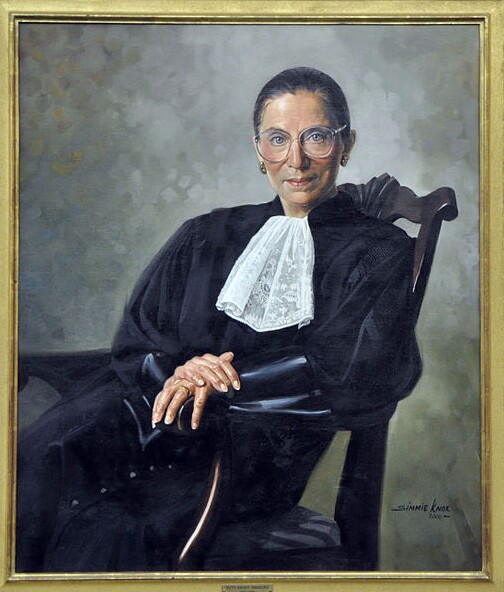
Ruth Bader Ginsburg United States Supreme Court Justice was born on
15 March 1933, in Brooklyn, New York. Simmie Knox, under commission of the United States Supreme Court painted this portrait of her. She is the second female justice (after Sandra Day O'Connor) and the first Jewish female justice. She is generally viewed as belonging to the liberal wing of the Court. Before becoming a judge, Ginsburg spent a considerable portion of her legal career as an advocate for the advancement of women's rights as a constitutional principle. (Wikipedia)


Finally - another link to the date, and - stretching things a bit to achieve arty-fartyness - a famous ceiling painting by Caravaggio (the only ceiling painting by him).

The date:

Every 248 years Pluto moves inside Neptune's orbit for about 20 years. The period January 23, 1979 to March 15, 1999 was the last time Pluto's very eccentric orbit carried it inside the orbit of Neptune. During that time, Neptune became the outermost planet in the solar system.

For 35 interesting facts about Pluto, see Random Facts, HERE


The painting:


The fresco, features Jupiter, Pluto and Neptune as allegorical representations of alchemy. The artist used his own body and facial features as model for the figures. Jupiter stands for sulphur and air, Neptune for mercury and water, and Pluto for salt and earth. The fresco was commissioned by Cardinal Francesco Maria Del Monte for the ceiling of a small second-floor alchemy lab of his hunting lodge in 1597.

On his eagle, Jupiter swoops down towards Neptune and Pluto, who are standing at the opposite edge of the ceiling, as if he were making the sky light up with a crystal ball. Any interpretation of the gathering of the gods, seen, unusually, from below, must shift between mythology (the gods, identified by the animal associated with each: an eagle for Jupiter, a sea stallion for Neptune and the three-headed dog Cerberus for Pluto); astrology (zodiac signs can be seen on the globe), and alchemy.
Hat tip to Guia Bargigli at THIS BLOG for clear representations, information and interpretation of the painting.