 Nimrod, the classical piece, part of Elgar's Enigma Variations, used in countless movies, most recently in the final scenes of Christopher Nolan's Dunkirk, raising lumps in many throats. The piece is also played every year on Remembrance Sunday at the London Cenotaph, and is often heard during funeral services.
 Who or what is, or was, Nimrod?
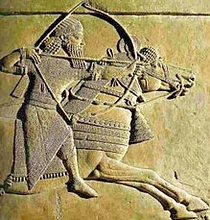 Once upon an Old Testament Time Nimrod was a mighty hunter, leader, founder of the city and tower of Babel and, rebel "against the Lord". He was son of Cush; grandson of Ham, and great-grandson of Noah. There's a good read about him, written by Shaul Wolf in a lighthearted style: The Life and Times of Nimrod the Biblical Hunter. I've mentioned Nimrod myself in an archived post about Sir Edward Elgar HERE.
 In more recent times the name Nimrod has been given to ships and a fighter plane; but has also, overtime
  gathered moss and become somewhat less "mighty". In modern American English the term nimrod has come to be used to describe a dimwit or stupid person, thanks in great part to cartoon character Bugs Bunny. Bugs ironically refers to hunter Elmer Fudd as "nimrod", as being an incompetent hunter (I guess!) Personally I have never heard the term used in this way exactly....except, perhaps, that a very dear one of mine, now long gone, did occasionally, and I should add affectionately, call me "Nimrod" as a nickname. I was unaware, at the time, of the name's origins and - I'm guessing - so was he!
And so...here's the version of Nimrod used in the movie Dunkirk, now doing the rounds, and which I blogged about last week HERE. The movie's full original score was composed by Hans Zimmer, who arranged Elgar's iconic piece to fit in seamlessly for the final scenes.SOME music arouses sad or happy emotions because of past events that we associate with it (the 'Listen, darling, they're playing our tune' syndrome) but this doesn't account for the fact that some tunes seem to have the power to affect different individuals' emotions in an apparently similar way, even when the people concerned have no shared history of experience to account for this reaction. Music scholars and philosophers have long disputed whether or not music actually 'means' anything, and if so, what. The late Deryck Cooke comes closest, in my view, to explaining this contentious area of musical aesthetics. In his book, The Language of Music (OUP, 1959), Cooke suggests that all composers of tonal music from the Middle Ages to the mid-20th century have used the same 'language' of melodic phrases, harmonies and rhythms to evoke the same emotions in the listener. If true, this could account for the fact that Nimrod seems to communicate the same feeling of melancholy to different people. This is a hideous oversimplification of Cooke's complex theory. He argues that it should be possible to compile a dictionary of musical idioms and their corresponding 'meanings' to identify which sequences of notes convey joy, grief, innocence, erotic love, etc. (Linda Barlow, Reading, Berks.)
IT IS a very rare tune which would cause a listener to want to cry. But a harmonised piece of music can very easily do so. Music often depends for its interest on creating and resolving tension. Tension is given to a passage by, for instance, moving away from the key in which the piece started. When the 'home' key is returned to it comes with a feeling of resolution. The classical sonata form is basically an exercise in waiting for the return of the tonic key. Composers started to use devices such as a long dominant pedal (signalling that we are about to return to the home key) and then delaying the final resolution longer than expected, giving added weight to the home key when it is finally reached.
Another way of creating and resolving tension is through dissonance. Two or more notes that do not sound pleasant together are changed for some that do. The more dissonant the interval, the more it can make you physically tense up (I find my neck and shoulders tightening). And probably the simplest trick of all is like a rhetorical device much loved by Hitler - start quietly and get louder. If you're really out to milk the emotions you are more subtle and reach the loudest point about nine-tenths of the way through and subside back to peacefulness.
Nimrod uses all of these tricks. The theme itself is harmonised using dissonances (some of which resolve into further dissonance, heightening the effect); it starts quietly and gradually builds up; just before the final statement of the theme there is a long roll on a timp while the brass extend the feeling of 'here we go back to the tonic key' by waffling in the dominant, and after the loudest bit of all it recedes to a quiet conclusion. Music can also make you cry if it is crap. (P S Lucas, Birmingham 18.)

