
Tomorrow would have been the birthday of a longtime hero of mine, artist and designer William Morris.
William Morris was a pioneer of socialism and ecological thinking in 19th century Britain, as well as being a multi-talented artist, member of the Pre-Rafaelite Brotherhood, and Arts and Crafts artistic movement, a poet, novelist, translator, embroiderer, calligrapher, engraver, gardener, decorator, dyer, weaver, and architectural preservationist. He designed furniture, printed and woven textiles, stained glass, tiles, carpets, tapestry, murals, wallpaper, books and type. He believed that art should be affordable and available to all and that every craftsman was an artist - he eschewed any form of elitism.
"My hero" on all counts. Before looking at his natal chart I half- suspected Aquarius would be somehow prominent.
William Morris was born 24 March 1834 in Walthamstow, Essex, England. Astrodatabank ives 1:00 am as his birth time, but with a "C" rating only = not always reliable.

An Aries stellium (tight cluster of planets): Sun, Venus, Mercury and Pluto in the energetic sign of the initiator. And I was right about Aquarius: Neptune, Mars and Uranus in Aquarius, Mars (ruler of Aries) and Uranus (ruler of Aquarius) conjoined. Mars energy links to his leaning towards the new and unusual, Uranus, unsullied in its own sign, Aquarius links to his socialism and humanitarian sensibilities. Jupiter in Taurus and Saturn in Libra are in exact quincunx (150*) a rather uncomfortable aspect. Saturn represents work and discipline, Jupiter is excess and expansion, these two planets in quincunx = a tendency to overwork and overstretch oneself. Additionally, Saturn is in opposition to Morris's Aries stellium, adding further to his obsessive work ethic.
Moon could well have been in Virgo, it's not possible to be sure without a time of birth, but Virgo does match that tendency of his to overwork. In his own words he confirmed this: "Give me love and work - these two only."
So, William Morris was a dynamo, physically and mentally.
 "News from Nowhere", Morris’s famous Socialist novel, is a Utopian fantasy that tells the story of a man who awakes the morning after a Socialist League meeting in a Socialist paradise, where people are free and equal and poverty has been abolished. At the book’s end, the man returns to his own time, but is inspired to bring about what he has dreamed.
Wisdom from William Morris, equally valid today, long after these words were spoken or written :
A few of his designs, there are dozens more at Google Image - all gorgeous:


La Belle Iseult by William Morris

A William Morris sofa:

World Beyond the Wood (fantasy novel by William Morris)


See also
William Morris : The Soul of Arts and CraftsBeing a brief account of his life and values and the beginnings of the Arts and Crafts Movement.
William Morris was a pioneer of socialism and ecological thinking in 19th century Britain, as well as being a multi-talented artist, member of the Pre-Rafaelite Brotherhood, and Arts and Crafts artistic movement, a poet, novelist, translator, embroiderer, calligrapher, engraver, gardener, decorator, dyer, weaver, and architectural preservationist. He designed furniture, printed and woven textiles, stained glass, tiles, carpets, tapestry, murals, wallpaper, books and type. He believed that art should be affordable and available to all and that every craftsman was an artist - he eschewed any form of elitism.
"My hero" on all counts. Before looking at his natal chart I half- suspected Aquarius would be somehow prominent.
William Morris was born 24 March 1834 in Walthamstow, Essex, England. Astrodatabank ives 1:00 am as his birth time, but with a "C" rating only = not always reliable.
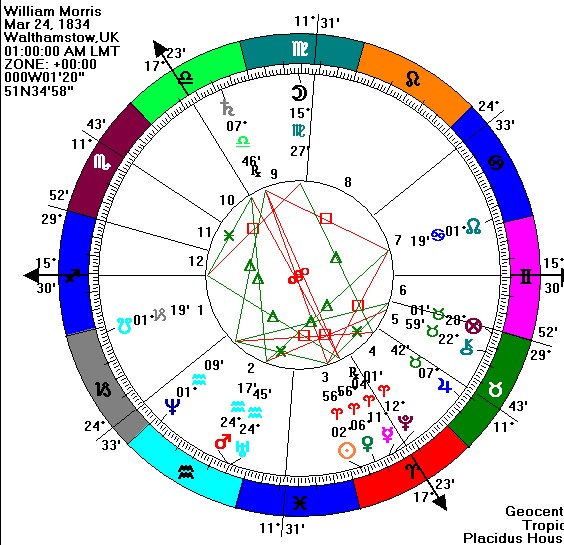
An Aries stellium (tight cluster of planets): Sun, Venus, Mercury and Pluto in the energetic sign of the initiator. And I was right about Aquarius: Neptune, Mars and Uranus in Aquarius, Mars (ruler of Aries) and Uranus (ruler of Aquarius) conjoined. Mars energy links to his leaning towards the new and unusual, Uranus, unsullied in its own sign, Aquarius links to his socialism and humanitarian sensibilities. Jupiter in Taurus and Saturn in Libra are in exact quincunx (150*) a rather uncomfortable aspect. Saturn represents work and discipline, Jupiter is excess and expansion, these two planets in quincunx = a tendency to overwork and overstretch oneself. Additionally, Saturn is in opposition to Morris's Aries stellium, adding further to his obsessive work ethic.
Moon could well have been in Virgo, it's not possible to be sure without a time of birth, but Virgo does match that tendency of his to overwork. In his own words he confirmed this: "Give me love and work - these two only."
So, William Morris was a dynamo, physically and mentally.
"When William Morris (1834-1896) died at the age of sixty-two, his physician declared that the cause was "simply being William Morris, and having done more work than most ten men." This multi-faceted man was at one time or another (and sometimes simultaneously) a designer and manufacturer of furniture, stained glass, tapestries, wallpaper and chintzes; an accomplished weaver; a pioneering preservationist; an active Socialist and social reformer; a successful poet and novelist; and in his last years, the founder of the Kelmscott Press. Yet all of these activities were of a piece, unified by several threads in the tapestry of Morris's life.
One continuity, dating from early childhood, was his love of nature, evidence of which may be found in the fond natural descriptions of his letters and poetry, the patterns of his tapestries, and the vining borders of the Kelmscott book. There was also his passionate devotion to the Middle Ages and to everything they represented; romantic Medievalism informs Morris's literary output, as well as his arts and crafts work and the books from his Kelmscott Press.
A third thread was his belief that it is impossible to separate esthetic issues from social and political ones. Morris often contrasted the social organization of the Middle Ages with the present condition of England, which led him to advocate a complete reform of industrial society. At first, he advocated an overhaul of the flawed esthetics of the age and later, realizing that such reform alone was insufficient, a thoroughgoing political revolution." See HERE.
 "News from Nowhere", Morris’s famous Socialist novel, is a Utopian fantasy that tells the story of a man who awakes the morning after a Socialist League meeting in a Socialist paradise, where people are free and equal and poverty has been abolished. At the book’s end, the man returns to his own time, but is inspired to bring about what he has dreamed.
Wisdom from William Morris, equally valid today, long after these words were spoken or written :
I hope that we shall have leisure from war, -- war commercial, as well as war of the bullet and the bayonet; leisure from the knowledge that darkens counsel; leisure above all from the greed of money, and the craving for that overwhelming distinction that money now brings: I believe that, as we have even now partly achieved liberty , so we shall achieve equality , and best of all, fraternity , and so have leisure from poverty and all its griping, sordid cares.
History has remembered the kings and warriors, because they destroyed; art has remembered the people, because they created.
I do not want art for a few any more than education for a few, or freedom for a few.
I pondered all these things, and how men fight and lose the battle, and the thing that they fought for comes about in spite of their defeat, and when it comes turns out not to be what they meant, and other men have to fight for what they meant under another name.
If you want a golden rule that will fit everything, this is it: Have nothing in your houses that you do not know to be useful or believe to be beautiful.
No man is good enough to be another's master.
A few of his designs, there are dozens more at Google Image - all gorgeous:


La Belle Iseult by William Morris

A William Morris sofa:

World Beyond the Wood (fantasy novel by William Morris)


See also
William Morris : The Soul of Arts and CraftsBeing a brief account of his life and values and the beginnings of the Arts and Crafts Movement.


