Showing posts with label alchemy. Show all posts

Friday, March 15, 2013

Arty Farty Friday 15 March

15 March 44 BC : Julius Caesar was murdered on the Ides of March.
Typogravure of a 19th century painting by Karl von Piloty:


Julius Caesar, the "dictator for life" of the Roman Empire, murdered by his own senators at a meeting in a hall next to Pompey's Theatre. The conspiracy against Caesar encompassed as many as sixty noblemen, including Caesar's own protege, Marcus Brutus. Caesar was scheduled to leave Rome to fight in a war on March 18 and had appointed loyal members of his army to rule the Empire in his absence. The Republican senators, already chafing at having to abide by Caesar's decrees, were particularly angry about the prospect of taking orders from Caesar's underlings. Cassius Longinus started the plot against the dictator, quickly getting his brother-in-law Marcus Brutus to join.

Caesar should have been well aware that many of the senators hated him, but he dismissed his security force not long before his assassination. Reportedly, Caesar was handed a warning note as he entered the senate meeting that day but did not read it. After he entered the hall, Caesar was surrounded by senators holding daggers. Servilius Casca struck the first blow, hitting Caesar in the neck and drawing blood. The other senators all joined in, stabbing him repeatedly about the head. Marcus Brutus wounded Caesar in the groin and Caesar is said to have remarked in Greek, "You, too, my child?
From This Day in History.


Nearer to our own time:

Janet Leach was born 15 March 1918 in Grand Saline, Texas, USA died 12 September 1997. She was a studio potter working in later life at St Ives, Cornwall in England. In 1956 she married Bernard Leach, a famous British studio potter. Janet was a potter in her own right before meeting Bernard and her independent spirit ensured that her work was quite different from much of her husband's in style. She never felt the need to pay reverence to her husband's work, was sometimes even critical of it. In return her own work was not always valued within the St Ives Studio, much of it remained hidden. David, Bernard Leach's son from one of his previous marriages, stated before his father's death: "Janet must be the one person who has worked closely with him for a number of years without being visibly influenced. She is so strong in herself that she has maintained more independence than anyone else who has been as close to that dangerous fire, my father!"

See more about Janet Leach HERE and HERE


Aldo Giorgini, artist and scientist, pioneer in computer graphics, was born in Voghera, Italy on 15 March 1934. He was one of the first computer artists to combine software writing with early printing technologies, leaving an aesthetic legacy in the field of the digital arts. He died in 1994.


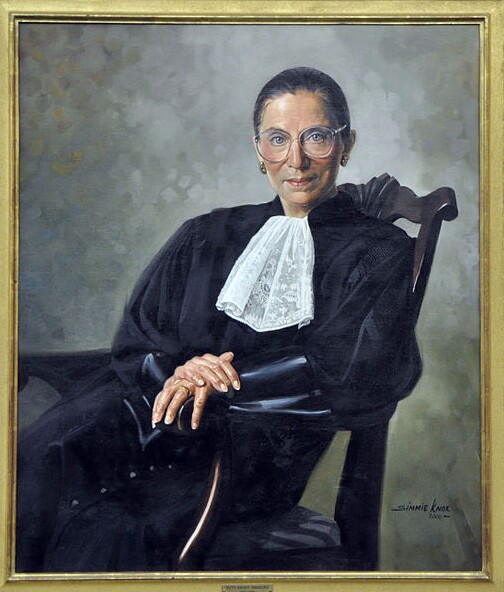
Ruth Bader Ginsburg United States Supreme Court Justice was born on
15 March 1933, in Brooklyn, New York. Simmie Knox, under commission of the United States Supreme Court painted this portrait of her. She is the second female justice (after Sandra Day O'Connor) and the first Jewish female justice. She is generally viewed as belonging to the liberal wing of the Court. Before becoming a judge, Ginsburg spent a considerable portion of her legal career as an advocate for the advancement of women's rights as a constitutional principle. (Wikipedia)


Finally - another link to the date, and - stretching things a bit to achieve arty-fartyness - a famous ceiling painting by Caravaggio (the only ceiling painting by him).

The date:

Every 248 years Pluto moves inside Neptune's orbit for about 20 years. The period January 23, 1979 to March 15, 1999 was the last time Pluto's very eccentric orbit carried it inside the orbit of Neptune. During that time, Neptune became the outermost planet in the solar system.

For 35 interesting facts about Pluto, see Random Facts, HERE


The painting:


The fresco, features Jupiter, Pluto and Neptune as allegorical representations of alchemy. The artist used his own body and facial features as model for the figures. Jupiter stands for sulphur and air, Neptune for mercury and water, and Pluto for salt and earth. The fresco was commissioned by Cardinal Francesco Maria Del Monte for the ceiling of a small second-floor alchemy lab of his hunting lodge in 1597.

On his eagle, Jupiter swoops down towards Neptune and Pluto, who are standing at the opposite edge of the ceiling, as if he were making the sky light up with a crystal ball. Any interpretation of the gathering of the gods, seen, unusually, from below, must shift between mythology (the gods, identified by the animal associated with each: an eagle for Jupiter, a sea stallion for Neptune and the three-headed dog Cerberus for Pluto); astrology (zodiac signs can be seen on the globe), and alchemy.
Hat tip to Guia Bargigli at THIS BLOG for clear representations, information and interpretation of the painting.

Tuesday, February 26, 2013

ALCHEMY

The subject of alchemy came up in a post last week. How about a look into what's available online about this ancient mystery? Always bearing in mind, of course, that point raised in yesterday's post - that history can be massaged and embroidered to suit the writer. The history of alchemy drifts very far back in time, so what's copied below has to be approached with that in mind. For myself, at one time I'd have discounted alchemy as simply being the beginnings of chemistry as we know it today. Was there more to it though? I don't know, but I'm willing to suspect there might be some discovery in the near future which, while not entirely validating alchemy's every claim, will put it in a kinder light than its current category as "pseudo-science".

Alchemy's basic aim was transmutation: changing something into something else. As generally understood it was the attempt to change base metal into gold; but other transmutations were involved too: of mind and spirit, which I think was why the Egyptians began their quest. Acquiring wealth, and power, would obviously have been strong motivation for some alchemists later on. In their need to understand transmutation, for whatever purpose, ancient alchemists were learning practical metallurgy, how to extract metals from ores, and gathering an understanding of chemical reactions.


Thinking about this ancient art/science I couldn't help being reminded of the TV series we're watching on DVD - Breaking Bad, about a chemistry teacher who uses his skills to make methamphetamine to sell in order to pay huge bills resulting from necessary treatments for his lung cancer (mentioned in an earlier post.) The results of his "cooking" do effect transformation of minds - but I suspect, not in a way which ancient alchemists would have approved.

Coincidentally, when preparing yesterday's post on revisionist history I noticed this at Wikipedia
Alchemy
Science historians are taking a new look at alchemy. Traditionally there was little room in the history of science for alchemy, which famously tried to convert lead into gold (lead oxide has a yellow colour), and it has been seen as closer to magic or mysticism than science. However there has been a revival of scholarship on the field and historians are finding reasons to give at least some alchemy a new interpretation. Alchemists, some historians are now saying, contributed to the emergence of modern chemistry as a science.
The best potted history of alchemy I've found online is HERE - it comes from a book by A. Cockren - Alchemy Rediscovered and Restored.
The extract begins:
To most of us, the word "alchemy" calls up the picture of a medieval and slightly sinister laboratory in which an aged, black-robed wizard broods over the crucibles and alembics that are to bring within his reach the Philosopher's Stone, and with that discovery, the formula for the Elixir of life and the transmutation of metals. But one can scarcely dismiss so lightly the science - or art, if you will -that won to its service the lifelong devotion of men of culture and attainment from every race and clime over a period of thousands of years, for the beginnings of alchemy are hidden in the mists of time. Such a science is something far more than an outlet for a few eccentric old men in their dotage.

What was the motive behind their constant strivings, their never-failing patience in the unravelling of the mysteries, the tenacity of purpose in the face of persecution and ridicule through the countless ages that led the alchemists to pursue undaunted their appointed way? Something far greater, surely, than a mere vainglorious desire to transmute the base metals into gold, or to brew a potion to prolong a little longer this earthly span, for the devotees of alchemy in the main cared little for such things.

The accounts of their lives almost without exception lead us to believe that they were concerned with things spiritual rather than with things temporal................... To appreciate and understand the adepts' visions, it is necessary to trace the history of their philosophy..........................
(Below: engraving by Hans Weiditz: An Alchemist, c. 1520.)

The piece goes on to outline how the doctrine spread, via China, Egypt, the Arab world to Europe and Britain, and how it evolved during the 17th and 18th centuries. The article ends with Our Debt to the Alchemists by Reginald Merton, which I've taken the liberty of copying almost in full (if anyone objects copyrightfully, I shall reduce it or take it down). (I reckon there's more than enough there to provide seed material for one or two movies!) I've added illustration and links to further information about named individuals.
"If there were any of the alchemists who discovered the mineral agent of transformation, fewer still were able to find its application to the human body. Only a very few adepts knew of the essential agent, the sublime heat of the soul, which fuses the emotions, consumes the prison of leaden form and allows entry into the higher world. Raymond Lully (left) made gold for the King of England. George Ripley gave a hundred thousand pounds of alchemical gold to the Knights of Rhodes, when they were attacked by the Turks. Gustavus Adolphus of Sweden had an enormous number of gold pieces coined that were marked with a special mark because they were of "Hermetic origin." They had been made by an unknown man under the protection of the king, who was found at his death to possess a considerable quantity of gold. In 1580, the Elector Augustus of Saxony, who was an alchemist, left a fortune equivalent to seventeen million dollars. The source of the fortune of Pope John XXII, whose residence was Avignon and whose revenues were small, must be ascribed to alchemy (at his death there were in his treasury twenty-five million florins). This must be concluded also in the case of the eighty-four quintals of gold possessed in 1680 by Rudolph II of Germany.


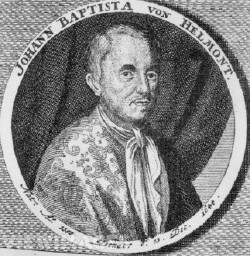
The learned chemist Van Helmont (right), and the doctor Helvetius, who were both skeptics with regard to the Philosopher's Stone and had even published books against it, were converted as a result of an identical adventure which befell them. An unknown man visited them and gave them a small quantity of projection powder; he asked them not to perform the transmutation until after his departure and then only with apparatus prepared by themselves, in order to avoid all possibility of fraud. The grain of powder given to Van Helmont was so minute that he smiled sarcastically; the unknown man smiled also and took back half of it, saying that what was left was enough to make a large quantity of gold. Both Van Helmont's and Helvetius' experiments were successful, and both men became acknowledged believers in alchemy. Van Helmont became the greatest "chemist" of his day. If we do not hear nowadays that Madame Curie has had a mysterious visitor who gave her a little powder " the color of the wild poppy and smelling of calcined sea salt," the reason may be that the secret is indeed lost; or, possibly, now that alchemists are no longer persecuted or burnt, it may be that they no longer need the favorable judgment of those in official power.

Until the end of the eighteenth century, it was customary to hang alchemists dressed in a grotesque gold robe on gilded gallows. If they escaped this punishment they were usually imprisoned by barons or kings, who either compelled them to make gold or extorted their secret from them in exchange for their liberty. Often they were left to starve in prison. Sometimes they were roasted by inches or had their limbs slowly broken. For when gold is the prize, religion and morality are thrown to the side and human laws set at naught. This is what happened to Alexander Seton, called "the Cosmopolitan." He had had the wisdom to hide all his life and avoid the company of the powerful and was a truly wise man. However, marriage was his downfall. In order to please his ambitious wife, who was young and beautiful, he yielded to the invitation extended him by the Elector of Saxony, Christian II, to come to his court. Since Seton was unwilling to disclose the secret of the Philosopher's Stone, which he had long possessed, he was scalded every day with molten lead, beaten with rods and punctured with needles till he died.

The famous alchemists Michael Sendivogius, Botticher, and Paykull all spent part of their lives in prison, and many men suffered death for no other crime than the study of alchemy. If a great number of these seekers were impelled by ambition or if there were among them charlatans and impostors, it does not diminish the fact that a great many of them cherished a genuine ideal of moral development. In any event, their work in the domain of physics and chemistry formed a solid basis for the few wretched fragmentary scraps of knowledge that are called modern science and are cause for great pride to a large number of ignorant men.

These "scientists" regard the alchemists as dreamers and fools, though every discovery of their infallible science is to be found in the "dreams and follies" of the alchemists. It is no longer a paradox, but a truth attested by recognized scientists themselves, that the few fragments of truth that our modern culture possesses are due to the pretended or genuine adepts who were hanged with a gilt dunce's cap on their heads. What is important is that not all of them saw in the Philosopher's Stone the mere vulgar, useless aim of making gold. A small number of them received, either through a master or through the silence of daily meditation, genuine higher truth. These were the men who, by having observed it in themselves, understood the symbolism of one of the most essential rules of alchemy: Use only one vessel, one fire, and one instrument. They knew the characteristics of the sole agent, of the Secret Fire, of the serpentine power which moves upwards in spirals -- of the great primitive force hidden in all matter, organic and inorganic -- which the Hindus call kundalini, a force that creates and destroys simultaneously. The alchemists calculated that the capacity for creation and the capacity for destruction were equal, that the possessor of the secret had power for evil as great as his power for good. And just as nobody trusts a child with a high explosive, so they kept the divine science to themselves, or, if they left a written account of the facts they had found, they always omitted the essential point, so that it could be understood only by someone who already knew
..........................................."


*********************************************

When the circle, the square and the triangle come together, they form a symbol that is used to denote alchemy. The symbol in question is a circle, within a square, within a triangle, which parallels the great work of the alchemist.
"This figure represents the alchemical Squaring of the Circle, within the microcosm of the Work." D. Stolcius von Stolcenberg, Viridarium chymicum, Frankfurt, 1624. Extract from "The Golden Game", Stanislas Klossowsky de Rola.
The symbol is impeccable as a representation of alchemy, as it shows man's relationship with the universe, the need to transcend the material (the square) towards the sublime quality of the spiritual (the circle), all under the watchful protection of our maker (the triangle).
When one acquires the right knowledge and wisdom, they acquire an understanding, -a gnosis- that enables them to remove the shackles of the material world, achieve oneness with spirit and then harmonize that oneness with the all. (See HERE)

***********************************************

PS: There's also more information and loads of links to helpful relevances at Library of Halexandria.

Also HERE.

And HERE.

And the Alchemy Website HERE.

Thursday, February 21, 2013

GLYPHS

When I began to study astrology in earnest one of my first tasks was to commit to memory the glyphs used to represent the signs and planets. To understand a natal chart the first essential is to recognise the glyphs. Sign glyphs are better known than planet glyphs, they often appear in newspaper and magazine Sun sign columns, because of their relative familiarity they were easy to memorise. Planet glyphs are less familiar, but there are only seven major ones to remember, and Sun and Moon are easy-peasy. I used to draw the shapes continually until I had them locked in. It helps in memorising the planet glyphs to have some idea of why they are as they are. They're not simply shapes dreamed up at random. Each part of the odd looking symbols has significance. Astrologer Alan Oken explained this in his book Complete Astrology, from which I started to dutifully copy before discovering that the work has already been done by astrologer Carole Somerville - SEE HERE.

I've wondered about the origin of planet glyphs. There's not a lot of information available. The glyphs are said to date back to at least mediaeval times. About.com has a piece by Anne Marie Helmenstine, Ph.D on alchemy symbols. It would seem that the link between astrology and alchemy can still be identified from the planet symbols we use. It's interesting to look through the collection of alchemical glyphs, some are strangely beautiful.
See also Wikipedia's page on alchemy.

When considering these things some years ago an old blog friend of mine, Anthony North, commented:

AN: I've often thought that astrology and alchemy are related, in that they came from a similar pre-science that was shared - a kind of instinctual knowing, I suppose. Now if we could track this beginning from the snippets that are left behind - including Hermetica, for instance - then we'd really begin to grasp ancient understanding of the universe.

I replied...
Yes, though I'm not sure whether they are actually related disciplines or whether it was just that the same people who practiced one also practiced the other, and borrowed appropriate symbols. Wikipedia states (tentatively) that alchemy's roots go back to Egypt - 5,000 BCE. There's a wide flung net of mystery that'll never really be solved. A lot of valuable information was lost when the Library of Alexandria was destroyed
It remain intriguing.

Saturday, March 07, 2009

Weekend Waffle

A line in John Anthony West's excellent book "The Case for Astrology" caught my eye the other day. He talks about the Principle of Correspondences, and how it relates to astrology and to that thing called magic, also alchemy and, well....everything really. He goes on to say that "Art is magic, literally and technically". He uses composers as examples in his book, but we can use artists and writers equally well - they take inanimate materials: canvas, paper, paint, chalks, pencils, inks, a camera, film, and tranform them into something which can initiate a rush of emotion in the observer.
By reaction with the Principle of Correspondences their work can touch our inner being - not in every case, but where Correspondences exist. When we feel drawn to someone or something, I'm confident that the Principle of Correspondences is at work - somehow, through astrological links. If we knew exactly how, we'd be well on the way to solving the mystery of astrology.


I saw Archbishop Desmond TuTu interviewed on late night TV this week by, of all people, Craig Ferguson. It was a lovely interview, thanks to the uninhibited approach of the interviewer and the delightful personality of the interviewee.The archbishop was born with Sun, Mercury and Venus in Libra - sign of balance and diplomacy. Moon and Jupiter in Leo, help to make him comfortable on the world stage. He has a Grand Cross showing very clearly in his chart, signifying the struggles he has lived through in trying to effect justice and peace in a strife-torn Africa. This man is a wonderful example of Christianity. Many other churchmen could (and should) take lessons from him.
(12 noon chart used in the absence of birth time).


I keep reading complaints that too much is being written and discussed about trivia, especially trivia related to America's new First Family. Critics say that "there are more important things to write about, these days". Well, yes of course, and there are thousands of people writing on those important topics.

Communication has increased a million-fold or more in the past year or two. I can't identify the astrological reflection of this, unless the mushrooming was started by Jupiter's transit through Sagittarius -both planet and its home sign are connected to excess and expansion. More of what used to be part of girly chats over coffee has morphed into journalist and blog fodder.

Interest in trivia has always been part of life. It's necessary, I believe, to counteract an overdose of gloom and heavy duty news. I do, occasionally, have a need to read about whether Michelle Obama's sleeveless dress was thought okay for a serious political venue, or whether President Obama's hair is rapidly turning grey, or what dog will be choosen for First Dog. It's similar to the way we crave morsels of sweetmeat after large helpings of food which had to be chewed and chewed and chewed for digestion's sake. News is news, trivia is trivia, there's room for both in the ever expading world of communication.

Wednesday, January 14, 2009

Wednesday's "Why?" ~ The Glyphs


When I started to study astrology in earnest one of my first jobs was to commit to memory the glyphs used to represent the signs. To understand a natal chart the first essential is to recognise the glyphs. Sign glyphs are better known than planet glyphs, they often appear in newspaper and magazine Sun sign columns, because of their relative familiarity they are easy to memorise.


Planet glyphs are less familiar, but there are only seven major ones to remember, and Sun and Moon are easy-peasy. I used to draw the shapes continually until I had them locked in. It helps in memorising the planet glyphs to have some idea of why they are as they are. They're not simply shapes dreamed up at random, each part of the odd looking symbols has significance. Astrologer Alan Oken explained this in his book "Complete Astrology", from which I started to dutifully copy before discovering that the work has already been done by Carole Somerville at Suite 101- see Glyphs of the Planets .


In typical Aquarian fashion, I've wondered about the origin of the planet glyphs. Water Carriers accept very little at face value y' know! There's not a lot of information available though, other than that the glyphs seem to date back to at least mediaeval times. I found this interesting page at a site called Purple Hell: "Alchemical Symbols"


It would seem then that the link between astrology and alchemy can still be identified from the planet symbols we use. I found it interesting to look through the whole page at the large collection of alchemical symbols. Some of them are strangely beautiful.