Showing posts with label children's books. Show all posts

Saturday, July 22, 2017

Taking the 5th (House, that is!)

 Leo by Ronald Searle
The Sun is about to leave zodiac sign Cancer and begin its transit through the sign of Leo. Leo is associated with astrology's 5th house. 5th house represents, among other things, childhood and child-like activity.

We all, no matter how sophisticated or knowledgeable, retain remnants of childhood/child-like fantasies within our nature. As this summer progresses and nothing at all in current news cycles has much ability to improve a dismal mood, it might be wise to simply "5th-house-it", at least for a short interval, before heading back into the gloom.

Authors of books intended for children often had timeless wise advice to offer, for us all, whatever stage of maturity we have or haven't reached. The following wee snippets always cheer me during times of worry, and wondering about what could possibly come next:


Think (laterally) about A.A. Milne's Winnie the Pooh ~~~


'Supposing a tree fell down, Pooh, when we were underneath it?'
'Supposing it didn't,' said Pooh.
After careful thought Piglet was comforted by this.


It's snowing still," said Eeyore gloomily.
"So it is."
"And freezing."
"Is it?"
"Yes," said Eeyore. "However," he said, brightening up a little, "we haven't had an earthquake lately."


The old gray donkey, Eeyore stood by himself in a thistly corner of the Forest, his front feet well apart, his head on one side, and thought about things. Sometimes he thought sadly to himself, "Why?" and sometimes he thought, "Wherefore?" and sometimes he thought, "Inasmuch as which?" and sometimes he didn't quite know what he was thinking about.


Then think about the Sesame Street story:

There's a Monster at the End of This Book by Jon Stone


Grover is horrified to learn that there is a monster at the end of the book, and begs the reader not to finish the book, so as to avoid the monster.
Fearful of reaching the end of the book, Grover constructs a series of obstacles, such as attempting to tie pages together and laying brick walls, to prevent the reader from advancing. Increasingly frightened (and also in awe of the reader's strength at overcoming the obstacles), Grover pleads with the reader to stop reading as the book nears its conclusion. However, the monster turns out to be Grover himself, making the story self-referential.


OR: the Harry Potter tales~~~


"Happiness can be found even in the darkest times if one only remembers to turn on the light." - Albus Dumbledore.


HOWEVER...

If You Give a Moose a Muffin, by Laura Joffe Numeroff ~~~

If a big hungry moose comes to visit, you might give him a muffin to make him feel at home. If you give him a muffin, he'll want some jam to go with it. When he's eaten all your muffins, he'll want to go to the store to get some more muffin mix.

Hmmmm.....yeah!


But, it's always good to remember that:


Friday, January 30, 2015

Arty Farty Friday ~ Bill Peet & Patrick Caulfield, born 29 January

Two artists with very different styles were born on 29 January: In 1915, American Bill Peet, famous for his work and tempestuous times with Walt Disney, also for his many illustrated children's story books. Born some 21 years later, in the UK, Patrick Caulfield, whose rather different version of 1960s pop-art won him fame.

Briefly:

Bill Peet (January 29, 1915, Grandview Indiana – May 11, 2002), children's book illustrator, and story writer for Disney Studios, 1937-1964. His artistic talent showed up early; he filled the margins of his school books with sketches, later shone as an art student on scholarship at the Herron Art Institute, Indianapolis. Studies completed, he left the midwest for Hollywood, to seek better job opportunities. He was hired as an “in-betweener” to fill in the interstitial cells between the main scenes, for Walt Disney studio’s production of Snow White and the Seven Dwarves, later, with his talent recognised, he climbed the Disney hierachy and worked on films such as Pinocchio, Fantasia, Dumbo , Song of the South, Cinderella, Alice in Wonderland, Peter Pan, Sleeping Beauty, One Hundred and One Dalmatians, The Sword in the Stone, The Jungle Book, and others. He eventually left the Disney Studios after 27 years, following a particularly bitter argument with Walt Disney (one of many throughout his time there) over the story production of The Jungle Book (See this at Blabbing on Arts and Culture blog). He then focused on writing and illustrating books for children, and now has a long list of much-loved children's books to his credit.

An imaginative and stylish storyteller, he would frequently embed messages within his tales. There's an especially good story which I suspect we might all benefit from reading: The Wump World.

Bill Peet married his schooldays sweetheart, Margaret. There's a sweet website created by the Peets' son HERE.


If a passing reader has around 12 minutes to spare, there's a YouTube reading of The Wump World with all his illustrations.


 From his Dumbo story board

More of Bill Peet's Dumbo sketches at Deja View blog HERE.


 From the 1001 Dalmations story board


 From his book The Whingdingdilly


Over the Atlantic and on a different wavelength altogether was Patrick Caulfied, born in Acton, London on 29 January 1936. He died in 2005. A student at the Royal College of Art, 1960-63 along with David Hockney, he developed a unique style characterised by the use of line and depiction of banal, everyday objects saturated in colour and made strangely important. Few human or animal figures grace his artwork, its focus is interiors: office, restaurant, city, decor - all stylised with clean, simple, minimalist flavour. Reviewers of his artwork have pointed out that, though his paintings appeared simple, this was deceptive and rarely the desired effect. By his own admission there were periods when he sought simplicity and others when he sought complexity. The paintings' unity lay in the power of Caulfield's imagination and wry detachment. Resistance to classification meant that Caulfield's work was not as widely known as that of some of his contemporaries.

He is said to have been
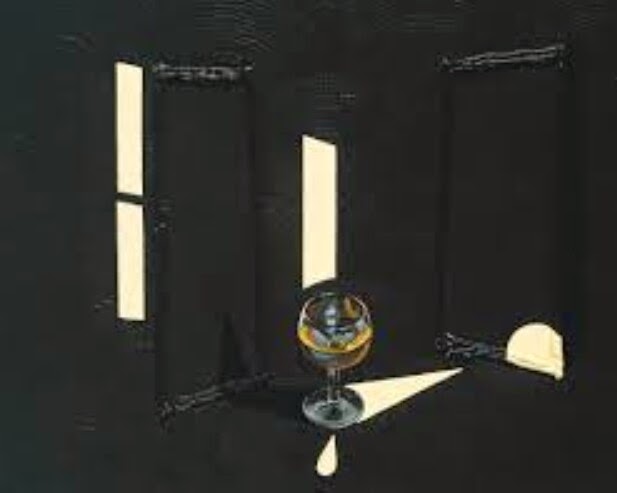
"a keen drinker, arriving at his "morning pub" at opening time for Old Speckled Hen, before moving on to double Irish whiskeys. After lunch and work, he went to the evening pub, before returning home to watch television. Glasses of red wine were a frequent motif in his paintings."

"Caulfield was apt to grin sheepishly when making wolfish remarks, especially when declaring his dislike of facile or excessively worthy sorts of painting. He had no time for raw green countryside. Plein air as an excuse for landscape genres enraged him. Interiors for him: places with light switches and engaging artificiality and plentiful refreshments."

Patrick Caulfield married Pauline Jacobs, they had met at Chelsea Art School in 1968; they had three sons. After the marriage was dissolved, in 1999 he married artist Janet Nathan.
(See obituaries at The Telegraph and The Guardian).

After Lunch (1975)
From Tate website HERE
Caulfield's paintings explore alternative ways of picturing the world. After Lunch was one of his earliest works to combine different styles of representation. In this case, what appears to be a photomural of the Château de Chillon hanging in a restaurant is depicted with high-focus realism, contrasting with the cartoon-like black-outlined imagery and fields of saturated colour of its surroundings. Caulfield deliberately makes the relationship between these varying representational methods uneasy and ambiguous, so that the picture appears more real than the everyday world around it.


 Lamp and Pines (1975)


 Tandoori Restaurant


 Second Glass of Whisky (1992)


Entrance (1975)
See Platform 505 HERE
Pictures such as “Entrance” employ a rigorous use of black, with complex arrangements of grids, outlines and trellises. The atmosphere is playful and upbeat yet equivocal. These strange gardens and interiors are recognisable but unfamiliar, a parody of the real thing.
BBC website has a slideshow of some of Caulfield's paintings, HERE.


ASTROLOGY

Bill Peet, born January 29, 1915, Grandview, Indiana. Chart set for 12 noon as no time of birth available.


Patrick Caulfield, born January 29 1936, Acton, London, UK. Chart set for 12 noon as no time of birth available.


The artwork of Bill Peet and Patrick Caultfield was so different in "feel"; will their natal charts reflect this?

I see Peet as being a warmer, softer, more engaged in humanity kind of guy - from his choice of art style and genre. He had the heavier Aquarius input: Sun conjunct modern ruler Uranus, and Mercury conjunct Jupiter all in sign of the Water Bearer. Without a time of birth we can't know where Aquarius was placed house-wise though.

I suspect the warmer, softer feel of Peet's artwork comes via Venus (planet of the arts) in philosophical Sagittarius and a likely Cancer Moon, which could well have been conjunct Neptune(creativity and imagination). Mr Peet's talent for writing stories (for children) to match his artwork is reflected by Mercury (the writer's planet) in helpful sextile to artistic Venus; also significant: Saturn in Mercury-ruled Gemini in harmonious trine to Mercury in Aquarius.


Patrick Caulfield's paintings, though attractive and colourful, have a distinctly distant "feel" to them - detached from the human world, they concentrate on line, precision, design and colour rather than on flesh and blood. Whimsicality is absent, its place taken by what art reviewers see as wry detachment and some embedded humour.

Mr Caulfield was of a different generation from Mr Peet's, born a world away too. He was strongly influenced by art trends of the 1960s. His natal chart spreads rather thinner than Peet's, bringing in, Aquarius Sun and Mercury, with personal planets lying between Aries Moon (whatever his time of birth) to Jupiter in Sagittarius.

Arts planet Venus, in his case, was in Capricorn; this reflects the structural feel, reliant on line, of much of his artwork. Very significantly, too, a close trine between Venus (art) and Uranus (the avant garde) in Venus-ruled Taurus links to his pull towards modernity and an avant garde art style.

Hard-edged Saturn and Mars in Pisces possibly overwhelmed the usual gentle softness of Pisces - as far as his art style was concerned anyway. Jupiter in Sagittarius could be seen as source of the wry humour said to be involved in some of his paintings.

It's a pity no times of birth are known for the two artists - I'd be very surprised if their rising signs didn't contrast quite starkly.

Friday, April 13, 2012

Arty Farty Friday ~ Garth Williams, illustrator of children's books

Children's book illustrators are "a breed apart" in the art world. Garth Williams was one such, and really, his name should be better known.

He was a mid-April Aries-type, born
16 April 1912; he died in 1996. Williams sort of "fell into" the work of illustrating children's books. Both his parents were British artists who moved around quite a lot: New York, Canada, England. His first aim was to be an architect, but the Great Depression, and later World War 2 got in the way of his ambition.

He studied portraiture and sculpture.

After the war, in the USA, he produced art work for The New Yorker. His work must have caught the eye of E.B. White, author of Stuart Little - illustrating this book was Garth William's entrance into the world of children's book illustrating, a world in which he stayed from 1945 for the rest of his professional life. His work on E.B. White's Stuart Little and Charlotte's Web, followed by a commission to illustrate a set of eight books in Laura Ingall Wilder's Little House series cemented his reputation and name among children's authors - if not in the minds of his young readership.


His style is easily recognisable, and admired by both young and older fans for his signature ability to endow animal faces and bodies with recognisable human emotions, gestures and body language, without this seeming to be in any way false.


He wrote a few children's stories himself, only one of these achieved much publicity. The Rabbits’ Wedding, published in 1958. It raised a few hackles because he had depicted, quite innocently, a marriage between a white rabbit and a black rabbit. The book was castigated, even burned, in the American South, an area still resisting the desegregation movement. His book became a best seller.
Williams’ response:
“The Rabbits’ Wedding has no political significance. I was completely unaware that animals with white fur were considered blood relations of white human beings. It was written for children from two to five who will understand it perfectly. It was not written for adults, who will not understand it because it is only about a soft furry love and has no hidden messages of hate.” ( quote from Time.com)


There are hints in various biographical articles that his life, outside of illustrating, may not have been the innocent and serenely romantic haven often depicted in his work. From a piece at Answers.com :
Although he avoided sentimentality, his work, especially when the subjects are animals, often suggests Romantic escapism—life is simple; the characters are charming and innocent. This may have been Williams's artistic counter to his own rather chaotic personal life: the tragedies and displacements of World War II, his peripatetic wanderings, and his four marriages.

And at Werewolf:
Williams married four times, and helped nurse one of his wives through a terminal illness. Reading his own account of his life in the Something about the Author series, it is striking that his succession of wives tended to be extremely young – one, a ward of the family, another a young woman with polio – when he married them. In the 1960s and 1970s, his restless, adventurous spirit took him to Mexico, where he bought the ruins of an abandoned 400 year old silver mine, and rebuilt the adjacent villa as his home and studio. Reportedly, the villa contained an internal waterfall and a dining room that could seat up to 150 people.

In many such respects, Williams seems to have been untouched by age, and retained his youthful vision until the end of his life. Only half jokingly at 80, when one interviewer noted that his youngest daughter was now 50 years old, Williams reportedly replied : “ But how can that be – when I’m only 42 !”

A good biographical article on Garth Williams is at Through the Magic Door

Garth Williams' natal chart is set for 12 noon as birth time isn't known.


He was a quadruple Aries with both Sun and Moon in that sign as well as Mercury and Venus. How this translated in his personal life isn't known, but it doesn't compute too clearly with the style of his illustration. Neither does Uranus in its home sign Aquarius, sitting in harmonious sextile to Venus, planet of art. His artwork isn't the least bit Uranian.
His Arien and Uranian traits must have manifested in his non-professional life. 4 wives, reportedly bohemian lifestyle, and "restless, adventurous spirit" - there ya go - thats a quadruple Aries and Uranus in Aquarius!

For astrological reflection of his art style see Saturn in Taurus (sign ruled by Venus planet of art) in harmonious sextile to Neptune (creativity) in Cancer (sentimental, nurturing, romantic).

Jupiter in Sagittarius, its home sign clearly links to his peripatetic lifestory: USA, Canada, UK, Mexico.

Wednesday, July 27, 2011

For The Child in Us All

Zodiac sign Leo, through which the Sun is currently travelling, is associated with 5th house in astrology. 5th house represents, among other things, childhood and child-like activity. We all, no matter how sophisticated or knowledgeable, retain remnants of childhood/child-like fantasies within our nature.

Amid the current bad news cycle of debt ceilings, deficits, impasses with world-wide financial calamity waiting in the wings, it might be wise to "5th-house-it all". Simplify, simplify.....at least for a few minutes, before heading back into the fray.

Few ordinary people, and not too many extraordinary people, fully understand the underpinnings of the present crisis, even less the theatrical games being played by Washington DC's pantomime artists. Authors of books intended for children often had timeless advice to offer - for us all, whatever stage of maturity we have or haven't reached. I don't know about you, but these wee snippets always cheer me during times of worry and wondering about what could possibly come next:


Think (laterally) about A.A. Milne's Winnie the Pooh ~~~


'Supposing a tree fell down, Pooh, when we were underneath it?'
'Supposing it didn't,' said Pooh.
After careful thought Piglet was comforted by this.


It's snowing still," said Eeyore gloomily.
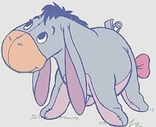
"So it is."
"And freezing."
"Is it?"
"Yes," said Eeyore. "However," he said, brightening up a little, "we haven't had an earthquake lately."


Then think about the Sesame Street story:

There's a Monster at the End of This Book by Jon Stone


Grover is horrified to learn that there is a monster at the end of the book, and begs the reader not to finish the book, so as to avoid the monster.
Fearful of reaching the end of the book, Grover constructs a series of obstacles, such as attempting to tie pages together and laying brick walls, to prevent the reader from advancing. Increasingly frightened (and also in awe of the reader's strength at overcoming the obstacles), Grover pleads with the reader to stop reading as the book nears its conclusion. However, the monster turns out to be Grover himself, making the story self-referential.


AND

If You Give a Moose a Muffin, by Laura Joffe Numeroff.

If a big hungry moose comes to visit, you might give him a muffin to make him feel at home. If you give him a muffin, he'll want some jam to go with it. When he's eaten all your muffins, he'll want to go to the store to get some more muffin mix.

That one's a fable President Obama might benefit from reading!