The USA's version of "middle class" is different from the UK's version. Here the middle class seems to refer to anyone not living in actual poverty, yet not of the 1% of elite bankers, financiers, corporate CEOs, "celebs", multimillionaires and billionaires. In the UK middle class is understood to relate to the professions: doctors, lawyers, professors, scientists - that sort of thing. Ordinary folk, tradespeople, craftsmen, office workers, factory workers, store assistants etc. are the working class. Bearing that difference in mind, yesterday I read a good article by Edward McClelland at Salon.
RIP, the middle class: 1946-2013
The 1 percent hollowed out the middle class and our industrial base. And Washington just let it happen
Here's a paragraph from the piece:
When I was growing up, it was assumed that America’s shared prosperity was the natural endpoint of our economy’s development, that capitalism had produced the workers paradise to which Communism unsuccessfully aspired. Now, with the perspective of 40 years, it’s obvious that the nonstop economic expansion that lasted from the end of World War II to the Arab oil embargo of 1973 was a historical fluke, made possible by the fact that the United States was the only country to emerge from that war with its industrial capacity intact. Unfortunately, the middle class – especially the blue-collar middle class – is also starting to look like a fluke, an interlude between Gilded Ages that more closely reflects the way most societies structure themselves economically. For the majority of human history – and in the majority of countries today – there have been only two classes: aristocracy and peasantry. It’s an order in which the many toil for subsistence wages to provide luxuries for the few. Twentieth century America temporarily escaped this stratification, but now, as statistics on economic inequality demonstrate, we’re slipping back in that direction. Between 1970 and today, the share of the nation’s income that went to the middle class – households earning two-thirds to double the national median – fell from 62 percent to 45 percent. Last year, the wealthiest 1 percent took in 19 percent of America’s income – their highest share since 1928. It’s as though the New Deal and the modern labor movement never happened.
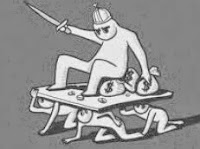
The highlighted sentences are what I latched onto immediately. At this time of equinox and balance in the natural world, doesn't it seem peculiar that any kind of equinox or balance has never, ever existed for humans - anywhere on Earth? Balance, even partial balance, of the distribution of wealth and bounty of planet earth?
We, in the west at least, have moved in cycles of vicious feudalism/slavery, to a much milder disguised form of the same, back to a variation of the more intense form, under a different name.
Why is this? Why does it have to be like this? Karl Marx and others throughout history must have asked the question and tried to answer it. Their solutions didn't take, anymore than it would be feasible to try stopping a toy train on circular track and causing it to take a different route where no tracks existed.
But who laid those tracks in the first place? The elite (for want of a better description of the planet's early rulers). How did they become rulers, and capable of doing this? Why did they think it was the right thing to do?
If astrology works at all, it has to be something inherent in humans due to our physical position in our solar system. Our very nature must drive us along these already laid tracks, and divides us very unequally into rulers and ruled. I wonder where it says that in planetary language? Is it due to the Sun's rule over life itself? That could explain the need for leaders - a ruler: king, emperor, president, whatever, but it doesn't explain why things are, and have always been, so unbalanced; or when efforts to bring about even minor adjustments are made, results are short-lived at best. We soon veer back to the same old tracks. The part of DNA relating to greed for wealth and control must be fairly rare but very, very powerful.
That little lot spewed, unbidden, right off the top of my head and could well be utter rubbish. I needed to let off some steam.
“The first man who, having fenced in a piece of land, said "This is mine," and found people naïve enough to believe him, that man was the true founder of civil society. From how many crimes, wars, and murders, from how many horrors and misfortunes might not any one have saved mankind, by pulling up the stakes, or filling up the ditch, and crying to his fellows: Beware of listening to this impostor; you are undone if you once forget that the fruits of the earth belong to us all, and the earth itself to nobody.”
― Jean-Jacques Rousseau, Discourse on the Origin of Inequality