Showing posts with label space. Show all posts

Tuesday, July 18, 2017

From Summer of Love to Mars (and back?)

Another 2017 anniversary has been noted by several writers and columnists this month: the so-called Summer of Love's 50th. Here's one writer's take on it - Todd Gitlin: Summer of Love and Rage.

Hippie-dom, and Summer of Love were something I only read about, back in England, and, otherwise engaged in my own throes of marriage, separation and frustratingly attempting divorce in an era when it was nowhere near as easy as it is today. I did fleetingly enjoy a few of the LSD-induced songs drifting through my transistor radio, but back then the other side of the Atlantic seemed as far away as Mars - and as alien.

Commenter "Rodmacd", in a thread below the linked piece had this to say:
The hippie era was pretty brief. The Summer of Love, followed 2 years later by Woodstock; thought, with breathless anticipation, to be an "OMG, What's Next?!" event -- and, as we all now know, "next" turned out to be a few years of a whole lot of not much until the hippies traded in their tie-dyes for tie clips and pasted over their "War is not healthy for Children and other living things" bumper stickers with ones that read "He who dies with the most toys wins". Mighty Mammon took a shot or two back then, but it rallied strong and remains the heavyweight champion of the American Dream.


Oh - and speaking of Mars... dragging myself back to 2017 again, here's an interesting piece by Tyler Losier:


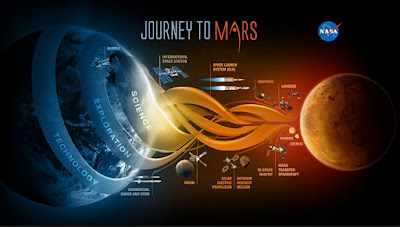
The race to the red planet: How NASA, SpaceX are working to get to Mars.


Well then...speaking of space travel, and potential future ways to do it, or aid it: here's another interesting piece, this by Tom Spender:
Teleportation: Photon particles today, humans tomorrow?


As the always quotable and much lamented Sir Terry Pratchett once wrote:
“This is space. It's sometimes called the final frontier. (Except that of course you can't have a final frontier, because there'd be nothing for it to be a frontier to, but as frontiers go, it's pretty penultimate . . .)”
― Terry Pratchett, Moving Pictures

Tuesday, April 07, 2015

FAR OUT!

A good proportion of our TV time lately has been taken up visiting
The X-Files, via Netflix, starting from the pilot episode of Season 1, first aired in 1993. It's surprising how fresh these old episodes still feel, in spite of the clunky looking computer monitors, cellphones, and some of the fashion styles of Dana Scully and other female cast members. None of that takes away from decent dialogue, engaging plots and fascinating subject matter. We're now into early episodes of season 2. Lots more still to enjoy! And, slipping back to yesterday's topic, there's that haunting theme music.

Maybe a steady diet of X-Files encouraged me, last week, to click on a heading which eventually led me to its source in The New Scientist -

Is this ET? Mystery of strange radio bursts from space (31 March 2015 by Sarah Scoles). "Mysterious radio wave flashes from far outside the galaxy are proving tough for astronomers to explain. Is it pulsars? A spy satellite? Or an alien message?"
"BURSTS of radio waves flashing across the sky seem to follow a mathematical pattern. If the pattern is real, either some strange celestial physics is going on, or the bursts are artificial, produced by human – or alien – technology.
Telescopes have been picking up so-called fast radio bursts (FRBs) since 2001. They last just a few milliseconds and erupt with about as much energy as the sun releases in a month. Ten have been detected so far, most recently in 2014, when the Parkes Telescope in New South Wales, Australia, caught a burst in action for the first time. The others were found by sifting through data after the bursts had arrived at Earth. No one knows what causes them, but the brevity of the bursts means their source has to be small – hundreds of kilometres across at most – so they can't be from ordinary stars. And they seem to come from far outside the galaxy.
The weird part is that they all fit a pattern that doesn't match what we know about cosmic physics....................................
Michael Hippke of the Institute for Data Analysis in Neukirchen-Vluyn, Germany, and John Learned at the University of Hawaii in Manoa found that all 10 bursts' dispersion measures are multiples of a single number: 187.5...................."

More in another article HERE.

Maybe, just maybe, those signals are echoes of messages sent by our far-future selves; or perhaps remains of messages bouncing back, sent long, long ago by far distant ancestors of ours, about whose civilisation we know absolutely nothing, yet. Is the truth really out there?


I spied a little more far-outness yesterday, this at Mother Jones website:
ETs for Hillary: Why UFO Activists Are Excited About Another Clinton Presidency

Wednesday, November 26, 2014

INTERSTELLAR

We've at last seen Interstellar! I enjoyed it, for husband, "jury still out". The film's two and three-quarter hours...3 hours in our seats, including ads and previews, didn't seem over-long.

My only complaint was that some of the softly spoken dialogue was all but inaudible. My hearing is usually fine, no problems. As it's the third week of showing this movie at our 6-screen cinema, perhaps management has relegated Interstellar to the least well-equipped screening room. I have to suspect there's some local cause because I haven't come across any such complaint about sound in any review I've read since seeing the film. Whether we lost anything crucial through lack of some dialogue, I can't say. We'll probably rent the DVD in due course and find out.

I'd have benefited from more research before seeing the movie, but didn't want to know any plot details in advance, so desisted. I wish, in particular, that I'd seen this piece about the movie's spaceships before seeing the film. Even after reading it though, I'm still puzzled about one aspect.

Without giving too much away and spoiling this film for any who might still wish to see it, I'll just say that what puzzles me most wasn't involved in some of the high-fallutin' quantum physics, timey-wimey space wot-nots involved, those had to be understood by me in my own peculiar way, rightly or wrongly, but the question I still cannot answer had to do with the circular space ship Endurance, and its minor craft as described in the linked piece above. When the crew entered the wormhole discovered near Saturn, they used the smaller Ranger vehicle, while the Endurance "wheel" remained somewhere outside the wormhole's entrance. When Ranger arrives through the wormhole, into a new galaxy, Endurance is there, ready for them. Now, I might have not followed what was being said or done, or maybe I missed something (not hard to do in this movie filled with "somethings"), but in spite of spending time searching for an answer online I still haven't resolved this.

For anyone who hasn't seen the film and who doesn't intend seeing it - or for any who have seen it and would appreciate explanations, there's a very good article and commentary at
Screen Rant Interstellar Ending and Space Travel Explained
With commentary at Interstellar Spoilers Discussion.

All that said, in a nutshell Interstellar is the tale of how, when Earth becomes uninhabitable in the future, due to changes in climate, inability for crops to survive, attendant lack of food, a large proportion of Earth's population already dead, a remaining branch of NASA and one visionary professor (played by Michael Caine) struggle to devise a plan for humans to save their race. This, the professor hopes will be possible by travelling outside of our Milky Way galaxy, via a wormhole discovered near planet Saturn. The hope is that there will be planets in the new galaxy capable of supporting human life. To this end NASA had already sent out a set of explorers to some possibly suitable planets. From three of those planets "pings" have been received from beacons set by three different astronauts, indicating that there might be possibilities for humans to begin colonies on those planets.

The movie's hero, ex-astronaut turned struggling farmer and widower, Cooper ("Coop"), played by Matthew McConaughey, is persuaded to head a small team to be sent to investigate the three "pinging" planets in the new galaxy to assess their viability. There's lots of other stuff going on around this point which I shall not mention. Enough to say that Cooper takes on the mission, much to the angst of his young daughter Murphy.

Matthew McConaughey, for me, made this movie enjoyable. I should also mention that director Christopher Nolan had hand a hand in it too! I said to husband on our way across the car park that had the lead part been played by someone like Tom Hanks, Brad Pitt, Tom Cruise, George Clooney, I'd have been turned right off. McConaughey is an actor to whom I'd not paid much attention until we rented Dallas Buyers Club some months ago. His dedication in that movie, his willingness to lose so much weight (some others in the cast did too) endeared him to me, as does his Texas accent which makes me feel "at home" with him. In Interstellar he gives another excellent performance as a
father whose love for his family, and dedication (that word again) to his race (the human race), become a division of loyalties almost impossible for him to bear. He's not an over-the-top or method actor, he's a natural. He understands, I believe, from his own depths, what it is he's portraying, and how to do it best. Perhaps I should mention here that his birthday is 4 November - Sun in Scorpio.

What else? Well, there's lots of timey-wimey, spacy-wacey stuff for cinema-goers to get their heads wrapped around, which I'll not detail for two reasons - a) unwilling to spoil it for others; b) still contemplating it all myself!

Some reviewers align Interstellar with one of my all-time favourite movies 2001 A Space Odyssey. I don't see it quite in that category. Interstellar, though complex, is less mystical, more spelled out, more obviously (potentially) understandable once you get "your eye in".

There's a Dylan Thomas quotation used more than once during the movie to good effect, it's this:
Do not go gentle into that good night,
Old age should burn and rave at close of day;
Rage, rage against the dying of the light.


Lyrics from a lovely song Starlight by Muse, an English band, floated into my mind later. I think some see the ship in the song as a ship sailing the ocean, but the song works even better about a ship sailing through space and time:
"Our hopes and expectations
Black holes and revelations
Our hopes and expectations
Black holes and revelations........

Far away
This ship is taking me far away
Far away from the memories
Of the people who care if I live or die

Here it is sung not by Muse but by Adam Lambert:


Monday, July 01, 2013

Voyager I & Distant Earth

News that NASA's Voyager I spacecraft is still within our solar system (just), after some 35 years of travel at unimaginable speed, is truly mind-blowing.

Since last summer the spacecraft has been exploring uncharted territory where the effects of interstellar space, the space between stars, can be felt. Scientists don't know how wide this new found region in the solar system is or how much farther Voyager I has to travel to break to the other side. "It could actually be anytime or it could be several more years," said chief scientist Ed Stone of the NASA Jet Propulsion Laboratory, which manages the mission.


What an achievement though ! When held against 21st century drone strikes and cyber-snooping doesn't it show how far we have fallen into disrepute since 1977 when Voyagers I and II were launched? It reminds me of Pilgrim's Progress....but in reverse: from Celestial City to City of Destruction!


From NASA's website


(Voyager I has come up before in posts, in 2007 and 2012.)


Harking back to my old "Music Monday" habit, a piece of music occurs to me in relation to the above.

Songs of Distant Earth, Mike Oldfield's album released in 1994, based on Arthur C. Clarke's science fiction novel The Songs of Distant Earth, which I'm currently reading. The whole of Mike Oldfield's album, almost an hour long, is available on YouTube, as well as some shorter versions. Here's a 5 minute taster comprising two sections The Chamber and Hibernaculum


Arthur C. Clarke's novel is set in the far distant future: the 39th century, some 200 years after Earth's sun had "gone nova". Mankind had had a thousand years' warning of coming destruction, and had sent seed ships out into space in the direction of what appeared to be hospitable systems and planets. These ships contained seeds to rebuild mankind - human and domestic animal embryos, and the bacteria necessary for human survival. Early life would be shepherded by robots. Vast distances involved would take hundreds, maybe thousands, of years to cover. After the seed ships were launched, and during the following century or two discoveries were made enabling faster space travel, close to 20% of the speed of light. By the time Earth's destruction was imminent, a million humans, in hibernation, in a state of the art spaceship named Magellan, were able to escape the devastation. Their ultimate destination was a planet named Sagan Two.

The Magellan's route passed close to a planet named Thalassa, one of the destinations of an earlier seed ship. Colonization of Thalassa had been initially reported to Earth, but then all contact had been lost. The Magellan, needing to re-ice its deflector after collisons with space dust, decided to investigate the possibility of using water from Thalassa's vast oceans. The planet being mostly ocean with just three large islands where the colony of humans could have survived. Humans had survived - and flourished - in what appeared to be an idyllic existence. The Magellan's arrival upset the serene lifestyle of Thalassans. Magellan crew mingled with the Thalassan population, became involved in various ways with those who, though of the same species, fellow-humans, had never known life on Earth, and had felt little in the way of challenge or stress, throughout their lives. The people aboard Magellan, now out of hibernation, inevitably carried horrendous memories of Earth's last years.

Culture clash!

How could humanity thrive without the existence of challenge, one wonders. Human history has been filled with challenges and struggles from its outset, first against the elements, the search for food, wild animals, and of course struggle against one another, individually and communally. If the "struggle gene" were bred out of the species over several hundreds of years what would happen?
Thalassans?

I shall not get into the astrological argument which hovers here, I've strayed far enough from Voyager One already.

Friday, July 20, 2012

Arty Flighty Spaced-out Friday

Mixed bag today, but there are fleeting links between items.

Last week I received a comment on a 2008 post about a piece of sculpture I'd bought back then in an Oklahoma junk store. The commenter told me that she/he has a similar piece. This commment is the third of a kind I've received during the past four years, from others who own similar sculptures. We'd all like to know more about it. There's an engraved name "Morfy" (or in one case "Morphy") on top of the base. It must be either the artist's name or perhaps the model's. On the back of the base is imprinted: "Austin Productions Inc. 1972 (c)". It's big, and very heavy. I promised to bump a photograph of the piece into 2012 to test whether some new information would surface.

Here she is, I originally spotted her on a very high shelf in a murky junk store. She was coated with grime. I bargained for my "Black Magic Woman".


Any information will be gratefully received!

Going off at a slight tangent - another piece of artwork I bought five years ago, whose origin and artist were unknown to me until just yesterday:


Pure Uranus this one, which is why it attracted me as it hung in a display tent at an Arts Festival in a nearby town. It now hangs by my desk with assorted other artwork. The limited edition print is around 18" square, marked 239/500 and, I now know it is by Brad W. Foster. Just yesterday I discovered more about it after finding the artist's own website. I obtained Mr. Foster's permission to show a small image of the print here -its title is The Stars at Night are Big and Bright (or Remember the Alamo?)
"Deep, deep, deep in space, the multi-species space cruiser Asimov and it's fleet of various support craft have come across a singularly unique artifact floating in orbit around a newly discovered ringed planet system. Many of the crew members with ancestors from the long lost planet of "Earth" insist that there is something very familiar about the design of this structure..............."
I took a quick look at the artist's natal chart from birth data given at Wikipedia.

Taurus Sun and Mercury (Taurus is ruled by Venus planet of the arts) reflect his obvious artistic talent, but it was seeing Jupiter conjunct Uranus (eccentric, futuristic, avant garde) that really "sealed the deal" astrologically. The artist is definitely Uranian in style - even the title of his website and publishing company "Jabberwocky Graphix" is Uranian. (Jabberwocky is a nonsense poem by Lewis Carroll who had Sun, Jupiter and Uranus in Aquarius, the sign ruled by Uranus!)

The artist also recommends:
"...that you look at it once it is up on your wall (at least six times a week is considered the minimum), or else it will get sad and lonely, and the tear-stains will make it look less attractive."
I've looked at the illustration many, many times and found new ingredients every single time! Love, love, love it!

Which segues rather well into:

Last Friday we were in Weatherford, 2 hours drive north west of our home, and coincidentally in the area where I bought "Black Magic Woman" (above). While nosing around town, with less than an hour to spare before closing time, we found the Stafford Air and Space Museum:

"Weatherford is the birthplace and childhood home of astronaut and flightpioneer General Thomas P. Stafford. The Stafford Air & Space Museum houses an amazing collection of air and space exhibits featuring flown-in-space artifacts and historically important aircraft. Founded in 1981 it is now thepremier museum of its type in the southwestern area of the United States."

Because it was so near to closing time we were allowed in without entry fee, to have a quick look around. The husband, a keen airplane fan, was thrilled to bits to see so many exhibits of planes from the earliest scary contraptions to more recent, terrifying, bombers. After our quick look-around I did my usual poseur inpression with a sculpture of General Stafford at the museum's entrance.


I preferred the space exhibits and wondered at the highly complex "guts" of space ships, sliced open and on display. The real thing reminded me of that print of mine (above). Those innards of a beast whose power can send humans all the way to the Moon and beyond. Somebody - many somebodies - understand how these are designed and manufactured with such precision, then put together, again with such precision! Not to mention the courageous individuals who actually choose to operate the things! Makes me feel such a darned ignoramus!

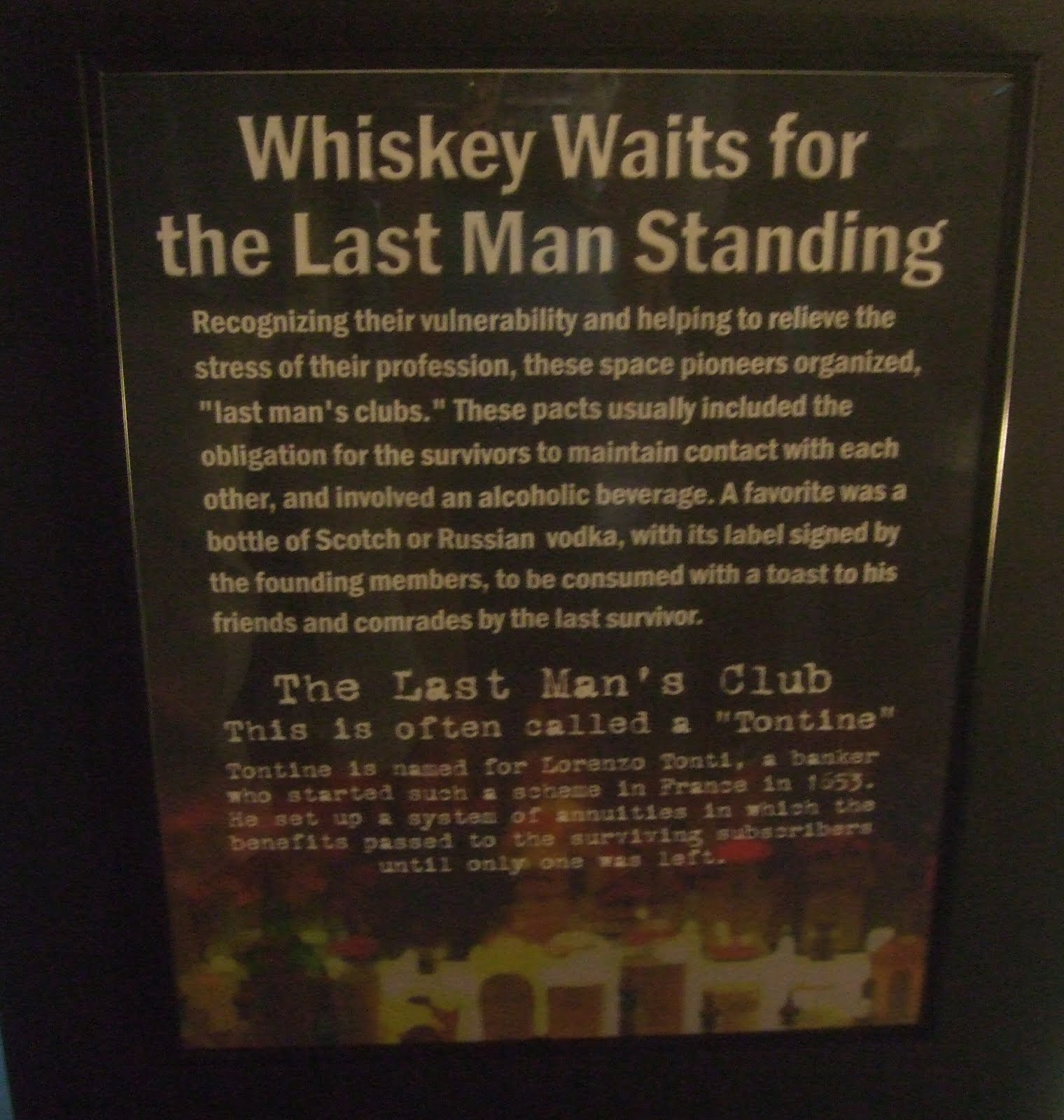
I picked out a small exhibit whach appealed to me as showing the essential normalness of those exceptional men and women who travel into space - especially the earliest pioneers. In a display case were some almost empty Scotch whiskey and vodka bottles covered with signatures and an explanation:


As it happens, today, 20 July, marks two space-related anniversaries:
1969: Apollo Program: Apollo 11 successfully makes the first manned landing on the Moon in the Sea of Tranquility. Americans Neil Armstrong and Buzz Aldrin become the first humans to walk on the Moon almost 7 hours later. (US Time).

1976: The American Viking 1 lander successfully lands on Mars.

Saturday, June 16, 2012

Now Voyager......so far away

Still a tad hungover from Prometheus (see Thursday's post) I needed a reminder of some real-world space-related wonderment:
The Voyager 1 spacecraft is a 722 kilogram (1,592 lb) space probe launched by NASA in 1977, to study the outer Solar System and interstellar medium. The spacecraft receives routine commands and transmits data back to the Deep Space Network. At a distance of 120 astronomical units (1.8x10¹⁰ km) as of February 2012, it is the farthest man-made object from Earth. Voyager 1 is now in the heliosheath, which is the outermost layer of the heliosphere. It will most likely be the first probe to leave the Solar System.

Being a part of the Voyager program with its sister craft Voyager 2, the spacecraft is in extended mission, tasked with locating and studying the boundaries of the Solar System, including the Kuiper belt, the heliosphere and interstellar space. The primary mission ended November 20, 1980, after encountering the Jovian system in 1979 and the Saturnian system in 1980. It was the first probe to provide detailed images of the two largest planets and their moons. (Wikipedia)


So...while we happily contemplate our astrological maps, Voyagers I and II are still out there exploring the real thing.

From the New York Times of 5 September 2007 "The Mix Tape of the Gods" by Timothy Ferris
Excerpt ~~

"If all continues to go well, Voyager should pierce the heliosphere’s outer skin by around 2015. It will then depart into the void of interstellar space, where it is destined to wander among the stars forever. Mindful of this mind-boggling fact, the astronomers Carl Sagan and Frank Drake persuaded NASA to attach a gold-plated phonograph record to each of the Voyager spacecraft. Containing photographs, natural sounds of Earth and 90 minutes of music from all over our world, the record was intended to preserve something of human culture beyond what an intelligent extraterrestrial, encountering the craft at some far-distant time and place, might infer from the spacecraft itself.

The information etched into the grooves of the Voyager record is expected to last at least one billion years. That’s a long time: A billion years ago, life on Earth was first venturing forth from the seas......................................

Contemplation of Voyager’s billion-year future among the stars may make us feel small and the span of our history seem insignificant. Yet the very existence of the two spacecraft and the gold records they carry suggests that there is something in the human spirit able to confront vast sweeps of space and time that we can only dimly comprehend."

Monday, July 06, 2009

David Bowie, Brandon Flowers, Adam Lambert - Common Denominator?

I still get the occasional comment on a blog post from October 2008, relating to that enigmatic song "Human". A recent commenter suggested that I should look at one of The Killers' new songs: "Spaceman", with a view to writing a post about it. I started out with that aim, but as is so often the case, I took a few side-steps.


Brandon Flowers, The Killers' lead singer, co-wrote both "Human" and "Spaceman". I considered doing a post about Flowers, took a look at a few reported interviews, and at his natal chart, and side-stepped again.


I noticed Flowers' natal Moon is in Aquarius - the exact degree can't be established without a time of birth, but it will lie between 11 and 24 Aquarius. (See 12 noon chart, right). I also noted that Brandon mentions David Bowie as being one of his chief inspirations. I immediately recalled Bowie's "Space Oddity"(video below) and "Starman". Looked at Bowie's chart with data from Astrodatabank - and see that his ascendant is at 9 Aquarius.


Another upcoming singer, Adam Lambert, runner-up on this season's American Idol also frequently cites David Bowie as his inspiration. Adam is to sing a Bowie medley in his set on the Idol concert tour which started its run on Sunday in Portland, Oregon. I suspect that it's no coincidence that Adam's natal Sun is at 9 Aquarius - same degree as Bowie's ascendant! It'll be interesting to see whether Adam's first album, due for release in the Fall, will contain anything written or co-written by him relating to space or space travellers!


For a passing reader uninitiated in the zodiac signs and their meanings, Aquarius traditionally relates to all things futuristic such as space travel, new technology etc. To have one's natal Sun, Moon or ascendant in Aquarius practically gurantees an interest in these areas. The astrology in this case is even more interesting because the actual degree of Aquarius, in at least 2 cases out of the 3, is exactly the same, and two of these artists cite inspiration from the third.

For more posts on Adam Lambert scroll down to the Label Cloud in the sidebar to the right and click on his name, it appears on the first line.


The Killers "Spaceman" - on YouTube

Sunday, September 09, 2007

Mind-boggling


While we contemplate our astrological maps, Voyagers I and II are out there exploring the real thing.

Here's a fascinating article from the New York Times of 5 September to boggle sleepy Sunday minds.

"The Mix Tape of the Gods" by Timothy Ferris

Excerpt

"If all continues to go well, Voyager should pierce the heliosphere’s outer skin by around 2015. It will then depart into the void of interstellar space, where it is destined to wander among the stars forever. Mindful of this mind-boggling fact, the astronomers Carl Sagan and Frank Drake persuaded NASA to attach a gold-plated phonograph record to each of the Voyager spacecraft. Containing photographs, natural sounds of Earth and 90 minutes of music from all over our world, the record was intended to preserve something of human culture beyond what an intelligent extraterrestrial, encountering the craft at some far-distant time and place, might infer from the spacecraft itself.

The information etched into the grooves of the Voyager record is expected to last at least one billion years. That’s a long time: A billion years ago, life on Earth was first venturing forth from the seas......................................

Contemplation of Voyager’s billion-year future among the stars may make us feel small and the span of our history seem insignificant. Yet the very existence of the two spacecraft and the gold records they carry suggests that there is something in the human spirit able to confront vast sweeps of space and time that we can only dimly comprehend."