Friday, March 10, 2017

Arty Farty Friday ~ Art Nouveau to Art Deco

Art Nouveau (New Art) had a limited reign in the art world: from around 1890 to 1914, straddling the turn of 19th/20th centuries. It died with the outbreak of the first world war.

Art Nouveau, as a movement, was evidence of a breaking away from the then traditional, rather dry art styles of 19th century painters. Artists began to feel that art should be more universally appreciated. They set about putting art into everyday objects, into architecture, jewellery, furniture and furnishings. The movement flourished throughout Europe. The term Art Nouveau was, originally, the name of a Paris shop, which somehow attached itself to the whole art movement.
The hallmark of Art Nouveau is its connection to nature, and organic patterning. Sinuous trailing vegetation, flowing shapes, beautiful women, delicate coloring.


Astrologically, it could be said that the movement's reign coincides with astrological cycles of the outer planets. Pluto had just moved into Gemini in 1890, at 2 degrees of that sign. It remained in Gemini until 1915. In addition, Neptune, in 1890 was at 5 Gemini, and remained in the sign until the turn of the century. Pluto and Neptune in Gemini were strongly in evidence in the communal atmosphere then, as Art Nouveau came to the notice of the general public. The proponents of this art style, though, had mostly been born when Pluto, and perhaps Neptune, were both transiting Taurus. It was the influence of Taurus on the artists' sensitivities, but Gemini on the public's sensitivities at work that helped propel Art Nouveau forward.

Some of Art Nouveau's best known artists have already been featured on this blog: Alphonse Mucha, Aubrey Beardsley, Charles Rennie Mackintosh, Gustav Klimt, Toulouse Lautrec.

At the outbreak of war, 1914, the communal atmosphere and peoples' attitudes changed. The style now known as Art Deco came next - an arty evolution. Art Nouveau declined rapidly . After the dreadful bloodbath that was World War I, when so many young men perished, a new attitude, new designs and new approaches to almost everything emerged. Art Nouveau's delicate organic curves and beautiful images gave way to angular, geometric design in architecture, furniture and graphic arts. One might describe this as Art Deco being the Yang to Art Nouveau's Yin.


Some Deco designers drew on classical motifs from Egyptian or Greek art and sculpture, and merged these with their new, sleek, brittle and urban designs. Art Deco spanned the years between the two World Wars, approximately 1920 to 1940, and its influence is seen most easily in the architecture of that period. While artists proper experimented with cubism, abstract and surrealist art, the architects and poster painters left a clearly identifiable imprint of the style known as Art Deco.


During the period of the first World War Uranus had transited Aquarius, its own sign, brewing up change of all kinds - change which wasn't able to permeate everyday life until the war had ended , with Uranus' transit of Aquarius in its last degrees. As Uranus moved into Pisces, that new creativity, brewed during the Aquarius transit, was given its head. With Neptune (Pisces' ruler) in flashy,sophisticated, urban Leo, this new style was born.


Once you "get your eye in" it's easy to spot architecture from the Art Deco period. There's a lot of it still around in American cities, even as far afield as Tulsa, Oklahoma. It was no doubt the influx of money from oil in the 1920s and 30s which brought on a flurry of new stylish building in Okie land. New York's skyscrapers are good symbols of Art Deco, of course, as are old movie theaters to be found in almost every American town. This building in a little town called Purcell about an hour's drive from our home, caught my eye. Husband obliged me with a photograph.


In Europe and Britain it's not quite as easy to find this style because of the destruction during World War II. There are still some examples though. I've spotted private houses or blocks of apartments with Art Deco DNA. Some Art Deco cinema frontages have survived on both sides of the Atlantic - that shown below is from 1937, in Normal, Illinois.


For many years, back in Yorkshire, I lived in an apartment, a block of four built in 1938, attached, originally, to a cinema with a clearly Art Deco frontage. The apartments, back then grandly called "Mansions" definitely had elements of Art Deco : flat roof, long narrow horizontally-paned windows. The whole structure was destroyed by fire in 1996, along with all our belongings, and any photographs of it I possessed.


A few Art Deco style houses can still be found in English seaside towns, not sure why that location was favoured, usually they're painted white. I used to fantasise that one day I'd find an Art Deco house I could afford, and live in it in my old age. Instead, I've found myself in Oklahoma in a house with not even a whisper of Art Deco about it. Ah well, maybe in my next life!

Thursday, March 09, 2017

You can't be pessimistic without a misty optic...

I recall that, long ago, my Dad had a little leather wallet containing a special cloth for cleaning spectacle lenses, on the wallet's cover were the words "You can't be optimistic with a misty optic" - from whence came this post's heading - kind of.

Reading around the internet these days one encounters a dense layer of gloom and pessimism about the future - and the present. While accepting that this is not without reason I do wonder whether, as Howard Zinn wrote, in his book You Can't Be Neutral on a Moving Train: A Personal History of Our Times :-
"Pessimism becomes a self-fulfilling prophecy; it reproduces itself by crippling our willingness to act."


20th century astrologer C.E.O. Carter, in his Encyclopedia of Psychological Astrology outlined basic astrological lore as to how specific planetary placement at time of birth can reflect likelihood of pessimistic inclination:
The watery signs [Cancer, Scorpio, Pisces] all tend to moodiness; the fiery [Aries, Leo, Sagittarius], especially Sagittarius, are either up or down; Libra is easily ruffled, but soon recovers equanimity, and the airy signs [Gemini, Libra, Aquarius] and Virgo usually attain an intellectual placidity. The earthy signs [Taurus, Virgo, Capricorn] are usually content, except Capricorn, which is easily depressed by snubs or slights.

Pessimism, as a general attitude, is the result of heavy Saturn afflictions, and weak benefic influence, in which is included the Sun. If the 9th [house] is involved, this attitude may even take form as a philosophy. The mutable signs [Gemini, Virgo, Sagittarius and Pisces], and especially Virgo, seem the commonest victims of pessimism, while the cardinal [ Aries, Cancer, Libra and Capricorn] are far less liable to contract it.
Pessimism has been with (some of) us always: pre-Trump, pre-Brexit, pre-Obama, pre-Bush, pre-Clinton, etc. It's part of human nature. Scanning a collection of quotes on the topic of pessimism I noticed this from one of my favourite astrologers, Rob Brezsny, of Free Will Astrology.
“It is noted that from 1967 to 1995 essays on negative emotions far outnumbered those on positive emotions in the psychological literature. The ratio was 21:1. Even those supreme perpetrators of pop nihilism, The New York Times and The Washington Post, have a better ratio than psychological literature. They average 12 negative stories to every one that might be construed to be non-negative. Many of their non-negative stories, however, cover success in sports and entertainment.

I demand that the purveyors of despair who pretend to be dispassionate observes of the human condition go ahead and disclose that the 10 most beautiful words in the English languages are chimes, dawn, golden, hush, lullaby, luminous, melody, mist, murmuring, and tranquil; that Java sparrows prefer the music of Back over that of Schoenberg; that math experts have determined there are 1/96 trillion ways to lace up your shoes; that the Inuit term for making love is translated as ‘laughing together in bed;' and that according to Buckminster Fuller, “pollution is nothing but resources we’re not harvesting.”

― Rob Brezsny, Pronoia is the Antidote for Paranoia: How the Whole World is Conspiring to Shower You With Blessings


Wednesday, March 08, 2017

International Women's Day

To mark the day, a link to an archived post about those heroic women at the avant garde of the fight : SUFFRAGISTS


Tuesday, March 07, 2017

Waiting...

Over the years on this blog I've often enjoyed scribbling a few lines on US politics, but at present, on that front, I'm simply confused. To my eye and ear US political commentary has lately swerved unnervingly in several directions at once - or in quick succession. I don't know who I am, politically, any longer.

Arriving here in 2004, just before Bush's win of his second term, I rapidly realised I wasn't an American conservative, aka Republican. After watching how Democrats performed, I realised I wasn't a Democrat either. By 2008 when I became a US Citizen and was eligible to vote, I registered Independent, the only other option in Oklahoma.

I detected no valid left-side, equivalent to the UK's old Labour Party in politics here. Democrats were, at best, the equivalent of UK's old and ineffective Liberal party; I'd never have considered supporting them in my wildest nightmares. I did, however, vote for Obama in 2008, with high hopes that his soaring rhetoric would not crash and burn. It did. In 2012 I left the presidential choice box blank on the ballot paper.

That was then.

When Senator Bernie Sanders declared his candidacy in the 2016 presidential election, I knew, and clearly, who I was politically - at last! That happy condition was short-lived, due to the DNC's corrupt doings to ensure - so they thought - a Hillary Clinton win. I could not bring myself to vote for Hillary Clinton in November 2016, neither could I, in all conscience, vote for Donald Trump, so I voted for the only other option on the ballot - a Libertarian.

But that's all done now, the die was cast, we're stuck with the outcome: President Trump. Democrats/Liberals have split into at least two factions: those who retain Clinton-fever and still smart at her loss, blaming anything and anyone they can for it - even Russia! Another faction is a mix of former Sanders supporters, and other Democrats turned off by earlier Clintonite meddlings, even some who voted for Trump in desperation. The second faction tends to be the target of the first faction's ire. Most major newspapers (far as I can tell) and political websites on the liberal side support the first faction - strongly. A recent, and sickening, example appeared in the magazine Vanity Fair: Why the Alt-left is a Problem. I was happy to see that Yves Smith of naked capitalism.com had written an excellent rebuttal yesterday.

Of late, and apart from output at naked capitalism.com, I've often found palatable articles on what are considered to be more conservative-leaning websites and blogs. That is a tad worrying, and why I'm feeling confused. Once again I don't know, politically, who I am, where I fit - if anywhere.

I don't see President Trump as the monster many do, but he's certainly not of presidential calibre; the people he has picked for his team do not promote confidence. In time, I suspect he'll settle - or be settled through manipulation - into a template of near-classic Republican proportions, his frequent Tweets an added bonus.


At the weekend I read several other pieces decrying what their "liberal" authors termed the "alt-left". I'm not sure if I'm of the alt-left variety. I suspect not. I think I'm far left - waiting in far left field - out there where buses don't run. Mostly in solitude, gazing into the horizon, watching, waiting for something to change.

As John Mayer sang:

It's hard to beat the system
When we're standing at a distance
So we keep waiting
Waiting on the world to change...

Monday, March 06, 2017

Music Monday ~ Remember the....

On this day, 6 March, in 1836: Battle of the Alamo. After a thirteen-day siege by an army of 3,000 Mexican troops, the 187 Texas volunteers, including frontiersman Davy Crockett and colonel Jim Bowie, defending the Alamo are killed and the fort is captured.

For Music Monday:
From Wikipedia

El Degüello is a bugle call, notable in the US for its use as a march by Mexican Army buglers during the 1836 Siege and Battle of the Alamo to signal that the defenders of the garrison would receive no quarter by the attacking Mexican Army under General Antonio Lopez de Santa Anna.

"Degüello" is a Spanish noun from the verb "degollar", to describe the action of throat-cutting. More figuratively, it means "give no quarter." It "signifies the act of beheading or throat-cutting and in Spanish history became associated with the battle music, which, in different versions, meant complete destruction of the enemy without mercy."


Marty Robbins' tribute to the battle:


My 2007 post on The Alamo is HERE.


Another archived post of mine, written after our visit to The Alamo and San Antonio is here.


Saturday, March 04, 2017

Saturday & Sundry thoughts on Fascism & Astrology

The suggestion that the USA is drifting into fascism is frequently thrown around in online articles and in conversations in comment threads. It's not an idea that emerged with Donald Trump's ascendancy to the Presidency, it has been around for decades. This thought led me to an old, 2011, post of mine, one that has a different focus on fascism. I'm copying it here, dusted down, with some of the comments from that time included.


It's weird how Google sometimes manages to lure a person who is looking for a specific fact into something fascinatingly related, yet not exactly what one was seeking.

In trying to find the birth date of Bertram M. Gross, author of Friendly Fascism, the New Face of Power in America(1980), didn't find what I searched for but stumbled into Dennis Dutton's 1995 review of a book The Stars Down to Earth, and Other Essays on the Irrational in Culture, by Theodor W. Adorno.

Now...don't laugh...Adorno wrote that astrology is akin to fascism!
Some paragraphs extracted from the review are below. It does us no harm at all to read such views from time to time - if only to consider our motives and check that our integrity remains intact...or anyway, if only to laugh at an arrogant self important writer who verges on fascisistic tendencies himself....reviewer isn't too friendly either.


To be sure, there are many intriguing observations throughout this mostly readable essay. In a passage perhaps even more true today than when it was written, Adorno says that a “climate of semi-erudition is the fertile breeding ground for astrology.” He refers to people who have gone just beyond the naive acceptance of the authority of science, but who don’t know enough, or who have not sufficiently developed “the power of thinking,” that they can replace such acceptance with anything better: “The semi-erudite vaguely wants to understand and is also driven by the narcissistic wish to prove superior to the plain people but he is not in a position to carry through complicated and detached intellectual operations.” In other words, quantum mechanics is pretty tough, but astrology offers sophisticated understanding of all reality in a few easy steps. Besides, astronomy is about those remote stars and planets out there — rather cold and impersonal. In Adorno’s apt title phrase, astrology brings it all down to earth, because it’s about the single most important thing in the universe: me.

In an analogy that isn’t too far-fetched, he says that to the semi-erudite individual “astrology, just as other irrational creeds like racism, provides a short-cut by bringing the complex to a handy formula and offering at the same time the pleasant gratification that he who feels excluded from educational privileges nevertheless belongs to the minority of those who are ‘in the know’.” Someone once remarked that Scientology boosts self-esteem largely by giving semi-educated, degreeless persons impressive certificates to hang on their walls, and Adorno is right that there’s a similar syndrome at work with most New Age esoterica, including astrology. (In literary theory, there are no certificates, of course — you just have to learn the jargon.)

Hey - I object to being called semi-erudite Adorno, unless you accept that you can be described as semi-bigoted.

Here's the kicker: (And I do not repeat NOT have a dependent mind! That accessory is reserved for skeptics - dependent upon their own addictive skepticism - their only route to a feeling of superiority).

It is not only capitalism that is embodied in astrology as part of the culture industry, but fascism as well: the “astrological ideology resembles, in all its major characteristics, the mentality of the ‘high scorers’ of the Authoritarian Personality’.” In fact, Adorno says, it was this realization that induced him to begin the study of Righter in the first place. (Refers to an American astrologer: Caroll Righter) The sucker for astrology is a dependent mind. “Moreover, by strengthening the sense of fatality, dependence, and obedience, [astrology] paralyses the will to change objective conditions in any respect and relegates all worries to a private plane promising a cure-all by the very same compliance which prevents a change of conditions. It can easily be seen how well this suits the overall purpose of the prevailing ideology of today’s cultural industry; to reproduce the status quo within the mind of the people.”

So for Adorno it all ties together, rather too neatly, in my opinion: late capitalism, irrationalism, and weak, dependent, fascism-prone personalities in need of the authority of astrology — and all these factors lying at the very heart of so-called enlightened modernity.

Adorno is at pains to deny that the appeal of astrology is basically mystical. It’s not that it supplies a new sort of religion but that it makes the alienated individual more at home in the world of consumerism and the “drabness of a commodity society.” In this respect more than in any other, “astrology resembles . . . other mass media such as movies: its messages appear to be something metaphysically meaningful, something where the spontaneity of life is being restored while actually reflecting the very same reified conditions which seem to be dispensed with through an appeal to the ‘absolute’.” In the division of labor of the culture industry, astrology has, to use a cliché Adorno avoids, its special job in the general provision of opium for the masses.

Last sentence of the review, and as fair a summing up as one could expect from this reviewer:
If Adorno doesn’t like something, no matter how inane or innocuous, it isn’t long before he begins to detect in it the seeds of fascism. The Stars Down to Earth seems now and again almost as obsessive as the astrology it analyzes.
Fascists, opium providers ?..."It takes one to know one" - as my old Gran used to say.


COMMENTS

Christina said: Wow - what a hoot.
Fascistic astrology is not…but don't you think he makes a few good points that we, as astrologers, should keep in mind.

I hate to say it, but I recognize the "climate of semi-erudition". Not on this blog, of course. And this is familiar too, the guy sitting next to you at a conference who has "the narcissistic wish to prove superior to the plain people but he is not in a position to carry through complicated and detached intellectual operations."
Aside from that we're all absolutely blooming marvellous.

Twilight responded...
Christina ~~ I appreciate your point about the narcissistic wish to appear superior. Yes. That's to be found in at least one member of a group in most fields I guess - and in most groups of any kind, social or professional. It must be a potential hard-wiring fault in some of us (all of us?) So why should astrologers be any different. ;-)
I see Adorno as a guy chasing a buck from a book using a spin on astrology nobody had yet thought of in exactly those terms.

Astrology Unboxed said... Kudos to Mr. Adorno for originality! I have yet to be called a fascist, especially since my own inclination is to the opposite side.
Since I started as an astrologer, I heard many epithets(crook, fraud, delusional, psychic, naive being the kindest one) but not this one.

I agree with Christina, that Adorno has a point in the need for us astrologer to be not only more scientifically inclined but also intellectually. Some of the research done by astrologers in recent years has not really helped our field except to boost the egos of those same researchers. We - astrologers- need more people like Rob Hand. Unfortunately, I do not have the chops for it.
I can't wait to pass Mr. Adorno's opinion of us to one of my Facebook astrology groups. It's bound to promote a lively discussion. Thanks, T.


Twilight responded... Astrology Unboxed (Fabienne) ~~
Yay for Robert Hand!!! And his ilk, if he has any, and for astrology bloggers like us who are, of course, impeccable on all fronts...LOL!!
Hope it generates some chat on FB.


Wisewebwoman said...I had to laugh at this one, T. I mean, seriously? I would never have put fascism and astrology in the same breath, not to mention a book!
Twilight said...WWW ~~~ I know...quite ridiculous. And insulting to boot.

Anon and Ever said... Oh yes, you are right, there is not only the right wing imbecility but also the left wing imbecility and even if the right wing imbecility is what we can easily find today we have never to forget the left wing imbecility, in which anything an author did not like or did not agree was compared to “fascism” not well defined and not properly described...

Twilight said...Anon & Ever ~~~ Agreed. Fascism, socialism, and other terms are thrown around willy-nilly, they have already lost their meaning - apart from their now seeming to be on a level with profanity, in the USA at least.

Friday, March 03, 2017

Arty Farty Friday ~ Woman in Gold

One evening this week, via Netflix, we watchedWoman in Gold, a 2015 British-American film, the true story of Maria Altmann, an elderly Jewish refugee living in Cheviot Hills, Los Angeles, who, together with her young lawyer, Randy Schoenberg, fought the government of Austria for almost a decade to reclaim Gustav Klimt's iconic painting of her aunt, Portrait of Adele Bloch-Bauer I, stolen from her relatives by the Nazis in Vienna just prior to World War II. Altmann took her legal battle all the way to the Supreme Court of the United States, which ruled on the case Republic of Austria v. Altmann (2004).

It's an engaging true story, with Helen Mirren playing the part of Maria Altmann - superb performance too!

This is the painting to which the movie refers - online images of it do it no justice at all. Klimt used gold leaf in its production, so in real life it must shimmer and shine.


As for Gustav Klimt - I wrote a blog post on him 10 years ago - it'd benefit from a re-do, but, for now a link to it must suffice: The Sensuality of Gustav Klimt

Wednesday, March 01, 2017

VARIOUSLY


A few dregs lurking in corners of my Word Pad:


Came across these words in a comment thread recently and thought...HUH?
"mene mene tekel upharsin"
Turns out the simple way of saying this is "the writing's on the wall".

For a full explanation and biblical origin of the phrase see www.gotquestions.org


During husband's researches into vintage photographers he encountered one whose relative was named Cassius Clay - back in the mid 19th century. We thought it unlikely that the world famous boxing champion whose original name was the same had been named after the relative of a virtually unknown 19th century photographer, so I headed for Google and Wikipedia :

Cassius Marcellus Clay (October 19, 1810 – July 22, 1903), nicknamed the "Lion of White Hall", was a Kentucky planter and politician who worked for the abolition of slavery.

I live and learn - whether on or off the ecliptic!


On our recent wander in Texas I added to my collection of vintage Austin Productions sculptures with this one - at a bargain price. It's "Guitarist" by David Fisher (1980).


For cat fanciers there are cat cafés - who knew?

Cat cafés are quite popular in Japan, with Tokyo being home to 58 cat cafés as of 2015.
A nice slideshow of photographs from one such is HERE


Cartoon by Gahan Wilson - telling the hard truth!

Tuesday, February 28, 2017

Pisces Considered

In his book, Astrology published 1964, Louis MacNeice, not an astrologer, but a poet and scholar, gathered together much of interest from a variety of sources, ancient and modern. On zodiac sign Pisces, through which the Sun now travels, he wrote the paragraphs below, quoting from some professional astrologers whose works may now be less known by the average astrology fan. Some related links identifying those astrologers are added at the end of this post. The excerpt has been copy-typed by my own fair fingers, rather than copy-pasted from elsewhere on the internet. Illustrations here were added by me.


 Pisces by Erté
Pisces the Fishes
February 20 to March 20
A mutable, watery sign. To be both mutable and watery might be thought to be overdoing the fluid element; traditionally Pisces types are liable to lack both stability and precision. But the ruler of this sign is Jupiter (though some would substitute Neptune), which tends to correct the balance. The water symbolism is made much of by astrologers (Pisceans are said to be wonderfully adaptable and to make good actors) but the actual fish reference has mostly been dropped. Varley provides an exa of the latter: "Pisces was found to signify persons who were employed in fishing, and in other watery concerns...It is a sign under which many fishmongers were born...and some of the persons born when it is rising approximate to fishes in their eyes, which are somewhat conspicuous and phlegmatic."

 Pisces by David Palladini
Modern astrologers do not mention fishmongers but they stress the fact that Pisceans at their best are idealists and, at their worst, drifters. They are not individualists and in fact seem hardly conscious of their own individuality. And they certainly are not go-getters: They are gentle, shy, sensitive (often hyper-sensitive), vague, and prone to melancholy. Some retire from ordinary life by drifting (astrological textbooks always warn them against drink); others retire into lives of dedication, in cloisters or hospitals. They are extremely malleable, often hesitant, and keep changing course; Barbault says that the Piscean voluntarily loses himself in a labyrinth. When they lie it is not usually intentional but just part of their general confusion. The Moon in Pisces is dangerous for she encourages fantasies and hallucinations. At one extreme the Piscean can lapse into schizophrenia.

All this being so, it is not surprising that some of the artists born under this sign (it could be said to be a natural sign for artists) should have had tragic careers. It was the Sun-sign of the unfortunate German poet Holderlin, who went mad. Nijinsky was born with Pisces rising, and also went mad. And the pessimistic German philosopher Schopenhauer was born under Pisces with Saturn very prominent in his horoscope. A tragi-comic example from fiction is Dickens's Mr Mickawber in David Copperfield, a person who (according to Gleadow) is "notoriously Piscean."
On the brighter side of the picture, Pisceans are very lovable people because they are very loving. Not only is Pisces rules by Jupiter (which tends to redress the shyness, neurosis, etc.) but it is in this sign that Venus is exalted. And, true to the oceanic nature of the sign, the Piscean tends to "lose himself" in love. In Morrish's scheme there is a similar merging or fusion but here it is a "liberation" in the symbolic ocean of the cosmos: We have reached the highest point of yoga or spiritual consciousness, the top of the Zodiacal ladder. As usual, this is Morrish's own formulation, but he also accepts the traditional idea of the Piscean Age and, unlike Gleadow and others, deplores the fact that it is passing: Everywhere he sees a "characteristic destruction of Piscean values."

With this we have come the full circle of the Zodiac.

ASTROLOGERS MENTIONED
John Varley
Morrish (L. Furze-Morrish?)
Rupert Gleadow

For more posts on this sign - please click on Pisces in the Label Cloud in the sidebar.

Monday, February 27, 2017

Music Monday ~ Front Porches & A Guest Post - by Anyjazz

If the world had a front porch like we did back then
we'd still have our problems but we'd all be friends
Treating your neighbor like he's your next of kin
Wouldn't be gone like the wind
If the World had a front porch, like we did back then

Front porch family


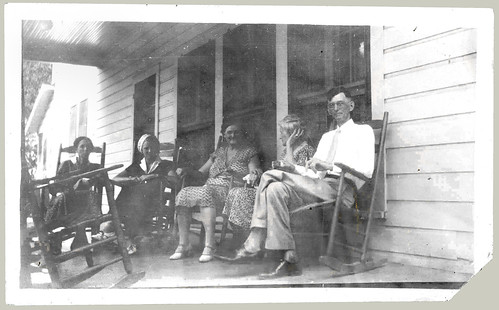
In the 1990s my husband relinquished his job in Oklahoma to move to Kansas and take care of his ailing mother who suffered from Parkinson's Disease. Below is what he wrote in his journal from that time. I found it particularly appealing, and use it here (again) with his permission - a guest post of sorts.


Sunday, July 27, 1997

After mother finished pushing her dinner around on her plate, spilling her water and dropping her pills, I ushered her in two cycles around the kitchen table for exercise and returned her to her TV launching chair.

Then I went out, with all necessary accessories to stay in contact, including beeper and telephone, to sit in the front porch glider. A couple small pillows from the couch and an icy bottle of tea went with me too. And a book to run competition with the busy activity on the street and sidewalks that pass my line of vision in the apron of the front yard.

Across the street, little Desiree was at work schooling her invisible playmate in the fine art of ballet and cheer leading. The new neighbor on the east kept to the house mostly, and the stout pair on the west did their usual, arrived and left, arrived and left. Nothing much new in the front yard world so the book had little competition for my thoughts. I read until nearly nine.
"The highest function of love is that it makes the loved one a unique and irreplaceable being. The difference between love and logic is that in the eyes of a lover, a toad can be a prince, whereas in the analysis of a logistician, the lover would have to prove that the toad was a prince, an enterprise destined to dull the shine of many a passion." Tom Robbins in “Jitterbug Perfume”

Proving a toad is a prince or a prince is a toad.... Ponderings that take my mind. All the interactions of humans, luring, flirting, leading, flashing, feeding the mind, grooming the hair, daring to judge what's fault and what's fair, move only to a conclusion. A conclusion as certain as the last stop on the bus line, as illuminating as an eclipse and as dreaded and elusive as a cherry pit in a hot cherry pie. Nothing is certain. Everything changes. Toads are toads. Princes are princes. Fools are fools.

Of course to a cynic, the looming sunset of life can produce little beauty and not much comment except "I told you so!" But to a romantic a toad is a prince. The ends are merely a part of the beginning and all the pudding in-between. Life to the cynic is a clanking chain of events that prove everything is related, everything is temporary and everything is eventually as worthless as the inevitable last link.

But the romantic knows a secret. Life is the memories you make. Nothing more, nothing less. If you plant nightshade, as Mr. Nightingale quoted, you get nightshade...

The conclusion for the day is, I shouldn't sit for long periods in the glider by myself. In only a short time, so many thoughts float like dumplings in my brain soup that the bowl expands and the scalp stretches and separates the strands of hair across even greater expanses of bald. Sitting in the front porch glider is one of the known causes of baldness. In men.

Women have to go to the bathroom more often. Women think in little concise thoughts that mean something useful. They dispense their considered wisdom to the summer air around a glider and then go to the bathroom. Women perform their magic daily. They run the world and all of humanity and make it seem as if they don't know the first thing about it. Magic. Daily magic.


Saturday, February 25, 2017

Nullify ?

A tid-bit of news not, as yet, made much of: there's a petition for a writ of mandamus seeking to nullify the results of the 2016 U.S. Presidential election on a current SCOTUS docket.


SCOTUS docket 16-907 DISTRIBUTED TO JUSTICES FOR CONFERENCE on March 17, 2017.

While the world is paying attention to theatrical battles over President Trump’s executive orders and cabinet nominees, a largely unnoticed and potentially landmark case sits before the Justices of the Supreme Court of the United States. A petition for a writ of mandamus seeking to nullify the results of the 2016 U.S. Presidential election sits on the SCOTUS docket..........
Commenters at naked capitalism.com:

(sleepy): SCOTUS will view it as a political issue, not a judicial one, and punt.

(Pat):That would be the best choice. Probable worst outcome more tantrums from those behind the case and their supporters. Anything else spells violent response to me.


More HERE
The Resistance has taken the first official step toward ending the nightmare that is Trump’s presidency. The Supreme Court of the United States has just advanced a case that could kick Trump’s entire administration out of office.
I've nothing to add other than this, if successful (highly unlikely), would be preferable to impeachment of President Trump, leaving us with President Pence - not a beneficial exchange! But, but...violent response....rock and hard place! Better to stick with what we've got, all things considered.

Friday, February 24, 2017

Arty Farty Friday ~ Richard Hamilton, Father of Pop Art.

 Heaventree of Stars
Some seven years ago, searching for artwork related to astrology I came across this print by English pop artist Richard Hamilton. Its title is from a quotation from James Joyce's Ulysses:
“The heaventree of stars hung with humid nightblue fruit.”

Richard Hamilton was dubbed "Father of Pop Art". It was he who coined a name for the genre in fact; he influenced many artists who came after. Mr Hamilton died, aged 89, in 2011. Today, 24 February is the anniversary of his birth in 1922, it seems appropriate to add to an old post of mine and re-air it.

Hamilton's best known work is a 1956 collage often cited as the beginning of English Pop Art: Just What Is It That Makes Today's Homes So Different, So Appealing? It was originally intended to be a poster advertising a famous London exhibition, This Is Tomorrow.

'Just What Is It That Makes Today’s Homes So Different, So Appealing?'


From a piece by Fiona MacCarthy in The Guardian in 2014:
SNIPS
In Britain in that early postwar era there was a sudden thrilling influx of sophisticated, streamlined consumer goods from the US. It was bonanza time for British housewares, too, as the government-supported Council of Industrial Design (now the Design Council) campaigned to improve standards in British manufacturing and a new breed of industrial designers emerged from British art schools. In 1956, exactly coinciding with Hamilton's collage, the Design Centre opened in the Haymarket, a heaven for aspirational homemakers. There was even a royal seal of approval when Prince Philip's inaugural prize for elegant design was awarded to the Prestcold Packaway refrigerator.

But, as Hamilton was well aware, a backlash was beginning. Richard Hoggart, in The Uses of Literacy (1957), voiced the misgivings of many in lamenting the pervasive influence of American mass culture, "full of corrupt brightness, of improper appeals and moral evasions". There was a dawning consciousness that have-it-all housewives could be less than happy. The Feminine Mystique, Betty Friedan's bestselling analysis of female domestic frustration, would be published in America in 1963. Labour-saving appliances were certainly seductive, but there was now a movement of suspicion and distrust that one might define as Tupperware resistance. As an artist, Hamilton thrived on this ambivalence.

That Hamilton was anti-capitalist is an understatement. But he still adored the uninhibited plenty of American culture. Like other contemporary artists, Allen Jones being an obvious example, he devoured and then recycled the imagery of popular American magazines. He spoke of this as "plundering the popular arts". By popular arts, Hamilton emphatically did not mean the folk arts, which turned him very squeamish. The neo‑romantics, the Kitchen Sink School and the St Ives artists were similar betes noires...........Hamilton's art contained the shock of the eclectic. His all-embracing attitudes caused widespread puzzlement. He challenged the traditional hierarchy of values, the purist view held by the British art establishment of what was proper subject matter for a work of art. Hamilton was a knowledgeable, deeply serious artist who loved and respected the great artists of the past. But he was also determinedly responsive to the modern. The critic David Sylvester, a friend of Hamilton's, described this as verging on madness, a consuming obsession with "modern living, modern technology, modern equipment, modern communications, modern materials, modern processes, modern attitudes"....

Hamilton took pride in variety. His work ranges from book illustration, for instance his 50-year stint illustrating James Joyce's Ulysses, through collages, sculptures, politically charged pictures, digital images, and straight-ahead painting. He was a friend of Paul McCartney and designed the now famous cover of the Beatles' White Album along with the poster which accompanies it. The album cover, one might think, needed little in the way of design, but the story goes that it was made deliberately simple after the uproar following a previous album cover showing the lads with butchered body parts and dolls' heads.


ASTROLOGY

Richard Hamilton was born in London, UK, on 24 February 1922. No birth time available so a 12 noon chart is shown below.


Sun conjunct Venus and Uranus in Pisces; Moon (whatever the birth time)was in Aquarius with Mercury. It's all there, in a nutshell! Sun (self) Venus (art) Uranus(the unexpected, avant garde, eccentric) all closely linked in Pisces (imagination and dreams.) Moon (inner self) and Mercury (communication, mental process) in Aquarius, sign ruled by Uranus (as above).

As if all that weren't enough to describe him, there's a Yod (Finger of Fate) linking Saturn (work, business) and Neptune (creativity) via sextile, then connecting both planets via quincunx (150 degrees) to Uranus and Venus. This formation can be interpreted in astrology as a funnelling of the sextiled planets' blended characteristics through the planet(s) at the apex. So here, creativity (Neptune) and business (Saturn) are blended, and channelled into the world via art (Venus) in a changeable and often unconventional style (Uranus).


EXAMPLES:

Barmaids Miss Douce and Miss Kennedy from the "Sirens" episode of Ulysses.


The Transmogrification of Bloom (Ulysses)


Shock & Awe (Y'll know this one!)


English politician of the mid 20th century Hugh Gaitskell, disguised as Phantom of the Opera . Hamilton was furious about his refusal to get rid of Britain's nuclear deterrent.


Guggenheim in Chrome


Mick Jagger, and the art dealer Robert Fraser, in handcuffs following a drug raid ( from the Swingeing London series, 1967 - 1972)


BATHROOM


Five Tyres Remoulded


The White Album + Insert


The Artist