Monday, April 27, 2015

Music Monday ~ Actors brave enough or good enough to get up and sing...

We watched a DVD of a movie from 2000 the other night: Duets, one of my favourite actors, Paul Giamatti, surprised me by singing! The film in general is a bit clunky, but Paul Giamattti, never disappoints - it was worth the price of the DVD for his part alone! His character in Duets gets himself involved in a karaoke competition, singing with a hitch-hiker who, it turns out, was on the run from the police. Here's his duet, Paul does not lip-sinc, though his partner does.

The actors who sang their own tunes in the film...: Huey Lewis, Gwyneth Paltrow, Paul Giamatti, and Maria Bello. Arnold McCuller sings all of Andre Braugher's songs [Paul's partner in the duet]....
(Wikipedia)


That got me chatting to anyjazz and remembering other actors who have surprised us by being able to sing - sing well that is!

My second contribution, from another favourite actor, Robert Downey Jnr, in his part in the TV series Ally McBeal. He got up to sing to Ally, a song written by Sting - and Sting joins him on the stage as he sings. As someone, somewhere, wrote "you don't just get up and sing with Sting"...well, not if you can't sing!


AND

Here's a link to RDJnr singing with Sting again, elsewhere, to prove he wasn't doing a lip-sinc for Ally.


Anyjazz rumaged in the garage for a few minutes and came back with two LPs, one by Robert Mitchum, one by Rhonda Fleming. Hmm - oldies eh? I found a couple of YouTube examples of their singing talent:

Robert Mitchum, live on a British TV show - he warms up considerably after the halfway mark!


Ms Fleming could definitely sing!


Throwing this open to any passing readers. There are several lists online to refresh memories, by the way.
Who, among well-known actors, has surprised you by demonstrating their singing talent?

Saturday, April 25, 2015

Jim Webb - a 2016 Contender?

So far, although several Republican presidential hopefuls have eagerly thrown hats into the 2016 ring, with others "still considering" doing so, Democrats remain coyly reticent, possibly unwilling, or financially unable to face the colossus that is the Hillary Clinton campaign. Bernie Sanders hasn't yet said a definite "No"; Elizabeth Warren has, several times. This piece by Andrew Levine, at Counterpunch, puts another name, Jim Webb, into the mix: The Last Chance to Derail the Clinton Juggernaut?

SNIPS
Now would be a good time to dust off an old idea: “critical support.” That idea, along with much else associated with the Left, effectively went missing during the 1980s.

It may seem like splitting hairs, but critical support is not quite the same thing as unqualified support. When critical support is offered, support is qualified and disagreement is expressed. With straight out support, disagreements, if any, are overlooked.....................................

However, there is a candidate running for President in the Democratic primaries next year who will merit at least critical support from the Left — what is left of it, that is.That candidate is Jim Webb, the former Senator from Virginia. Webb has not yet declared his candidacy, but he is showing all the signs.

Voters who could care less where a candidate fits on a left-right spectrum – the majority of voters nowadays – may find, as they learn more about Webb, that they have no problem supporting him outright.

But those of us who look forward to a time when an authentic Left reemerges, do care. We care that Webb is soft on capitalism, not that any other Democrat is better; and we are queasy about where he still stands on the Vietnam War. He may not be the best candidate in the field on gender issues either, though the evidence on that is ambiguous at best.

In any case, the plusses swamp the minuses – to a degree that is unprecedented in recent decades. This is why, for us, critical support seems about right...............

A complete natal chart isn't possible without a time of birth, which isn't known at present, but here's a 12 noon chart for Jim Webb's date & place of birth:
9 February 1946, St. Joseph, Missouri. Let's see what his astrology has to say:


There's a nice Airy circuit going on! Sun/Mercury/Venus conjoined in Aquarius; Jupiter in Libra; Uranus in Gemini. This guy is not lacking in mental acuity - thinking "on his feet" comes naturally to him, as easily as deeper, analytical, thinking. His natal Moon could be in Gemini too, depending on time of birth, otherwise in late Taurus.

Mars conjunct Saturn in Cancer links to his military family background and career.

I like what we know of his natal chart! The two planets in Cancer will have been "feeling" recent opposition from Pluto in Capricorn, also linked to the pesky set of Uranus/Pluto squares of recent times. Beyond that, I don't see anything major coming up for him soon, though by November 2016 Pluto will be back at 15 Capricorn, opposite natal Mars after a few months of to-and-fro.


A piece, The Jim Webb Story, mainly a book review written in 2008 by Elizabeth Drew on one of Webb's books, A Time to Fight: Reclaiming a Fair and Just America, includes dozens of clues about Jim Webb's personality, aims and more about his Scots-Irish and military background, his entry into politics. It's an all-round interesting read, and one I'll go back to, if and when Webb confirms he will run in the 2016 presidential election.

A few snips from the piece:


Relating to his campaign for a Senate seat:
Webb ran an unconventional campaign, going more with his intuition than with the advice of Democratic Party professionals, who at times despaired over him. He chose his own pacing and for a stretch in the summer evinced little interest in campaigning at all. He is not one to be guided by focus groups; he doesn’t play the angles. Like a boxer or a military man, Webb decides on his targets and charges straight at them. “We picked our themes and stuck with them,” he says. His three campaign themes were the war, the growing chasm between the wealthy and the working class, and the exceptionally high rate of incarceration in the US.........


Reid considered Webb such a valuable new asset to the Democrats—a moderate with military credentials from a swing state—that he also took the unusual step of inviting the freshman to give the Democrats’ response to the President’s State of the Union address. Webb tore up the draft supplied to him by the Democratic leadership staff and wrote his own speech. He gave the staff members fits by refusing to show them his version until shortly before the speech was to be given. In his speech, Webb went straight at Bush over the war in emotional and somewhat personal tones,

So Jim Webb arrived to the Senate with a reputation for being unpredictable, even a little weird, a little bit out of control, a little hotheaded. The sense in Washington that he was—well—different was enhanced by his famous first encounter with President Bush after the election, when at a November White House reception for newly elected members of Congress, Webb refused to shake Bush’s hand....
The author of the piece found a different personality:
When I was about to meet with Webb for the first time, in 2007, I expected to find someone who would be difficult to talk to, a little bit strange—someone with whom I had to be very careful not to put a foot wrong, lest I set off some land mine. What I found was completely surprising. Webb turned out to be an easy conversationalist with a low, gentle voice, a ready smile, and a sometimes very full laugh. During an hour-and-a-half-long conversation over sandwiches in his office, I kept waiting for him to be weird, but that never happened. Even Webb’s looks are surprising: on television his large, flat face, with its broad forehead, looks like a potato—pale and pasty. In person his complexion is ruddy—with piercing blue eyes that suggest a man who might in fact have a wild side, a man whom one doesn’t want to cross. Yet there is an air of almost preternatural calm about Webb, of a man who knows who he is. He is reserved; one gets the sense that he’s seen things he just doesn’t want to talk about. (This is a characteristic shared by other Vietnam veterans.)
From talks with his colleagues and others in and around the Senate, it became clear that his reputation belied the actual Webb. A senior Senate Democratic aide said, “He’s proven all that wrong.” Others described Webb in unusual terms, as applied to elected politicians: “polite” (I heard this several times), “shy,” “modest,” “a very nice person.” His close friend Claire McCaskill, of Missouri, also a Democratic freshman senator, told me, “The fact that Jim is so grounded separates him and makes him seem more complicated than he is. He’s not a complicated person.”
This different kind of senator doesn’t much share in the folk habits of the body he serves in. He’s not a back-slapper; he doesn’t engage in the touchy-feely behavior of most of his colleagues on the Senate floor, and, as McCaskill put it, he’s “not much of a schmoozer.” He knows that a certain amount of collegiality is necessary to being effective in the Senate, but he doesn’t go overboard. Webb is as plainspoken on the Senate floor as he is elsewhere; he observes the required courtesies, but his speech is unadorned with the flummery of much senatorial oratory.

Well, well, well....I'm now hoping for Jim Webb the presidential candidate - it'll make the "race" as a whole and especially the struggle for Democratic nomination far more interesting!

Friday, April 24, 2015

Arty Farty Friday ~ George Petty

I wasn't particularly inspired by any artist born around this time who'd not already been under the Arty Farty Friday microscope, so... a tidied version of something from past pages, featuring a pin-up artist, one of the best and foremost of his day: George Petty. He was born on 27 April 1894, in southern Louisiana, died in 1975.

In one particular genre of art, USA artists cornered the market: pin-up art. I enjoy it, admire it and don't give a damn what feminists have to say about it. Pin-up art is highly skilled airbrush work - not easy to master, or so I'd guess. One of my very early blog posts, from 2006, features several pin-up artists and their "Neptune connection" - that post is definitely in need of a tidy-up, but the information is readable.

George Petty's father's profession, photographer, no doubt had influence on the younger Petty, especially as Dad enjoyed producing photographs of women, often nude women. The family moved from Louisiana to Chicago where George grew up. He attended evening classes at the Art Institute. He later studied in Paris at Académie Julian, famous for its alumni, John Singer Sargent, Alfonse Mucha, Matisse, and particularly influential to George Petty, J.C. Leyendecker - see archived post HERE. On return to the USA George wasn't drafted to serve in World War 1 as his father had died, leaving him as head of family.

He worked for an advertising agency, won first prize in the 1933 Chicago World's Fair poster contest. When the magazine Esquire was launched George Petty was engaged as a cartoonist. He lost no time in including in his presentations evidence of his fine talent for illustrating beautiful females. This led to more advertising work - swimsuits, cigarettes and more varied work for Esquire, True magazine and for calendars - those for the Ridge Tool company were to become internationally famous.

What came to be known as The Petty Girl had arrived. Petty never looked back. Petty Girls were idolised by military men of World War 2, Petty Girl copies were famously painted by military artists, The Girls were carried into battle on the noses of war planes. Below is a (possibly not as Petty-like as some) example of nose art from my husband's vintage photograph collection. Click on image to link to it + comments at Flickr.

Gypsy


Shrewd businessman as well as talented artist, Petty always retained secondary rights and kept his original artwork; use of his work on playing cards, glassware etc was strictly licensed. The core of his business was kept within his family circle. His wife added her ideas, son posed as date to Petty Girls. His good-looking daughter Marjorie was always his main model. All of which, for me, indicates there was no sleazy, soft-porn intention to any of his work, rather there was an innocently teasing feel to it, never crossing the line, hinting only, sometimes quite pointedly but never vulgar.


ASTROLOGY


Sun in Earthy, Venus-ruled Taurus, and in first decan (tenth) of the sign, the Taurus decan, underlined his artistic temperament. There's emphasis on neighbouring sign, Airy Gemini, generational Neptune & Pluto with Jupiter are close together there. Mars in Aquarius and Saturn in Libra form a loose Air Grand Trine with the Gemini planets - could be seen as a nice reflection of his skills with the....AIRbrush ? Or even carriage through the AIR of his Petty Girls - on the noses of aircraft ?

In that Airy circuit Neptune (creative), Pluto (erotic), Jupiter (wide publication), Saturn in Libra (fair-minded business sense) and Mars in Aquarius - (ambition, energy, unconventional) - all fitting for what we know of George Petty.

Born before 6:00 AM his natal Moon would have been in business-oriented Capricorn; if born later, natal Moon would have been in unconventional Aquarius; either would fit, and blend with the general flavour of his natal chart. It's a pity no birth time is available, we can't know his rising sign or exactly where the planets fall in relation to the chart's angles.


A few examples of his Girls, many more can be found via Google Image:


Thursday, April 23, 2015

By George!! (Saint or Adamski-style)


(Origin of post title)

Today, 23 April is St. George's Day, patron saint of England. St George was a Roman soldier revered by early Christians for his defence of their beliefs, and his eventual death because of it. As the St George stone rolled along it gathered mythology about dragons and stuff. That's all there is to tell really - so how about a look at another George, one who didn't wait for mythological moss to grow, but created his own: George Adamski.

When we were young(ish) we each had our own favourite sphere of the fantastical - unless, that is, we were hopelessly and absolutely boringly realistic and pragmatic at all times. My favoured sphere of the fantastical was Erich von Däniken's world of ancient alien spacemen. I wasn't overly excited by more contemporary UFO sightings, such as the Roswell thing, and Adamski's ramblings, which even in my more gullible younger years seemed loopy and much too far out.


Wikipedia's page has most of the facts/fiction on Adamski; various skeptics' forums have, over the years, gleefully deconstructed his many stories.

It seems to me that George Adamski must have either
a) actually seen or experienced "something" - not necessarily exactly what he wrote and spoke about;
b) had a screw loose, some chemically related mental imbalance; or
c) had an acute business sense and the imagination required to write best-sellers and promote them with a straight face.

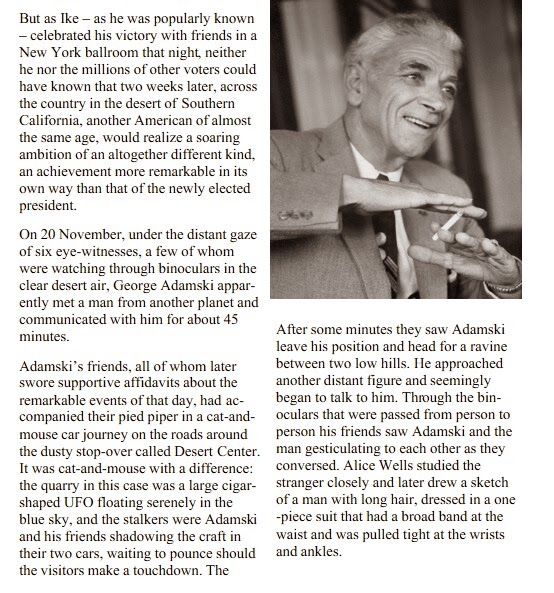
 Excerpt from George Adamski: The Toughest Job in the World by Tony Brunt-HERE


ASTROLOGY


Adamski's natal chart might reveal a clue or two:
Born on 17 April 1891 in Bydgoszca, Poland,
at 2:07 AM.
(Astrodienst "A" rating)

His impulsive Aries Sun itched to have him be a pioneer...of something! He wanted to be a pioneer of extra-terrestrial contact didn't he? Uranus (planet of all that is futuristic, unexpected and eccentric) was in opposition to his natal Aries Sun from Libra, maybe encouraging eccentricity, even in opposition managing to drown out any more practical, realistic impulses he might have experienced. Likewise, restrictive Saturn in sensible Virgo was in opposition to expansive, adventurous Jupiter and Venus in imaginative, dreamy Pisces - it appears the Pisces "flavour" won this tug-o'-war.

Outer planet Neptune (ruler of Pisces)was conjoined with Pluto in Gemini - for a whole generation; in Adamski's case the pair were conjunct his North Node of the Moon, and in sextile to his natal Leo Moon, drawing Neptune's penchant for illusion close to his inner nature.

UPDATE @ 6pm~
I've just noticed that Astrodienst has calculated natal chart for 2:07 AM, and I followed suit, but according to their source note it should be 2.07PM

Luc de Marre quotes him in a letter to Wilhelm Konig in 1954 "between 2:00 and 2:15 PM."

Here's a PM chart, ascendant and angles have moved as has Moon's position.


Moon Leo, Virgo rising, Saturn on ascendant. A Leo Moon fits his craving for publicity and limelight.
Neptune at top of chart giving it prominence. Virgo rising with Saturn close....not sure about that fitting him too well....but...

Wednesday, April 22, 2015

EARTH DAY


Three quotes for Earth Day 2015:

“Earth processes that seem trivially slow in human time can accomplish stunning work in geologic time. Let the Colorado River erode its bed by 1/100th of an inch each year (about the thickness of one of your fingernails.) Multiply it by six million years, and you’ve carved the Grand Canyon. Take the creeping pace of which the continents move (about two inches per year on average, or roughly as fast as your fingernails grow). Stretch that over thirty million years, and a continent will travel nearly 1,000 miles. Stretch that over a few billions years, and continents will have time to wander from the tropics to the poles and back, crunching together to assemble super-continents, break apart into new configurations- and do all of that again several times over. Deep time, it could be said, is Nature’s way of giving the Earth room for its history. The recognition of deep time might be geology’s paramount contribution to human knowledge.”
― Keith Meldahl, Rough-Hewn Land: A Geologic Journey from California to the Rocky Mountains.


“I realized up there that our planet is not infinite. It's fragile. That may not be obvious to a lot of folks, and it's tough that people are fighting each other here on Earth instead of trying to get together and live on this planet. We look pretty vulnerable in the darkness of space.”
― Alan Shepard, astronaut.


“He who knows Mars, Venus, Mercury or Jupiter very well will also know very well how very precious our earth is!”
― Mehmet Murat ildan.

Tuesday, April 21, 2015

Astrology and Sexism

Skimming through my archives, looking for something to click a switch in my head and lighten inspirational darkness, I hovered on a post from the summer of 2011:
Thoughts on Misogyny, Misandry & Sexism. With Hillary Clinton in the presidential campaign run once again....hmmm.

BRIEF SNIP
Misogyny: The hatred of women. Misandry: The hatred of men. Sexism: The belief that one gender is superior to the other........................
C.E.O. Carter in his Encyclopedia of Psychological Astrology has no entry for misogyny, misandry or sexism. I suspect because in the mid 1920s when the book was written these were not yet perceived as problems; or if so, in certain enlightened circles, an author - even an astrologer - might shy away from voicing an opinion on the matter, if selling books and maintaining a reputation was the aim. I've noticed quite a bit of sexism arising in casual turns of phrase in old astrology books I've picked up in antique/junk stores.
I doubt that a tendency towards sexism or gender conflict is identifiable in a natal chart. These are most likely the result of life experience, or era-related societal culture. I've noticed, even more often, since writing that post, that sexism does creep into the text of some older astrology books. Scratching around the net for more on how sexism might have crept into astrology generally, and why, I came upon a good piece at the CURA website (most reliably good astrology articles on the net are there, in my estimation).
The Repression of the Feminine in Astrology by Shelley Jordan

SNIP from introductory paragraphs:
Astrology's Hidden Agenda

Anyone studying the techniques of traditional astrological interpretation with eyes open will inevitably be struck by its prejudicial assumptions. Most astrology texts state flatly that certain factors in the birth chart lend themselves to either ease or difficulty of life and expression. For example, detriments, exaltations and the like still send chills of fear or excitement up and down the spines of many astrologers. After all, isn't it supposed to be 'good' to have a planet in exaltation and 'bad' to have a planet in detriment? And in spite of a recent well-intended and humanistic stretching of definitions, aren't certain planets still considered fundamentally preferable to others?

Even more pervasive and persistent in its judgmental nature is the evaluation of the aspects as either 'good' or 'bad'. An insidious dichotomous thinking surrounds aspect interpretation, which, at its roots, is both sexist and racist. There is a largely unknown historical, numerological basis to this dogmatic but unrecognized prejudice that precludes the possibility of reform and evolution in the field of astrology.

The major Ptolemaic aspects, the trine, sextile, square and opposition have traditionally been divided into two general categories. Trines and sextiles are typically considered favorable, desirable, harmonious, easy, creative, and soft. Squares and oppositions are described as discordant, afflicting, stressful, frustrating, challenging and hard. Astrological erudition has, until very recently, been dominated by cookbooks representing trines and sextiles as patently good, squares and oppositions as inherently negative. It is commonly asserted that a chart for an auspiciously blessed life will preponderate with trines and sextiles between beneficent and well-placed planets. The infelicitous and the unendowed will have baleful squares and oppositions to afflicted bodies. This superstitious and erroneous litany regarding the dangers of certain astrological conditions permeates nearly the entire corpus of astrological literature.

There's more food for thought in that piece. We have to keep in mind, though, that astrology's basic doctrine comes from eras and cultures where societal norms were so very different from today's in the West. It's easy for us in 2015 to do a bit of revisionism, criticise early and even much later astrologers; we "know the ending", or the results as far as we've reached to date. What we should be criticising is any astrology/astrologer who continues to allow any hint of sexism into their writings, interpretations and advices.

A natal chart does not indicate gender. The "masculine/feminine" polarity dictated by astrological lore is usually referred to as masculine/feminine or positive/negative; both less than ideal ways to express what the polarity indicates in human terms. Some astrologers use Chinese terms yin and yang instead. (Wikipedia) In Chinese philosophy these describe how apparently opposite or contrary forces are actually complementary, interconnected, and interdependent in the natural world, and how they give rise to each other as they interrelate to one another.

Virginia Woolf put it another way:
“It is fatal to be a man or woman pure and simple; one must be woman-manly or man-womanly. ... Some marriage of opposites has to be consummated.”
~ Virginia Woolf, A Room of One's Own

What the world is missing is more of what humans have come to see as "the feminine" in all humans - not necessarily just more female humans in power, though I guess that could help on the surface, depending on the female humans involved! A healthy respect for "the feminine" in all humans, alongside equal respect for "the masculine" would be a good starting point; seeing people first as people, not as a gender would help too.

Monday, April 20, 2015

Music Monday ~ Brought to mind by a few of today's birthdays.....


Glancing down a list of birthdays for 20 April I decided to pick three names which immediately brought some song or piece of music to mind.


First, surprisingly, was Adolph Hitler (20 April 1889) whose name comes up in the signature tune of an old British TV series (1968-1977) - Dad's Army:


Next, Jessica Lange (20 April 1949). She played Patsy Cline in a movie about the singer's life - I've seen and enjoyed it several times : Sweet Dreams.
Ms Lange lip-sincs to Patsy Cline's recordings - it works well:

Movie trailer:


Also Luther Vandross (20 April 1951), gone too soon! Here singing a longtime favourite of mine from Man of La Mancha, Impossible Dream


Any face from the list linked at the top of the post bring a song or piece of music to a passing reader's mind?

Saturday, April 18, 2015

Netflixing: Cedar Cove, Knife Fight, Halt & Catch Fire.

Our Netflix diet of late has been a potpourri of The X-Files, Quantum Leap, and Cedar Cove, judiciously arranged so that soothing Cedar Cove episodes come just before bedtime. Retiring to bed after some of the more gruesome X-Files episodes can endanger a peaceful night's rest!

Cedar Cove, we've discovered, is one of those "comfort food" series: undemanding plot-lines, idyllic setting, pleasant, good-looking characters, decent script and acting. It originated on Hallmark channel, to which we've not had access, but I can well imagine most of its fare being of this good-natured ilk.


Cedar Cove is based on Debbie Macomber's novels of the same name. The series focuses on Municipal Court Judge Olivia Lockhart's professional and personal life and the townsfolk of her small town, Cedar Cove. The Judge is nicely played by Andie MacDowell. Her "love interest" (there always has to be one of those) is Jack (Dylan Neal) the newly arrived from Philadelphia leading (only) reporter on the town's newspaper. See Wikipedia for full cast list. Filmed on beautiful Vancouver Island, the series' location is actually meant to be Port Orchard, Washington State, a dozen or so miles from Seattle.

If anyone's looking for a bit of undemanding comfort viewing as antidote to ubiquitous slam-bang nastiness, this series acts as welcome relief.

Decent movies, as against TV series, on Netflix have proved harder to find. We've begun watching several only to dump them after 20 minutes or so. The majority are definite "C", "D" or "E"-list fodder - in our estimation at least. Last weekend we tried a movie newly introduced to Netflix, Knife Fight, subject matter not as one might expect from the title. The film is about shenanigans in the American political campaign business. Rob Lowe (once of the wonderful West Wing) heads a cast which also includes another West Wing alumnus, Richard Schiff - the pair share a couple of the best scenes in the film, bring in much-needed chuckle-worthy one-liners. I really enjoyed the film, but most critics panned it. American politics and their shenanigans being comparatively new to me, I'm probably more easily pleased. I've seen several other movies of this genre, and for me, though this isn't one of the best, it's definitely better than some critics would have us believe, and worth a viewing, especially as full-on campaign season is about to come down on us once again.


Another, fairly new to Netflix, series devoid of slam-bang is Halt & Catch Fire. It originated on AMC channel, which has a good record of screening excellent series such as Breaking Bad and Mad Men. With those two as recommendation we decided to give Halt and Catch Fire a try. It's set in Dallas, Texas in the early 1980s, when personal computer development and production was in its infancy. Whereas Mad Men is about the advertising industry and its personalities, Halt & Catch Fire is about the burgeoning personal computer industry and those involved.

I didn't much enjoy the pilot, but as husband was intrigued we stuck with it, and I eventually became hooked too. One doesn't really need much, or any, deep tech know-how to appreciate the story lines - they're all about the characters, and their creative aims and dreams. The show is worth a look-in if you're tired of police and courtroom dramas, or hospital tales, or historical themes, or nasty slam-bang - this is something different, not top-notch but interestingly different.

PS~~ Halt and Catch Fire, known by the assembly mnemonic HCF, refers to several computer machine code instructions that cause a computer's CPU to cease meaningful operation. (Wiki)

Friday, April 17, 2015

Arty Farty Friday ~ Ford Madox Brown - Aries x 6

 Self portrait
I've chosen to feature Victorian artist Ford Madox Brown as much for his unusually Aries-packed natal chart as for his paintings. More on the astrology later in this post.


His style has similarity with that of the Pre-Raphaelite Brotherhood (including Rossetti, Hunt and Millais), but he was some years older than the main group of Pre-Raphaelites, and in fact has been described as having pioneered the style of painting which which came to be known as Pre-Raphaelite before the Pre-Raphaelite Brotherhood was actually founded in 1848.

Ford Madox Brown's paintings tended to be less "perfect", more down to earth, sympathetic to ordinary people, less in awe of the beautiful people, whether mythical or real. He was a longtime friend of my own hero, William Morris. In 1861 he was one of the founding members of William Morris' business, Morris, Marshall, Faulkner and Company (later Morris and Company).

Brown was born, according to Astrodatabank on 16 April 1821 at 4.00 PM in Calais, France to English parents. He studied in Europe, remained in France for some years, married his first wife, Elizabeth. Their first child died in infancy in 1842, a second child was born in 1843. They moved to England in 1844. However Elizabeth contracted tuberculosis, and died aged 27 on the journey back to England from Rome where she had been staying. Brown married again, to a younger woman, Emma Hill, who had been his model, and live in lover for several years. He's said also to have had some "associations" with women outside his marriage, in particular with another artist, Marie Spartali Stillman and a writer, Mathilde Blind.

Detail of his biography is at Wikipedia.
Also, there's a good combinations of biographical facts and copious illustrations
at Hoocher.com HERE.

As for Brown's personality, I've gleaned little. At mentalfloss there's this note:
4. According to one source, Brown "threw brilliant parties, hosted animated debates and even fashionable seances." The article goes on to state that Brown's admirers considered him "the handsomest man in London" as well as "the best conversationalist." Apparently, he was referred to as a "King of Hearts."

Ford Madox Brown's best known paintings are The Last of England, Work, and the frescoes he painted for Manchester's Town Hall.


Click on image for a bigger version:

 The Last of England (1855)

The painting tells the story of the emigration of a young family from England to Australia; part of the emigrating movement of the 1850s, when people sought new lives around the British Empire.
See HERE.
Compelled to leave all they have known and loved, their grim stoicism testifies to their determination.
The Last of England also tells the story of the artist, Ford Madox Brown. In 1852, he was "intensely miserable, very hard up and not a little mad". The main figures are portraits of Brown and his beloved model, Emma Hill, whom he married in 1853. They form a solid unit, bound together in their love. It is a painting full of human emotion, incident and drama; from the vulnerability of their baby's tiny hand to the savage anger of the figures in the background.

His painting, Work, really needs to be seen in large format, this is better done by going to Wikipedia HERE and clicking on the image there.


From The Guardian:
Underpinning these two great paintings lay Brown's abiding interest in the underdog. Unlike his friend William Morris, he was never a systematic socialist, opting instead to make a series of pragmatic and personal interventions in the lives of the poor. He taught art at the Working's Mens' College and, later, set up the Labour Bureau in Manchester. In the same way, his art is one of engaged observation rather than noisy propaganda. Perhaps this was because, unlike the independently wealthy Morris, Brown understood poverty to be a complex, nuanced business. While never actually starving, he spent at least two decades of his working life harried by a lack of cash. The Last of England sold for less than it should, and Brown's hyper-sensitivity also meant that he tended to crash up against the institutions and people who would have done him most good.

Below is just one example of frescos in Manchester Town Hall (click on it for a bigger version)
- the rest can be seen at the BBC website HERE.


From the same Guardian piece:
Although he had no prior relationship with Manchester, its brisk, nonconformist atmosphere suited him particularly well. While reviewing the city's history to find subjects for his murals, he found an abundance of moments that chimed with his own subtle understanding of the human condition.

ASTROLOGY


What can I say? All personal planets are in Aries, apart from Moon in Libra - a predominantly Cardinal chart. Moon in Venus-ruled, arty Libra symbolically depicts a kind of funnel through which all Aries' pioneering, motivated and forceful attributes are directed. Moon lay in opposition to
Venus, Saturn and Jupiter, with Libra's best balancing act going on to calm down the worst of Aries' impetuosities and aggressive instincts.

Generational outer planets Uranus and Neptune were in exact conjunction in Capricorn when Ford Madox Brown was born.

From Gary Lorentzen's website:
Uranus/Neptune in the 19th Century—Economic Self-Interest vs Social Benefit ~
The old Sagittarius influence was gone and an entirely new, modern impulse was shaping the expression of Uranus/Neptune. Commercial capitalism was replaced by industrial capitalism and a growing state capitalism. Colonialism came into its own as states consolidated their holdings forming extended, global empires. Almost immediately, however, there was a reaction to this trend in the form of a growing socialist/communist movement that applied the lessons of the previous cycles to a new, scientific materialism and scientific state management. But the conjunction took place in Capricorn in the Capricorn decanate. The impulse to move away from the old Sagittarian idealism was strong, and a new, more practical, economic idealism was forming.
That does fit Brown's art, generational and astrological outlook well. The conjunction makes challenging square aspects to his natal Mercury and Mars in Aries - could be seen as challenging him to get with the new paradigm!

Thursday, April 16, 2015

Last Night on American Idol - Harry v Quentin, the astrology.

A quick extra post brought on by an event from last night's live American Idol episode. You really had to be there (in front of the TV) and fairly familiar with the workings of Idol to properly appreciate what went on. Googling the names Quentin Alexander and Harry Connick Jnr along with American Idol will likely bring up more information on the event than any casual non-fan reader will wish to know.

Quentin, a creative and obviously emotional 20-year old, usually soft-spoken and kindly, honestly responded to a question by presenter Ryan Seacrest, was immediately misunderstood/misinterpreted by Harry Connick Jnr and scolded, in an unnecessarily harsh way (to my ear). Quentin responded, very politely and calmly, standing, by then near Harry at the side of the judges' desk. The awkwardness spread through the rest of the show, with a further explanation/apology from Quentin later, after his second song, and a bit more, quite unnecessary, softer scolding from Jennifer Lopez.


I was on Quentin's side beginning to end, husband wavered a bit, but came around later. Commentary online today has been divided, ranging from barely above racist, disgustingly thoughtless and ignorant, and highly supportive. The "drama", I should mention, stemmed from possible elimination of Quentin's friend, Joey Cook (a very creative, fun gal who I too was surprised to find in-line for elimination, due to public votes - and/or manipulation by whomever).

Gotta have a look at Harry's and Quentin's charts, thought I.

Here they are (click on image for larger version):

Both set for 12 noon.
Left is Harry's 11 September 1967, New Orleans.
Right: Quentin's 11 December 1994, New Orleans


I can see right away why I've been rooting for Quentin since episode one of this season! Never mind that.

Quentin's Sagittarius Sun/Mercury reflect a need for honesty and bluntness, and his Aries Moon (whatever his time of birth) could slam no brakes on that, in fact it acted as accelerator! I kept thinking, before seeing the natal chart that, in the unlikely event of me being in a similar situation I'd have had to act in much the same way...Aries Moon does tend towards that kind of thing.

Harry's musical technical talent isn't in question, and Quentin had always accepted his pointers with good grace and appreciation. Harry's nit-picking Virgo Sun, backed up by two outer planets in Virgo could try the patience of a saint though - especially in such an emotional and public setting.

Harry's natal Sagittarius Moon afflicts him with some of the same bluntness "enjoyed" by Quentin via his Sun/Mercury. Harry's natal Saturn is very likely conjunct Quentin's Moon, depending on times of birth - that'd be apt to put a damper on any back-slapping praise!

There's more, I'm sure.


WORD-QUIRK

I usually consider myself reasonably well-equipped to understand most non-technical reading matter, if written in English that is. There are, though, still a couple of words which regularly cause me to pause and ask myself, "now what does that really mean?" Both queries have been mentioned in posts in the past and relate to the words "postmodern" and "meta".
Snips and links

Postmodern:
What the heck is "postmodern" or "postmodernism"? I researched, read and continued to ponder. I've come to the conclusion that, in the main, it's used fairly indiscriminately by those who want to sound knowledgeable. It literally means something which occurs later than that which was thought to be modern : post = after. So really, postmodern is very modern, more modern than modern. But no - that's not it! Postmodern is a reaction to the modern - a going back to what was there before the modern happened. It's all very confusing! If post-modern means anything then, astrology is postmodern. We're in an era where the commonly held motto is "astrology is crap". Postmodern thinking dictates that we revert to eras of long ago when astrology was revered. Astrology is postmodern! Post is HERE.

Meta:
It appears writers who feel they are being "hip" or "cool" now use meta to refer to something that is self-referential. Sigh. I searched for enlightenment, found this piece by Ben Zimmer from last May in the Boston Globe He begins:

You know what? I’d love to write a column about the word meta. I could explain how meta started off as a prefix meaning “above or beyond” (the metaphysical realm is beyond the physical one) or “at a higher level of abstraction” (metalanguage is language used to describe other language). Then I could talk about how meta broke free as a standalone adjective to mean “consciously self-referential” and has become a perfect meta-commentary on the consciously self-referential age we live in. Maybe I could even start the column with an introduction about wanting to write about the word meta..........
Post and link are HERE
, along with comment from mike.

I'll probably have to accept a personal mental blind-spot for those two words.

A couple of other word-quirks I've been noticing lately in TV conversations and interviews, serious or light-hearted -

1. Speaker begins his/her responses with "So......." when the word doesn't fit the context at all.

"So..." is being used in place of the old fashioned "Erm..." or "Hmm..." or just a pregnant pause to give the speaker a split-second's worth of time to think. What surprises me is how many otherwise brilliant individuals have picked up the "So..." habit - I heard Elizabeth Warren do it not long ago.


2. The other word-quirk is use of the word "hashtag" in conversation. Before I arrived in the USA I wasn't even aware of hashtags. Learned about them first as used before a numeral: #3, as, I guess, short form for "number 3". Then I came across a similar symbol depicted on the telephone receiver, experienced panic when told by some robot responder to "press 2 then the pound sign."
"Wha....?"
I risked pressing the hashtag-looking thing and all worked out well enough - as well as things can when speaking with a robot!

Hashtag, the word, has been creeping into conversation, I've noticed it in light-hearted TV conversations a few times. Someone will make a remark about a current topic, then add, for instance, "hashtag so topical" (but replacing "so topical" with more hip-sounding word(s) summing up the topic in question).

So...what can I say.... it's all meta and postmodern...hashtag don't understand!

Wednesday, April 15, 2015

Pregnant Cows or Pregnant Barley?

Hat-tip Wikipedia
Fordicidia, a Roman agricultural festival in honour of goddess Tellus, known as "Grain Goddess", regularly associated with Ceres in rituals pertaining to the earth and agricultural fertility was held in Ancient Rome every
April 15.

A pregnant cow (forda or horda) was sacrificed to Tellus in each of the 30 wards of Rome and one on the Capitoline Hill. The sacrifice was in hope of promoting fertility (presumably of cattle and crops in the fields). The unborn calves were cut away from the mother, burnt, and the ashes were used by the Vestal Virgins in a purification rite in the festival of Parilia on 21 April. (An archived post on Parilia is HERE)

That's one version of the tale, the most widely reported, and a pretty gruesome one at that! One website has a different take on the Fordicidia/Fordicalia. The writer at piereliogion.org suspects that something could have been lost in translation. The theory goes like this:
......the words forda and horda do mean ‘pregnant cows’, that is, ‘cows in calf.’ The two different forms forda- and horda- are dialect forms in which the h- and f- are allophonic (you say tomayto, I say tomahto). There is a similar situation with the words hordeum and fordeum which both mean ‘barley’ ......Furthermore, the name of the festival Fordicidea, the form usually used in classical Rome is questionable. The name in Ovid’s Fasti certainly ends in -cidea which has a meaning ‘slaughter’ (as in ‘suicide, genocide’), but both Hordicalia and Fordicalia are also attested various places as names of the festival and these have the more usual form of the name of a festival in Latin, with a typical -alia ending.....
The writer points out that wastefully slaughtering upwards of 30 pregnant cows was not in the best interests of farmers, and had no sympathetic magical resonance with prayers that there should be a good harvest of grain in the coming season - Tellus being Grain Goddess.

Regarding the alternative explanation, the writer goes on to explain:
How can barley be pregnant, one might well ask? Barley gets pregnant in the spring, when the over-wintered grain (which just looks like lawn grass all winter), shoots up and begins to form ears, inside the stalks. At first it isn’t noticeable, but eventually, a close look shows that the stalks between the nodes are getting “fat” because the ears are forming inside, while they are still covered by the sheaf of one of the blades of the barley. In English, the barley is said to be “in the blade” meaning that it is forming ears. This is a time of great anxiety for grain farmers since they are hoping that everything will turn out right and the ears will eventually shoot above the main part of the plant and then ripen properly. Very widely among the Indo-Europeans, there is a festival to encourage the grain growth at this time, which seems to be the main impetus for these Tellus Mater festivals.
It's hard to say which version is most likely correct, but I'm thinking that, if Roman high authorities had anything to do with it, then I doubt the sensibilities of the farmers for their cows would be taken into account. Slaughter of the pregnant cattle, if ordered from on high, would have to be carried out, regardless. Makes little sense to us, but then, so do many orders of our 21st century governments.

Tuesday, April 14, 2015

WINNING WAYS ~ ("Alice thought the whole thing very absurd" )

A rabbit-hole, of sorts. This one unintentionally stumbled down after reading some posts about a recent debacle among fans of science fiction and the Hugo Awards. It seems that there has been a disruptive faction afoot, criticising nominations and the modern sci-fi genre, mainly because of the allegorical nature (usually leaning leftward politically) of stories and embedded messages, and - rather silly this - book covers which do not truly represent the nature of the novel inside (it was ever thus, wasn't it?) See here, and at the links provided there.

After reading a couple of threads of comment on these matters, I came to the conclusion that it's pretty silly to designate what is good, better, best among any kind of writings, art, music, acting etc. Taste is always subjective. End of story. Or is it?

Competition in itself is a healthy part of human nature - heck, human nature is, I suppose, the product of competition: evolution. Competitive spirit, in different measure, in different spheres of life, lies within us all. Astrologers might put this down to a reflection of planet Mars in our nature. Ancient Greeks valued the competitive spirit, honoured it in their Olympic Games, a tradition to which we still cling. That kind of competition seems to me to be a more reasonable deal - there really are winners there - indisputable winners.
"Sport, a healthy body and the competitive spirit were a large part of Greek education and so it is hardly surprising that organised athletic competitions would at some point be created, as they had been in the earlier Minoan and Mycenaean civilizations." (See HERE)

The Greeks had a word for it (didn't they always?) Thumos.
Wikipedia -
Thumos (also commonly spelled "thymos"; Greek: θύμος) is a Greek word expressing the concept of "spiritedness" (as in "spirited stallion" or "spirited debate"). The word indicates a physical association with breath or blood. The word is also used to express the human desire for recognition.
(There's also a good piece on Thumos at Classical Wisdom )


"The human desire for recognition", is a driving force of the competitive urge. Now...dragging this back into the 20th and 21st centuries, returning to consider all those Awards ceremonies like the Hugo Awards, all literary prizes and awards in the world of the arts in general.

James English's book, The Economy of Prestige relates to this topic, and is described at Amazon:
"This is a book about one of the great untold stories of modern cultural life: the remarkable ascendancy of prizes in literature and the arts. Such prizes and the competitions they crown are almost as old as the arts themselves, but their number and power--and their consequences for society and culture at large--have expanded to an unprecedented degree in our day. In a wide-ranging overview of this phenomenon, James F. English documents the dramatic rise of the awards industry and its complex role within what he describes as an economy of cultural prestige................... In the wild proliferation of prizes, English finds a key to transformations in the cultural field as a whole. And in the specific workings of prizes, their elaborate mechanics of nomination and election, presentation and acceptance, sponsorship, publicity, and scandal, he uncovers evidence of the new arrangements and relationships that have refigured that field. "

One reviewer there observed:
He [James English] reminds us of the Dodo in Alice in Wonderland, who cries, 'Everybody has won, and all must have prizes'...English dissects the dishy politics and tawdry tricks, but the author is after much bigger intellectual game. He wants to understand how the awards-biz carries our cultural currency, creating our shared investments in what is art...The Economy of Prestige is rich fare for anybody who has ever been trapped at an awards banquet. It ought to win a prize. (Karen R. Long Cleveland Plain Dealer 2005-11-13)

For a reminder about Alice and the Dodo.

That brought me nicely back to the rabbit-hole entrance from which I set out, and the thought that often accompanies such investigations: instead of "cherchez la femme", in this case it's "cherchez le dosh!" Follow the money!

Monday, April 13, 2015

Loveless Favourites

So many songs are about love and romance, but once one begins to think along lyrically loveless lines, there are equally as many that are not. Three of my favourite loveless lyrics, plus three from Himself (aka anyjazz ):

Anyjazz chose:
Strange Fruit ~ Billie Holiday


Penny Lane ~ The Beatles


Mañana ~ Peggy Lee


From Yours Truly:

Buddy, Can You Spare a Dime ~ George Michael


Sailing to Philadephia ~ Mark Knopfler/James Taylor


Proud Mary ~ Tina Turner (You might need to fasten your seat belts for this one, it's a long rough ride - but fun!)


What are your "loveless" favourites?