Monday, February 11, 2013

Music: Vintage 1908

Commenter "Dan" asked if I'd: "do a post on why 1908 was such a great year for music?" I asked for a little clarification on whether Dan was thinking along the lines of musicians born that year (whose talents would only come to light decades later); or was interested in what was actually going on musically in the year 1908? Reply was:
I am more interested in what was actually going on musically in the year 1908. Two of my favourite pieces were composed that year - Gustav Malher's The Song of the Earth and Gustav Holst's Savitri opus 25. On the other side Arnold Schoenberg started his adventure in atonal music and RCA Victor and Columbia market the flat disc recordings. And among pop music, there is It's a Long, Long Way to Tipperary and Take Me Out to the Ball Game which seem to be everlasting.
Hmmm......and hmmm again.

First thought was that Dan's attraction to particular music originating in 1908 might have reflection in his own natal chart in some way.

Next thought: to take a look at the outer planets' positions for that year, for these can indicate a general overall "atmosphere" for the time in question.

Uranus transited Capricorn in 1908 moving between 12 and 14 degrees with some back-and-forth during the year.
Neptune transited Cancer between 13 and 16 degrees.
Pluto transited Gemini between 23 and 25 degrees.

I think we can discount Pluto when considering matters musical.

In 1908 we see a Uranus-Neptune opposition, Capricorn-Cancer. Bearing in mind that Uranus connects to change, invention, the avant garde; and that Neptune is planet of creativity (among other things), this long-lasting alignment, the two planets around 180 degrees from each other, has significance. Most astrologers, when writing about this opposition, which lasted roughly 1905 to 1912, emphasise division, social class struggle and conflict which would eventually lead to the start of World War I in 1914. None of which takes into account Neptune's link to creativity being dynamically activated by avant garde Uranus.

I see related influence in two of the items "Dan" mentioned: Arnold Schoenberg's adventure in atonal music and RCA Victor and Columbia marketing the flat disc recordings.

Richard Tarnas did touch on how the arts in general reacted during this period of time - (See HERE)
.........the extraordinary confluence of events that coincided with the last Uranus-Neptune opposition which extended throughout the first decade and a half of the twentieth century: the revolution in human self-understanding mediated by depth psychology, especially Jung's archetypal psychology and his deepening of Freud's psychoanalytic breakthrough (which continued its own important evolution during these years); the revolutions in physics and cosmology (Einstein's relativity theory, Planck's quantum theory); in painting and the visual arts (Picasso, Matisse, Braque, Kandinsky); literature (Joyce, Proust, Kafka, Rilke); music (Stravinsky, Schoenberg); philosophy (William James, Bergson, Husserl); spiritual activism (Gandhi, Tolstoy), esotericism and mysticism (Rudolf Steiner, Aurobindo). The remarkable coalescing of these and many other related events and trends precipitated a radical transformation of vision for the entire culture, as well as the seeds for future profound changes in the cultural psyche.
Considering music, without particular astrological links, a rundown of "musical ages" at Bizymoms.com is interesting:

Timelines only quoted here (apart from the period relevant to this post) - full detail at the link.
There are 5 musical periods, which are listed and explained below:

Medieval and Renaissance (0 – 1600 A.D.)
Baroque (1600 – 1750 A.D.)
Classical (1750 – 1820 A.D.)
Romantic (1820 – 1910 A.D.)
With the coming of the industrial revolution, new thinking and new ideas were developing and these came to be expressed in the arts and music as well. Composers such as Berlioz, Schumann, Mendelssohn, Schubert, Brahms, Liszt, Chopin and Tchaikovsky were some of the great composers of the romantic period. Gradually, the style of music writing became broader and more expressive. New techniques of playing were developed and instruments were improved.
In the early 20th century, the late romantic composers like Dvorak, Bruckner, Mahler, Debussy, Strauss, Ravel and Rachmaninoff took music into greater heights and gave it new dimensions. All these great composers developed and maintained their own styles and nationality to their music, though they worked within their frameworks in the musical period.
Modern Era (1910 – Present)
1908 stood at the end of the Romantic Era, on the cusp of the Modern Era. Any remaining Romanticism was to be obliterated by the onset of World War I.

From HERE: Some musical "firsts" from 1908 (among numerous other "firsts" relating to air travel, Ford's model T, communication and sports)
1st performance of Maurice Ravel's "Rapsodie Espagnole"

1908 "Take me out to the Ball Game registered for copyright.

Gustav Mahler's 7th Symphony, premieres in Prague

Brooklyn Academy of Music, opens in NYC

Oscar Strauss' musical "Der tapfere Soldat," premieres in Vienna

Edward Elgar's 1st Symphony in A, premieres

Frederick Delius' "In a Summer Garden," premieres.


One of the pieces of music mentioned by Dan:


CONCLUSION
Perhaps 1908's musical compositions have special appeal to "Dan" due to natal chart configurations. But in general 1908's musical atmosphere reflected the Neptune/Uranus opposition, on the cusp of something different, something new: invention and creativity, gradually changing the Romanticism present during much of the 19th century. I suspect that "Dan", via his natal chart, is particularly sensitive to that atmosphere.

(Illustration: Fluffy ruffles girls rag : characteristic two-step.Composer/Lyricist: Davis, Marian I.Publication: Cleveland :Charles I. Davis Music Publisher, 1908.

Saturday, February 09, 2013

THOUGHTS ON CRIME and MORALITY

Three dramas have recently been part of our entertainment diet (one still at mid-meal). They have very different backgrounds but loosely similar themes: morality and crime, but they could hardly be called Morality Plays in the old sense: Les Misérables (book, film, musical); Breaking Bad (TV series); and Scandal (film about the real-life Profumo Affair in Britian in the 1960s.)

The stories prompt one to question commonly held rigid opinions of what is right and what is wrong. Is the law always right? Can there be moral justification for committing crime? Are crime and morality related, is crime always a moral indicator? In two of the dramas there are activities which, though against laws in place at the time, stemmed from valid personal reasons, considered by the law-breaker extreme enough to warrant his actions.
Nothing is easier than to denounce the evildoer; nothing is more difficult than to understand him.
― Fyodor Dostoevsky

Les Misérables
In Les Misérables the main character, Jean Valjean, stole a loaf of bread because his sister's children were starving. For this crime he was sentenced to 5 years imprisonment. 14 extra years and hard labour were added to his sentence because of his attempts to escape. He had broken the law, but wasn't it the moral responsibility of the governing body of France to make certain its citizens were not starving? Who would not steal bread to feed starving children? That's just the beginning. When his sentence is over he's put on probation, he has become hardened and inhumane, which is understandable. At the first opportunity he steals silver from a priest, who then forgives him, prevents his re-arrest and lifetime imprisonment, but tells him that it is on condition that, from then on, he will live a good life. He does so, changing his name as well as his lifestyle. An "establishment" figure, police officer Javert, hounds Valjean with a burning determination, obsessed by a need to adhere rigidly to the letter of the law. Javert wasn't wrong - but he wasn't right either.
A criminal remains a criminal whether he uses a convict's suit or a monarch's crown.
― Victor Hugo


Breaking Bad
In Breaking Bad, an acclaimed TV series we're watching via DVD, a highly qualified chemistry teacher in New Mexico, Walter White, discovers that he has inoperable lung cancer. He's a mild-mannered, easy-going family man. He has a pregnant wife and a teenage son who suffers from cerebral palsy. The treatments Walter White needs are horrendously expensive, will not be covered by insurance. He turns down the offer of help from a former business partner. Instead, he uses his rare expertise to begin "cooking meth" (the drug methamphetamine) and selling it, in partnership with a younger guy who knows the business. The expensive chemo therapies, paid for by ill-gotten gains from selling his high quality meth, do cause an improvement in his condition. Improved health means he's able to withstand an operation, set to cost some $200,000.....even more meth cooking and selling is needed.

Over time Walter White becomes hardened psychologically, he meets and does business with criminals and drug lords, as well as dealing with dark thoughts of his own early demise. He is closely involved in murders, multiple deaths, and other crimes directly and indirectly, as well as ensuring that more young lives are destroyed via drug use. We are only at Season 3 (of 5) so I cannot say how it will unfold, but Walter is gradually being turned to stone, morally, mentally and emotionally by results of his crimes.
When a man, before innocent, commits crime, he passes, by a sudden transition, into a new world. The significance of all objects around him is changed; the laws of association in his own mind are changed; a viper is born in his breast which stings and goads him. Sounds that he never heard before ring in his ears; a violated conscience turns avenger and scourger;--the foe is within him. Were it merely an external enemy, assaulting the criminal from without, perhaps he might be fled from, resisted, bribed, or would at last remit his inflictions through very weariness of tormenting. But not so with the consciousness of wrong.... It will not sleep, nor tire, nor relent.
HORACE MANN, Thoughts
Breaking Bad, though its crimes are on a far more serious level from those in Les Misérables raises similar questions. If you were diagnosed with inoperable cancer with, at most, months to live, no means to pay for expensive treatment, and had the skill to make meth (or carry out some other illegal activity), so that your family would not be left with huge medical bills, with likely loss of their home. Would you forgo treatment and face certain death within months, or use your skills, illegally, to make money enough to finance your treatment? There are other similarities to Les Miz too: Walter White's brother-in-law, Hank, is leader of a DEA (drug law enforcement) team pursuing some new mysterious meth-lord. So, Hank = Javert. Walter White takes the alias "Heisenberg" for his meth-dealing persona; Jean Valjean used "Monsieur Madeleine".

In Breaking Bad I see another immorality equal to, or worse than, that of Walter White - the lack of a proper, affordable health care system in the USA, such as is available in most other developed countries, where citizens would not face bankruptcy if catastrophic illness hit them. That is the single, over-riding, wrong which spawned though hardly justified, Walter Whites' huge crimes.
The more insidious kind of crime is writing the laws that make your crimes legal.
― Brandon A. Trean
Wrongs, crimes, immoralities are like trees and plants, they grow from a tiny seed, develop roots that spread, often in unexpected directions; stem and branches grow, bear poisoned fruit and they too, over time, spread beyond anything a person looking at that first tiny seed could have envisaged. In both Les Misérables and Breaking Bad "the seed" can be identified in societal wrongs: deliberate uncaring mis-management by government or ruling body.

Scandal
Circumstances of the third drama, the movie Scandal are somewhat different, and relate to a real-life slice of immorality - and vice rather than crime. It could stand as a morality play for politicians and powerful wealthy guys who like to prey on young women. The Profumo Affair from Britain's early 1960s, is storyline of the film. The film almost certainly skews and embroiders some facts for better dramatic effect. It can tell only basic facts we were allowed to know about the affair. There will be much more still hidden, and will remain so if certain powerful individuals have their way.

John Profumo, Britain's disgraced Minister for War was at the centre of this scandal, which had potential to bring the entire government down. Profumo was one of Dr. Stephen Ward's "clients". I see Ward as "the seed" in this story, for it was from his activities that all other actions grew. Oddly, some saw him as "fall guy". In acting as a high society procurer of young women for the Great and the Bad, Ward had no extenuating circumstance. He apparently did what he did just for the hell of it, and because he could. He wasn't in need of money, a successful osteopath with a client list filled with some of the wealthiest individuals in the UK.

Profumo, in betraying his wife (film star Valerie Hobson) and carrying on a affair with Christine Keeler, one of Ward's "young ladies", thought his powerful position made him invulnerable. There have been many men in similar situations since, there were many before, and will be many more in the future. Profumo, though, was particularly careless in that his chosen extra-marital lover, Christine Keeler was also extra marital lover of a Russian naval attaché, the pair were also introduced by Ward. Minister for War + Russian naval attaché : hot sex + cold war = alarm bells! The young women involved, Christine Keeler and of lesser importance Mandy Rice-Davies, were not forced into doing what they did. They were showgirls from poor backgrounds, willingly coerced, hankering after more bright lights and good times. They were teenagers - not an excuse, but a fact to be taken into consideration. There are no good guys or gals here, nor even any good intentions by bad guys. When eventually arrested Stephen Ward was accused of living off immoral earnings, he committed suicide rather than go to jail.
(Photograph: Ward and Keeler. Getty Images.)
The vices of the rich and great are mistaken for error; and those of the poor and lowly, for crimes.
~Lady Marguerite Blessington

Friday, February 08, 2013

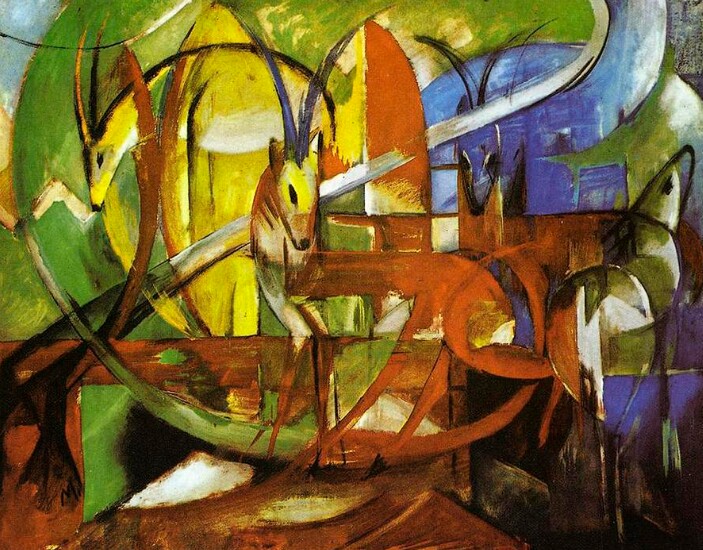
Arty Farty Friday ~ Franz Marc, casualty of World War I

Born on this day, 8 February, in 1880: German expressionist painter and printmaker, Franz Marc, best known for his colourful paintings of animals His life was cut short by World War I. He had volunteered in 1914, and was killed, aged 36, during the invasion of Verdun in March 1916. His closest friend, another German artist, August Macke, had been killed within weeks of war's outbreak, aged 27.

Franz Marc set out initially to pursue a career in the church, his pull towards art was discouraged by his artist father who considered his son lacked talent, resulting in Franz experiencing feelings of worthlessness and periods of depression.

From German Expressionism.com
In 1905, Marc spent the summer walking the Bavarian Alps where he first became interested in representing animals within their natural surroundings. In 1907, he married a friend to legitimize her child conceived with another man. On his wedding night, he suffered a nervous breakdown and fled to Paris. In Paris, he found peace in the late works of Van Gogh and Gauguin. In September of that year, he returned to Nature at Swinemunde where he began to truly understand the joyous meaning of organic unity and harmony that exists among all living things. Once he felt this connection, his life changed. He returned home to Munich via Berlin where he visited the zoo every day for several weeks.

From 1907-10, he taught lessons on animal anatomy in his studio. In 1908 he divorced his first wife and in 1911 he married his second wife, Maria Franck, who was a drawing teacher from Berlin. In 1909 he....came into contact with Wassily Kandinsky who would become a mentor. The two split from this group and founded Der Blaue Reiter (The Blue Rider). In 1910, he met his closest friend, August Macke. Macke introduced Marc to the important collector Bernhard Koehler who would support Marc throughout his career. In 1910, Marc had his first one man exhibition in Munich....... In April 1912, after seeing the Futurist exhibition in Berlin, Marc began to experience feelings of an impending Apocalypse. It was said that Marc possessed a sensitivity bordering on clairvoyance.

Marc is particularly loved for his animal subjects including horses, deer and dogs. He attempted to spiritualize German art by shifting its focus from the external towards the soul of the individual artist and his connection to the natural world. Franz Marc is perhaps best known for his paintings because he produced only 46 prints.

At franzmarc.org we are told:
In the spring of 1914 Franz and Maria Marc bought a small country house in Ried. According to Kandinsky, this purchase was one of "Marc's greatest wishes come true." He was even able to keep a dog and a tame deer there. But in August of 1914, at the outbreak of the war, Marc volunteered. Kandinsky visited him to say "Auf Wiedersehen." but Marc replied "Adieu." Within two months, Marc's first personal indication of the war's magnitude occurred; August Macke died in battle in September at the age of twenty-seven.

Marc wrote and drew extensively at the front. His drawings show a remarkable looseness and facility, for the most part combining figurative elements within a Cubist of Futurist framework of lines. Frequently still, innocent animals are depicted, yet now within a gradually tightening web of force lines that are reminiscent of Marc's vision of destruction, Fate of the Animals, 1913.

While cataclysmic events occurred around him, Marc nevertheless theorized on the supposed benefits of war, including the thought of a spiritual breakthrough and redemption through suffering. He was so moral in his belief in the eventual beneficent effects of the war that he could ignore the fact that patriotic allegiances fueled the war and caused his presence. Finally, he interpreted events in a more fatalistic way. Like the animals who had become simply motifs in a large scheme, he saw himself at war in similar terms. In the war Marc was forced to rationalize his aim, but the conflicts and questions that resulted disturbed him profoundly. Paul Klee was "afraid that he might be a completely different man some day," as if his delicate balance might not withstand reality. The trauma of the war for Marc was such that, at the end, only death could give him relief. In that state his own innocence could be restored. One of Marc's last letter, before his death at Verdun in 1916, concluded on this notes:

"I understand well that you speak as easily of death as of something which doesn't frighten you. I feel precisely the same. In this war, you can try it out on yourself - an opportunity life seldom offers one...nothing is more calming than the prospect of the peace of death...the one thing common to all. It leads us back into normal "being". The space between birth and death is an exception, in which there is much to fear and suffer. The only true, constant, philosophical comfort is the awareness that this exceptional condition will pass and that "I-conciousness" which is always restless, always piquant, in all seriousness inaccessible, will again sink back into its wonderful peace before birth... whoever strives fro purity and knowledge, to him death always comes as a savior."


Natal Chart~ data from Astrodatabank:

There's a predominance of Earth signs here. Earthy Venus-ruled Taurus is on the acendant, creative Neptune is nearby; and there is a Grand Trine in Earth; natal Moon is Earthy too - in Capricorn. The Grand Trine is made up of Venus (planet of the arts), Neptune (creativity and imagination) and Uranus (the avant garde). Marc's Earthiness clearly translates through his artwork via his concentration on animal subjects. In first house, Pluto at 25 Taurus is conjunct Fixed Star Algol, and Mars. This is a natal chart where Algol's allegedly unfortunate "influence" manifests (it doesn't in every case) : Franz Marc's death in war.

I haven't mentioned Sun and Mercury in Aquarius yet - they are semi-sextile Jupiter in sensitive, intuitive Pisces - reflection of his "sensitivity bordering on clairvoyance" mentioned in one of the quotes, above, and of his philosophical outlook.


Marc’s philosophy can be seen in works such as Blue Horses (1911), in which the powerfully simplified and rounded outlines of the horses are echoed in the rhythms of the landscape background, uniting both animals and setting into a vigorous and harmonious organic whole. In this painting, as in his other mature works, Marc used a well-defined symbology of colour: blue, yellow, and red each stood for specific emotional qualities. (HERE)


In 1912 Marc’s admiration for the works of the French painter Robert Delaunay and for the Italian Futurists made his art increasingly abstract. He began to use the faceted space and forms of Delaunay’s brightly coloured Orphist compositions to express the brutal power and timorous fragility of various forms of animal life; an example is Tyrol (1914), a work that approaches abstraction. (HERE)

The full implication of this motif for the art of Franz Marc can best be seen in one of his last oil paintings, Tirol, painted in 1913 and retouched in 1914. The overall image of this painting is, as in Fate of the Animals, one of cataclysmic destruction. The heavens have broken asunder and mountains are crumbling and depositing rocks and ruin upon the village below. In the lower part of the painting two small cottages appear on a hilly bluff, and to the left of them stand two dead trees.
But our attention is consistently drawn to the dominant motifs of the foreground, the thin, diagonally inclined tree which sweeps across the canvas from the lower right-hand corner to the left center of the composition. The branches of this tree culminate in what can best be described as a sickle shape. The tree, in fact, assume the form of some giant scythe. The painting remained in this state throughout the year 1913, for it, to, along with Fate of the Animals, was exhibited at the First German Herbstsalon. After the exhibition closed, however, Marc asked to have the painting returned to him and later in 1914 he added, immediately above the diagonal tree, the same motif of the "Apocalptic Woman" that had fascinated artist of the late fifteenth century, the motif which indicated that a rebirth of man would follow the destruction of the evil society of the present, the motif which spoke of the coming "Age of Righteousness". (HERE)

The Fate of the Animals


Thursday, February 07, 2013

Once Upon a Time on the Internet....

Feeling generally disgruntled with Google, Microsoft et al and the ways the computer experience has changed since first I owned a home computer, I began reminiscing.

October 2001 it was when I first dipped my toes into the internet pool. I'd used a computer at work for several years, but we were not linked to the internet, that was to be new and exciting territory. Because I was short of space at home I bought a rather avant garde all-in-one computer, made in London by a small independent outfit. It has taken more than 10 years for the big boys to start selling something similar. My computer worked fine most of the time, but as it was experimental it needed some fine tuning, had to be shipped back to the manufacturer for repair twice over a period of 3 years. Windows ME (millennium edition) was the operating system I used then, it was not well-thought of by most would-be experts who swore by Win98. ME worked for me.

Initially I got myself caught in the AOL net - AOL was a big deal back then, and was probably introduced to me as part of the Windows package. For a while it seemed to me that AOL was the internet. There were newsrooms, chat rooms, message boards, and other seminal social networking bits and pieces. I became an accepted member of a small discussion and writing group who produced some amusing narratives, parodies, games and pieces of prose. That was fun! Gradually I found my way around the net, discovered Google, Wikipedia, and Amazon, along with a few astrology websites and message boards.

I did eventually break loose from the AOL enclave and found my way around what in those days seemed more like a village or small town. It now seems like a teaming, screaming over-populated metropolis, so I choose to remain inside fairly narrow confines - in real life too. It's a jungle out there in both the real and virtual world, the natives can be restless and ruthless, also often idiotic, and not in a good way.... off their trolleys, out there circling Jupiter!

Too much of a good thing?

I suppose the net's huge international metropolis is the same as any real life metropolis: people tend to stay within their own neighbourhoods and communities much of the time, venturing out only on special occasions for a particular purpose. So, in fact, the net is only as wide and as deep as one's desired reach. Even though I was not around at the very beginning, seeing it grow so rapidly has been a wee bit disconcerting. Main big-name players back then were friendly, seemed akin to good next door neighbour types, always helpful, always ready for fun, always there when needed. Those same big names have now become overbearing, dictatorial, loud and demanding.

Such is life!

If television's a babysitter, the Internet is a drunk librarian who won't shut up.
― Dorothy Gambrell, Cat and Girl Volume I

The internet is just a world passing notes around a classroom.
― Jon Stewart
(I'd relate that description, more precisely, to Facebook.)


Distracted from distraction by distraction
― T.S. Eliot
Yep!

Attention is the limited resource on the internet - not disk capacity, processor speed or bandwidth.
― Mills Davis
Definitely!

Wednesday, February 06, 2013

There's a word for that......

Slipping the odd foreign word or phrase into conversation is sometimes evidence of pretentious snobbery, sometimes it becomes necessary because there really is no alternative, sometimes also use of "the foreign" is chosen with sarcastic intent or simply for a laugh.

The illustration (left) comes from Futurama Fry at quickmeme.com. I recognise the dilemma, and hear it sometimes on TV when US natives pronounce certain foreign words. "Empire", when referring to a style of women's dress (very high waist) is pronounced here as "ompeer", while in England we'd just say empire as in Empire....there are a couple of other examples but they refuse to spring to mind right now.

Anyway....I've learned a few more foreign words recently. I doubt they'll ever come up in my conversation, but I might throw one into a post now and then - in the interests of showin' off, of course.

The other day, reading a message board devoted to Les Les Misérables (the musical) I repeatedly came across the word leitmotif - had to Google it. For any passing reader in the dark, as I was, it comes from the German and is literally translated as "leading motif" or "guiding motif".
From Simple Wiki
Leitmotif is a German word meaning leading motif. It is a little musical theme that is often repeated in a piece of music, very often in opera. The leitmotif is linked in the musical story with a person or a thing or an idea. The leitmotif might be a short tune, but it can also be a rhythm or just a chord.

The word “leitmotif” is sometimes used in other things such as literature. In a book it might be an idea that keeps coming during the story. It can also be used in movies or video games.

The word “leitmotif” is particularly associated with the operas of Richard Wagner. The leitmotif helps to make the story dramatic and bind it together, because it makes the music easier to understand. Sometimes a leitmotif will change during an opera as the character changes. Various dramatic effects can be made with leitmotifs. For example, a leitmotif might be played before a character comes onstage, so the audience will know who is coming before the actor can be seen.
Leitmotifs or music themes are also used to dramatise movies. For example, the famous Jaws the me uses a leitmotif for the shark.
Another new, to me, word I stumbled upon: verklempt - also in relation to Les Miz, in a review from someone who had been to see the new movie. Urban Dictionary translates it from Yiddish (I think) as choked with emotion, on the verge of tears. (German verklemmt = emotionally inhibited in a convulsive way).

Yet another word of Yiddish origin I've heard or read in past weeks: kvetch. Free Dictionary: To complain chronically or habitually. From Yiddish kvetshn, "pinch, squeeze; complain."

Words originating from the Yiddish and German tend to pop up more frequently here than they did in the UK, I've noticed. A couple of words of German origin I was aware of but seldom use: schadenfreude – pleasure at someone else’s misfortune; and gestalt less easy to understand (for me anyway) there isn't a simple translation. Answers has this:
A physical, biological, psychological, or symbolic configuration or pattern of elements so unified as a whole that its properties cannot be derived from a simple summation of its parts.
Cue another memory: Back in the UK, during the year my husband lived there with me while I waited...and waited....and waited for the USA's long-winded immigration and visa processes to complete, we got the idea for a cartoon, which husband decided to illustrate - then we couldn't quite get the captions exactly right. Here they are, from the depths of his files. Was this an attempt to illustrate gestalt? I still don't understand the word!


In the UK many French words and phrases have slipped into common use over the years, sometimes with serious intention, sometimes as sarcasm or humour. Examples:
Voilà! Avant garde (use that often myself), bon voyage, c'est la vie! Quelle horreur! Quelle surprise! Vive la différence! Chez, chic, cliché. And what about the poseur and the raconteur - bringing on that old ennui?
Dozens more at Wiki

All of which brought to mind a McDonald's TV commercial which I cannot find still available online. Where it had been uploaded it is now been marked as "private" and is no longer available via YouTube. Dang! I wonder why it has been taken down when others are still available? A photograph of a frame from the ad. is the best I could manage. There's a description of the commercial at a blog Advertising Wizards HERE. The blog writer doesn't like the commercial though. I do, mainly thanks to the actor involved whose name I haven't yet discovered. He has exactly the right expression, tone and good timing - looks easy, probably isn't! It makes me chuckle whenever I happen to see it.

The "plot": Guy with McD's coffee cup sits on park bench looking straight ahead, apparently at a sculpture. A young woman sitting at the other end of the bench asks him if he's a fan of the sculptor (a French name) - guy looks slightly taken aback then says "He has a certain... je ne sais quoi." The young woman who had seemingly lost interest now perks up and says "Ah! Tu parles français'!" Guy: "Yeah. Oh yeah....all the time" (a lie of course). It does lose a lot in the telling.

Tuesday, February 05, 2013

THE AMERICANIZATION OF EMILY and Anti-Glorification of War

I bought a tape of the 1964 movie The Americanization of Emily another one I'd missed first time around. It's known among film buffs as an anti-war movie and stars James Garner and Julie Andrews.

It really isn't anti-war - or perhaps I should say that, in the context and setting the story takes place, it ought not to be termed anti-war. More accurately the movie is anti-glorification of war. I found that, on reflection, there's a feeling of "something not quite right" about the movie, even though I thoroughly enjoyed it.

The setting is England during World War II and just before D-Day. To have been anti-war at that juncture would have meant being willing to allow Hitler and his Nazis to overrun Britain as they had already overrun much of Europe. Sometimes war, horrific as it is, becomes inevitable. I'll not natter on further about the general storyline of the movie, but instead use TCM's brief synopsis. A few viewer reviews, positive and negative, can be found at the link too.

In wartime London just before D-Day, Lieut. Comdr. Charlie Madison, an aide to eccentric Rear Admiral Jessup, specializes in supplying the top Navy officers with luxuries such as party girls. Madison is an exponent of cowardice as a virtue because he believes reverence of heroism promotes war. He falls in love with Emily Barham, his British motorpool driver, a young woman who has lost her husband and brother in the war. Admiral Jessup is obsessed with the idea that the Army has a better image than the Navy and is determined that the first dead man on Omaha Beach on D-Day be a sailor. Jessup orders Madison to photograph the D-Day landing, and, despite his protests which alienate Emily, Madison is forced at gunpoint to be the first man to land on Omaha Beach. Running from the bombs, Madison trips a land mine and is reported to be the first man killed in the invasion. Photographs of his supposedly dead body appear in the newspapers, and he becomes a hero, but later he is found alive. Admiral Jessup then organizes a hero's welcome for Madison, but he threatens to confess the true story of his cowardice to the press. Emily, in a reversal of sentiment, promises to marry him if he will keep his secret, and Madison agrees to remain quiet.

The Am of Em was an adaptation of William Bradford Huie's novel, which, according to a comparison at Wikipedia carries no comparable message to that of the movie. The reason isn't hard to find. It was Paddy Chayefsky who developed novel to screenplay - the same Paddy Chayefsky who penned that well-remembered "mad as Hell" speech from the movie Network. For more about him see two archived posts HERE and HERE. I'll simply mention here that he was born 29 January 1923 - Sun in Aquarius!

Chayefski said, it is reported, that he treated the serious-toned novel as satire. His screenplay's theme of cowardice as a virtue, and the wrong-headed glorification and absurdities of war and its heroes, has no parallel in the novel.

The novel briefly mentions that Emily's mother, Mrs.Barham, has been mentally scarred by loss of her husband and son, but she is not a major character. The movie has a long and memorable scene between Charlie Madison (James Garner) and Mrs. Barham (the wonderful Joyce Grenfell), full of eloquent (some say preachy) antiwar rhetoric, in which Charlie breaks down Mrs. Barham's denial of the loss of her husband and son, and reduces her to tears while nevertheless insisting that he has performed an act of kindness. The novel has no parallel to this scene, but it's the key scene of the film. Here it is:


It has to be kept in mind that the movie was released in 1964, in the midst of the USA's war in Vietnam. The sentiments expressed have to be taken in with that in mind, otherwise there'd be a danger of disrespect for those, military and civilian, who died in World War II in opposition to the very real and imminently encroaching scourge of Naziism. The movie shouldn't be seen or described as "anti-war", but as anti-glorification of war, anti- the naming of streets after heroes, anti- the building of statues to Generals and, anti- making war so heroic and noble that young people will feel it their duty to be eager to go to war. I'll add my own anti- here: anti the ubiquitous (in the USA) bumper stickers, declarations on TV at every opportunity, along the lines of: "God bless our troops" "We support our heroic military", "Thank you for your service". In other words, nowadays viewers would be wise to take the message offered by the movie, but be sure to put it into a context relevant to our own times - which is what Chayefski did in 1964.

My husband quickly recognised the film's background music, a piece especially important to him. One of his jazz idols, Paul Desmond, recorded a melody titled Emily, which husband has always loved, but had been unaware it had connection to this movie.

Emily, composed by Johnny Mandel, lyrics by Johnny Mercer. A version with lyrics, sung by Sinatra, below, and jazzy rendition by Stan Getz and Bill Evans (my own favourite version), and a link to Paul Desmond's version too.


Monday, February 04, 2013

Drones: "most brutal weapons of all"

It was announced on Friday that Germany is about to acquire armed drones.
From the full Associated Press report HERE
Defense Minister Thomas de Maiziere said Friday that Germany would work with France to develop a new generation of unmanned aerial vehicles.

"We have a gap in our capabilities that we would like to close," he said.

Germany already has unarmed drones, including the Israeli-built Heron 1 model, which it uses for reconnaissance purposes in places such as Afghanistan. Officials said Germany might consider purchasing an armed version of the Heron 1 for use after 2014, to bridge the gap until 2020 when the system being developed with France becomes available.
(Photograph from RP Defense blog)

I had been labouring under the mistaken idea that Germany would nevermore have the option to become fully militarised, after having been instrumental in lighting the blue touchpaper for two horrendously devastating world wars within a ridiculously short time span 1914-1918, 1939-1945. Some generations had the misfortune of living through both bloodbaths. I'm not sure where I got the idea in the first place - probably kidding myself. Wikipedia has a page outlining the real situation.

It doesn't take an over-active imagination to see where a potential drone-fest will end, as more and more countries acquire the technology. We used to think our greatest danger lay in nuclear weaponry. That supposition ought now to be updated to include armed drone use. Potential for human error has always been present, now an added possibility of techno-error - even without planned intention of attack. Can you imagine World War 3? Skies dark with competing drones over cities throughout the world....need I write more?

For any passing reader who still thinks drones are "a good thing", keeping the operator and "our heroic troops" safe and sound in underground bunkers far, far away - continents away - from the action, would do well to read an essay by a German guy, Dirk Kurbjuweit, translated into English by Christopher Sultan, and dated August 2012:
Fear the Reaper: 'Humane' Drones Are the Most Brutal Weapons of All

I'll copy some brief snips, but the full essay is essential reading:

....... According to the traditional concepts of combat, a war waged with drones is a cowardly war. The coward, in this equation, is the one who takes little or no risk to fight against those who take great risks........................

To date, the most humane of all weapons is the one that is potentially the most gruesome -- the intercontinental ballistic missile, equipped with multiple nuclear warheads, which is capable of wiping out a city of a million people. It has zero victims, because no one has dared to use it.........................

The "good" drones, on the other hand, have a much more tragic track record. The Bureau of Investigative Journalism in London found that the United States used drones in Pakistan 337 times between 2004 and 2012, killing between 2,524 and 3,247 people. The casualties included 482 to 852 civilians, of whom 175 were children. Of the many evils of war, civilian victims are the worst.

The high rate of civilian casualties stems from the fact that the Americans are not using their armed drones in the battlefield, but in the vicinity of people who are considered to be terrorists. Of course, this means that there will sometimes be civilians nearby who, despite the precision of drones, will lose their lives.................

The most precise weapon for hunting down terrorists is still an intelligence agent like James Bond, but he has to risk his life during his missions, which is why the drone is preferred in real life.

A humane approach to war is a complex issue. Drones seem relatively humane, but that perception only increases the temptation to use them. They spare one's own troops, which is good, but they pose a great threat to civilians, which is terrible. As a result, the humane approach gives rise to a special form of inhumanity....................

A weapon also has a psychology, meaning that it affects the disposition of its users in its own, unique way. The drone is especially tempting for politicians of a gentle, humanitarian nature. Former US President George W. Bush, who does not fall into this category, used armed drones in Pakistan 52 times in the last four years of his presidency. His apparently gentler and more humanitarian successor, Barack Obama, has already deployed drones 285 times. Just as the drone suits Germany, it also suits Obama. Because it doesn't seem as terrible as other weapons, the barriers to its use are relatively low.

Saturday, February 02, 2013

BANDITS! (Real and Imagined)

This weekend marks the anniversary of the death of a woman known, in the USA, as The Bandit Queen: Belle Starr. She was murdered in Oklahoma on 3 February 1889, two days before her birthday, 5 February. (Photograph of the Belle Starr statue in Woolaroc, north-eastern Oklahoma. Hat tip to The World Rebooted website)

From Texas Originals at Humanities Texas website
When Belle Starr was shot to death in 1889, a newspaper declared her to be "a most desperate woman." Her killer was never identified. Many suspected her son, whom Belle had recently beaten for mistreating her horse. Her unsolved murder was a fitting end to a life that was a whirlwind of violence, crime, and legend.

She was born Myra Maybelle Shirley in 1848, and at the age of sixteen moved to the North Texas town of Scyene. She kept company with notorious criminals, including Jesse James. She married three times to three different outlaws and even spent time in prison for stealing horses.

Though she was ruthless to her enemies, she had a great capacity to make friends, and she even mingled with the Dallas elite during the brief periods when her gunfights and thievery gave way to respectable living.

But it was only after her death, at age forty, that her legend grew. The National Police Gazette invented new stories about her, and her embellished reputation continued to inspire popular novels and western films long after her death.

Stories circulated depicting Belle as an elegantly dressed woman riding atop a black mare, in a feathered black sombrero, toting a Colt .45 pistol that she called "my baby."

Instead of being remembered as a desperate criminal, she became a romantic symbol of the disappearing American West, known as "Belle Starr, the Bandit Queen."

Her story, as briefly told, but in more detail at This Day in History. See also BELLE STARR The Bandit Queen by Maggie Van Ostrand at Texas Escapes. Hat-tip to that website for the photograph below: Belle Starr and notorious outlaw Blue Duck.


More photographs, including of one of Belle Starr's weddings can be seen at The Ellison Collection.

I see that Belle Starr was a quadruple Aquarius with Sun Mercury, Neptune and Moon (if born before 7 PM) all in Aquarius. Sun in Aquarius and Uranus (the rebel planet) in Aries were helpfully blended via a sextile aspect. Ms Starr presents a good advert for the textbook, rebelliously eccentric, type of Aquarius some astrologers and textbook authors love to peddle. Sun Aquarians like Belle, though, outside of textbooks come few and far between - for which we should be truly thankful!


Above was an example of the real - now for an example of the imagined, from the vintage photograph collection, pen and vivid imagination of my husband aka anyjazz:

Link to husband's Flickr page where this photograph and narrative appeared originally some 5 years ago.


The Notorious Butterfat Gang
This is the last known photograph of the notorious Butterfat Gang of Seven who terrorized the dairy industry in the mid 1930’s. Harlan Underln, standing, center, led the gang in raids on milk trucks and neighborhood Rubber Baby Buggy Ice Cream wagons throughout Iowa and County Cork

The Butterfat Gang of Seven, (actually there were five or so members, but none of them could count) all descended in some way from lineage of the infamous robber, Dennis Moore of the 17th century in England. Highwayman Moore was noted for lupin(e)s and doing something completely different.

The method of the Butterfat Gang was simple. They would stand in the road and stop dairy delivery trucks. Eight or nine of the gang members would circle the truck and stand lookout. Three or four other members would then insist the driver sell them what ever stock was carried on the truck. The driver would then be obligated to return to the dairy and restock for the morning deliveries. This certainly confounded dairy owners not to mention the trauma experienced by many cows.

Their last caper was said to be the carefully planned robbery of the 2:40 AM milk train. It went awry when most of the gang members overslept. No one knows how many actually showed up as none of them could actually count. The engineer refused to stop the train anyway.

Throughout their reign of confusion, none of the gang was ever caught. Actually no one ever looked for them either. They all lived well into their fifties and died overweight

Heppel Whitsig, (seated, with cigar) invented the combination creel and picnic basket and went on to a successful retirement in poverty. He never married. His twin brother, Wimpole, (also seated but no cigar) was either the youngest or the oldest in the gang, depending on which account of his birth was accurate. His mother could not seem to recall the event.

Fred (too tall) Herringbun was not on the Titanic when it tragically struck an iceberg. He married young and his wife dressed him funny.

Gable Snoot, seventh from left in this picture, worked briefly as a store window model for suspenders (or braces). He was spotted there by a Hollywood movie director who went into hiding and was never seen again.

The rest of the gang is pretty much unknown but perhaps someone will recognize a relative or a neighbor here.

These events rarely get a notation in history books although some say the gang activities accelerated the research leading to the invention of the milking machine.

*******************************************************************

Note from your blogger: It's a real tragedy that the birth dates of the gang members remain unknown, for they would have greatly enhanced astrological data banks.....if the gang hadn't first held 'em up (the banks that is) and demanded a recount. None of the Butterfats ever got beyond that "one two button my shoe" business - "too high-falootin' for us country folk", they claimed.

My favourite gang members are Gable Snoot: hand on hip,at far right - or as anyjazz puts it "seventh from left" - Gable obviously had an inner urge to show-off - definite Leo-type; and Fred (too tall) Herringbun, far left was very obviously a docile and biddable lad married to a dominant fashionista: I'd guess Fred was a Pisces-type, except on Fridays.


Friday, February 01, 2013

Arty Farty Friday ~ William McVey, Sculptor

Curiosity about a photograph of a sculptural relief found among the husband's vintage collection led me to investigate the work of sculptor William McVey. The photo, below, comes from a large collection of negatives husband found in an antique store in Wichita Falls, Texas some years ago. The professionally stored and listed collection of hundreds of negatives, grouped into two sets, had seemingly once been the property of an American airforceman in World War 2, stationed in England in the mid-1940s, returning to Texas when the war eneded. Husband scanned the collection of negatives which turned out to be mainly of aircraft and English airfields, some personnel and scenery - the 2 sets can be seen, on multiple pages, at Flickr HERE and HERE.


That photograph was among the second set of later dated negatives, taken after the photographer had returned to the US. From other photographs the location can be established as on the campus of University of Texas, Austin - at the Texas Memorial Museum.......The sculpture can be seen in the modern photo (right). The figure supporting the map of Texas is "an Atlas figure named Texas Natural Resources, shouldering the wealth of Texas rivers and forests." (See HERE).


I searched for information on the sculptor and found the name: William McVey.

From Texas Archival Resources Online
William M. McVey was born in Boston July 12, 1905, spent his boyhood on a farm near Worcester, Massachusetts and moved to Cleveland, Ohio with his parents in 1919. He later said that he could not remember a time when he was not drawing and modeling. After graduating from high school in 1922, he attended the Rice Institute (later University) in Houston, Texas on an athletic scholarship from 1923-1927, ....took courses in the department of architecture, including art.....transferred from Rice and returned to Cleveland’s Institute of Art to study sculpture, graduating in 1928..... went to Paris, where he lived from 1929 to 1931 and studied at the Colarossi, Scandinave and Grand Chaumiere academies . (He later recalled that when his borrowed funds ran out, he became an official tour guide in Paris to earn money.)

McVey returned to the United States to launch a career as teacher and sculptor. In March 1932 he married Leza Sullivan, a ceramist and textile artist; they had no children. McVey held a number of teaching positions, including assignments at the Institute of Art in Cleveland, Ohio State University, Detroit’s Cranbrook Academy of Art, Houston Museum of Art, and the University of Texas at Austin. During World War II he served in the Army Air Force both in the U.S. and in the Philippines, earning four battle stars and the rank of major. In 1953 he returned to the Cleveland Institute of Art, where he became head of the Sculpture Department.

McVey’s sculptures are found coast to coast and include portrait busts along with architectural sculpture.......

McVey died in Cleveland, Ohio on May 30, 1995
.

Some snips from a piece by Faye Sholiton HERE (Images added).

Bill McVey, as professor and artist, aimed for accessibility. His goal, he said, was “the presentation of the sculptural idea in a form acceptable and meaningful to the intelligent layman, without sacrificing quality.”

Few artists have left as many monuments on the American landscape as sculptor William Mozart McVey. His nine-foot bronze Winston Churchill (1966) greets visitors to the British Embassy in Washington, D.C.

Not far away, six statues sculpted by McVey between 1967 and 1974 can be found in the porch and crypt of the National Cathedral. His memorials to Davey Crockett, Jim Bowie (below) and the heroes of the Alamo were the centerpieces of Texas’s centennial in 1936.


His stone and cast bronze animals that reside in many of the nation’s zoos are as beloved as any of the caged ones.
But it was in northeastern Ohio that McVey left the greatest body of his work. Among his 48 pieces of public sculpture: the 16-foot Long Road aluminum wall relief (1962) for the now-defunct Jewish Community Center in Cleveland Heights: a line of people which stops above a wing-shaped bar; beneath are 10 figures in a family or social grouping - depicts Jewish people searching for equality and security through the ages. Man Helping Man (1974); and the seven-foot bronze Jesse Owens (1982) in Cleveland (below):


....and the bronze monument to his own wire-haired terrier, McDog (1985), at the Cleveland Botanical Garden.


..............His achievements in sculpture were surpassed only by his achievements as a teacher at the Cleveland Institute of Art. Many artists call him their spiritual father...... For those who knew him, however, Bill McVey’s greatest legacy was the gift of laughter, which permeated every aspect of his life and art. Churchill’s bronze cigar sat in an ashtray; a terra cotta bird struggled to hatch from a ceramic egg McVey had fashioned; and a handmade sign over the door read: "BE ALERT. WE NEED MORE LERTS."


William McVey depicted the zodiac too - in a sun dial at Case Western Reserve University, Cleveland, Ohio.

Brief note on his astrology:
His natal Sun and Neptune lay in sensitive Cancer. Neptune (creativity) links to Mars in Scorpio and Saturn in Pisces via two trine (120*) aspects, and that forms a Grand Trine configuration - harmonious circuit. Neptune's creativity blended with the energy of Mars and hard strength of Saturn - it translates well to the way a sculptor manifests his/her artistic urges, for the work of a sculptor has to be more physically demanding and energetic than that of a painter weilding only paintbrush and pencil.

Venus, planet of the arts in communicative Gemini conjoins Jupiter in late Taurus - here I see another connection to the way this artist communicates his artistic urges - via solid Earth-related materials.

Wednesday, January 30, 2013

Real-life Aquarius

I wish Many Happy Returns to all born with Sun in Aquarius!

I'm bumping up a lightly edited version of a 2008 post of mine: my own take on Aquarius, as found in real life.......


AQUARIUS IN REAL LIFE ~~~
As a 27 January variety of Aquarius myself, I've often thought that textbooks have a take on Sun in Aquarius that is not exactly right. Maybe not all textbooks, nor for everyone, but certainly wrong for some age groups. The position of a Sun sign's ruler is likely to modify the way the Sun sign manifests.

I suspect that such modification is most easily identifiable in the case of Aquarius and its modern ruler, Uranus. Uranus, moves very slowly, taking a long human lifetime(around 84 years) to make full circle of the zodiac, remaining in each sign for around 8 years. Even Aquarius' traditional ruler, Saturn, is the slowest mover of the inner planets, but I'll ignore that for now, to avoid confusion.

While Uranus travels slowly through each zodiac sign, every January/February of those 8 years a wide swath of Aquarius-born folk will result. Rulers of most other Sun signs cover the full zodiac fairly quickly. There are millions of Sun Geminis with Gemini's ruler, Mercury in Capricorn, for instance, but they are not all of the same age group, they're more widely scattered. The same applies to other rulers of Sun signs. Pisces and Scorpio-born individuals are exceptions, they also have modern rulers, (Neptune and Pluto) both slow moving.

I can confidently say that any Sun Aquarius-types who were in school when I was were born with Uranus, their Sun's ruler in Taurus; it transited that sign between 1935 and 1941. This would not be a certain "rule of thumb" for most other Sun signs whose ruling planets are quicker moving.

Saturn, traditional ruler of Aquarius, still figures quite heavily in the makeup of Aquarius natives and, I suspect, more especially when Uranus, modern ruler of Aquarius, is in an Earth sign.

So... some real-life examples which I see as support for the above proposition. A few Sun Aquarius-types I have known and loved. All were born in that part of Aquarius between 23 January and 8 February.

First, my father. I have enough of his birth data to know that from him I inherited Sun Aquarius, Mercury in Capricorn and Saturn in Aries. He was a master baker first and foremost. He and my mother spent their lives running their own small businesses, first a bakery and shop, later a small hotel, a cafe, a fruit shop, and latterly sub-Post Offices. They were an Airy pair (Aquarius/Libra) with itchy feet, loved to move house and location, and had a variety of talents. Was my Dad in any way typical of Aquarius ? Not the textbook kind. He had Sun and Venus in Aquarius, but in many ways he seemed more like Capricorn. He worked very hard and long hours to keep the businesses going, especially the bakery. He was very good at what he did, a perfectionist when it came to bread-making. People came from miles around to buy his bread and baked goods. He was in no way rebellious, or revolutionary, he was quite predictable. Very easy going, kindly, liked and respected by everyone, and absolutely devoted to my mother, and to me. (URANUS IN CAPRICORN).


Second non-textbook Aquarius, a close schoolfriend from around age 9 to 16 (on the right). She was born one week after me. She had a talent for drawing and painting and went on to Art School, while I attended Grammar School. She abandoned hopes of a career in art early on though, left home to work in the south of England as a children's nanny, after taking training. She soon married, settled down, had two children, and never did return to the north of England. After many years out of touch we located each other again a few years ago. Sadly her husband died in 2005. She still paints, knows nothing of computers, and still lives where she moved after marriage.

Is she typical of Aquarius? Again, not really. Both she and I had a great need for freedom and a devout wish to leave the small market town where we grew up. We both did leave by age 18. No clear sign of textbook Aquarius, other than that need for freedom.(URANUS IN TAURUS).


Third non-textbook Aquarian was my very first boyfriend, around age 15 or 16. He was born two days before me, but either in the previous year or two years before. A farmer's son, very quiet and shy, and an only child (like me). We "courted" for two years. He decided to ask if we should get engaged..... at which point it was I who did the Aquarius thing and fled. I could never see myself as a farmer's wife.

Was he typically Aquarian? Definitely not. Least typical of any so far. He was a sweet, good natured lad, very easy going (like my Dad). But I can't think of a single textbook Aquarius trait he had. Perhaps he developed some in later life. He married the girl he befriended after me, and, as far as I know, still lives in the same place as when he was a boy. (URANUS IN TAURUS).


Fourth, my cousin (my father's sister's son), born four days before me, same year. He's had a very varied career, including teaching, draftsman, and member of the police force. He, like my friend and I, left the small market town early on, to find a future. He is very intelligent, not at all outgoing, a little old fashioned in many ways. He won't have anything to do with computers, though he used them at work, but he loves playing bridge. Interestingly, our lives have followed similar time-lines regarding marriage, divorce, deaths, and caring for ailing loved ones. I see a little of both Aquarius and Capricorn in my cousin - heavily weighted towards Capricorn.
(URANUS IN TAURUS).


Lastly, Uncle Ted, my father's brother. His birthday was 4 days after mine, he was a couple of years younger than my Dad, always my favourite uncle. He served in the Royal Air Force during the war, and worked for the RAF in civilian capacity afterwards. He was great fun, clever, witty and lively.
(URANUS IN AQUARIUS).


Another Sun Aquarius-type I've met more recently: my husband's younger daughter. She is the most like a textbook Aquarian I've encountered so far. She, in common with most of those above, left her home base at an early age to find her future. Her birthday is the day before mine, but obviously of a different generation from me, or any of my friends and relatives listed above.
(URANUS IN LEO).

As for yours truly, it's impossible to say how others see me, but I believe I'm a little like my cousin, but with the Capricorn/Aquarius mix reversed - a bit more Aquarius than Capricorn for me - or so I like to think.

Conclusion: The only common traits I can detect, in most of the Sun Aquarius-types above (and myself), is a fair amount of versatility and a need for freedom and variety - all very appropriate for an Air sign. None of the textbook rebellious, inventive, eccentricity. No cold unemotional attitudes unless a certain shyness or reserve can be counted as such.

It seems to me that Sun Aquarians born when Uranus lay in Taurus or Capricorn are unlikely to match textbook descriptions, and may better match descriptions of Capricorn traits in many respects. Sun Aquarians with Uranus in Virgo, the third Earth sign, are an unknown quantity to me. It would be interesting to compare them with the other age groups who have Uranus in an Earth sign.

The very important part played by ascendant, angles, Moon position etc. in astrological birth charts has been put aside for the purposes of the above post, it's the Sun sign and ruler issue only I'm highlighting.