Showing posts with label illustrators. Show all posts

Friday, November 23, 2018

Arty Farty Friday ~ Josh Kirby & Discworld

Some of us might be unfamiliar with the name Josh Kirby, but many of us - especially fans of the novels of the late Sir Terry Pratchett - will have seen many examples his artwork.

Ronald William "Josh" Kirby
(27 November 1928 – 23 October 2001) was a commercial artist born on the outskirts of Liverpool in the town of Waterloo, Lancashire. With a career spanning 60 years, he is known for being the original artist for Terry Pratchett's Discworld novels, as well as some of science fiction's most acclaimed book cover illustrations.
See Wikipedia HERE.

Mr Kirby came by the nickname "Josh" at Liverpool City School of Art where colleagues likened his work to that of the great painter Sir Joshua Reynolds.

Kirby’s most significant milestone, in the 1980s, was teaming up with Sir Terry Pratchett.

From https://discworld.com/josh-kirby/

With the Discworld series, Josh found the perfect complement for the more fantastically humorous side of his talent, and his larger than life images exploded off the covers, inspiring many fans to dive into the Discworld.

Cover paintings for The Colour of Magic in 1983 and The Light Fantastic in 1986 quickly established Kirby as the illustrator for Discworld — at the time inseparable, like Tenniel for Alice or E.H. Shepard for Winnie-the-Pooh. Sir Terry himself said, “I only invented the Discworld, Josh created it.”

It should be noted, though, that the cognoscenti appreciated Kirby long before fame dug him in the ribs. He exhibited his paintings in London’s Portal Gallery, in ICA in Berlin, and in many provincial British galleries. Visitors to the huge art show at the 1979 World SF Convention in Brighton voted him Best SF Artist (Professional Class), when Discworld was still years away.............

After, in his own words, ‘many false starts’ he produced a pencil rough of the chosen image, to be approved by the publisher’s art editor, or, in the special case of Discworld, discussed over the phone with Sir Terry Pratchett. Although it seems like simple common sense, this artist/author contact and feedback was unusual in the publishing world, where illustrators normally dealt only with art editors. (Is it mere coincidence that authors are so frequently unhappy with their covers? Perish the thought.)

A slow worker, it took Kirby four weeks to complete a single illustration, or eight, counting the preliminary time taken to read the novel, select and visualize suitable images, and draw sketches to work out how they could be best presented.

When asked about influences, he most often named three past artists. The oldest was Hieronymus Bosch, famous for those teeming, surreally fantastic landscapes of heaven and hell. Next was Pieter Bruegel the Elder, with his hauntingly detailed groups of warts-and-all Flemish peasants, and finally muralist Frank Brangwyn, who made bold use of colour in his large scale, monumental compositions.

Josh Kirby Art
is a website dedicated to this artist and the best place to see more of his work.


ASTROLOGY

For any stray passing astrology fan, I'll post a 12 noon natal chart for Josh Kirby, with a link to my archived post containing the natal chart of Sir Terry Pratchett. Notable points, for me are Kirby's Sun and Saturn in Sagittarius (see this quote from above linked extract: "Josh found the perfect complement for the more fantastically humorous side of his talent, and his larger than life images exploded off the covers...") How much more Sagittarius-like could an artist's style be? His Venus in Earthy Capricorn, though, linked to Capricorn's ruler Saturn in Sagittarius acts as a disciplinary factor, ensuring this artist is practical and careful too. (See above extract, again: "A slow worker, it took Kirby four weeks to complete a single illustration, or eight, counting the preliminary time taken to read the novel, select and visualize suitable images, and draw sketches to work out how they could be best presented.") Uranus in Aries, in harmonious trine to his natal Sun reflects his ease in coming up with the unusual and unexpected, sufficient to match Sir Terry's own wild imaginings.


A link between Josh Kirby's and Sir Terry Pratchett's natal charts exists via Kirby's Jupiter in Taurus, close enough to sir Terry's natal Sun/Mercury to be considered conjunct!

Josh Kirby born on 27 November 1928 in Waterloo, Lancashire, UK.


Friday, April 20, 2018

Arty Farty Friday ~ A.A. Milne, E.H. Shepard, Christopher R. & Winnie the P.

Watching a DVD of the 2017 biographical drama film "Goodbye Christopher Robin" this week reminded me that here was another of those magical collaborations we encounter from time to time, partnerships which bring forth something that becomes almost legendary. I've mentioned a few such partnerships in past blogs...off the top of my head: Billie Holiday and Lester Young, Billy Strayhorn and Duke Ellington. Author A.A. Milne and artist E. H. Shepard make up another such pair. In this case though, sadly, it is said that neither man was too happy about the success of their collaboration, because it overshadowed their other work. Milne's famous son Christopher Robin was also unhappy about his involvement. That does seem a tad ...erm... ungrateful all round, doesn't it? Perhaps, from their point of view, their lives were taken over in ways they had neither planned nor foreseen - they were all taken in directions they would rather not have pursued. Still, millions of children and adults have reason to be grateful for what emerged.

This set of first editions is priced $16,500


The film, by the way is well worth a look.


My 2009 archived post on A.A. Milne is HERE. I'm curious to see A.A. Milne's natal chart against that of E.H. Shepard. Both charts are set for 12 noon as birth times are unknown. Click on chart image for larger version.


A.A. Milne born in London, England on 18 January 1882.

Milne's is a very Earthy natal chart: Sun, Moon and Venus in Capricorn. Saturn, Neptune, Jupiter and Pluto in Taurus. Uranus in Virgo. Air enough to crank up his writing skills came from Mercury in Aquarius and Mars in Gemini. A Grand Trine in Earth links Uranus to Neptune & Jupiter to Venus, perhaps to Moon also. Moon's position isn't exact as shown, due to lack of a birth time.

Shepard's chart isn't as Earthy, his Sun and Mercury are in Fiery Sagittarius, but there's still emphasis on Taurus from Neptune and Pluto, with Mars there too. Uranus is in Virgo in both charts, so the pair shared an Earthy generational tone, along with millions of others.

Both men had served in World War I, they suffered from memories of the horrors they had experienced. I'm tempted to connect their ease of collaboration to Chiron (the mythological Wounded Healer) in Taurus, sign ruled by Venus, planet of the arts. Chiron is conjunct Jupiter and Neptune in Milne's chart; conjunct Neptune and Mars in Shepard's. Their writing and drawing collaboration could well have afforded a means of healing their mental wounds.


E.H. Shepard born in London, England on 10 December 1879.

Friday, February 02, 2018

Arty Farty Friday ~ C.E. Brock, Illustrator.

Charles Edmund Brock
(5 February 1870 – 28 February 1938) was a widely published English painter, line artist and book illustrator, who signed most of his work C. E. Brock. He was the eldest of four artist brothers, including Henry Matthew Brock, also an illustrator.
They were trained at the studio of Henry Wiles and their career began in the early 1890s under the helm of Macmillan.

The Brock brothers "were attracted to the architecture, furniture, and costume of the later eighteenth and early nineteenth centuries" (Rogerson, Ian), they "set about gathering period artefacts for their studio", which they shared also with their brother Richard. This is one of the keys to their success as illustrators, since, with the help of family and friends who posed as models attired in those garments and placed in such settings, the Brocks were able to recreate very realistic scenes from the books they would illustrate.
(See HERE)

C. E. Brock was chosen to illustrate Jane Austen's Pride and Prejudice in 1895 as part of its Illustrated Standard Novels. Charles Brock's name, thereafter, became forever linked to Jane Austen's. However, he also illustrated books by other highly regarde authors of the time: Jonathan Swift, William Thackeray, Charles Dickens, and George Eliot.


Born on 5 February 1870, in London, there's little to nothing available online about the private life or personality of C.E. Brock. His natal chart suggests a forward-looking, somewhat intellectual character - 3 personal planets in Aquarius, Moon in Aries, and Venus, planet of the arts in imaginative Pisces linked by helpful sextile aspect to Jupiter in Taurus (the sign ruled by Venus). The chart shown is set for 12 noon, as time of birth isn't known. Moon's position will not be accurate, but would be somewhere in Aries. Ascendant as shown is also not accurate.

Friday, April 29, 2016

Arty Farty Friday ~ Mary Petty, Alan Dunn & the Fermi Paradox .

While searching for a painter, illustrator, photographer or sculptor to feature today I came across Mary Petty's name in a list of April 29 birthdays. She was one of The New Yorker's cover artists and cartoonists for many years.

From a 1994 article by Victoria Donohoe, Inquirer Art Critic:
It's said that the decades after the Civil War in America produced, in a rising level of prosperity, some of the most powerful and picturesque personalities in our nation's history.

That was an era of robber barons and incompetent politicians, to be sure, but also of utopian reformers with dreams for the betterment of mankind. And it was an era of major creative talents in the arts and literature who had to make their mark in Europe before finding patrons on this side of the Atlantic.

During this period, a series of women ruled social life in some major cities - in New York, for instance - with particular vim and vigor between the third quarter of the 19th century and World War I. Afterward came flappers and another round of prosperity in the 1920s, but those good times were quite unlike the ones experienced earlier.

Seemingly in response to this contrast of eras, Mary Petty staked her whole 40-year career as a cover artist and cartoonist for the New Yorker magazine between 1927 and 1966 on elucidating the difference. She zeroed in on what, to her, was the clear superiority of a way of life being lived around her in her youth
.


There are lots more examples at Google Image


 29 Apr.1899 New York City (12 noon)
There's precious little about Mary Petty's personal life on the internet, no photographs of her other than one from a school yearbook. I've added her natal chart, just for completion.
She was part of a generation with both Pluto and Neptune in communicative Gemini, a generation which, in adulthood during the 1920s onward gave us some memorable writers, artists and communicators in general. Her natal Mercury sextiles both Gemini outers, while Saturn opposes Neptune from Sagittarius. The Saturnian reflection upon Neptune's creativity could be seen as Ms Petty's gravitation to, and preference for, illustrating older, traditional lifestyles.


Ms Petty was married to another cartoonist, Alan Dunn, and thereby does hang a tale. A cartoon of Dunn's (below) is credited with inspiring the Fermi Paradox.


From Wikipedia:
In 1950, while working at Los Alamos National Laboratory, Fermi had a casual conversation while walking to lunch with colleagues Emil Konopinski, Edward Teller and Herbert York. The men discussed a recent spate of UFO reports and an Alan Dunn cartoon facetiously blaming the disappearance of municipal trashcans on marauding aliens. The conversation shifted to other subjects, until during lunch Fermi suddenly exclaimed, "Where are they?" (alternatively, "Where is everybody?"). Teller remembers, "The result of his question was general laughter because of the strange fact that in spite of Fermi's question coming from the clear blue, everybody around the table seemed to understand at once that he was talking about extraterrestrial life." Herbert York recalls that Fermi followed up on his comment with a series of calculations on the probability of Earth-like planets, the probability of life, the likely rise and duration of high technology, etc., and concluded that we ought to have been visited long ago and many times over.

Friday, June 26, 2015

Arty Farty Friday ~ Cliff McReynolds' Visionary Art

I discovered this artist from an album cover among husband's collection of LPs - this one:


"Nothing Will Be As It Was...Tomorrow"

From notes on the cover's reverse I discovered the artist's name: Cliff McReynolds. Research ensued, along with discovery of some of his other work.

Cliff McReynolds, born on 1 January 1933, is an American visionary painter from California. In the 1960s and 70s, he was part of a loosely associated group of California visionary painters. McReynolds' works are often on canvas measuring several square feet. Some of his paintings, including The Arrival or those from his La Jolla Pentych, are composed of complicated interlocking scenes with dozens of distinct elements. (Information from HERE.)

Natal chart is set for noon and San Diego, California - which, though likely not his time and place of birth, can still give some idea of where his choice of art style is reflected: for instance, Capricorn Sun is in exact harmonious trine to Neptune, planet of visions and imagination; while Venus (planet of the arts) and Mercury (communication) in Sagittarius trine Uranus (the unusual) in Aries. Planetary emphasis in Virgo signifies his detail-oriented nature - his artwork, from what little we can glean from images online, appears to be finely, painstakingly detailed.

The Artist's Statement (in full HERE), is a good read.
Snip:
Originality was the key to a style of painting recognizably one's own and a personal style was like a prize which would only be awarded to the most sensitive, tenacious, and industrious among us. I think it was Marcel Duchamp who said, "I force myself to contradict myself so that I can avoid conforming to my own taste" For some of us, this idea became a part of the process of creating an abstract expressionist painting. In practice it worked this way: the artist would stand before his work in progress wondering what to do next (and what to do next was the everlasting dilemma). When he finally decided to act, then that would become the thing that he would not do. Imagine patting your head and rubbing your stomach while driving your car blindfolded and you will have the idea.

Like most schizophrenics, criminals or artists, I'm out of step. First century reverence makes more sense to me than twentieth century sophistication. I see imagination as a better source of art than experience. Originality seems a natural byproduct of an artist's progress toward his potential, rather than a goal.


Since my goal is art locked into the real universe, I believe that conforming to universal creative principles offers a better chance for success than ignoring or opposing them. I'm not interested in "self-expression" or "personal truth" but in truth itself, particularly in its aesthetic and spiritual dimensions. In fact I define art as the creative expression of truth.


Examples of his work:

 The Arrival

 The Arrival (detail)


 The Creation. (With Natural Phenomena)

 Life (central piece of the La Jolla Pentych)

Snow Geese with Peacock -  note-card design for Pomegranate

 Landscape with Bird and Boy

 Landscape with Grenade (has also been used as an album cover)


Friday, February 27, 2015

Arty Farty Friday ~ John Tenniel, Alice & Political Cartooning

 Self-portrait
(Sir)John Tenniel was born in Bayswater, London, England on 28 February in 1820. His father was a dance teacher, the family lived in what has been described by a biographer as "genteel poverty", a state which afforded John a minimum of early formal education. Aided by his father's tuition he learned and polished some athletic skills - fencing, dancing and riding. His fencing practice resulted in an accidental blinding of his right eye. He attended the Royal Academy but soon removed himself, unimpressed by the quality of teaching there. Some of his artwork was exhibited when John was about 16 years old, which led to early recognition of his talent. Commissions began to arrive, a significant one was to create a fresco for the House of Lords (a division of the British Parliament).

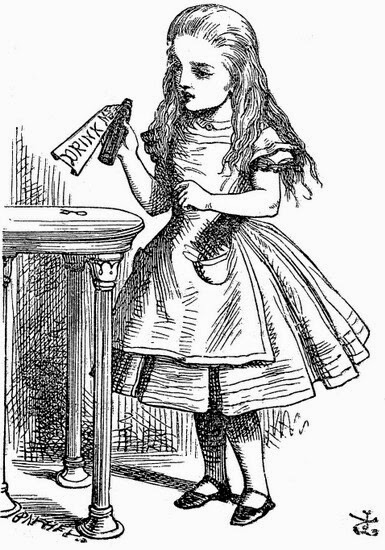
In 1850 Tenniel joined the staff of Punch magazine as principal political cartoonist, he held that post for some 50 years. His work drew the attention of Charles Dodgson (aka Lewis Carroll) who approached the artist with a request that he should illustrate a book, Alice's Adventures Under Ground. The book was published, in 1865, as Alice's Adventures in Wonderland, it contained 34 beautifully engraved line drawings, by John Tenniel, and became a classic. Tenniel later provided illustrations for Through the Looking-Glass(1872).

John Tenniel's work as cartoonist was always his natural preference, though his fame to this day, some 145 years later, stems from his "Alice" book illustrations. The reason being, I guess, that his political cartoons were "of that moment", and soon lost much of their relevance. They remain interesting, as pieces of history, though.

John Tenniel died on 25 February 1914.

A few examples of his cartoons, along with some of his best known illustrations.

In an arena formed of cotton bales, President Lincoln (still shown as clean-shaven) and the newly-elected President of the Confederate States, Jefferson Davis, square off as gladiators before an audience comprised of black slaves, one of whom sits in imperial state [cf. April 29, 1865]. The caption’s reference to “Emperor Caesar” may be ironically intended, as Caesar was a popular slave name.

The two combatants are armed with Bowie knives rather than the Roman gladius short swords. Each also has a pistol tucked into his belt, reflecting European perceptions about American violence and lawlessness (in many countries it was illegal for ordinary citizens to carry firearms). Lincoln holds a shield emblazoned with a representation of the national flag of the United States, while Davis’ shield bears the “Stars and Bars” flag. (See HERE)

  Widespread sympathy was felt in Britain for the grief  of the United States after Lincoln's assassination

 Father Neptune: Look here, my lass! You used to "Rule the Waves" but if you mis-rule 'em, as you've done lately, by jingo there'll be a row!!!
Britannia I'm sure I don't know who's to blame Papa dear!
Father Neptune: Don't know !!!  Then pipe all hands and find out!!!


ASTROLOGY

Born in London on 28 February 1820. No time of birth available, chart set for 12 noon.


Sir John Tenniel had a natal Pisces/Aries blend - not as easy-going a blend as Pisces/Aquarius I'd have thought. Creative dreamer blended with enthusiastic initiator. His Aries bits must have felt like a regular alarm bell constantly waking him from dreaminess. In his early years he did train, under his father's tuition, in a variety of athletic activities - this relates well to the Aries flavour in his chart. I haven't read much about the kind of man he was - or was perceived to be. From his artwork we have to assume he had a continuing sharp interest in political matters, and put this to use via his undeniable talent for drawing. His "Alice" book illustrations, though they brought him fame, were not really what he was about. Cartooning and politics seem to have been his first loves.

Sun, Mercury and Jupiter lay in Pisces, sign ruled by Neptune, and reflect his creativity, whether via his drawings of Alice's adventures, or illustrating the vagaries of political life in 19th century Britain and elsewhere.

Natal Saturn (law, authorities etc.) at 0 Aries, degree known as The Aries Point, a powerful degree, might offer a clue to his keen interest in political matters and interpretation of them in satirical fashion. Neptune conjunct Uranus on the Capricorn/Sagittarius cusp, though in itself a generational aspect, because the conjunction lay in helpful sextile to Tenniel's natal Jupiter, which conjoined his Sun/Mercury, adds a touch of the unexpected (Uranus) to this artist's creative (Neptune) gifts.

Without a time of birth Moon's exact position isn't known, other than that it would have been in Leo or Virgo as he was born. I don't have a reasonable guess to offer!

Friday, December 19, 2014

Arty Farty Friday ~ The Santa Side of Thomas Nast

I can't let this Arty Farty Friday - last one before Christmas - go by without taking a look at 19th century illustrator and cartoonist Thomas Nast. As well as being one of the USA's first influential (and controversial) political cartoonists he was the true originator of the image of Santa Claus we've grown used to seeing all our lives. Some people contend that Haddon Sundblom should be credited with the creation of today's best-known Santa image. His version is the one Coca Cola still uses. Sundblom was born more than 50 years after Nast though - he was not the originator, but was clearly inspired by Nast's Christmas illustrations.

Thomas Nast was born in Landau, Germany, on
27 September 1840, relocated to New York with his family six yeas later. His natural talent for drawing showed up early, by age 16 he was a draftsman for The Illustrated Newspaper. Three years later his work appeared in Harper's Weekly where he illustrated a report exposing police corruption. He soon became famous for cartoons castigating dishonest politicians, the Klu Klux Klan, and anarchists, while supporting the rights of Native Americans, African Americans, and conservation of wildlife.

Another of Nast's creations was the Democrat donkey, it appeared in an 1870 Harper's Weekly cartoon and was intended to represent an anti-war faction with whom he disagreed. The donkey symbol caught the public's imagination so the cartoonist continued using it to indicate some Democratic editors and newspapers.

His Christmas-time illustrations of Santa Claus, inspired by Clement Moore's well-known poem, The Night Before Christmas, must have provided Nast with a much-needed breather from constant political angst! His love for his wife and family show through in his Christmas drawings, his children appear in some of them, and settings reflect Nast's home in Morristown, New Jersey. It is thought that tales of St. Nicholas heard in Germany as a child also inspired his perception of Santa Claus, a perception that changed and developed as time passed. One of his early drawings of Santa depicted a small, almost elfin, character dressed in brown; another, from Civil War days is below. (Click on any image for a larger, clearer view.)


ASTROLOGY
Thomas Nast: born in Landau, Germany on 27 September 1840. Chart set for 12 noon as no time of birth is known.


With Sun, Mercury, Venus (art) and very possibly Moon in Venus-ruled Libra; also Neptune in socially conscious Aquarius harmoniously trining the planets in Libra, it's no surprise to find a socially conscious artist emerge! Where's his Santa-vibe though? Is it quirky Uranus in dreamy Pisces in trine to expansive, generous Jupiter in secretive Scorpio? I think so! Santa can be the world's best kept secret.


A few more examples of Thomas Nast's Santa side:


He illustrated books published by McLoughlin Brothers such as A Visit From St. Nicholas, Santa Claus and His Works, and provided Harper's Weekly with annual Christmas drawings until 1886. In 1889 his popular Christmas drawings from Harper's were published in a book: Christmas Drawings for the Human Race.