Showing posts with label architecture. Show all posts

Monday, February 25, 2019

Music Monday ~ Musically Architectural ?

Quora question:

If each music genre becomes an architecture what would it look like?


The answer by Jim Davis at the link has a selection of architectural illustrations for each music genre.


My non-pictorial answer would be along these lines:

Classical: Roman architecture
Pop/Rock: A typical city street
Jazz: An out-of-the-ordinary building (Frank Lloyd Wright skyscraper for example -see here)
Big Band and Swing: Dance Hall
Country: Rural ranch style dwelling
Christian: A church
Blues: Small, crumbling cottage in a rural swampy, or run-down urban area.


On a related theme, my post from last year:
Music Monday - Meet the Genres


Classical - Tall, handsome gentleman, polite and charming, with a beautifully dressed lady on his arm.

Swing & Big Band - Clean-cut happy-go-lucky guy in blazer and slacks, will buy drinks all round at the bar, girl friend is a leggy blonde who loves to socialise.

American Standards - A bit of a solitary nerd, horn-rimmed spectcles, always scibbling on the back of tickets and cigarette packets.

Jazz - African American couple, moody, changeable, charismatic, but for outsiders, not easy to understand.

Blues - Solitary, gloomy African American guy - tends to study his own navel a lot.

Early Rock and Roll - Teen school friends, frequent the coffee bars, a bit full of themselves- they think they've invented the wheel.

Psychadelic 60s - Good looking young couple, long flowing hair, he bearded, she bra-less, both smoking - something.

Country - A couple who've been through the mill, romantically and in life generally. They drive an old truck & go to church of a Sunday.

Folk - A youngish couple who have an oddly old fashioned look, a bit rumpled, a bit unkempt, yet they always retain a certain classiness.

Friday, July 13, 2018

Arty Farty Architectural Friday

I found this collection of photographs of:
The most beautiful building in every US state, according to people who live there
well worth wandering through. I did worry and wonder about what our home state of Oklahoma's input would be, I needn't have done so, it's absolutely fine, as are the two "Honorable Mentions" for the state.

Friday, July 21, 2017

Arty Farty Friday ~ From Hopper House to McMansions to Rapunzel & Pringles

The Sun will soon leave zodiac sign Cancer, for this year, but before it does I notice there'll be an important American painter's birthday anniversary tomorrow, that of Edward Hopper. I've blogged about this artist on three past occasions: HERE, HERE and HERE, between 2007 and 2013. Today I'm drawing attention, again, to just one of his works:

The House by the Railroad (1925)


Edward Hirsch wrote a poem about that painting, it begins:

The House by the Railroad

Out here in the exact middle of the day,
This strange, gawky house has the expression
Of someone being stared at, someone holding
His breath underwater, hushed and expectant;

This house is ashamed of itself, ashamed
Of its fantastic mansard rooftop
And its pseudo-Gothic porch, ashamed
of its shoulders and large, awkward hands......

Full poem can be read HERE

It ends:

...This man will paint other abandoned mansions,
And faded cafeteria windows, and poorly lettered
Storefronts on the edges of small towns.
Always they will have this same expression,

The utterly naked look of someone
Being stared at, someone American and gawky.
Someone who is about to be left alone
Again, and can no longer stand it.


I was reminded of this particular Hopper painting after spending much time nodding and chuckling though a website/blog McMansion Hell. There's a section devoted to the 50 States of McMansion Hell, where the author, Kate Wagner, has begun taking readers through the architectural horrors and decor mis-demeanors of high-priced modern mansions in each US state. There are also sections devoted to architecture, McMansions 101, history, as well as some of general arty-farty type interest. A visit is highly recommended. From the home page, to access heading links to all the good stuff available, just click on the three little lines in the very top left-hand corner of the screen.

Edward Hopper's House by the Railroad wasn't, of course, a McMansion, but many of today's over-priced, piles, filled with pretensions to opulence and historical relevance do owe a lot to similar styles from decades past - it's just that they their designers didn't know when to stop - or where!

I've wondered if, in decades long past, builders used a common catalogue of styles available as "sets" - a bit like a Lego set. The customer would pick one from the "menu" and could also order from a list of "sides" - as happens in restaurants. Perhaps the same things happen today, in the case of McMansions, but menus now have a wider variety of sides, and McMansion customers have bigger appetites and fatter wallets.
 "Rapunzel Towers"

 McMansion "Pringle Can of Shame"
As we drive around, just through some of our neighbouring "fly-over" states, we often spy much older houses, either left unoccupied, or currently owned by people of fairly modest means, sporting what we've come to call "Rapunzel Towers"; Ms Wagner calls these "Pringles Cans of Shame". Kansans, especially, during past decades, seem to have had a liking for this "side" of architectural kitsch.

Friday, June 06, 2014

Arty Farty Friday ~ Charles Rennie Mackintosh & Margaret MacDonald Mackintosh

Charles Rennie Mackintosh, a longtime favourite of mine. Back in the UK I had framed posters and prints of his work around my bedroom walls. He was born exactly a year after famous American architect Frank Lloyd Wright, my post on both men and their natal charts is HERE. I've lifted the Mackintosh portion for today's post so's I can add some information including the chart of Charles' artist wife Margaret MacDonald Mackintosh.

First, a reprise on Charles Rennie Mackintosh, - his birthday anniversary falls tomorrow, 7 June. Biographical detail is at the Wiki link, also HERE, so I will not repeat the bulk of it.

Mackintosh found many and diverse outlets for his talents: watercolours, posters, furniture design, architecture, interior design. Such diversity is fitting for a Sun Gemini individual. While Frank Lloyd Wright is famous for his dramatic architectural work, the talent of Charles Rennie Mackintosh shines most brightly from his exquisite interior design and artwork. He did design houses, and buildings such as the Glasgow School of Art, notable in their own way, and more traditional in design and proportion than those of his Gemini contemporary across the Atlantic.

Charles Rennie Mackintosh blended the sinuous organic style of Art Nouveau and and the simplicity of Japanese form to create something unique. His architecture remained truer to Scottish tradition, his interiors didn't. Sadly, his talent didn't bring the accolades he deserved in his own lifetime. In "The Mackintosh Style" by Elizabeth Wilhide the author remarks that:

"Sheer bad luck, professional setbacks and misunderstanding conspired to provide Mackintosh with what has been described as 'a tragically small range of opportunities'.

A proud and difficult temperament only made matters worse and gave a sad inevitability to his decline. What began so brilliantly ended in self-imposed exile, near-penury and almost critical eclipse."

Mackintosh died of cancer at age 60.

It is poignant and ironic to note that Charles Rennie Mackintosh's furniture and artwork now sell for millions of pounds/dollars, yet at the time of his death his entire estate, which comprised the contents of two studios, was assessed at 88 pounds ($136.40). Mackintosh buildings were being demolished as late as mid-20th century, whereas today they are prized for the treasures they truly are.


House for an Art Lover


Glasgow School of Art


Born in Glasgow, Scotland UK, on 7 June 1868 - no time known- chart below set for 12 noon.


His Uranus/Mercury conjunction reflects the avant garde styles he presented to what must have been, at times, an astonished public. His designs were fresh and new, like nothing seen before in traditional Scottish circles. I've often thought that he was born at least a couple of decades before his time. I guess having Uranus so close to a very personal planet like Mercury can do that to a person!

Sun is alone in Gemini. Mercury/Uranus and Venus lie in sensitive Cancer. A serious Capricorn Moon would have been somewhere between 6 and 18 degrees.

The probable (can't be sure without time of birth) opposition between Uranus/Mercury in Cancer and Moon in Capricorn suggests an internal struggle which could have made his temperament seem "difficult". The Mars/Pluto conjunction in Fixed sign Taurus could also reflect a somewhat stubborn or awkward nature. Sun is tightly sextile (helpful aspect) Neptune in Aries (creativity), but Jupiter is square (challenging) Mercury/Uranus - is this a possible source of his lack of lucky breaks and opportunity?

There's a loose Grand Trine linking Jupiter in Aries to Saturn in Sagittarius to Venus in the last degrees of Cancer. Jupiter, Venus and Saturn are three helpful planets for an artist/architect to have within a linked circuit - technically this is a Fire Grand Trine indicating a go-getter, initiator, but Venus has slipped just off the Leo leg, and lies still in Cancer. Maybe a symbolic indication of the slipping away of the fame to which he was justly due, within his lifetime.


MARGARET MacDONALD MACKINTOSH

Margaret was born on 5 November 1864 in Tipton, near Wolverhampton, England. The family later moved to live in Scotland. She met Charles around 1893, while she and her sister Frances were studying at the Glasgow School of Art. They married in 1900. Margaret was described as a woman who was totally original in looks and style. She had no poses, great masses of coppery burnished hair, above a broad brow and quiet eyes. Charles and Margaret seem to have achieved that elusive wonder "a match made in heaven". It's warming to find at least one among the marital detritus of the art world in general.

Margaret's sister, Frances married Charles' friend Herbert MacNair, they formed the group known as The Glasgow Four, and became pioneers of what was later termed Glasgow Style. Both sisters' names remained in the shadow of their famous husbands, but whereas MacNair destroyed most of Frances's work after her death, Charles Rennie Mackintosh acknowledged and revered Margaret's work and her contribution to his own creativity.

Margaret's watercolour paintings had influenced in Charles' own creative development, and she collaborated with him on many of his decorative and architectural projects. After 27 years of marriage, and not long before he died, Charles wrote to Margaret: You must remember that in all my architectural efforts you have been half if not three-quarters of them. He had often been heard to express the opinion that, while he possessed talent, his wife had genius. In 1914 the couple settled in England, living in Chelsea, London 1916-23, then in Port Vendres in the French Pyrenees from 1923 to 1927. Margaret died in January 1933.

A few examples of Margaret's work, then a look at her natal chart.


 Opera of the Winds. Gesso panel created for the front of the piano for Fritz Waerndorfer's Music Room in Vienna.

 Decorative panel, White Rose, Red Rose


ASTROLOGY

Both charts are here for easy comparison. Both are set for 12 noon as no times of birth are known.

Margaret, born 5 November 1864, Tipton, UK


Charles, born 7 June 1868 in Glasgow, Scotland, UK


The pair probably shared a Capricorn Moon, though we cannot be absolutely certain about Margaret's without a time of birth. Their natal Suns, without the aid of some other commonalities could have meant these two would never have felt an attraction to one another, but his Sun at 16 Gemini, linked to her Mars at 17 Gemini; his Saturn at 1 Sagittarius, to her Jupiter at 2 Sagittarius and Venus at 11 Sagittarius. These links must have combined to forge a strong enough astrological compatibility to manifest in a happy working partnership and idyllic marriage. A nice piece of evidence against jumping to conclusions about compatibility on Sun sign alone!

Friday, November 09, 2012

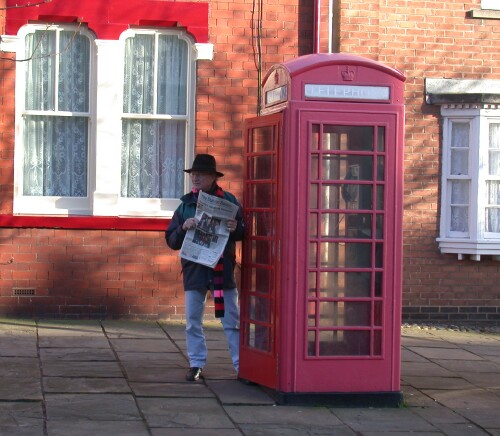
Arty Farty Friday ~ That Kiosk & Giles Gilbert Scott

The image shown on this postage stamp will be a familiar sight to any Brit, or anyone who visited the fair shores of the land of my birth during the 20th century, and beyond. Not quite as familiar to most of us is the name of its designer: Giles Gilbert Scott, architect. He was born in Hampstead, London on this day in 1880, 9 November, into a family of successful architects, both his father and grandfather were of that profession. He died in 1960.


Below: a photograph I took back in the UK, must have been in 2004. Husband appears to be holding up the local newspaper of his (now our) US hometown. I think he sent it for publication. At the time both his daughter and son-in-law worked on that newspaper, which occasionally carried pics of residents carrying the paper "in foreign parts". I also can see that he had my long striped scarf dangling, and the big black hat: Dr. Who? The box is wrong in colour and purpose though. Tardis is a Police Box, and blue - but y'all knew that.


Wikipedia
Scott's most ubiquitous design was for the General Post Office. He was one of three architects invited by the Royal Fine Arts Commission to submit designs for new telephone kiosks.The invitation came at the time Scott was made a trustee of Sir John Soane's Museum. His design was in the classical style, topped with a dome reminiscent of the mausoleum Soane designed for himself in St Pancras Old Churchyard, London. It was the chosen design and was put into production in cast iron as the GPO's "Kiosk no. 2" or "K2". Later designs adapted the same general look for mass production: the Jubilee kiosk, introduced for King George V's silver jubilee in 1935 and known as the "K6" eventually became a fixture in almost every town and village.

A related aside:
At Christmas, not long after I'd emigrated here to be with my husband, his son "AJ", who has inherited a goodly amount of creativity from his Dad, made this model for me from scrap copper - no doubt to help prevent me from feeling homesick.


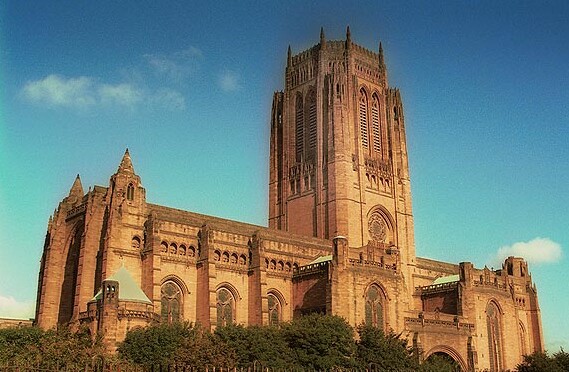
Some of G.G. Scott's other designs are equally familiar sights in the UK: Liverpool's Anglican Cathedral and Battersea Power Station, for instance.


See more detail of Giles Gilbert Scott's life and work at Wikipedia.


A quick look at his natal chart, or at least one set for 12 noon. Information on his time of birth can't be found.


Two things stand out for me, especially in relation to that telephone kiosk!
1. The harmonious trine between Mercury (communication) at 9 Sagittarius (expansion) and Jupiter(expansion) at 10 Aries (initiation).
2. The Yod (Finger of Fate) linking a sextile between Sun/Mars in Scorpio to Uranus in Virgo, then 150* quincunx links from both to
again, Jupiter in Aries. Translated as the energy and passions of Scorpio linked to the meticulous planning of something new and forward-looking channelled through Jupiter, planet of expansion in Aries sign of initiation.

Friday, June 12, 2009

Arty Farty Friday ~ Frank Lloyd Wright & Charles Rennie Mackintosh


Two famous architects who were also interior designers and artists, born on opposite sides of the North Atlantic Ocean, exactly a year apart, with Sun in Gemini.


FRANK LLOYD WRIGHT

We saw one of Frank Lloyd Wright's buildings last weekend when we visited Bartlesville in NE Oklahoma. There stands FLW's only skyscraper, The Price Tower - and beautiful it is too! Very Art Deco. Deliberately laced with copper decoration, so that, over time, it would turn to a beautiful dark green. I took this photograph:


Wright nicknamed the Price Tower, which was built on the Oklahoma prairie, "the tree that escaped the crowded forest," referring not only to the building's construction, but also to the origins of its design. The Price Tower is supported by a central "trunk" of four elevator shafts which are anchored in place by a deep central foundation, as a tree is by its taproot. The nineteen floors of the building are cantilevered from this central core, like the branches of a tree. (Wikipedia)

The Price Tower now houses a museum, hotel and bar in the heart of downtown Bartlesville.

More of his architectural designs:

A Greek Orthodox Church in Wisconsin


The Guggenheim, New York


Fallingwater - house designed by Frank Lloyd Wright


Frank Lloyd Wright born in Richland Center, Wisconsin on 8 June 1867 at 8pm (Astrotheme).


What am I looking for in the natal chart of an architect? As well as some strong Venus (artistry), I expect to see some prominent Saturn. Saturn relates to structure and engineering, mathematics - all necessary elements in architectural design.

If Astrotheme's given time of birth is correct Neptune (creativity, imagination) was very close to midheaven (the career area of the chart). Venus, planet of the arts, conjunct Pluto (power and passion) is in 10th house of career and public status.
Saturn (structure, engineering) is exactly opposing Venus/Pluto, from Scorpio (ruled by Pluto) creating a dynamic push-pull energy across the chart. Moon in detail- oriented Virgo brings in a necessary dedication to accuracy.

Overall, this natal chart is well-balanced, element-wise. I note a Yod (Finger of Fate) linking the sextile between Sun and Neptune, via 2 quincunx aspects to.....Saturn. So we have Saturn opposing Venus and Pluto and forming the apex of this Yod, channelling energy from Sun (self) and Neptune (creativity) via Saturn (structure, engineering, mathematics). Et voila - an architect!


"The mother art is architecture. Without an architecture of our own we have no soul of our own civilization"
(Frank Lloyd Wright)


CHARLES RENNIE MACKINTOSH

This is a favourite artist of mine. Back in the UK I had framed posters and prints of his work around my bedroom walls. He was born exactly a year after Frank Lloyd Wright.

Charles Rennie Mackintosh had many and diverse outlets for his talents: watercolours, posters, furniture design, architecture, interior design. Such diversity is fitting for a Sun Gemini. While Frank Lloyd Wright is most famous for his dramatic architectural work, the talent of Charles Rennie Mackintosh shines most brightly from his exqusite interior design and artwork. He did design houses, and buildings such as the Glasgow School of Art, notable in their own way, and more traditional in design and proportion than those of his Gemini contemporary across the Atlantic.

Mackintosh blended the sinuous organic style of Art Nouveau and and the simplicity of Japanese form to create something quite unique. His architecture did remain truer to Scottish tradition, his interiors didn't. Sadly, his talent didn't bring the accolades he deserved in his own lifetime. In "The Mackintosh Style" by Elizabeth Wilhide the author remarks that:

"Sheer bad luck, professional setbacks and misunderstanding conspired to provide Mackintosh with what has been described as 'a tragically small range of opportunities'.

A proud and difficult temperament only made matters worse and gave a sad inevitability to his decline. What began so brilliantly ended in self-imposed exile, near-penury and almost critical eclipse."

Mackintosh died of cancer at age 60.

It is poignant and ironic to note that Charles Rennie Mackintosh's furniture and artwork now sell for millions of pounds/dollars, yet at the time of his death his entire estate, which comprised the contents of two studios, was assessed at 88 pounds ($136.40). Mackintosh buildings were being demolished as late as mid-20th century, whereas today they are prized for the treasures they truly are.


House for an Art Lover


Glasgow School of Art


Born in Glasgow, Scotland UK, on 7 June 1868 - no time known- chart below set for 12 noon.


His Uranus/Mercury conjunction reflects the avant garde styles he presented to what must have been a sometimes astonished public. His designs were fresh and new, like nothing seen before in traditional Scottish circles. I've often thought that he was born at least a couple of decades before his time. I guess having Uranus so close to a very personal planet like Mercury can do that to a person!

Sun is alone in Gemini. Mercury/Uranus and Venus lie in sensitive Cancer. A serious Capricorn Moon would have been somewhere between 6 and 18 degrees.

The probable (can't be sure without time of birth) opposition between Uranus/Mercury in Cancer and Moon in Capricorn suggests an internal struggle which could have made his temperament seem "difficult". The Mars/Pluto conjunction in Fixed sign Taurus could also reflect a somewhat stubborn or awkward nature. Sun is tightly sextile (helpful aspect) Neptune in Aries (creativity), but Jupiter is square (challenging) Mercury/Uranus - is this a possible source of his lack of lucky breaks and opportunity?

There's a loose Grand Trine linking Jupiter in Aries to Saturn in Sagittarius to Venus in the last degrees of Cancer. Jupiter, Venus and Saturn are three helpful planets for an artist/architect to have within a linked circuit - technically this is a Fire Grand Trine indicating a go-getter, initiator, but Venus has slipped just off the Leo leg, and lies still in Cancer. Maybe a symbolic indication of the slipping away of the fame to which he was justly due, within his lifetime.
"There is hope in honest error - none in the icy perfections of the stylist." (Charles Rennie Mackintosh)