
Got back from our trip on Thursday evening, feeling somewhat "knackered" as they say in Yorkshire. A few nights in an assortment of strange beds can do that to a body - but we don't mind, our trip made a little fatigue worthwhile.
This trip was part planned part left to chance. Eventual destination would be, we hoped, Madison County, Iowa, to see those covered bridges made famous by Robert J. Waller's novel and the subsequent movie based on it. I've been itching to see the bridges for years. I, along with many people, found the film and the novel emotionally moving.
Each time we began planning a trip to Madison County in the past, something got in the way. This time we made it! Good thing we didn't plan too rigidly because I'd overlooked the matter of late summer State Fairs and suchlike. For instance, the unexpected Husker Harvest Days festival in Grand Island, Nebraska, and Kansas State Fair in Hutchinson, Kansas had motels filled to overflowing putting some receptionists in a spin. The motels and hotels were charging well-hiked rates for remaining vacant rooms. We had to bite the bullet and pay up the outlandish rate. However, we did give the the heaving Fairs themselves a wide berth. I enjoy local colour but not en masse!

Our route: northern Oklahoma, eastern Kansas, eastern Nebraska and western Iowa.....then back along a reversed and slightly different trail. We set off in hot hot temperatures, high 90s until we reached Nebraska, and eventually Iowa when we enjoyed a couple of delightfully cool but sunny days, just right for exploring the bridges. Rain and a cold front followed us home.
Some photographs from both my camera and the husband's, and a few notes:
By the time we reached Auburn, Nebraska around noon, Friday 7 September the temperature had cooled from high 90s in Kansas to just 65 degrees! Wonderful! We crossed the wide Missouri River. There are museums and memorial sculptures to Lewis & Clark , scattered around here. Their famous expedition took the pair through this area.
On into Iowa and a teeny tiny town, Walnut, known as "Iowa's Antique City" due to it's single street comprising of a dozen or so antique stores. We were not unduly impressed by the stores there - when several dealers gather together like this prices tend to rise to ridiculous levels. Husband's search for vintage photographs turned up few worthy of collection, prices way above those we see frequently elsewhere.
The name of Walnut's local newspaper (possibly now defunct)tickled me more than anything else in the town.

Scant choice of eating places in Walnut didn't appeal one little bit, then Husband discovered he'd somehow lost the cellphone (a Tracfone with a ton of unused units on it!) He'd either left it at our last stop in Emporia, Kansas, or it had dropped from his shirt pocket somewhere along the way. Our phone remains lost. We moved on from Walnut after one night's stay.
Rather than going on to West Des Moines as originally intended, we decided to drop anchor in a smallish town, Stuart, for a couple of nights. It appeared to be a handy base from which to explore The Bridges, avoiding the bustle of a big city. Iowa, outside of its few urban areas, is a very "farmy" state, even more so than Oklahoma -and that's hard to do!
First thing we saw in Stuart:

Then... (in case not readable "Site of Bonnie Parker & Clyde Barrow Bank Robbery April 16 1934")

Saturday evening in Stuart. We intended to take in a movie at the town's tiny cinema, but on the way there realised something was afoot. A Classic Car rally was in session. Beautifully restored American classics some parked, some cruising a circular route around town. We forgot the movie and concentrated on the cars. Locals were out enjoying the evening, children catered for with 1960s music, hula-hoop competitions and popcorn etc. A really nice atmosphere and small-town scenario unfolded. Husband commented that it does one a power of good to see that such pleasantly old-style atmospheres can still remain within these pockets of peaceful existence.


Below is what's probably the grand-daddy of our own Chevy Monte Carlo


On Sunday we "did" 4 of the 6 bridges. First visit was to Roseman Bridge (the famous one featured in Bridges of Madison County). The bridges are mostly found via unmade dusty roads. Clouds of white dust follow vistors' cars which, seen from a distance look like earth-bound comets with tails.


(Taken from an information plaque):
We also visited Holliwell Bridge (the longest), Cutler-Donohoe Bridge, and Hogsback Bridge. We gave Cedar Bridge a miss as it's not the original - a restoration after arsonists burned the old bridge in 2002 (how could they??) We didn't make the trek to Imes Bridge, 15 miles away. To be honest, all the bridges look much the same, apart from slight variation in size, inner construction style and the immediate surrounding areas.


As fascinating as the bridges themselves were, the many inscriptions on their inner walls intrigued me almost as much. Local authorities paint an area in the bridges' entrance-ways white, especially for visitors to inscribe messages. The white paint is obviously renewed every few years; older messages sprawl well beyond painted areas though. Some inscriptions are very, very touching: some to loved ones who've passed on, some to lovers wronged and regretted, or many just simple loving messages. There are, of course, many of the "so-and-so loves so-and-so", or "Kilroy Was Here" variety, but all in all these sites could be said to house Bridges of Love. Being a bit of a romantic myself, I choked up more than once while reading inscriptions.
Robert Kincaid in The Bridges of Madison County: "This kind of certainty comes but once in a lifetime". A quote remembered by one inscriber:


We looked around Winterset, small town featured in The Bridges of Madison County book and film, saw a few locations mentioned in the novel. I tried to decide which traffic lights were the ones where Robert Kincaid's truck stopped in front of Francesca, sitting in her husband's truck, in one of the most heart-rending scenes of the movie.


Also in Winterset is a house, birthplace and young childhood home of John Wayne whose family (and he) moved to California when he was 4 years old.
A couple more curiosities, this also in Winterset:
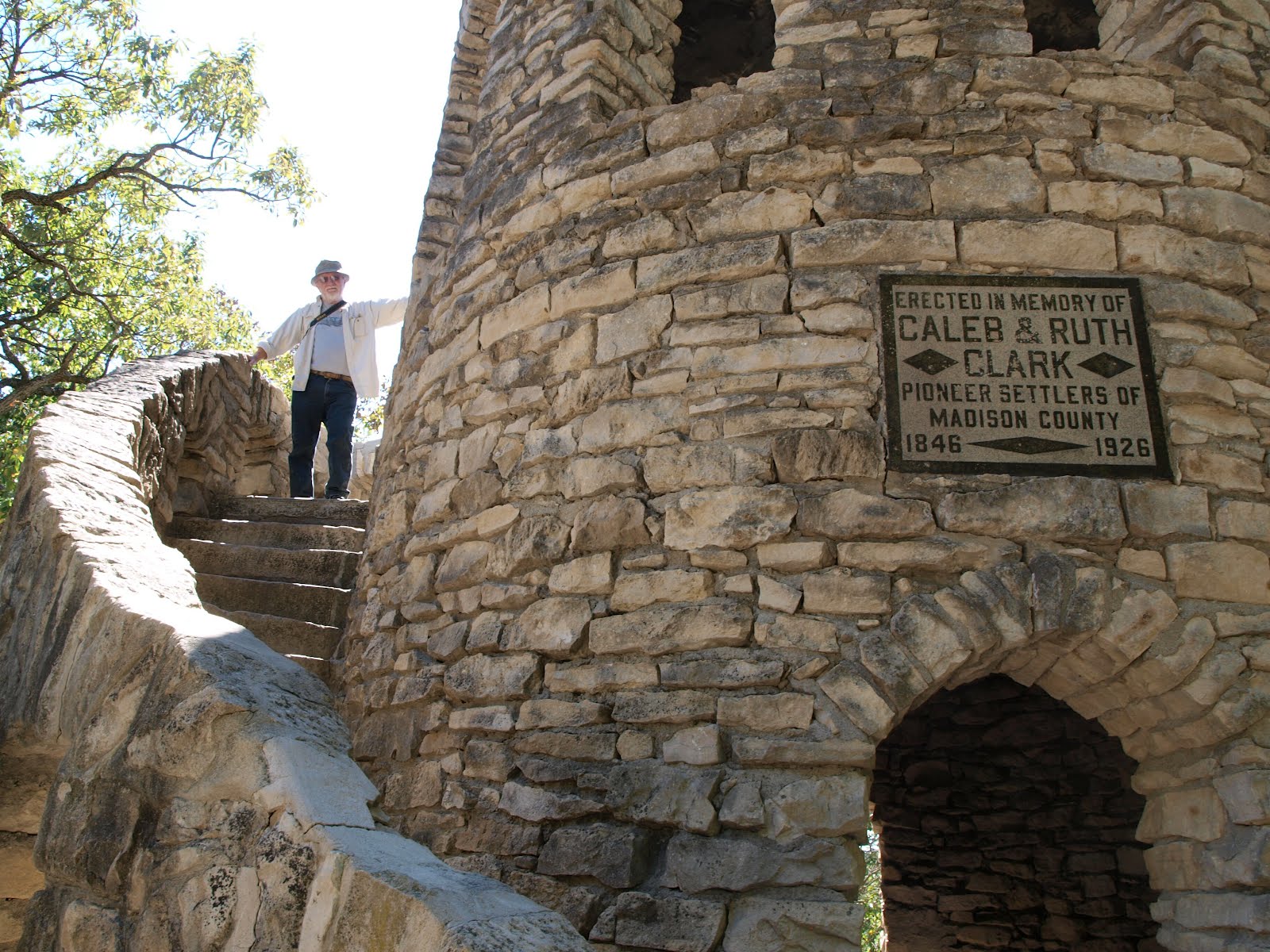
Clark's Tower, accessed via a long winding unmade tree-lined roadway up a steep hillside. Built in memory of Madison County's first pioneers, Caleb and Ruth Clark.


And.... one of those weird all-American "Roadside Attractions" in tiny Cawker City, Kansas:


An old 2-room jail in another tiny town, Buhler, Kansas, not far from Hutchinson, next to site of the old court-house now long gone, and the Town Hall now an antique store.

Hutchinson, Kansas where we stayed for two nights is a biggish city, but manages to retain its friendly atmosphere. Parts of the 1955 film Picnic were filmed there - among the city's humungous grain elevators (scene from movie below).

It was too awkward to get a photograph, so here's an old postcard of one of 'em

This post is already longer than intended, so just as postscript: we noted novelist Willa Cather's birthplace and a tribute museum in Red Cloud - last town in Nebraska before the Kansas border. We passed through centre point of the 48 contiguous United States in Lebanon, Kansas; and drove through Kingfisher Oklahoma, birthplace of Walmart's Sam Walton.
An excellent trip!
This trip was part planned part left to chance. Eventual destination would be, we hoped, Madison County, Iowa, to see those covered bridges made famous by Robert J. Waller's novel and the subsequent movie based on it. I've been itching to see the bridges for years. I, along with many people, found the film and the novel emotionally moving.
Each time we began planning a trip to Madison County in the past, something got in the way. This time we made it! Good thing we didn't plan too rigidly because I'd overlooked the matter of late summer State Fairs and suchlike. For instance, the unexpected Husker Harvest Days festival in Grand Island, Nebraska, and Kansas State Fair in Hutchinson, Kansas had motels filled to overflowing putting some receptionists in a spin. The motels and hotels were charging well-hiked rates for remaining vacant rooms. We had to bite the bullet and pay up the outlandish rate. However, we did give the the heaving Fairs themselves a wide berth. I enjoy local colour but not en masse!

Our route: northern Oklahoma, eastern Kansas, eastern Nebraska and western Iowa.....then back along a reversed and slightly different trail. We set off in hot hot temperatures, high 90s until we reached Nebraska, and eventually Iowa when we enjoyed a couple of delightfully cool but sunny days, just right for exploring the bridges. Rain and a cold front followed us home.
Some photographs from both my camera and the husband's, and a few notes:
By the time we reached Auburn, Nebraska around noon, Friday 7 September the temperature had cooled from high 90s in Kansas to just 65 degrees! Wonderful! We crossed the wide Missouri River. There are museums and memorial sculptures to Lewis & Clark , scattered around here. Their famous expedition took the pair through this area.
On into Iowa and a teeny tiny town, Walnut, known as "Iowa's Antique City" due to it's single street comprising of a dozen or so antique stores. We were not unduly impressed by the stores there - when several dealers gather together like this prices tend to rise to ridiculous levels. Husband's search for vintage photographs turned up few worthy of collection, prices way above those we see frequently elsewhere.
The name of Walnut's local newspaper (possibly now defunct)tickled me more than anything else in the town.

Scant choice of eating places in Walnut didn't appeal one little bit, then Husband discovered he'd somehow lost the cellphone (a Tracfone with a ton of unused units on it!) He'd either left it at our last stop in Emporia, Kansas, or it had dropped from his shirt pocket somewhere along the way. Our phone remains lost. We moved on from Walnut after one night's stay.
Rather than going on to West Des Moines as originally intended, we decided to drop anchor in a smallish town, Stuart, for a couple of nights. It appeared to be a handy base from which to explore The Bridges, avoiding the bustle of a big city. Iowa, outside of its few urban areas, is a very "farmy" state, even more so than Oklahoma -and that's hard to do!
First thing we saw in Stuart:

Then... (in case not readable "Site of Bonnie Parker & Clyde Barrow Bank Robbery April 16 1934")

Saturday evening in Stuart. We intended to take in a movie at the town's tiny cinema, but on the way there realised something was afoot. A Classic Car rally was in session. Beautifully restored American classics some parked, some cruising a circular route around town. We forgot the movie and concentrated on the cars. Locals were out enjoying the evening, children catered for with 1960s music, hula-hoop competitions and popcorn etc. A really nice atmosphere and small-town scenario unfolded. Husband commented that it does one a power of good to see that such pleasantly old-style atmospheres can still remain within these pockets of peaceful existence.


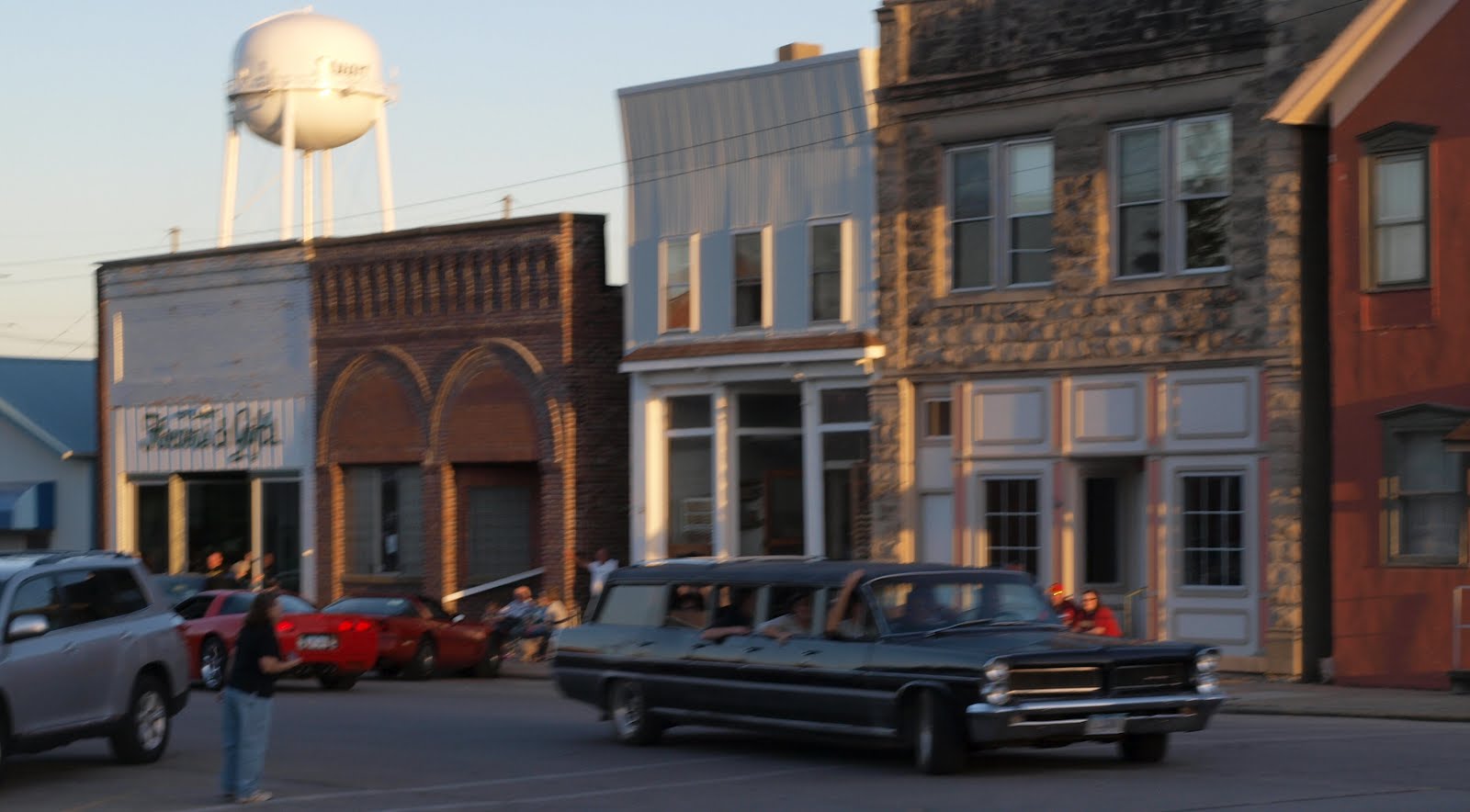
Below is what's probably the grand-daddy of our own Chevy Monte Carlo


On Sunday we "did" 4 of the 6 bridges. First visit was to Roseman Bridge (the famous one featured in Bridges of Madison County). The bridges are mostly found via unmade dusty roads. Clouds of white dust follow vistors' cars which, seen from a distance look like earth-bound comets with tails.


(Taken from an information plaque):
Roseman Bridge was completed in 1883 and was built by a local bridge builder, Benton Jones. Although only 6 covered bridges remain, there were many covered bridges once dotting Madison County in the early 19th century, all built by local craftsmen, with each bridge builder utilizing his own engineering design that uniquely separated the various construction styles.
Why did they cover the bridges? They were covered to protect them from the weather and extend their longevity. In 1870 a Board of Surveyors stated that "the expense of the roof is more than made up by the permanency of the bridge". The bridges ranged in cost from $900 to $1900. One historian quipped, "Bridges were covered for the same reasons women wore hoop skirts and crinolines, to protect the beauty seldom seen, but nonetheless appreciated."
The remaining bridges paint a story of pioneer people who took what they had and did the most with it. The structures which are attactive, durable and useful are a trubute to a generation of pioneers who left a land better than they found it and leaves us a link with a romantic past.
We also visited Holliwell Bridge (the longest), Cutler-Donohoe Bridge, and Hogsback Bridge. We gave Cedar Bridge a miss as it's not the original - a restoration after arsonists burned the old bridge in 2002 (how could they??) We didn't make the trek to Imes Bridge, 15 miles away. To be honest, all the bridges look much the same, apart from slight variation in size, inner construction style and the immediate surrounding areas.


As fascinating as the bridges themselves were, the many inscriptions on their inner walls intrigued me almost as much. Local authorities paint an area in the bridges' entrance-ways white, especially for visitors to inscribe messages. The white paint is obviously renewed every few years; older messages sprawl well beyond painted areas though. Some inscriptions are very, very touching: some to loved ones who've passed on, some to lovers wronged and regretted, or many just simple loving messages. There are, of course, many of the "so-and-so loves so-and-so", or "Kilroy Was Here" variety, but all in all these sites could be said to house Bridges of Love. Being a bit of a romantic myself, I choked up more than once while reading inscriptions.
Robert Kincaid in The Bridges of Madison County: "This kind of certainty comes but once in a lifetime". A quote remembered by one inscriber:


We looked around Winterset, small town featured in The Bridges of Madison County book and film, saw a few locations mentioned in the novel. I tried to decide which traffic lights were the ones where Robert Kincaid's truck stopped in front of Francesca, sitting in her husband's truck, in one of the most heart-rending scenes of the movie.


Also in Winterset is a house, birthplace and young childhood home of John Wayne whose family (and he) moved to California when he was 4 years old.
A couple more curiosities, this also in Winterset:
Clark's Tower, accessed via a long winding unmade tree-lined roadway up a steep hillside. Built in memory of Madison County's first pioneers, Caleb and Ruth Clark.

And.... one of those weird all-American "Roadside Attractions" in tiny Cawker City, Kansas:


An old 2-room jail in another tiny town, Buhler, Kansas, not far from Hutchinson, next to site of the old court-house now long gone, and the Town Hall now an antique store.

Hutchinson, Kansas where we stayed for two nights is a biggish city, but manages to retain its friendly atmosphere. Parts of the 1955 film Picnic were filmed there - among the city's humungous grain elevators (scene from movie below).

It was too awkward to get a photograph, so here's an old postcard of one of 'em

This post is already longer than intended, so just as postscript: we noted novelist Willa Cather's birthplace and a tribute museum in Red Cloud - last town in Nebraska before the Kansas border. We passed through centre point of the 48 contiguous United States in Lebanon, Kansas; and drove through Kingfisher Oklahoma, birthplace of Walmart's Sam Walton.
An excellent trip!


