Showing posts with label Arthur C. Clarke. Show all posts

Tuesday, December 18, 2018

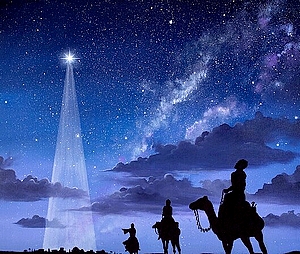
Stories of that Star of Wonder

During the run-up to Christmas, some years ago, I posted about the Star of Bethlehem story, which has always been something of a mystery to astronomers and astrologers alike. A then regular commenter and blog friend, "mike" related an alternative version of the Star's story. Commenter "mike" became ill, later on and had to cease commenting. I fear for the conclusion of his story. In memory of a good friend to this blog here is the story he related, as told at Wikipedia.


"The Star" was an episode of the Twilight Zone during its run in the 1980s, based on a science fiction short story by English writer Arthur C. Clarke.

I wasn't surprised to find that it originated with Arthur C. Clarke - I always enjoy his novels and imaginings.
"On an interstellar journey, far in the future, a medical doctor and a priest debate about the existence of God in the wonders of the universe. Dr. Chandler, believes in the random patterns, but the priest, Father Matthew Costigan—also an astrophysicist—believes it is God's grand design. While having their friendly debate and wishing each other a merry Christmas, their ship picks up a subspace signal from a long-dead world. Father Matthew claims it is impossible that a civilization could have survived its star going supernova. The planet was so far from the star when it exploded that it escaped the worst.

Upon landing on the now-dead planet, the explorers discover that the planet holds the last remains of a race which was destroyed when the supernova hit. Their civilization was quite advanced, with remnants of art and other pieces of their culture. Along with a computer record of their entire history comes evidence that they had had a thousand years of peace before their extinction. The captain requests Father Matthew to determine when the star went supernova. He calculates that the star exploded in the year 3120 B.C.

To his dismay, however, Father Matthew realizes that it would have taken 3120 years for the light from this explosion to reach Earth, in the Eastern Hemisphere. This star was the same star that shone down on Earth the day Jesus was born, "The Star of Bethlehem". In front of Dr. Chandler, Father Matthew cries out to God, to question why it had to be these people who had to lose their lives, why it could not have been a star with no life around it. Dr. Chandler attempts to comfort him by reading a poem he found among the archives of the advanced culture. It says that no one should mourn for them, for they lived in peace and love and saw the beauty of the universe. It says to grieve for those who live in pain and those who never see the light of peace. Dr. Chandler says that "whatever destiny was theirs, they fulfilled it. Their time had come, and in their passing, they passed their light on to another world. A balance was struck, and perhaps one day, whenever we've fulfilled whatever destiny we have, maybe we too will light the way for another world." The doctor's words and this quiet artifact consoles and encourages the priest."


What follows is copy-typed, by me, from a piece by Ann Barkhust in "The Best of the Illustrated National Astrological Journal 1933 and 1934."


The Star of Nativity, What was the Star? Who were the mysterious strangers?


The Star of Bethlehem has always been a fascinating enigma for modern astrologers. Present day believers (1933) in the star-legend are inclined to think the "Star of the East" might have been one of the transient stars which occasionally flare up in the heavens and then die away, often marking the death throes of a sun. Or, they say, it may have been a variable star; one which flares up for a few days or hours into great brightness, then sinks back into its usual dullness as though nothing had happened.

An increasing number of students, however, do not look to any star not in the usual course of the heavens. Quoting the "Zohar" we find the following: "When the Messiah is to be revealed a star will rise in the east shining in great brightness and will remain in the east fifteen days". So many of these ancient Jewish teachings have a foundation in the Egyptian that it lends corroboration to the claims of a modern school of astrological thought which identifies the Star of Bethlehem with the sacred Star of Egypt, Sirius, which is in the mid-heaven on Christmas Eve, at the time when the constellation Virgo, the Celestial Madonna, stands over the eastern horizon.

According to "Religion of the Stars", Sirius is the star that led the Wise Men from the East to the site of the blessed nativity. For ages prior to the time now allotted to that event, Sirius had been the star that indicated the coming of a Savior. At the present time (1933) Sirius rises on Christmas evening about seven o'clock, taking five hours and three minutes to reach the meridian. Thus now it stands directly overhead at midnight of Christmas Eve. This has not always been the case but for many thousands of years Sirius has been the most conspicuous object in the heavens Christmas night.

Jesus' birth, like that of all the other Messiahs, was the fulfillment of the promise foretold in celestial configuration. It is also stated in the Hebrew legends that a brilliant star shone at the birth of Moses, and was seen by the Magi of Egypt who immediately informed the King. Again it is said that when Abraham was born this star shone in the heavens eclipsing all other stars in glory. In his teachings to the Persians, the great teacher, Zoroaster, foretold the birth of the Christ-child at which time a shining star would be seen in the heavens. The Wise Men always knew precisely the time when the Sun would be in a direct line with that great fixed star, Sirius, the Dog Star.

In the "Celestial Ship of the North" the Magi - commonly call the Wise Men - are shown as astrologers who had pure, unassailable knowledge found in the Zodiacal heavens and the fixed stars. They were said to come from Arabia, but the word Arabia at the time of Jesus' birth meant not only Arabia Felix, but northern India, i.e. the Himalayas. These Magi were Mahatmas or Masters from India who had calculated astrologically the advent of Jesus and journeyed for two years or more to visit him. In the fifth chapter of the "Aquarian Gospel", by Levi Dowling, is found the following confirmation of this statement: "Beyond the River Euphrates the Magians lived; and they were wise, could read the language of the stars and they divined that one, a master soul, was born." Their number, three, is derived from the fact that they offered three gifts, but tradition had it that there were twelve or twenty Magi, and that the entire journey from India and a return took nearly five years. They fully realized that great planetary conjunctions are always coincident with critical periods on earth, at which time Mundane changes take place that are universal.

Kepler claimed positively that all the planets were in conjunction in Pisces when Jesus was born. Every eight hundred years Jupiter and Saturn are in conjunction the same as was thought to be in effect at his birth. The sign, Pisces, was generally connected with the Messiahs - called by the Kabalist "The Constellation of the Messiahs". Sephariel, an English astrologer of the present (20th) century, gives as convincing proof a chart for this birth, placing the Moon and Uranus in conjunction in the sign Pisces, with the Sun in the opposite sign, Virgo, that of the immaculate Mother. Arbanal, in his commentary on the prophet Daniel, claims with others that the Jews, who called their Messiah "Dag" or fish, connected him with the sign of the Fishes "which indicated the land of Judea." He states that his authority is from ancient and reliable sources.

In a recent article in the "Psychical Research Journal" is a statement "that the birth of the Babe at Bethlehem took place in the late summer, probably a few years BC. The form of the constellation was that of a cross, the shaft of which was formed by three planets in a vertical line - the Moon at the head, Mars at the center, and Venus at the foot. These were seen in the sign of the Crab (Cancer) whose principal stars formed the two arms of the cross. The sign of the Crab was visible before dawn in the eastern skies over Jerusalem, and the configuration reached exactness about one hour before dawn. The group of stars to the right or southern side of the cross were most important. It was called by the Romans the "Praesepe" or "Manger". From this description it is assumed that the moment of the birth would be the moment at which the Moon would come to a right line with the other two planets, Mars lying centrally between two clusters in the Crab. One of America's leading astronomers has checked all these details and made the following report:

"This configuration actually took place on September 27th BC6-7. It is a recurrent combination and liable to occur on the average once in thirty-one and four-tenths years; though not always with equal perfection. This "constellation" may probably have been seen in recognizable form some sixty times since the date first given. It is interesting to note that it occurs again this year, and will be seen in very perfect form on the morning of the 28th of August 1932."

Monday, July 01, 2013

Voyager I & Distant Earth

News that NASA's Voyager I spacecraft is still within our solar system (just), after some 35 years of travel at unimaginable speed, is truly mind-blowing.

Since last summer the spacecraft has been exploring uncharted territory where the effects of interstellar space, the space between stars, can be felt. Scientists don't know how wide this new found region in the solar system is or how much farther Voyager I has to travel to break to the other side. "It could actually be anytime or it could be several more years," said chief scientist Ed Stone of the NASA Jet Propulsion Laboratory, which manages the mission.


What an achievement though ! When held against 21st century drone strikes and cyber-snooping doesn't it show how far we have fallen into disrepute since 1977 when Voyagers I and II were launched? It reminds me of Pilgrim's Progress....but in reverse: from Celestial City to City of Destruction!


From NASA's website


(Voyager I has come up before in posts, in 2007 and 2012.)


Harking back to my old "Music Monday" habit, a piece of music occurs to me in relation to the above.

Songs of Distant Earth, Mike Oldfield's album released in 1994, based on Arthur C. Clarke's science fiction novel The Songs of Distant Earth, which I'm currently reading. The whole of Mike Oldfield's album, almost an hour long, is available on YouTube, as well as some shorter versions. Here's a 5 minute taster comprising two sections The Chamber and Hibernaculum


Arthur C. Clarke's novel is set in the far distant future: the 39th century, some 200 years after Earth's sun had "gone nova". Mankind had had a thousand years' warning of coming destruction, and had sent seed ships out into space in the direction of what appeared to be hospitable systems and planets. These ships contained seeds to rebuild mankind - human and domestic animal embryos, and the bacteria necessary for human survival. Early life would be shepherded by robots. Vast distances involved would take hundreds, maybe thousands, of years to cover. After the seed ships were launched, and during the following century or two discoveries were made enabling faster space travel, close to 20% of the speed of light. By the time Earth's destruction was imminent, a million humans, in hibernation, in a state of the art spaceship named Magellan, were able to escape the devastation. Their ultimate destination was a planet named Sagan Two.

The Magellan's route passed close to a planet named Thalassa, one of the destinations of an earlier seed ship. Colonization of Thalassa had been initially reported to Earth, but then all contact had been lost. The Magellan, needing to re-ice its deflector after collisons with space dust, decided to investigate the possibility of using water from Thalassa's vast oceans. The planet being mostly ocean with just three large islands where the colony of humans could have survived. Humans had survived - and flourished - in what appeared to be an idyllic existence. The Magellan's arrival upset the serene lifestyle of Thalassans. Magellan crew mingled with the Thalassan population, became involved in various ways with those who, though of the same species, fellow-humans, had never known life on Earth, and had felt little in the way of challenge or stress, throughout their lives. The people aboard Magellan, now out of hibernation, inevitably carried horrendous memories of Earth's last years.

Culture clash!

How could humanity thrive without the existence of challenge, one wonders. Human history has been filled with challenges and struggles from its outset, first against the elements, the search for food, wild animals, and of course struggle against one another, individually and communally. If the "struggle gene" were bred out of the species over several hundreds of years what would happen?
Thalassans?

I shall not get into the astrological argument which hovers here, I've strayed far enough from Voyager One already.

Tuesday, March 26, 2013

Talk of the Devil.......

In some recent "news" History Channel's current series "The Bible" has been criticised for their depiction of Satan. Apparently the actor involved has a passing resemblance to President Obama. Alright.....I'll stop myself from expanding upon that thought just now, and instead will wander along the secondary pathway it opened up: where did commonly held ideas of the physical appearance of Satan / the Devil originate?

An immediate thought shot me back to a novel I read last year: Arthur C. Clarke's Childhood's End. Oddly the part of the book which has most clearly remained in memory was the explanation of why humans have kept the commonly accepted picture of "the devil" or demons embedded in communal memory - the winged horned cleft-footed nasty - you know the one. Towards the closing chapters of Childhood's End it is explained by Rashaverak (one of the alien Overlords) to Jan, a character who has spend many years away from Earth and arrives back to find it much changed, and not much longer for the universe. The average Overlord, by the way, is much taller and more strongly built than a human, with large wings, horns on its head, and a barbed tail. Their appearance had, for many centuries, remained hidden from humans. Rashaverak revealed why the Overlords look so much like the Devil to the human eye. The reason is not, as many humans had guessed, that the Overlords had visited Earth in the past. Instead, it was a kind of collective precognition: the human race had a vague premonition, a foreshadowing, of its ultimate demise, and a creature looking like the Devil would be involved. That creature, it turned out, was Karellen, the Overlord.

The real explanation (or is it?) is that the horns and tail are derived from pagan lore which had, in turn, come about via Greek and Roman mythology: the Satyr, the god Pan provided horns, hooves and tail; the pitchfork he's often depicted carrying likely came from the two-pronged sceptre of Pluto, the King of Hell. Pagan gods were routinely demonised by the early Christian church in an effort to entice new converts, as well as restraining those already within "the flock" from falling back into the old ways.

Hat tip to Book Drum for the illustration.

Reverting to that mentioned in the first paragraph: this isn't the first time, actually it's probably one of many times, a President/Prime Minister has been linked to thoughts of Satan. In a rather different thought pattern Frankie Boyle, a Scottish comedian, once said of Britain's then Prime Minister: "For 3 million pounds you could give everyone in Scotland a shovel, and we could dig a hole so deep we could hand her over to Satan in person".

The Devil pulls the strings which make us dance;
We find delight in the most loathsome things;
Some furtherance of Hell each new day brings,
And yet we feel no horror in that rank advance.

~ Charles Baudelaire.


Saturday, December 08, 2012

Variations on a Theme: Mankind's Further Evolution

I've recently read Arthur C. Clarke's Childhood's End followed immediately by Michael Shaara's The Herald (Michael Shaara was the Pulitzer Prize winning author of The Killer Angels adapted for the movie Gettysburg (my post on that movie is linked).

Childhood's End and The Herald can be classed as apocalyptic/dystopian/science fiction novels. Science fiction was right in Arthur C. Clarke's wheelhouse, and though Michael Shaara's most famous book was historical (other end of the scale) he did write some other sci-fi stories and at least one other sci-fi novel - strange combination, history and science fiction!

I enjoy apocalyptic/dystopian novels and some sci-fi, though not all. Enjoying tales of dystopia is perverse of me I guess. I've tried to work out why, but can't quite unravel it. These stories don't scare me at all, or give me bad dreams as reading horror tales of zombies, werewolves or blood-sucking vampires might. The novels sell well, many from decades past have come to be called classics (think:Fahrenheit 451, 1984 The Handmaid's Tale).

I wasn't aware of it when I started reading, but Childhood's End and The Herald have loosely similar themes (apart from straightforward dystopia) : the improvement and further evolution of man, albeit by different means.

BEWARE SPOILERS.

The Herald (1981) was later re-titled The Noah Conspiracy and had a revised ending (I don't yet know how it differs from the original, but can hazard a guess). Storyline: a scientist plans to create an improved version of the human race, which will involve killing millions of people. The tale unfolds gradually, starting with the pilot of a private aircraft flying into a small US airport and finding it deserted. The reader is left, for much of the book, with the pilot attempting to find out exactly what's going on. We discover, eventually, a genetic scientist’s plan to create a "better" human race, eliminating negative traits which threaten, over time, to cause the death of the whole species. His plan will involve the mass killing of many millions of people, but will ensure survival of the race.

I found the novel a very easy read and a book I could not put down. I read most of it in one sitting (unusual for me), only stopped because it was dinner time.

The original title of the novel The Herald refers to words of
Friedrich Nietzsche, German philosopher, poet etc. An extract from his Thus Spoke Zarathustra by explanation:

Zarathustra’s Prologue:
When Zarathustra arrived at the edge of the forest, he came upon a town. Many people had gathered there in the marketplace to see a tightrope walker who had promised a performance. The crowd, believing that Zarathustra was the ringmaster come to introduce the tightrope walker, gathered around to listen. And Zarathustra spoke to the people:

I teach you the Overman! Mankind is something to be overcome. What have you done to overcome mankind?

All beings so far have created something beyond themselves. Do you want to be the ebb of that great tide, and revert back to the beast rather than overcome mankind? What is the ape to a man? A laughing-stock, a thing of shame. And just so shall a man be to the Overman: a laughing-stock, a thing of shame. You have evolved from worm to man, but much within you is still worm. Once you were apes, yet even now man is more of an ape than any of the apes.

Even the wisest among you is only a confusion and hybrid of plant and phantom. But do I ask you to become phantoms or plants?

Behold, I teach you the Overman! The Overman is the meaning of the earth. Let your will say: The Overman shall be the meaning of the earth! I beg of you my brothers, remain true to the earth, and believe not those who speak to you of otherworldly hopes! Poisoners are they, whether they know it or not. Despisers of life are they, decaying ones and poisoned ones themselves, of whom the earth is weary: so away with them! ........................................
Lo, I am a herald of the lightning, and a heavy drop out of the cloud: the lightning, however, is the Overman!"


Childhood's End first published in 1953 wasn't such an easy read, but still enjoyable. I balked a bit when the author changed his cast of characters a third of the way through the novel.

The story is told in three parts, spanning the period roughly mid-20th century to 2075. The author could have been echoing or projecting, via analogy, the troubled situation around the time of the story's conception: cold war, segregation, possibility of nuclear annihilation, uneasy years when the horrors of World War 2 were still fresh in memory.

Standard sci-fi ingredients begin the novel: huge space ships positioned over the world's major cities, ships populated by a race known as The Overlords, who never show themselves to humans, but communicate with human representatives. The Overlords were not here to take over the planet for our gold or other reserves, or to enslave the human race. Instead they seemed to be intent on saving us from ourselves. Over time they solve our major troubles: war, famine, segregation, crime and poverty become things of the past. Any resistance is quashed by direct application of CIA-style "soft power". Utopia is born. Whether that was a Good Thing is a matter for philosophical perusal - maybe a bit of astrological perusal also. Would it be possible to erase our natural instincts of aggression, greed, lust (drawn from the planetary position of Earth)? And would it be A Good Thing to deny us the ability to choose for ourselves, to choose wrong decisions, create destructive items, wreak havoc, jump to mistaken conclusions, but also to attempt to create solutions to overcome what our weaknesses had wrought?


We begin to see the outcome in the remaining two phases of the story, set in the following 100 or so years. The Overlords revealed themselves. Humans were horrified to find the alien beings looked incredibly like illustrations encountered somewhere long ago, in a far less benign role! They tell humans that their purpose is to protect them from "powers and forces that lie among the stars – forces beyond anything that you can ever imagine…. ‘It is a bitter thought, but you must face it. The planets you may one day possess. But the stars are not for man."

During the story's final phase, ten years later, Earth's children discover paranormal skills, fall into catatonia after strange dreams, and eventually withdraw from contact with parents. Overlords reveal that their job as servants of The Overmind, is to shepherd humanity into its next stage of development, though The Overlords, for unexplained reasons, cannot progress. Humanity in its current form has reached the end of its existence; the newly cultivated species will join The Overmind, Earth will be no more.

I was particularly taken by a very clever twist - the explanation of the Overlord's physical appearance.

The book can be read as a straightforward sci-fi tale, or can also be seen as a network of analogies, some more obvious than others, and, it must be remembered, seen from the viewpoint of the author in the early 1950s.

The huge spaceships forever hovering over all major cities = a world state fostering social justice. Add some prescience on the part of Arthur C. Clarke and translate them as super-sized corporations, enforcing sterility via their own opaque motivations. Interwoven, too is the ancient vision of of angels/demons hovering over mankind.

Astrologers believe that our individuality is defined, in part, by the position of the Sun, Moon and planets at the exact time and in the exact place where we were born. Whether that individuality could be so easily stripped from us, as a race, by benign means, is something this book might be asking us to consider. What did Arthur C. Clarke think of astrology? Not a lot, it seems. And that's a pity. See HERE

As far as I know, early sci-fi authors, while envisioning flying cars, alien beings and inter-galactic flight, didn't ever mention something as wildly unbelievable as The Internet, smart phones, i-pods, Facebook, Twitter. Already I'm beginning to feel that today's young generation belong to a subtly different race from the one to which I belong myself. This type of feeling can only spread, even to those many years my junior, in coming years. Perhaps this is the "shift in consciousness" some seem to expect....beginning with the end of the current cycle in the Mayan calendar?

Saturday, November 15, 2008

Kubrick, "2001", Astrology

For reasons which escape me I'd been fancying to see "2001 A Space Odyssey" again, so bought a used version at the ever reliable Amazon. We watched it this week. "2001" is a movie which really needs to be seen a few times in order to appreciate the layers of meaning, possible allegorical slants and hints it contains. Arthur C. Clarke and Stanley Kubrick were a bit ahead of themselves with the title date. "2100" might have been a better guess, but sci-fi specialists back in the '60s did tend to be over-optimistic about rates of progress in this mad, mad world. Between 1968, when the movie was released, and 2008, much has changed, but not nearly as much as they envisioned.


After some interesting conversations with the husband about the meaning of some scenes in the film, I searched Google for other opinions. Oh my! Some folks really plumbed the deeper layers. Most theories seem feasible, if one likes searching for embedded messages, and esoteric links.

I shall keep things as simple as possible and say that, in a mini-nutshell, the movie is a depiction of human evolution, past, present and future.

There are a few astrolgical nods in the movie. I guess Kubrick had some astro knowledge. He was a Sun Leo, very appropriate for someone whose career brought the screen to life for his audiences. His Mercury was conjunct Pluto (no wonder there are said to be hidden messages and motifs in this and other movies of his, Pluto loves secrets). His Natal Moon at 12 noon was at 25* of secretive Scorpio, that would fit nicely with the Pluto conjunct Mercury, but if he was born very late in the day Moon might have moved into philosophical Sagittarius - that's still a good fit.

The book upon which the movie is based was written, in collaboration with Stanley Kubrick by Arthur C. Clarke (Sun in Sagittarius sextile Uranus in Aquarius) sci-fi writer, inventor, futurist. It was loosely based on an earlier short story of Clarke's - "The Sentinel".

As for the astrological nods, they can be noted in an article by Jay Weidner "Alchemical Kubrick 2001", the author writes:

" Bowman (referring to astronaut Dave Bowman) is also a name for the constellation Sagittarius. Which is a man with a bow. This on it's own may appear to be uninteresting but one of the great alchemical secrets concerns the position of the center of the galaxy. This point in the sky is found right next to the constellation of Sagittarius. In fact, the Bow-Man of Sagittarius is shooting his arrow right into the heart of the Milky Way galaxy. Bowman represents Sagittarius' arrow as it passes through the center of the galaxy. This is also echoed later in the 'Beyond the Infinite' sequence where Bowman witnesses an exploding galaxy. "

"Kubrick uses alchemical allegories through out the film. The obvious analogies are the celestial alignments that proceed each of the alchemical transmutations in the film. The second main allegory is that it is a black stone that initiates these transmutations. Again this mirrors the alchemical lore about the black stone causing the transmutation of the alchemist. "

"....... every time the monolith, the magical stone, appears in the film there is also a strange, beautiful, celestial alignment occurring. And one must also remember that every celestial alignment in the film is followed by a visit from the monolith, that is, except for one. That would be the lunar eclipse that occurs at the very beginning of the film."


Celestial alignments preceded man's enlightenment in Kubrick's movie. I wonder if life will imitate art? When's the next beautiful celestial alignment due?

Here's another idea: using astrolgical doctrine and the four Fixed Signs as "monoliths", one could say that the film follows the progression of humans from their dawning, at Taurus, first Fixed Sign (the apes & tools/weapons) through development to their zenith at midheaven, Leo (the astronauts), onward to Scorpio(once the tools took over and had to be discarded), plumbing the depths of doubts... leading to understanding, and finally into Aquarius having gained knowledge, enlightenment. Then... re-birth. Alternatively the life cycle from Aries to Pisces ccan be used to describe the evolution, but it doesn't provide "the monolith", the angles.

We humans are somewhere around midheaven now, not ready to discard our "tools". We've a few long steps to go before the next monolith is due!