Showing posts with label American Dream. Show all posts

Wednesday, May 18, 2016

Once upon a time they dreamed.....

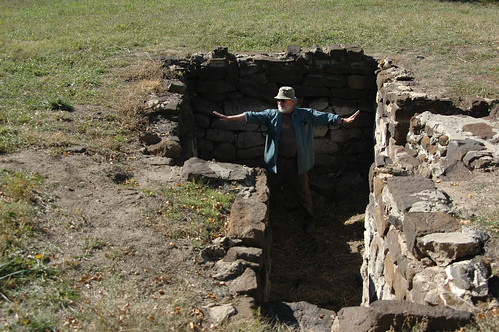
Hardly ever, when we've been out "on the road" has there been a time when we've not passed the skeleton or rotting corpse of someone's old American dream. Husband has taken numerous photographs of these - they have a perverse kind of beauty. I picked out three or four which show a kind of progression. The first has husband measuring the dimensions of someone's first American dream-home:

The Hogland Dugout
The Höglund Dugout, Lindsborg, Kansas:
One of the more unusual and unexpected sights in Kansas is the Höglund Dugout. Even though it is not readily apparent on the beaten path, the grave-like home dwelling is remarkable and worth searching out as one tries to imagine residing years in a rock reinforced 6ft x
12ft hole in the ground.

Dugouts were not uncommon in the Midwest during the 19th century. A lack of building supplies, the price of lumber from the East and sparse growth of trees contributed to the phenomenon. In addition, most homes built above ground were produced cheaply with no insulation. The lumber homes were hot and dusty in the summer and cold and drafty in the winter. In contrast, a dugout constructed with and in sod was relatively snug and kept the harsh elements to a minimum. Normally "Scandinavian" dugouts, as they were known, were built into the side of a hill. There are examples of dugouts in Sweden, so perhaps this is where Midwest Scandinavian immigrants conceived and developed the idea. However, the Höglund family lacked an incline on their chosen plot of land and therefore dug down.


Other American dreamers had homes like these:

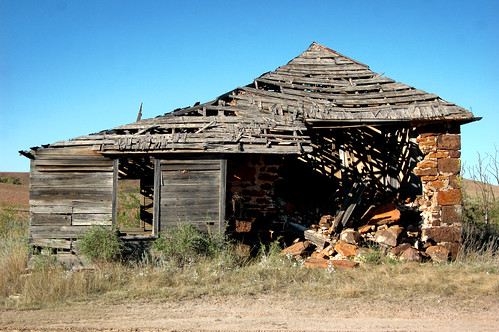
Losing ground


The old homestead.


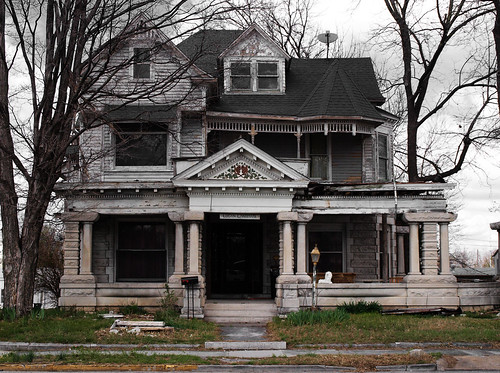
A home such as this one was, perhaps, the height of the American dreamer's aspirations:

Priorities


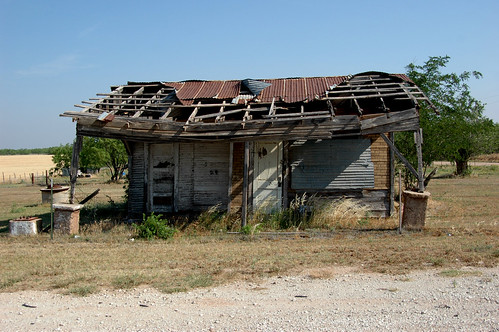
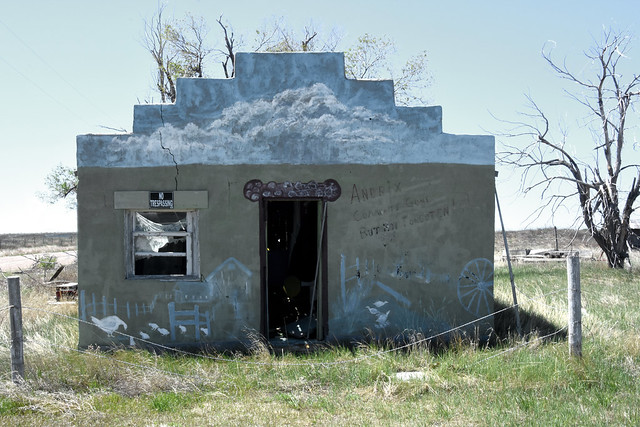
The photograph below appeared in my post a couple of weeks ago, after our trip to the edge of Colorado. Husband has since found a little more of its story - it fits well here.


Andrix, the town that ran away from home

Andrix, the town that ran away from home:

From website :Life Death Iron

Andrix was a tiny rural town in Las Animas County between Trinidad and Kim along Highway 160. Andrix served the needs of local farmers and ranchers, and once had a school, post office, church and a tiny store. A few scattered homes made up the rest of Andrix, and the population never amounted to much more than 50 or so. Andrix was typical of the many small rural communities found in Las Animas and Baca counties prior to the Dust Bowl years of the 1930âs.


Andrix struggled through the Dust Bowl and the depression, and the tiny general store was the center of activity in the town. A husband and wife ran the store starting in the late 1930âs. Barely eking out an existence, the couple remained faithful to the shrinking Andrix community, and kept a small inventory on hand to meet their needs.


The husband eventually passed away, his wife remaining in Andrix to run the store alone. In 1955 two locals robbed store and roughed up the poor widow (one of the robbers the widow had known since his birth) taking all the money she had to her name and stealing the few items left on her shelves. The thieves were apprehended down the road in Kim. The poor old widow never recovered from the shock of the robbery saying "The only place you are safe is heaven" although she remained faithful to her duty at the Andrix store, and was the last resident of the town in 1969.


The old Andrix store sits empty along Highway 160 today, a couple other structures, an abandoned car, and other refuse from the modern era mark the site. Someone, recently, has painted a memorial tribute to the Andrix community on the old storefront.

Saturday, October 22, 2011

Insightful Views of Frodnonag on The American Dream


I often find myself in awe of the writing, perspicacity and insight of some commenters on the few news sites I frequent. The articles are usually good - and they ought to be, written as they are by professionals or academics. However, some comments can occasionally outshine the articles. Maybe these too are written by (retired or resting) journalists or academics, it's hard to say, being signed only by screen-name. Here's one such comment which impressed me - it's more of an essay really, written by one "Frodnonag". The very long comment is a two-parter, and appeared beneath the article linked below. I asked the commenter if he/she would allow me to use it on my blog...... He/she responded with:
Sure, glad to, it's a compliment.

Let me note that I'm not a historian- just a reader and observer of life in the U.S. for the past 60 years- and that everything I write is my opinion and that's all it is. Whether or not it carries any weight with facts or any other way is up to the reader, because I do not mean to say I have any real answers.
Frodnonag
Part one interested me especially. I'm always keen to read views of "how we got here" by someone who has actually lived through a lot of the journey. This essay provides a personal view on the background of that mythical yet fascinating concept: "The American Dream". The second part of the comment/essay, relating to the Occupy Wall Street movement, and related issues, will follow, tomorrow:


COMMENT (Part 1)
Posted by Frodnonag
Oct 19 2011 - 10:43pm, at
http://www.commondreams.org/view/2011/10/19-6

Frodnonag commenting and expanding upon points arising from an article by Richard Gwyn: OWS ‘Angry Mob’ Suddenly Respectable

I see this American Dream in more than one way. On the coarsest level it is just a dream of an infinitely big pie divided up among into ever-enlarging slices for an ever-expanding number of never-satisfied individuals, a.k.a. consumers, or resource hogs. No one thinks that just because a pasture will support a cow it will automatically also support two or three or twenty cows, but here in the U.S. our "American Dream" tries to convince us of something very much like that. Clearly some of this originates from religious convictions during early settlement and the social meme of "manifest destiny" which I have always regarded as just a high-faluting and throughly dishonest variation on "I wants it... it's mine... I found it... nassty Hobbits want to take it from me. My Preciousss..." mentality of total entitlement and individualistic anti-social behavior over cooperative social behavior.

In fact, the frontier was first broached and settled by the outcasts, the weirdos, the rejects, the predators, the soldiers of fortune, and the slave masters, and less so by the saints and philosphers and educators- at first- since the demands of the New World made it mandatory that the early settlers have the ability to survive first of all, and if that worked out, as soon as possible there would be churches and then schools.

However, most early American pioneers must have had precious little time for the things most of us spend our days doing nowadays. Dawn to dark-thirty of hard work was the rule. And part of the American Dream, before it was even named, was the plan to work hard enough so that one day in the future one could sit back and watch other people work and rake in the wealth for you - that too is the American Dream: wealth through managing and/or exploiting unfairly the labor of others. It is a necessary system, I think, to have that; specialization, and division of labor and skills, that is - but has always been so prone to abuse by management/owners over workers.

Many years ago as a kid I had a recurring dream of some unknown but very real spot out in the West or western Midwest - for some reason I thought it was perhaps in Nebraska, for it was prairie/high plains/ big country without mountains, but not flat either, and someplace I had never been or seen, yet in these several dreams over the course of two or three yeares, I visited the place several times, and I always wondered if it existed.

Now I think that dream had something to do with the American Dream, which was a presence, almost palpable, to kids growing up in 1950's America, combined with a dream about the vanished, or vanishing, western frontier, the presence of which, especially throughout the first 300-400 years or so of North American settlement, up until the late 19th century, had a long and extremely profound psychological effect and is one of the main building blocks of anything we might call "American" about ourselves today.

The frontier, before the railroads in particular, and before telegraph and other forms of communication, was a place for seemingly infinite opportunities for fresh starts in life; or it was a refuge from the law or from enemies or from creditors, and until recent times remained in that role of refuge for many people, for all kinds of reasons.

As they used to say, a man could wear out four or five farms and still be young enough to go tear up a new piece of land and wear it out too. The sense of infinite and perennial resources they had then is understandable to anyone with an idea of the forest, fish, animal, and bird life on his continent - it was truly a cornucopia, and a land of plenty, in ways most of us today don't know. (Read Farley Mowat's "Sea of Slaughter" for a fascinating discussion of what happened to maritime resources early on due to European involvement in the New England and Maritimes and Banks regions - it's quite a shocking story, and a cautionary tale - or at least it should be.)

So the old belief in an ever available frontier with infinite resources of all kinds and always the chance for a second start, a new home, a move down the road - and the power of a man to make these decisions "for himself" - entirely, or at least mostly, on his own initiative.

It was capital - F Freedom to a much greater extent than was allowed in the Old Country.

That's the American Dream too, isn't it? Homesteading, or founding your own little Boonesborough even if it is just a shack on the edge of town with room for a couple of tomato plants - that's where it's at.

And for most Americans I think for a long time, hard work was the ticket to much success, although for many others, from the first days, it was not freedom but bondage, as the sturdy yeoman farmer, out of a George Caleb Bingham painting in my mind's eye, was relplaced by the mill hand and the sooty child picking slate from moving belts of coal and gazing at us in the future with holocaust eyes, as if to say, someone do something about this, for the love of God, please.

And yet, in many ways, we denied that plea and all the ones like it, and yet, the country did thrive and prosper, and grow like crazy, under robber baron management and slavery, for a long time, and because slavery and industrialization were both, on the whole, apparently creating societal improvements much more than societal harm, and were lucrative systems of exploiting various natural resources from furs to water power to timber to meat to minerals and so much more. Because of these factors, the harm being done to workers, to public health, and to the environment, were put under the rug, so to speak, as they still mostly are today, because they are a lot of trouble to deal with in a modern and enlightened scientific fashion. Therefore the state of denial is psychologically essential because a man has trouble when he knows that the thing he likes so much because it is good is also something which is slowly killing him, or his children, or his neighbors.

Better not to think about such things - and in the past, one could always move on down the valley or across the mountain, for the longest time.

The loss of that frontier changed the thing we like to call our American "character". As it was lost, we clung more and more to the mythical creations of the frontier, from the characters of Fenimore Cooper down to the ones of the TV westerns.

Now most westerns are supplanted by endless cop shows, most of them urban.
TV shows us how even in the past fifty to a hundred years we have become like more and more rats in a single cage. The Balkanization of the U.S.A.

In the city closest to me, due not to lack of space but the economic system, the poor people are crowded up and are shooting each other to death at a steady rate of several shootings per week, usually at least one daily, so as a war of attrition - of the people upon themselves - it may be worse than some of the stuff in the middle east, but "they gotsome crazy litle women there" so people keep on living there... that's the place I mean.

And I'm like "Dang, this is America? What th..?!?'" Like something Flaky Foont might come up with that he wants to go ask Mr. Natural about.

Goodnight. Obviously I am losing my mind once I mention Foont, that weirdo.... if I don't stop now I'll be telling a Fat Freddy's Cat story and that is to much to ask of such fine comments readers as yourselves.

Thank you, Frodnonag!

NOTE: For others, like me, who didn't recognise Flaky Foont or Mr. Natural or That Cat: the first two were cartoon characters of Robert Crumb; Fat Freddy's Cat was a creation of Gilbert Shelton.


Friday, April 17, 2009

Arty Farty Friday ~ Robert Frank ~ Capturing Real Life


A look at another photographer this week: Robert Frank. His work is classed as "street photography". He's most famous for the photographs in his two books "The Americans", and "The Lines On My Hand".
(Portrait of Robert Frank, left, in his house in Nova Scotia1969-1971 by Walker Evans)


Born in Switzerland, he spent much of his adult life in America. He came to realise that the reality of America was (and is) far different from the myth, The American Dream. Nowadays this is more widely appreciated, though less well known in the 1950s when Mr Franks was wielding his camera throughout the states, depicting a vastly different story from that offered in some of Norman Rockwell's lovely illustrations. America had, and still has, two sides.

In honor of the 50th anniversary of the publication of Robert Franks seminal photo book The Americans, the National Gallery of Art organized a comprehensive exhibit of his work. Read more at Smithsonian.com

An unconsoling portrait of his adopted country, the 83 photographs in the book are a record of the Swiss-born Frank's on-the-road travels in 1955 and 1956. It is a country of empty highways and drained faces in barrooms, divided by race and income. Frank's people seem bereft, beaten. It's a portrait by an outsider identifying to his fingertips with other outsiders.

The pictures rewrote the rules of photography, and a comfortable living. Their blurry casualness and tilted frames jazzed nearly every photographer of note to come along in the 60's. Visual motifs hold "The Americans" together -- jukeboxes, crucifixes, cars, televisions -- and the Stars and Stripes flutters throughout the pages like a tattered ghost. The book galvanized successive waves of artists, and not just photographers. Tune in to any beautifully bleak, high-grain, low-definition MTV video and you're probably watching refracted Robert Frank.
(From NYT Magazine)


Frank's photographs from Wales, England and elsewhere appear in his second book. His sharp insight, cuttingly critical at times, but with innate compassion and an artist's eye, provides much to enlighten future generations.


Born 9 November 1924 in Zurich, Switzerland. Time of birth unknown, 12 noon chart below.


It's a Watery chart, with Grand Trine linking and blending the Scorpio, Pisces and Cancer planets.
Here is incisive insight from Scorpio, compassion, sensitivity and artistic imagination from Cancer and Pisces. He has Fire energy too, sufficient to propel him to the success he achieved - this is reflected by his Aries Moon (whatever his time of birth), Jupiter in Sagittarius ( strong its own sign) and generational Neptune in Leo. Depending on time of birth the Fire planets could form a second Grand Trine.

The characteristics of his older years, described in the extract from Vanity Fair, below, stem from that Scorpio cluster, and possibly from his unknown ascending sign.

Frank Roberts is 84 now. From Vanity Fair (here)
"He has reached that age when a man does not have to apologize for his cruelties, his eccentricities, or his grooming habits. His prints have sold for more than a half-million dollars, but he shambles around looking like a Bowery bum. He has by turns been described by people who do not know him as ornery, reclusive, hard, manipulative to the point of destructive, and cold as a bowling ball. He rarely gives interviews. He speaks in short, elliptical snatches and views life with the detached outlook of an undertaker. He came to China to have a look before he dies. “To travel the road of possibilities,” he said. “Turn on a whole new audience.” "

"As he traveled around the country in 1955–56 making the photographs that would constitute his landmark book, The Americans, Frank's impression of America changed radically. He found less of the freedom and tolerance imagined by postwar Europeans, and more alienation and racial prejudice simmering beneath the happy surface. His disillusionment is poignantly embodied in this image of a disheveled African-American man disengaged from the crowd and asleep in a fetal position amid the debris of an Independence Day celebration on Coney Island."


This was one of the last still photographs Frank made before he devoted his creative energy to filmmaking in the early 1960s. As such, it may be interpreted as an elegy to still photography; the lone figure functions as a surrogate for Frank himself, as he turned his back on Life-like photojournalism to concentrate on the more personal, dreamlike imagery of his films."

"It's not the pretty or the sweet life, but the real life I looked for and got."(Robert Frank).


Saturday, May 31, 2008

He Lived the American Dream - and Nightmare

Gone, it seems, are the days when a modest High School graduate could become President of the United States of America. Now candidates of choice have Ivy League education, many years of college, a variety of degrees and impressive resumes. The American Dream, that anything is possible in this wonderful land, is now much less attainable, if attainable at all.

Harry S. Truman, President of the USA from 1945 to 1953, lived The American Dream. He was no Ivy League graduate. In his youth he attended High School and some evening classes at a local School of Law. His farmer parents were unable to finance 4 years of college. Harry Truman's first jobs included timekeeper, bank clerk and farm worker. He joined the National Guard in 1905, and when the USA entered World War 1 Truman was promoted to Captain and served in France. After the war he and a friend opened a haberdashery store, which failed in the recession.

Harry S. Truman's political career began after serving as judge in County Court from 1922.


In 1934, a Democrat, he was elected to the US Senate. By 1944, he was nominated to run as Vice President for Franklin D. Roosevelt. 82 days after being sworn in as VP, President Roosevelt died unexpectedly. President Harry S. Truman became the USA's 33rd president on 12 April 1945. At the time, the new President told reporters, "I felt like the Moon, the stars, and all the planets had fallen on me."

Below is his natal chart (centre ring), along with a chart for Washington DC on 12 April 1945 (outer ring). He was born 8 May 1884 in Lamar, Missouri. Time of birth according to Astrotheme was 4pm.

Astrology can be seen in action here!


Transiting Uranus, planet of unexpected change was at 10 Gemini, exactly conjoining Truman's natal Saturn - planet of career, laws, authority. Transiting Saturn at 5 Cancer conjoined natal Venus at 3 Cancer. It is well documented by his personal letters that he hated being separated from his beloved wife and daughter - Saturn conjoining Venus seems to reflect the future in this regard, for they were often separated by his demanding duties as President: Saturn= career/status restriction, affecting Venus = love, harmony, relatedness.

Truman's natal Mercury(communication) and natal Pluto (transformation and sometimes death) are at 00 and 01 Gemini - an eery reflection of the nightmare in his future. It was his word (Mercury) which gave the order, late in World War 2 after victory in Europe, for the dropping of atomic bombs (Pluto) on Hiroshima and Nagasaki, Japanese cities devoted to war work. Hundreds of thousands of civilian deaths, immediate and eventual were the result. Japan had refused to surrender, but after this surrender quickly followed.

President Truman made that difficult and frightening decision. He always stood by it. Whether it was right or wrong is not for us to judge. We cannot know for how much longer the Japanese would have continued to fight, or how many Americans and allies would have died at their hands, and in their prison camps. In my own humble opinion we ought not to even set ourselves up as judges. The only thing we, in the 21st century, should be doing is trying to ensure that nothing comparable ever needs to happen again.


The USA's 33rd president led his nation through the final stages of World War II and early years of the Cold War. He vigorously opposed Soviet expansionism in Europe and sent U.S. forces to turn back a communist invasion of South Korea. He wiped out segregation in the military, expanded the Social Security program initiated by President F.D. Roosevelt.

He also brought in a Fair Employment Practices Act, and a public housing and slum clearance program, a higher minimum wage; these became known as his "Fair Deal". President Truman was determined that his nation’s growing economy would provide increased opportunities for all Americans, particularly those with low incomes.

"The buck stops here", and "If you can't stand the heat, get out of the kitchen" are President Truman's words, still often quoted some 60 years on.

As the cover of this DVD declares, he was "A simple man. A Legendary President."