Showing posts with label mysticism. Show all posts

Friday, November 07, 2014

Arty Farty Friday ~ Morris Graves - Idiosyncratic Visionary

Morris Graves - an artist of mystical bent whose name isn't well-known, except perhaps among art experts and local people. He has been described variously as idiosyncratic, visionary, mystical, introspective, intensely private, student of Zen Buddhism and Vedantic philosophies, spiritual and sylistic...and most eccentric of the "Northwest Mystics" - artists of the Northwest School in the USA..."going about life in an interesting, just out-of-societal-bounds manner".

He was born on 28 August 1910 in Fox Valley, Oregon, died in May 2001. He was a sickly and moody child, often ill with recurring pneumonia. His family moved to Seattle during his second year.

He dropped out of High School, but returned to his studies in Beaumont, Texas while staying with his aunt and uncle there. He eventually grew to a height of six-foot six. Some sea-going adventures as a cadet or a stow-away followed, accompanied by his brother or a friend, including voyages to Japan, where he found inspiration.


 Hat-tip to Seattle Art Museum.org
Morris Graves' name first became known in 1933, after winning the Seattle Art Museum's (SAM) Northwest Annual Exhibition. The winning painting, a symbolic self-portrait: "Moor Swan" (see right).

Further adventures followed, including working for the WPA, meeting (and falling out with), artist Mark Tobey, World War II, where despite registering as a conscientious objector he had to spend a brief time in the army.

Graves' paintings at this time featured birds. For him, consciousness assumed the form of a bird, or of a chalice. The birds he depicted were blind, wounded, maddened or immobilized, with large eyes and beaks. Graves's wounded birds proved to be popular in America, now embroiled in the war - as well as relevant to the artist's emotional state.

He lived alone in his self-built home, "The Rock", on an isolated promontory. Graves' paintings became more universally known and appreciated when first exhibited at New York's Museum of Modern Art in 1942. MoMA bought 11 of his paintings for their permanent collection, even though Graves was, at that point, virtually unknown. 34 of his paintings were bought by art collectors. Morris Graves had "made it!"

He was, for a time, the "in thing" for East Coast art and intellectual society. Success and appreciation of his style continued until Pop-Art came along - people, as is their habit, flocked to see "something completely different".

Once financially secure Graves was able to allocate a good proportion of his funds to providing inspirational surroundings. After The Rock, he built, or caused to be built, two other homes in Western Washington and California, both reported to be extraordinarily beautiful creations. He also owned a country estate in Ireland. There's a description and photos of one of his homes at website of Iona Miller,but you need to scroll down a way for relevant piece.

For more, and interesting, detail on Morris Graves, there's a long essay, a very good read, at HistoryLink.org. The essay, from 2003 is by Deloris Tarzan Ament.

HistoryLink.org Essay 5205

PAINTINGS

Some titles can offer a clue to understanding the paintings, but sadly not every website bothers to include titles. I've found as many as possible. One or two were designated "untitled" by the artist.

Please click on images for bigger or clearer versions


 Time of Change


 Conflict Battling Crane Heads with Chinese Ceremonial Bronze

We are told by a biographer that the birds at each other’s necks, imagined as a ceremonial vessel, was representative of the artist’s inner conflict and inability to finish a voyage to Japan.


 Chalice


 Hibernation


 Memorial Day, Abandoned Western Mining Town


 Young Pine Forest in Bloom


 Bird Maddened by the Length of Winter

The above is considered to be one of Graves' anti-war works, painted in 1944 as World War II raged.
"Look at `Bird Maddened,' Daniel DuBois (who published a book of Graves' works) says, "and you see the almost camouflaged central image of a very fragile bird looking back over its shoulder while just barely hanging on by the points of its claws to a rock in an environment, which is extremely hostile. Without a doubt, this reflects Graves' sense of the fragility of life in war.

 Bird Maddened by the Sound of Machinery in the Air


 Bird of the Spirit


 Bird with Possessions


 Bird, Snake and Moon

 Snake and Moon

 Sanderlings


 untitled
I find the painting above scary, or at least unsettling, for some reason.

There's a slideshow of more paintings HERE. More paintings at Humboldt Arts too.


ASTROLOGY

Chart set for 12 noon, no time of birth is available.
Born on 28 August 1910 in Fox Valley, Oregon.


Seattle Art Museum has an interesting page on Graves, it includes several quotes from books mentioning the artist and how he was perceived, personally, by others. Example below:

He comes from the Pacific Northwest; an exceedingly tall thin figure, with large transfixed, rather alarmed eyes. . . He is shy and self aware to a degree, aloof yet (you suspect) ruthless in his self-determination. . . . In short he is very birdlike: receding, private, mobile, and migratory. . . He has the willful steely quality of a bird—its fierce capacity to survive.
—Frederick S. Wight, Director of the Art Galleries, University of California, on meeting Morris Graves, 1956

An Earthy harmonious trine between Sun in Virgo and Saturn in Taurus = a meticulous, demanding and determined character with a reasonably good business sense.

Neptune (mysticism, creativity) opposite Uranus (the unexpected, innovation, eccentricities) is a generational opposition affecting many. Skyscript adds:
"...most noticeable in charts where it contacts the angles or Sun or Moon. Uranus fosters change and innovative breakthroughs. Neptune relates to mass consciousness. When these planets are in contact with each other, collective ideals will be shaken and disturbed in order to allow new modes of thought and collective expression to emerge."
Because we have no time of birth it's not possible to accurately place the opposition in Graves' chart.
Uranus also trines Mars and Saturn, so those aspects would tend to draw the opposition into a more personal significance. Each end of the opposition also forms square aspects to Jupiter, creating a T-square.

Venus (the arts) in Leo is in helpful sextile to Jupiter (religion, beliefs, travel) - that's a good fit. He was an enthusiastic traveller, always gathering inspiration for his art.

Moon conjunct Pluto? Maybe. We don't know correct Moon position without time of birth, but it was likely to have been in communicative Gemini. He was a solitary type, not given to social butterfly antics, but he satisfied urges to communicate using a paintbrush.

Any more?

Any copyrighted material on these pages is included as "fair use", for the purpose of study, review or critical analysis only, and will be removed at the request of copyright owner(s).

Monday, January 06, 2014

Mystical Music Monday ~ Bernadette and the 1844 Gang


Tomorrow, 7 January 2014, will be the 170th anniversary of the birth of Bernadette Soubirous, a miller's daughter born in Lourdes, France, later venerated as a Christian mystic and Saint in the Catholic Church: Saint Bernadette. She was born in 1844, died 1879, aged 35. Her story is well-known, related in the movie Song of Bernadette, and honoured in this Song of Bernadette written by Leonard Cohen, sung here by Jennifer Warnes ~


The early months of 1844 brought forth some rather special natives with fairly unusual natal charts. Personal planets and some outers clustered around "the winter signs" Capricorn/Aquarius/Pisces. Occasionally Moon would be found out on a limb, as in St Bernadette's case. Her chart is below, using data from astro.com.


Some others born during the first half of 1844 have a touch of mysticism in their makeup too - there must've been something in the air during those months! That doesn't apply to the first of the group listed below though.

On another level altogether, and a bit closer to home : Cole Younger - Thomas Coleman "Cole" Younger (born January 15, 1844, 2 weeks after St Bernadette). American Confederate guerrilla during the American Civil War and later an outlaw with the James-Younger gang. He was the eldest brother of Jim, John and Bob Younger. tacitly acknowledged as "the brains" of the gang. He sometimes showed kindness, giving stolen foodstuff to the poor, and among Confederate sympathizers Younger and his cohorts were perceived almost as folk heroes. Their occasional hide-out in the hills of Oklahoma is now known as Robbers' Cave State Park.
(See HERE)


Olney H. Richmond (22 February). American mystic. From a mundane background, he became a feed and grain dealer. However, he had so many "unusual" experiences during the Civil War that he turned to metaphysical study. Richmond later founded the Temple of the Stars and wrote the "Mystic Text Book" for Masons only.


Abdul Baha'i, (23 May). Persian religious leader of Baha'i who aimed to establish a New World Order. The eldest son of Baha'u'llah, he followed the mystic path from age nine and became his father's successor. Abdul-Baha weathered internal strife and religious persecution to establish communities around the world. In 1920, the year before his death, he was knighted by the British government.

Camille Lemmonier (23 March). Belgian novelist, short-story writer, and art critic, one of the outstanding personalities of the 19th-century French literary renaissance in Belgium.
..........under the influence of the naturalism of Émile Zola. Like his other novels, it is a work of great violence, describing characters of unbridled instincts and passions. Happe-Chair (1886)....deals with the life of drudgery led by mill workers. Later, in the work of his middle period, Lemonnier turned to psychological analysis, condemning the conservative tendencies of the bourgeoisie. He then developed a mystical naturalism, as in Le Petit homme de Dieu (1903; “The Little Man of God”).

There's something else worth a mention, it's what blog friend and commenter "mike" calls a "quinky-dink". William Miller (1782-1849), a Baptist preacher, from the United States, credited with beginning the mid-nineteenth century North American religious movement now known as Adventism, predicted that sometime between 1843 and 1844....Jesus Christ will come again to this earth, cleanse, purify, and take possession of the same, with all the saints, sometime between March 21, 1843, and March 21, 1844.
He didn't. I do wonder, though, whether William Miller had astrological knowledge and had noted the peculiar line up of planets during part of that period.

Hmmm - funny ol' year, 1844!


Postscript
RIP Phil Everly.
There's an old post on Phil and his brother HERE.

Wednesday, April 13, 2011

MANLY P. HALL, Astrologer, Mason, Mystic, etc.

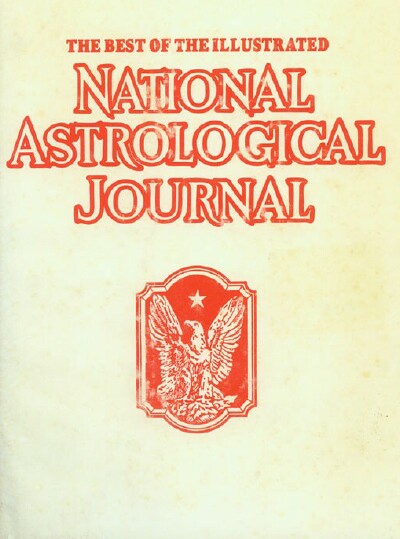
On our recent travels in Texas I found another old astrology-related book in an antique store. The Best of the Illustrated National Astrological Journal covering the years 1933 to 1935, edited by E.A. Wagner, published in 1978. As might be expected, much of the content is dated and/or has been superseded by more modern trains of thought and styles of presentation. Still, it's an interesting curiosity.

An article, by Manly P. Hall, caught my eye. Everything he wrote here, with slight modification, could be applied to the USA in 2011! Our current problems, no longer related to machines, now stem from corporations.


An excerpt from the longish piece:


The Mechanistic Complex by Manly P. Hall (1933)

The autocrats ruled antiquity, the aristocrats dominated the Middle Ages, while the mechanocrats have a stranglehold upon modern civilization. Consider feudal america - a land of filching knights and robber barons. Competition has broken up the unity of the nation and transformed the lane of the free and the home of the brave into a vast battlefield of economic exploitation.

The petty princes of medieval Europe sallied forth from their castles on strategic hills to maraud the countryside. today great industrial magnates from their strongholds upon the high crest of wealth ravage the fertile plains of the nation. The armies of the robber barons of old were composed of "robot" serfs, fed and clothed that they might have strength to extend the boundaries of their scheming liege.

The modern brigand has discarded weak, puny man and is now served by an army of machines. Modern competition is a war of giants. Great grinding mechanisms, whirling with ever increasing velocity, compete in a wild banditry of production.

Humanity is forgotten, races are forgotten, nations are forgotten. The bonds of state and community, which are the warp and woof of civilization are forgotten. Every man's hand is against his brother. Ambition rides in the vanguard of each faction. .....Great industries relentlessly destroy their competitors and justify themselves by the code that life is a survival of the fittest. Why should man be more gentle and considerate of machinery than he is of a fellow human creature?............but machinery is habit-forming......A machinery-obsessed, wealth-mad creation is dashing headlong into oblivion.
The name Manly P. Hall is familiar to me from past forays into esoteric writings. I've never been strongly drawn to matters esoteric, especially anything connected with theosophy, reincarnation, the masonic community or theories about a New World Order and the Illuminati, all of which were a feature of Mr. Hall's lifestyle and writings. Such subjects do provide rich fodder for novelists and other authors and lecturers but, in my view, little in the way of simple truths applicable to everyday life. Manly P. Hall wrote about astrology too. I have his Astrological Keywords.

For any passing reader unfamiliar with Manly P. Hall and his works, some background:

Manly Palmer Hall (March 18, 1901 – August 29, 1990) was a Canadian-born author and mystic. He is perhaps most famous for his work The Secret Teachings of All Ages: An Encyclopedic Outline of Masonic, Hermetic, Qabbalistic and Rosicrucian Symbolical Philosophy, which is widely regarded as his magnum opus, published in 1928.

He has been widely recognized as a leading scholar in the fields of religion, mythology, mysticism, and the occult.

Carl Jung, when writing Psychology and Alchemy, borrowed material from Hall’s private collection.

In 1934, Hall founded the Philosophical Research Society (PRS) in Los Angeles, California, dedicating it to an idealistic approach to the solution of human problems........ In his over 70-year career, Hall delivered approximately 8,000 lectures in the United States and abroad, authored over 150 books and essays, and wrote countless magazine articles.
(From: http://www.manlyphall.org/)


Above: Manly P. Hall, at age 89.

Data for the natal chart of Manly P. Hall, as shown below, comes from Astrodatabank, who give the time of birth (6.02 AM) only a DD rating: "dirty data" - not reliable. I've used this time of birth even so. I have a nasty suspicion that this time might have been suggested by those who'd wish to place his natal Moon into Aquarius rather than allowing a later time of birth putting Moon in Pisces along with Ascending degree, Sun, Mercury and Venus. Aquarius lends a hint of the clear intellectual among all that foggy Pisces imagination, dreams and visions! (My opinion only, of course.)


What stands out?

South node of the Moon (a sensitive point in the chart)is at 25 Taurus - the degree of Fixed Star Algol. Algol can sometimes be found prominent in the charts of those who have some unfortunate circumstances surrounding their lives or deaths - or those who are exceptionally intense and passionate in their endeavours; extreme creativity and some connection to "the dark side" can be noted too. Although Mr. Hall lived to age 89, according to some on-line sources there were rumours that he had been assassinated. Though why someone would consider murdering a man of that age, whose time was limited anyway, is beyond me!

Heavy emphasis on Pisces - the dreamer, potentially addictive (to dreams or other substances), creative, sensitive, mystical.

Saturn in Capricorn, sign of its rulership, is the strongest positioned planet in this chart, and conjunct Jupiter represents something of an enigma. Limitation conjoins excess; restriction conjoins exaggeration. Dreams and creativity conjoin business/career (Saturn).

Neptune, modern ruler of Pisces, in Gemini lies in challenging aspect to natal Sun and, if time of birth here is correct, in harmonious trine to Moon. Such aspects to personal planets draw Neptunian traits (creativity, nebulousness, illusion) into an individual's personality.

Hall was of the Pluto/Neptune in Gemini generation which spawned some incredibly talented characters. There's no doubt at all about the talent of Manly P. Hall as a communicator, or his passion for his subject. However, talent allied with passion for a topic does not necessarily result in accurate conclusions.

Wednesday, October 14, 2009

Arthur M. Young - Inventor, Mathematician, Scientist, Philosopher, Mystic, Astrologer

Arthur M. Young was born in Paris, France, his American parents lived there at various periods, while his father, a landscape painter, studied Impressionism. I'm going to call Arthur M. Young AMY, from here on, for brevity and ease of typing. He was a mathematician and scientist first and foremost, and inventor of the first Bell Helicopter. It was later in life that he slid into philosophy, metaphysics, ESP, and even astrology. Shock horror -a scientist who was also an astrologer! Would that there were more of his ilk around today.

In Jeffrey Mishloves "An Appreciation of Arthur M. Young" he writes:
"Arthur was also a student of eastern mysticism and yoga.............. was a master of astrology, and he enjoyed demonstrating its value with reference to my own chart. He did so in the most uncanny ways."
There's a website dedicated to AMY. It includes some of his essays, several of which mention his study of astrology, in fact one is dedicated to the subject.

THOUGHTS ON A SCIENCE OF LIFE
Part III: On the Value of Astrology for a Science of Life
by Arthur M. Young (1992)
In summing up his essay, AMY wrote:
To sum up: The rejection of astrology by science is based on the belief of science that there is no way for planets to influence life. This belief is opposed by the practitioners of astrology, who find a factual correlation between the position of the planets and the dates of important events in life.

But the principles on which physics is based do not predict or even accommodate life. Life requires a narrow temperature range and a periodic alternation of this temperature, and hence a very special environment, requiring a planetary system with a certain type of sun. This makes life depend on contingency rather than law, and indicates that while the laws of nature are necessary to life they are not sufficient.

Since alternation (periodic change) of temperature is necessary to the evolution of organic life in plants and animals, it would seem that the evolution of consciousness, which has its inception in organisms which move against entropy, should for its completion require an alternation of longer period than the daily or yearly alternation of temperature. This is what the outer planets supply.

As for the question of how the planets can influence mundane events, this problem already exists in biological rhythms, which have been found to be endogenous; that is, not dependent on known physical influence

That, I can (just about) understand. I'm not going to pretend that I understand his Theory of Process , his studies of consciousness and suchlike. I don't. It's all way over my head. His Theory of Process relies on a kind of wave-like effect which he considers applies to everything in one way or another, because it's the origin of everything, starting with "Light"..... (I think!)


Ahem (too deep for me) - quickly turning to AMY's chart then - it's not my usual format, because I don't have that software on the laptop. It'll have to do!

We should find prominent Saturn/Capricorn(mathematics and science) Uranus/Aquarius (invention and maybe astrology) and Jupiter/Sagittarius (philosophy)

Arthur M. Young born on 3 November 1905 in Paris, France. Astrotheme gives his time of birth as 10.23am.


His Sun and Mercury in Scorpio remind me that Carl Sagan has these placements (but with even more Scorpio planets). As well as its reputation for eroticism, passion, paranoia etc. Scorpio has that incisive mentality (especially with Mercury there) which can cut through stuff which leaves the rest of us highly confused. AMY's Scorpio Sun closely trines mystic Neptune in Cancer - here's his draw to mysticism - a draw which Carl Sagan didn't have.

Aquarius Moon trines Jupiter in Gemini. The harmony between invention and philosophy in AMY's life is here, for Jupiter is ruler of Sagittarius (his rising sign, and therefore Jupiter is his ruling planet) and it is in very helpful aspect to his inventive Aquarius Moon.

Now we come to more of what I was expecting to see: Saturn in Aquarius, and....Uranus in Capricorn. Aquarius, Capricorn, Uranus, Saturn - there's a peculiar link here.
Aquarius and Capricorn were originally both ruled by Saturn, modern astrology places Uranus as ruler of Aquarius, and in AMY's chart the planets swap homes, with Saturn in Aquarius and Uranus in Capricorn. I'm not sure how that can be interpreted except that it's a conglomeration involving mathematics and science(Saturn and Capricorn) invention and astrology (Uranus and Aquarius) - all kind of related to one another by marriage (as it were), bringing together two very different realms. In addition Moon in Aquarius is in helpful semi-sextile aspect to Uranus in Capricorn - a further blending of the two realms.

So, all in all, AMY's natal chart, even from my minimalist take on it, clearly matches his chosen paths in life.