Showing posts with label occult symbolism. Show all posts

Friday, September 26, 2014

Arty Farty Friday ~ REMEDIOS VARO

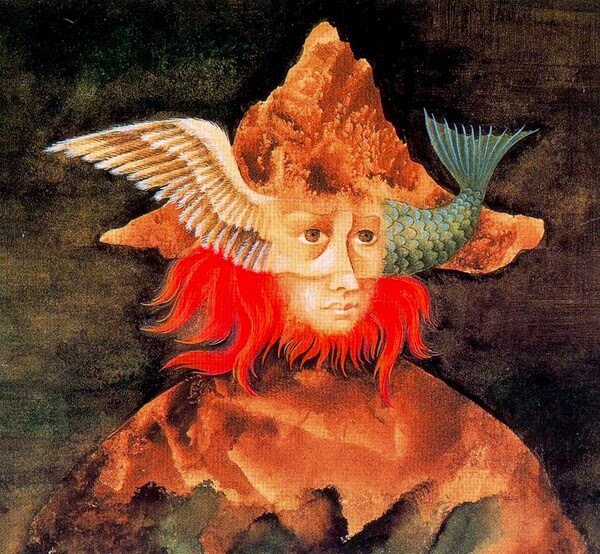
Remedios Varo - at first I thought it to be the name of a male, but it's not. Remedios Varo's name given at birth was María de los Remedios Alicia Rodriga Varo y Uranga. In Spain names do take on a more epic quality than in most other countries of the world. Anyway, Remedios Varo, as she became known, was born on 16 December 1908 at 10:45 pm in Anglès, Spain. Her father was a hydraulic engineer, he taught her to draw in a style which had later clear influence on her artwork. Varo used imagery related to her father's profession. Complex pieces of imaginary machinery can be seen in her paintings, which draw also from her studies of alchemy theories and processes. Her figures are thought to be autobiographical. Science, dreams, witchcraft, mysticism and humor thread through her psychological or spiritual subject matter.

Educated in Spain, in Madrid and Barcelona, rumored to have taken classes together with Salvado Dalí. She married painter Gerardo Lizarraga, then, apparently without benefit of divorce married, or (it's not clear) conducted a lengthy affair with, French poet Benjamin Péret. During the Spanish Civil War they fled to France. Settled in Paris. She soon gravitated towards the city's arty bohemian surrealist groups. Varo and English surrealist artist, Leonora Carrington became friends at this time, a friendship that survived for the rest of Varo's life.

As World War II began Varo relocated yet again, this time to Mexico City. Most of her her artwork was created in Mexico, where she was also able to pick up her friendship with Leonora Carrington, who had also fled to Mexico.

In order to cover living expenses, Varo took a variety of jobs: furniture painting, costume design, toy-making, commercial illustration for a company selling pharmaceuticals, and scientific drawings for Venezuala's Ministry of Public Health. Her marriage/association with Péret ended on his return to France. Her third husband-to-be, Austrian businessman Walter Gruen then entered the scene. Wed in 1952, she no longer needed to rely on odd jobs for her livelihood. Her true creative potential now emerged.

Varo's longtime interest in mysticism, alchemy, magic and, oddly, science co-exist in her paintings. Many, or most, of these are explained as being an exploration of the female psyche. It was only around the time she died suddenly, of a heart attack, in 1963 when her career was thriving, that women were beginning to assert their independence after centuries of treatment as second-class citizens. Many of her paintings need to be viewed with this in mind.

A few examples of her work, some with explanation taken from Women as Mythmakers: Poetry and Visual Art by Twentieth-Century Women,by Estella Lauter. The book has an error in Varo's year of birth, by the way. She, as many women will, knocked a few years from her age for public consumption. It was not until her death that her true birth year was discovered.

Please click on the images for clearer and/or bigger versions:

 La Revelación (1955)


 Embroidering the Earth's Mantle

Re the painting titled Embroidering Earth's Mantle, explanation from Janet A. Kaplan's biography of Varo,
"Unexpected Journeys" ~
In the central panel of the autobiographical triptych, Embroidering Earth’s Mantle [...], Varo offered a closer look at the life of a convent student.... here captive in a tower, (they) work as in a medieval scriptorium, embroidering the mantle of the world according to the dictates of a “Great Master.” This hooded figure reads from the catechism of instructions while stirring a broth boiling in the same alchemical vessel from which the girls draw their embroidery thread. Each girl works alone, embroidering images onto a continuous fabric that spills out from table-height battlements around the facets of the tower. Together they create a landscape with houses, ponds, streams, boats, animals, and humans, all nestled within the folds of the fabric. Theirs is the traditional work of the convent, where needlework was deemed a skill appropriate for cultured young women.

Characteristically, Varo treated such tradition with irony. Among the girls working diligently, each at her own table, guarded by a comical veiled figure who lurks in the background playing a flute, Varo’s rebellious heroine has “embroidered a trick in which one can see her together with her lover” [...], their rendezvous subtly visible in a rendering hidden upside-down within the folds that flow from her table. In a masterful variant on the myth of creation, she has used this most genteel of domestic handicrafts to create her own hoped-for escape. Unlike Rapunzel and the Lady of Shalott, Varo’s young heroine imprisoned in the tower is not merely a metaphor for confinement, but also an agent of her own liberation. [...]

 Energia Cosmica

 Papilla Estelar (1958)

Papilla Estelar = either Stellar Porridge or Celestial Pablum, or similar.
(Page 90 of Estella Lauter's book linked above)
"[This painting creates] an image of female nurturing...The protagonist is seated at a table inside an octagonal enclosure in the sky. She is grinding the food from the stars and feeding it to the moon in its cage. She is at once powerful and impotent. Because the moon is waning, it seems likely that she is saving it from death...A closer look at her setting reveals the source of her ambivalence; although there are steps leading from her enclosure, she could not take them unless she could walk on clouds... [She] is as caged as the moon..."
Often seen as an autobiographical artist, Varo uses these women as her stand-ins exploring the occult, the Kabala, and alchemy.


 Creation of the Birds
Page 84-5 of Lauter's book "...protagonist has assumed the form of an owl in order to paint birds who will come to life and take flight for the first time... She dips the brush, attached to her own violin (in the place of her heart), into paint from an alchemical alembic where the substance from the stars is stored. With her other hand, she holds a triangular magnifying glass to intensify the light from the moon... The woman/owl gives wings to her visions of the birds."
[Page 91] "... [This] is her image of what will be required if human creators wish to make a world in which all the species of life can survive. Her choice of the owl, always a figure of wisdom, is clarified by the information that the pre-Hellenic, Cretan Athena was a patron of the arts and a goddess of renewal ..."


 Three Destinies

 Analogy of Winter

El otro reloj'  -The Other Timepiece (1957)

Sympathy (Sympatía), [Originally titled, The Madness of the Cat – La Rabia del gato], 1955

The "Sympathy" painting is mentioned in a very good biographical essay on Varo at a blog called Femspective. See HERE. The author offers one mundane explanation of this painting; I see another explanation, related to astrology. Does anyone else see the same?


 Premonicion (1953)

Varo doesn't appear to have as much interest in astrology as in the occult generally. There is one painting of "Taurus", but it's not as special as the rest of her work. There is oblique reference to astrology here and there among her paintings, if one looks for it, but I've found no evidence that she was "into it" to any extent.

 The World
Earth Air, Water, Fire - see?


ASTROLOGY

Remedios Varo's natal chart with data from astro.com where it is given an AA (very reliable) rating. Exact place of birth, Anglès, Spain, wasn't available on my software's atlas but it offered Zuera as nearest available. This puts placement of all planets the same as astro.com's' there are just three minutes of difference in the ascending degree.


I see her astro-signature, as it relates to her art style and choice of subject matter, reflected by Venus/Mars in Scorpio in harmonious trine to Neptune in Cancer. Venus, planet of the arts is being energised by Mars, which accounts for Varo's energetic support artistically for her gender and the need for equality of the sexes. Neptune's link to imagination, dreams and fantasy feeds into her way of illustrating her points in such a creative manner.

There's a nice chain of sextiles linking Neptune at 16 Cancer to Jupiter (her Sun's ruler) at 14 Virgo, to Mars/Venus at 14/22 Scorpio to Uranus at 15 Capricorn. I like to find such chains, they indicate a kind of smoothness in the way a person is using their energies in co-ordination, to successfully manifest their talents...depending on which planets are involved, of course.

There are also 3 oppositions in Varo's chart: Sun/Mercury opposite Pluto/North Node; Moon opposite Saturn; Uranus opposite Neptune. Her Sun and Moon, major components of her personality, are each opposed by a planet relating to intensity or rigidity/limitation. Maybe these two oppositions acted as drivers and brakes in her nature? The third opposition, Uranus-Neptune forms to link each end of the sextile chain already mentioned. It's a Cancer-Capricorn cardinal opposition framing the sextile-chain. One could say, whimsically, that in so framing, it seems to exclude Saturn and Pluto from the major mix, leaving a calmer, sweeter, more integrated configuration to hold sway.

Friday, December 13, 2013

Arty Farty Friday ~ Xul Solar's draw to the Occult, Astrology and Language.

Casting around for an artist to feature - one born around this date - I discarded a couple, no doubt worthy ones too, but they didn't stir up sufficient enthusiasm for me to wade into preparing a post on either: Kenneth Patchen, from the Beat era and Roger Fry, one of the pretentious (my opinion) London Bloomsbury Set. Then I discovered Xul Solar.

Xul Solar (Oscar Agustín Alejandro Schulz Solari), born December 14, 1887 in San Fernando, Buenos Aires Province, Argentina. He died in 1963.

From this Spamula link: ".....painter, sculptor, writer, and inventor; a visionary utopian; an occultist and astrologer who yet remained catholic; an accomplished musician who was fluent in seven languages, two of which were of his own devising...."

Some of Solar's paintings are shown at that link; lots of others appear in the video below, and for the best collection see: Taringa - El mejor post de Xul Solar


Considering the artist's list of diverse interests and accomplishments I decided this guy must surely have Gemini prominent in his natal chart as well as its opposite sign Sagittarius - where natal Sun and Moon lay (Moon would have been in Sagittarius whatever his time of birth). Or, I wondered, is this an instance where a person born in the southern hemisphere shows signs of "flipped" zodiac sign syndrome?


Clip from THIS WEBSITE


In order to fully understand the concepts within Xul Solar’s magical realist, baroque paintings, it is important to know specific details about his life. Xul solar happened to be a very curious man who studied Buddhism, the Jewish Cabbala, philosophy, anthropology, astrology and the duodecimal system. To top it off, he was fluent in Sanskrit, Latin, Spanish, Portuguese, English and Greek (Hommage). Given this information, it is clear that Solar was obsessed with knowledge and understanding the world around him in all of its diversities and complexities. Solar viewed a fusion of various irreconcilable worlds as the key to understanding the world around him. He would fuse these worlds through language. His love of knowledge and understanding of the importance of unity led him to create a language of his own. His emphasis on unity and language was even seen in his paintings that often contained words. One example of this is in his painting titled Façade Project. His emphasis on the importance of unity was shown in small-scale paintings that contained larger than life concepts in order to stress the importance that each small detail of life played in unifying to create and understand the whole. Solar’s use of language as a unifying force will be discussed throughout this essay.

Solar viewed language as the main vehicle for unity. Solar states, “I am the creator of a universal language ‘pan lengua’ based on numbers and astrological signs that will help people to know each other better(Solar).Solar’s newly invented language represented a fusion of various languages to invent one ambiguous and unifying language that crossed cultures, artistic genres, religious concepts, and sciences.........Solar’s intent was to create a new language that would erase boundaries existing between opposing worlds........something that all cultures were able to connect with.
Language = communication = Mercury = Gemini. A more clear indication of Gemini leading a person's nature would be hard to find, yet only generational Pluto and Chiron are in Gemini. With Sun, Moon and Mercury all in Sagittarius, the southern hemisphere zodiac flip would be a tempting theory in this case.

What particularly interested me, as well as trying to understand some of his paintings, was his gravitation to study the occult and feature it in his work. He designed a tarot deck, at least one painting represents the I-Ching, cabalistic symbols, and representations of zodiac signs can also be found here and there.

From here again:

".... the San Signos (Holy Signs), a collection of sixty-four visionary texts based on the hexagrams of the I Ching. These texts were written at the request of Aleister Crowley, after a series of meetings between the two men in Paris in 1924. In a letter he wrote to Xul five years later, Crowley reminded him that ‘you owe me a complete set of visions for the 64 Yi symbols’ and added ‘your record as the best seer I ever tested still stands today.’ "

Venus and Jupiter in Scorpio, with Jupiter linked by opposition to Neptune and Pluto in Taurus/Gemini could well be reflecting this draw to the occult.

There are lots of examples of this artist's work, at the links provided above, much of it really needs translation - not from foreign language - from his symbolism - but here are a few items which are very clearly related to the individual occult or astrological.

Solar's version of the Signs of the Zodiac


Desarrollo de Yi Ching, tempera on paper, by Xul Solar, 1953.


Designs from Solar's Tarot Deck - stays fairly close to traditional versions, I think.


Tuesday, September 10, 2013

Symbolism, Occult & Otherwise ~ Metropolis, Hide and Seek

It's a while since I inadvertently stepped into one of the internet's many rabbit holes, but did so at the weekend. On Friday evening TCM was showing a 2010 restoration of Fritz Lang's 1927 silent movie Metropolis. I couldn't recall ever having watched it before, at least not in full, nor could husband, so we decided to give it a try. I'm not a fan of silent movies but this one has some very nice art deco architectural bits and backdrops going on, which was enough to keep me interested for the almost all of the 2 and a half hour film. It's a curiosity, if nothing else, with dystopian elements later tackled and enlarged upon in finer detail by George Orwell and others of his genre. There were scenes, however, which reminded me more of Monty Python or Benny Hill sketches than dark dystopian scenarios, but that had to be excused due to the film's age.

For anyone who hasn't seen Metropolis, in a nutshell it's a tale of a city of the future - 2026 - further into the future for audiences in 1927 than it is for us. The city is divided into two, part for the workers and part for the thinkers. The workers live and toil in an underground section of the city, slave-like,down-trodden, sheep-like, ill-treated, providing the life blood of the city above, often quite literally. The thinkers, the equivalent of 21st century's real-life Elite, the 1%, capitalists, the Oligarchy etc. live in luxury in the city above.

Bear in mind that Fritz Lang was Austrian-born, the film was made during the Weimar period in Germany, history has proved him to be something of a prophet in many ways. A love story develops in the film - rather too rapidly - under what seems to 2013 eyes very contrived circumstances, but it is a necessary plot device. The king pin of Metropolis has a son who appears to be a little more liberal-minded than his fascist capitalist Dad. He falls in love with a gal, a teacher to kids of the workers. She promises the children, or prophesies to them, that there will be a better life in the future, a "mediator" will come along to help them.

We then meet an inventor with occult leanings and a pentacle on his door, and the fun begins.....

Now...I was going to write a straight ahead review of Metropolis when I stepped into the rabbit hole mentioned earlier. Looking around the net for reviews to ensure I hadn't missed anything crucial while out during the film doing the dishes, I found a website called The Vigilant Citizen with a long and interesting article about the film, pointing out stuff I'd half recognised but dismissed as artsy pretension. I'll leave a passing reader to take a look at VC's article.

On the VC website sidebar I caught sight of one of the writer's other pieces, reviewing a movie we'd seen just a few nights earlier on HBO, Hide and Seek, 2005 movie starring Robert de Niro and Dakota Fanning. The story tells of a traumatised child who sees the results of her mother's apparent suicide. Neither of us had enjoyed the film much, thought it ridiculously contrived, but stayed with it to discover the ending - which revealed quite a twist neither of us had foreseen. Vigilant Citizen saw lots and lots more in the movie than we did. More symbolism than would fill a book in fact! Symbols of MK (as in MK-ultra) mind control and how it can be used in popular culture among other things.

There's no denying, once made aware, that symbols were present, in both Hide and Seek and in Metropolis. Were they put there, in the case of Metropolis, as artsy devices by a writer who had a genuine interest and some knowledge of occult practices; and in the case of Hide and Seek in an attempt to be superficially darkly edgy and "hip" 21st century style?

Vigilant Citizen discusses several other movies as well as some pieces of pop music and music videos with occult symbolism, and some "MK" in mind. After skimming a couple of these I began to experience a familiar rabbit-hole queasy sickness and retreated.

For any of stronger constitution there's more at The Fortean Times too: The Illuminati X-Factor.

Occult, and other, symbolism exists, of course it does. Occult symbolism has existed for thousands of years. Does it have any serious relevance today though, beyond pretentiousness in art, seeking to portray a knowledge of secret, dangerous, dark stuff that few are aware of? I suspect that, where any kind of symbolism is found in popular culture nowadays it stems mainly from affectation. In the case of Metropolis I'm not so sure. Fritz Lang was possibly making use in his film-making art of the symbols of one of his other interests - the occult. He was said to have had a definite fascination with aspects of the "dark arts".

On my way out of the rabbit hole I noticed a book for sale on E-bay ($400!!). Follow My Stars by astrologer Louis de Wohl, it is inscribed by the author to none other than... Fritz Lang.