Showing posts with label World War 1. Show all posts

Tuesday, July 24, 2018

Poetry & War

I notice that today, 24 July, was the birthday of
Robert Graves (24 July 1895 – 7 December 1985), an English poet, historical novelist, critic, and classicist.

[Robert Graves] developed an early reputation as a war poet and was one of the first to write realistic poems about the experience of front line conflict. In later years, he omitted his war poems from his collections, on the grounds that they were too obviously "part of the war poetry boom." At the Battle of the Somme, he was so badly wounded by a shell-fragment through the lung that he was expected to die and was officially reported as having died of wounds. He gradually recovered and, apart from a brief spell back in France, spent the remainder of the war in England.
Graves, however, didn't remain one of the better known World War 1 poets such as Rupert Brooke, Wilfred Owen, or Siegfried Sassoon (his close friend).

The Poets of World War 1 formed part of our high school syllabus in English Literature - back in the 1950s. I have faded memories of some of their works and histories. Looking back, it seems like a rather depressing study for young women to have undertaken, but as World War 2 was still fresh in memories of both students and teachers - and even World War 1 was recalled by some of the older ladies teaching us, I suppose it was no bad thing that the horrors of war be etched deeply into our subconscious minds.

Here are three of Robert Graves' war poems.

Hate Not - Fear Not

Kill if you must, but never hate:
Man is but grass and hate is blight,
The sun will scorch you soon or late,
Die wholesome then, since you must fight.

Hate is a fear, and fear is rot
That cankers root and fruit alike,
Fight cleanly then, hate not, fear not,
Strike with no madness when you strike.

Fever and fear distract the world,
But calm be you though madmen shout,
Through blazing fires of battle hurled,
Hate not, strike, fear not, stare Death out!


Give Us Rain

'Give us Rain, Rain,' said the bean and the pea,
'Not so much Sun,
Not so much Sun.'
But the Sun smiles bravely and encouragingly,
And no rain falls and no waters run.

'Give us Peace, Peace,' said the peoples oppressed,
'Not so many Flags,
Not so many Flags.'
But the Flags fly and the Drums beat, denying rest,
And the children starve, they shiver in rags.


1915

I’ve watched the Seasons passing slow, so slow,
In the fields between La Bassée and Bethune;
Primroses and the first warm day of Spring,
Red poppy floods of June,
August, and yellowing Autumn, so
To Winter nights knee-deep in mud or snow,
And you’ve been everything.

Dear, you’ve been everything that I most lack
In these soul-deadening trenches — pictures, books,
Music, the quiet of an English wood,
Beautiful comrade-looks,
The narrow, bouldered mountain-track,
The broad, full-bosomed ocean, green and black,
And Peace, and all that’s good.

Tuesday, July 08, 2014

"....With Our Own Feathers..."

A few weeks ago I glanced through a list of what a writer considered the ten best American TV mini-series ever. It contained some of my own longtime favourites, such as Centennial, Lonesome Dove, Rich Man Poor Man. Commenters had added some lesser-known (to me) titles, including one from 1976, Once an Eagle starring Sam Elliott. OOooo--h! Sam Elliott! Gotta get me one of those DVDs! I did, and we've now watched the 7-episode, 9 hour set. It's a younger Sam Elliott than I've been used to, less grizzled, but that voice is still the same. Sam is one star who has truly aged like a good wine - there aren't many like him. (Stop drooling blogger!)

Once an Eagle is also title of the novel by Anton Myrer from which the mini-series was adpated. After the first couple of episodes, while pondering the series' title, I suspected it might have come from a poem, or perhaps from a bible quotation. The title is, indeed, a quote from poetry by Æschylus (525 BC – 456 BC), a playwright of ancient Greece:

So in the Libyan fable it is told
That once an eagle, stricken with a dart,
Said, when he saw the fashion of the shaft,
"With our own feathers, not by others' hands,
Are we now smitten."
Frag. 135 (trans. by Plumptre), reported in Bartlett's Familiar Quotations, 10th ed. (1919)

I think, if I'm understanding those words correctly, that Walt Kelly's character Pogo said much the same thing, centuries later:
"We have met the enemy and he is us".

In war, as in peace those words have echoed through the centuries. We truly are our own worst enemies. There are different ways of interpreting this thought though. In a review of the novel (HERE) the reviewer states:
".....I offer the quote from the flyleaf where Myrer found his title. This is a powerful warning to those who would do right by America and her armed forces. There are numerous enemies operating from within. This book gives us a wonderful hero but, it also warns us to look over our shoulders as well. The resurgence of this book should also serve as a reminder to the "perfumed princes" in the officer corps that their oath is to the Constitution, that their duty is to the country and that honor demands that they put the nation above personal consideration. The men and women of the armed forces, who are sworn to obey the orders of the officers appointed over them, deserve no less. The nation deserves no less and Anton Myrer's novel from 1968 reminds us of that even today."
From Once an Eagle, watched in 2014, a somewhat wider message came over for me, in Elliott's sensitively acted facial expressions as enemies closely face one another, as his longtime friends are killed in action, or as suggestion of more insightful plans and methods are trampled upon by those who put self-interest above everything else. What's it all about - war? Sam Damon admitted he didn't know, but did know that "there'll be another" and we should be ready, and he felt the need to be a part of the "being ready".

From our perspective now, post Korea, Vietnam, several minor conflicts, 9/11, Afghanistan, Iraq, Syria, murdering drone attacks...that ancient poetry means, to me, that we are "smiting" ourselves by creating, then inflaming, what we perceive as enemies. Our own metaphorical feathers could come back in a different form one day to harm, or even destroy us, just as the eagle's feathers helped to propel the arrow that eventually killed it.

Although the style of filming in Once an Eagle is more than a tad dated now, it's still an engaging and informing tale of US army life in the early to mid-20th century. This isn't a story of the two World Wars though, it's a story of army people - and a people story in general, how they coped, or didn't, during and between the wars. It's the story of Sam Damon, a Nebraska farm boy who enlisted in the regular army. His story begins in 1916. Two years later, in France, he became an infantry squad leader, excelled in that position and and won a battlefield commission to, eventually, the rank of Major.

Sam Elliott, in some ways, was playing another version of the cowboy in the white hat, while actor Cliff Potts played the cowboy in the black hat, Courtney (Court) Massengale, an ambitious self-absorbed climber through the ranks, of limited skills, climbing in any way he could devise, including judicious choice of well-connected wife. The story takes us through World War I, then the dreary (for some) between-wars period, Sam's and Court's marriages, and their wives' gradual disillusionment, then on to World War II.

There are lots of soapy elements running through the series, of course: wives, families, loyalties, disloyalties, and an interval when Damon, on extended leave, helps out in a relative's factory. There he strikes out against racism, still rampant even in the northern part of the US, and finds he'd be as effective a leader in civilian life as in the military; but he admits to his wife that he loves the army too much to give it up. His wife remains unimpressed, especially when their son enlists in the airforce at the start of World War II, serves in a bomber squadron based in England.....and....you guessed didn't you?

I understand the novel takes the story on past 1945 to the Vietnam conflict, the TV series ends during the second half of World War II, in a very abrupt and unsatisfying fashion. Many loose ends were left dangling. I had to wonder whether, back in 1976, the producers had hoped to make a sequel, but that didn't happen.

A reviewer some years ago (HERE) proposed that Sam Damon is "a metaphor for the U.S. Army itself in the first seven decades of the 20th century. It came of age in World War I, achieved greatness in World War II and withered in Vietnam".

Friday, March 01, 2013

Arty Farty Friday ~ Oskar Kokoschka

Born this day, 1 March, in 1886 was expressionist artist, poet and playwright Oskar Kokoschka - trips off the tongue rather well! He was born in Pöchlarn on the Danube in Austria, another artist who fought in World War 1, and had to flee from Europe to Britain at the start of World War 2.

Kokoschka was seriously wounded in the First World War, and taken prisoner. He suffered a head injury and a bayonet wound to the lung, spent a period of convalescence in Vienna, but was then sent to the Isonzo Front, where his health, mental and physical, broke down. He went to Stockholm to consult a brain specialist and then to Dresden to try to recover his health.

Events before his military service probably fed into the deterioration from physical injuries. He had carried on a tempestuous love affair with Alma, widow of Gustav Mahler. The affair had ended, but his obsession led him to commission a life-sized doll to replace Alma - complete and life-like in all details, which he treated like a living companion - it has even been said that he escorted it to the opera.

After the end of the war the political situation in Dresden was unstable. Kokoschka formed part of a small, left-wing bohemian group. In the liberal climate of 1919 he was officially appointed Professor at the Dresden Academy.

After teaching at the art academy in Dresden (1919-24), Kokoschka travelled extensively in Europe and N Africa. In 1937 his works were removed from German galleries by the Nazis, who considered his work degenerate. He moved to London in 1938, but wasn't happy there. Subject matter of his paintings at this time became political and often critical of his host country, Britain. After World War II he moved to Switzerland, established an international summer school in Salzburg.
He died in 1980.


The Bride of the Wind or The Tempest (Windsbraut)1913-1914. Kokoschka's best known work, an allegorical picture featuring a self-portrait by the artist, lying alongside his lover Alma Mahler. Kokoschka met Mahler, then recently widowed from Gustav Mahler, in 1912. A passionate romance ensued, with the artist producing numerous drawings and paintings of Mahler. The painting depicts Mahler in a peaceful sleep beside Kokoschka, who is awake and stares into space. The couple's break-up in 1914 had a profound effect on Kokoschka, whose expressive brushwork grew more turbulent.
(See HERE)


Knight Errant In the Vienna of 1914, a woman having an abortion was cause for scandal, even within the confines of the relatively open-minded art world. When such a woman was the widow of a famous composer, unwed, and carrying on two love affairs simultaneously, her decision would alarm even the most sympathetic souls. Thus it is that the agonized knight errant of Oskar Kokoschka’s painting is to this day read as an expression of the artist’s pain over the death of an unborn child and the crumbling of his relationship with the fascinating, and quite unrepentant, Alma Mahler.

The central figure appears to be a self-portrait of Kokoschka, clad in the armor of a medieval knight. He lies errant, or lost, in a stormy landscape, his two attributes—a winged bird-man and a sphinxlike woman—in close proximity. The bird-man has been interpreted either as the figure of death or another self-portrait, while the sphinx-woman has been seen as a stand-in for Mahler. A funereal sky bears the letters “E S,” which probably refer to Christ’s lament, “Eloi, Eloi, lama sabachthani” (“My God, my God, why hast Thou forsaken me?”) As if the self-equivalence with chivalry and the martyred Christ were not enough, the agitated brushwork and disturbing composition convince us of Kokoschka’s spiritual discomfort.
Cornelia Lauf (See HERE)


The Duomo, Florence.


The Loreley (1941/2) title refers to a mythical Rhine maiden, who lured sailors to their death. Kokoschka explained that his painting mocks British claims to maritime supremacy: "Britannia no longer rules the waves; inaction has lasted too long; an octopus swims away with a trident, the emblem of marine power. Queen Victoria, who built up the British fleet into a dominant position, rides a shark and stuffs white, brown and black sailors into its mouth. Only the frog on her hand refuses to accept the same fate: it represents Ireland, where there are no reptiles except frogs". (See HERE)


Marianne-Maquis: 1942 was a year of deadlock during the Second World War. Whilst the Soviet Union was battling the Nazis in the East, there were repeated calls for British and American governments to launch a Second Front in Western Europe. In Marianne-Maquis, Kokoschka vents his criticism of the allies’ delay by showing British war leaders Winston Churchill and General Montgomery drinking tea in the Café de Paris in Soho. The central figure is Marianne, the traditional personification of France, now linked to the ‘Maquis’, the French Resistance. (See HERE)


Anschluss - Alice in Wonderland (1942) addresses the German annexation of Austria; the painting also contains symbolic elements suggested by the second part of the title. In the background, Kokoschka’s former city, Vienna, is engulfed in flames. Wien is inscribed on a building. People are running rampant through the city streets, suggesting that the cultural capital of the former Austrian Empire might soon be reduced to this sort of social destruction. In the right foreground of the painting, a youthful nude with plaited blond hair stands erect. She symbolizes Austria and serves as a visual contrapposto to Hitler’s Aryan ideal. This is not the healthy, robust model seen so often in Nazi propaganda—her figure is disproportionate and her pose is awkward. This is, perhaps, another attempt at satirizing a contemporary, political event. In an attempt at modesty, she reaches with her left arm to cover herself with a fig leaf, alluding to classical statuary and humanist traditions. Kokoschka has placed her inside a pen of barbed wire, separating her from the chaos on the streets. Her right arm is extended outward and she points with one finger directly at the viewer, a warning to Kokoschka’s British audience that this sort of thing could happen to them, as well, if not more careful about their policy-making. (Information from pdf HERE)


What We Are Fighting For : (1943) According to Kokoschka, of all the political allegories completed during his time in London this one was the one he “meant most seriously.” He discusses the iconography of the composition:    A bishop is blessing the troops, and with his free hand is dropping a penny into the Red Cross collecting-box; an endless procession of prisoners file along with hands raised; in a rickshaw pulled by Gandhi sit the Governor of the Bank of England, the President of the Reichsbank, and a Marshal of France; in the foreground lies a starving mother holding an emaciated child who is playing with a rat. The prospering American munitions industry appears as a globe-like monster with two levers for arms, one pulling out a blue rabbit, signifying peace, as an emblem of hope for the future, while the other crams human bones into the armaments machine which turns them into cartridges. In the right foreground stands a bust of Voltaire with the inscription CANDIDE, i.e., ‘the best of all possible worlds’....... we can assume that simply creating something interesting to look at was not Kokoschka’s intent. His goal was to teach.

More paintings HERE and via Google Image.


ASTROLOGY

(12 noon chart shown as no time of birth is available.)
I noticed, somewhere in my searches, a reference to the artist as a "Sensitive Titan", his Sun and Mercury in Pisces reflects sensitivity, but in general he seems to have experienced discomfort rather than joy from his sensitive nature.
I see this discomfort represented by the opposition of Mars to Sun/Mercury; Mars possibly representing "The Titan"? Venus in Aquarius, and Uranus conjunct Jupiter both link to Kokoschka's non-establishment politcally-aware side, and perhaps his rather unruly Aquarian Venus led him into the affair with Alma Mahler which eventually cost him much pain. Moon would have been in Capricorn, whatever his birth time, and it probably is in line to form a Grand Trine in Earth with Neptune and Mars - connecting to both his creativity and "The Titan" in him. It's rather strange he has no planet in a Fire sign.


Friday, February 08, 2013

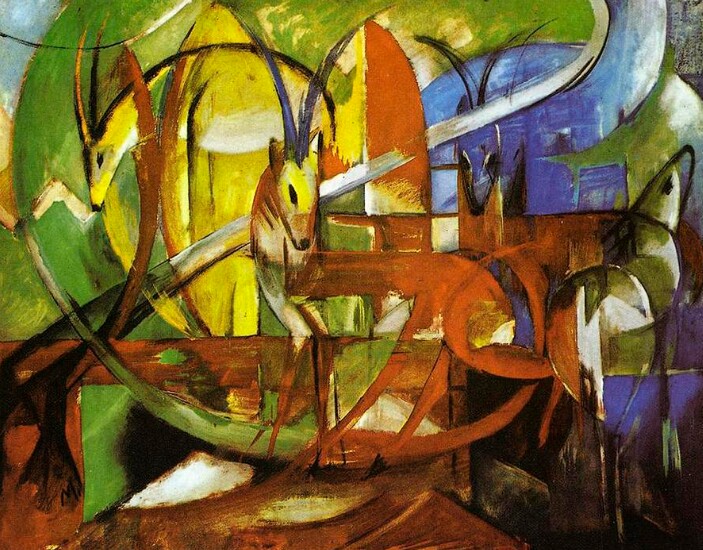
Arty Farty Friday ~ Franz Marc, casualty of World War I

Born on this day, 8 February, in 1880: German expressionist painter and printmaker, Franz Marc, best known for his colourful paintings of animals His life was cut short by World War I. He had volunteered in 1914, and was killed, aged 36, during the invasion of Verdun in March 1916. His closest friend, another German artist, August Macke, had been killed within weeks of war's outbreak, aged 27.

Franz Marc set out initially to pursue a career in the church, his pull towards art was discouraged by his artist father who considered his son lacked talent, resulting in Franz experiencing feelings of worthlessness and periods of depression.

From German Expressionism.com
In 1905, Marc spent the summer walking the Bavarian Alps where he first became interested in representing animals within their natural surroundings. In 1907, he married a friend to legitimize her child conceived with another man. On his wedding night, he suffered a nervous breakdown and fled to Paris. In Paris, he found peace in the late works of Van Gogh and Gauguin. In September of that year, he returned to Nature at Swinemunde where he began to truly understand the joyous meaning of organic unity and harmony that exists among all living things. Once he felt this connection, his life changed. He returned home to Munich via Berlin where he visited the zoo every day for several weeks.

From 1907-10, he taught lessons on animal anatomy in his studio. In 1908 he divorced his first wife and in 1911 he married his second wife, Maria Franck, who was a drawing teacher from Berlin. In 1909 he....came into contact with Wassily Kandinsky who would become a mentor. The two split from this group and founded Der Blaue Reiter (The Blue Rider). In 1910, he met his closest friend, August Macke. Macke introduced Marc to the important collector Bernhard Koehler who would support Marc throughout his career. In 1910, Marc had his first one man exhibition in Munich....... In April 1912, after seeing the Futurist exhibition in Berlin, Marc began to experience feelings of an impending Apocalypse. It was said that Marc possessed a sensitivity bordering on clairvoyance.

Marc is particularly loved for his animal subjects including horses, deer and dogs. He attempted to spiritualize German art by shifting its focus from the external towards the soul of the individual artist and his connection to the natural world. Franz Marc is perhaps best known for his paintings because he produced only 46 prints.

At franzmarc.org we are told:
In the spring of 1914 Franz and Maria Marc bought a small country house in Ried. According to Kandinsky, this purchase was one of "Marc's greatest wishes come true." He was even able to keep a dog and a tame deer there. But in August of 1914, at the outbreak of the war, Marc volunteered. Kandinsky visited him to say "Auf Wiedersehen." but Marc replied "Adieu." Within two months, Marc's first personal indication of the war's magnitude occurred; August Macke died in battle in September at the age of twenty-seven.

Marc wrote and drew extensively at the front. His drawings show a remarkable looseness and facility, for the most part combining figurative elements within a Cubist of Futurist framework of lines. Frequently still, innocent animals are depicted, yet now within a gradually tightening web of force lines that are reminiscent of Marc's vision of destruction, Fate of the Animals, 1913.

While cataclysmic events occurred around him, Marc nevertheless theorized on the supposed benefits of war, including the thought of a spiritual breakthrough and redemption through suffering. He was so moral in his belief in the eventual beneficent effects of the war that he could ignore the fact that patriotic allegiances fueled the war and caused his presence. Finally, he interpreted events in a more fatalistic way. Like the animals who had become simply motifs in a large scheme, he saw himself at war in similar terms. In the war Marc was forced to rationalize his aim, but the conflicts and questions that resulted disturbed him profoundly. Paul Klee was "afraid that he might be a completely different man some day," as if his delicate balance might not withstand reality. The trauma of the war for Marc was such that, at the end, only death could give him relief. In that state his own innocence could be restored. One of Marc's last letter, before his death at Verdun in 1916, concluded on this notes:

"I understand well that you speak as easily of death as of something which doesn't frighten you. I feel precisely the same. In this war, you can try it out on yourself - an opportunity life seldom offers one...nothing is more calming than the prospect of the peace of death...the one thing common to all. It leads us back into normal "being". The space between birth and death is an exception, in which there is much to fear and suffer. The only true, constant, philosophical comfort is the awareness that this exceptional condition will pass and that "I-conciousness" which is always restless, always piquant, in all seriousness inaccessible, will again sink back into its wonderful peace before birth... whoever strives fro purity and knowledge, to him death always comes as a savior."


Natal Chart~ data from Astrodatabank:

There's a predominance of Earth signs here. Earthy Venus-ruled Taurus is on the acendant, creative Neptune is nearby; and there is a Grand Trine in Earth; natal Moon is Earthy too - in Capricorn. The Grand Trine is made up of Venus (planet of the arts), Neptune (creativity and imagination) and Uranus (the avant garde). Marc's Earthiness clearly translates through his artwork via his concentration on animal subjects. In first house, Pluto at 25 Taurus is conjunct Fixed Star Algol, and Mars. This is a natal chart where Algol's allegedly unfortunate "influence" manifests (it doesn't in every case) : Franz Marc's death in war.

I haven't mentioned Sun and Mercury in Aquarius yet - they are semi-sextile Jupiter in sensitive, intuitive Pisces - reflection of his "sensitivity bordering on clairvoyance" mentioned in one of the quotes, above, and of his philosophical outlook.


Marc’s philosophy can be seen in works such as Blue Horses (1911), in which the powerfully simplified and rounded outlines of the horses are echoed in the rhythms of the landscape background, uniting both animals and setting into a vigorous and harmonious organic whole. In this painting, as in his other mature works, Marc used a well-defined symbology of colour: blue, yellow, and red each stood for specific emotional qualities. (HERE)


In 1912 Marc’s admiration for the works of the French painter Robert Delaunay and for the Italian Futurists made his art increasingly abstract. He began to use the faceted space and forms of Delaunay’s brightly coloured Orphist compositions to express the brutal power and timorous fragility of various forms of animal life; an example is Tyrol (1914), a work that approaches abstraction. (HERE)

The full implication of this motif for the art of Franz Marc can best be seen in one of his last oil paintings, Tirol, painted in 1913 and retouched in 1914. The overall image of this painting is, as in Fate of the Animals, one of cataclysmic destruction. The heavens have broken asunder and mountains are crumbling and depositing rocks and ruin upon the village below. In the lower part of the painting two small cottages appear on a hilly bluff, and to the left of them stand two dead trees.
But our attention is consistently drawn to the dominant motifs of the foreground, the thin, diagonally inclined tree which sweeps across the canvas from the lower right-hand corner to the left center of the composition. The branches of this tree culminate in what can best be described as a sickle shape. The tree, in fact, assume the form of some giant scythe. The painting remained in this state throughout the year 1913, for it, to, along with Fate of the Animals, was exhibited at the First German Herbstsalon. After the exhibition closed, however, Marc asked to have the painting returned to him and later in 1914 he added, immediately above the diagonal tree, the same motif of the "Apocalptic Woman" that had fascinated artist of the late fifteenth century, the motif which indicated that a rebirth of man would follow the destruction of the evil society of the present, the motif which spoke of the coming "Age of Righteousness". (HERE)

The Fate of the Animals


Tuesday, August 03, 2010

Astonishing Correlations: Facebook vs. World War I

GUEST POST by Gian Paul

Facebook, launched on Feb. 4, 2004 by Mark Zuckerberg and his friends at Harvard, just celebrated it's 500 millionth adherent. Revenues for Facebook should surpass $1.1 billion this year and Apple/Microsoft and others may soon get into mega-battles to gobble it up before it get's too expensive to do so.


On May 20, this year, Facebook carried to all it's subscribers and fans Draw Mohammed Day. Success was mitigated, I think. Business-wise at least. Pakistan took Facebook off the free net and subsequently introduced a "censured" version. So did other countries.

Over half of Facebook adherents are non - American, 70% at the last tally. Free speech is what the Draw Mohammed Day was propagating, so it must sound like a threat to many Muslim regimes. Iran obviously and others, more moderate, also non-Muslim (China).


World War I started on 28 of June 1914 in Sarajevo by the assassination of Archduke Ferdinand of Austria. That horrible war, 5 years later, put an end to the Ottoman Empire, the biggest ever existing Muslim "world power".


Once before I'd been intrigued by the date of the start of World War I. And had predicted (posted in Astrologymundo some 6 weeks before) that some type of war action was imminent in Kashmir, which had gained it's - subsequently lost - "independence" on Aug. 15, 1947, jointly with India/Pakistan. The Mumbai attacks on Nov. 26, 2008 occurred when Pluto was opposite his own position of the Sarajevo assassination and
Neptune had gone direct to cross in opposition the place where the Sun was when Kashmere/Pakistan/India gained their independence from England.

In retrospect I think it was more intuition than science which had guided me. But it's again back in my mind, try to explain?!

Back to Facebook and Drawing Mohammed Day:

The day Facebook was launched, Feb. 4, 2004, there were astrologically speaking very strong aspects (by "heavy" planets and far beyond statistical probability) on the "Sarajevo Assassination" map: Saturn conjunct Sun; Uranus in opposition Mars (less than 1 degr. divergence); Neptune conjunct Uranus (1 degree divergence) and foremost Pluto opposition Saturn, exact, 1.5 minutes divergence only!

On May 20, when Facebook carried the Draw Mohammed Contest around the world, irritating many Muslims, obviously, the Sarajevo map received the following major transits, again far bejond any statistical probability:

Mars opposes Jupiter (1 degree divergence) - Uranus squares Pluto ( 1 degree divergence) and really ominous, Pluto opposes Sun at also less than 1 degree.

This is EXPLOSIVE STUFF. And Facebook (or who is behind and manipulating) knows it. Here are merely shown the astrological facts and evidence that should be a warning to thread this path of "helping the freedom of the press" a bit more lightly.

In my opinion there is no point in provoking against the innate (automatic) beliefs and instincts of many Muslims (the simply devout and the fanatics). The risk being of turning the simple and sincere ones all into fanatics as well.

Facebook is not without it's adversaries in the liberal world, mostly because of privacy concerns. Imagine what that can represent in "lesser developed" societies! But privacy is one subject, frontally attacking another's idol (Mohammed in this case), is another.

The Aquarian Age, supposedly promising "brotherhood, peace and understanding" to the many may have to face some moral issues of mutual tolerance which really, one might have thought, belong to the Dark Ages.

Friday, November 13, 2009

Arty Farty Friday ~ Otto Dix

Two days ago, 11/11, there was hushed remembrance of the sacrifices of two twentieth century world wars. It's appropriate this Arty Farty Friday to feature an artist who fought in both wars, and showed through his paintings that he was scarred, both physically and mentally, as were so many, on both sides of the conflicts. This artist was German: Otto Dix. We can, through his paintings, take a view of war from one who was, in those dark days, classed as "our enemy".

All art is exorcism. I paint dreams and visions too; the dreams and visions of my time. Painting is the effort to produce order; order in yourself. There is much chaos in me, much chaos in our time.
Otto Dix
Dix aspired to a career in art early on, and in 1910 entered the Dresden Academy of Fine Arts. World War One erupted four years later. Dix volunteered, served at the Battle of the Somme, was badly wounded, several times, and almost to the point of death on one occasion.
As a young man you don't notice at all that you were, after all, badly affected. For years afterwards, at least ten years, I kept getting these dreams, in which I had to crawl through ruined houses, along passages I could hardly get through.
Otto Dix
Post- war many of his paintings depicted the darker side of German society, violence, prostitution, depravity, and the forgotten disfigured veterans of the First World War. Many of his paintings were later burned by the Nazis, who also had him dismissed from a post as art teacher at the Dresden Academy.

Along with all other practicing artists, Dix was forced to join the Nazi government's Reich Chamber of Fine Arts , a subdivision of Goebbels' Cultural Ministry. He had to promise to paint only inoffensive landscapes. He still painted an occasional allegorical painting that criticized Nazi ideals.In 1939 he was arrested on a trumped-up charge of being involved in a plot against Hitler but was later released. He was conscripted late in World War 2, captured by Frech troops at the war's end and released early in 1946.
He returned to teaching, in Dresden.
(See Wikipedia)
People were already beginning to forget, what horrible suffering the war had brought them. I did not want to cause fear and panic, but to let people know how dreadful war is and so to stimulate people's powers of resistance.
Otto Dix

ASTROLOGY:
Otto Dix born 2 December 1891 in what is now part of the city of Gera, Germany, at 1.30 am (Astrodatabank).


The first thing that sprang into my mind when I looked at the chart - this guy should never have had to live through what he had to live through! Nor, of course, should anybody else. Dix's four important personal planets all lay in benign, sunny-faced Sagittarius - aka the wise old owl of the zodiac. Sun and Moon close together, blending inner and outer consciousness as one, and Venus/Mercury conjoined bringing together his art (Venus) and communication skills(Mercury). Libra, his rising sign is ruled by Venus, and, again, the feeling comes that this guy was not built for war!
Brave and impetuous as he was - it really was not his "game" in any way at all.
these are his own words on the matter:
I had to experience how someone beside me suddenly falls over and is dead and the bullet has hit him squarely. I had to experience that quite directly. I wanted it. I'm therefore not a pacifist at all - or am I?

I have to experience all the ghastly, bottomless depths for life for myself; it's for that reason that I went to war, and for that reason I volunteered.

Saturn planet of limitation lies very close to his ascending degree and in 12th house, the house of restriction and withdrawal - a portent of future restrictions of one sort or another.

His natal Sun is opposed by Pluto and Neptune, two outer planets exactly conjoined in Gemini. Pluto, planet of transformation and, sometimes, death is blended with Neptune's imagination and creativity. This combination pretty much sums up the content of a lot of Dix's paintings. These two planets lie in opposition to his essence, his Sun and Moon, and certainly his paintings are just about as opposite as one could imagine from what one might expect of a quadruple Sagittarian.

The Nodes of the Moon have relevance here too I think. North Node is at 25 Taurus, conjunct Fixed Star Algol - thought of by ancient astrologers as the most malignant of all stars. There are no planets or points close enough to be termed conjoined the North Node, which was probably a very fortunate thing for Otto Dix. He did live through the horrors, with time to tell the tale in pictures, as a warning to generations who followed. That would be -us!


Triumph of Death


Disabled by war


The Salon


War Tryptych

Storm troops advancing under gas


Trenches


Dance of Death


Night-time encounter with a madman


Tryptych contrasting a disabled veteran's plight with the lifestyles of wealthy war leaders.


The match seller (a Veteran of the war?)