Showing posts with label skeptics. Show all posts

Saturday, November 03, 2018

Astrology, Tarot, Skeptics

Skeptics love to come out to play on any astrology-related forum or website - it happens on a daily basis at Quora in the astrology section!

I do try to understand, but disagree with some arguments proposing, for instance, that what astrologers (and tarot readers) deal with: positions of Sun, Moon and planets in the sky; and in the case of tarot, illustrations on a deck of special cards, can be interpreted in so many different ways, therefore interpretations must be suspect. There is some latitude, for sure in both cases, but it's not that wide a latitude. In astrology, Neptune for instance, does not indicate anything connected to violence. Mars doesn't connect to the arts. Mercury isn't an indicator of physical energy, etc. The zodiac signs do have a variety of keywords, but they are all of related "flavour".

I used to dabble a bit in tarot, learned the basics, but decided to concentrate on astrology. I know enough to say, though, that each tarot card has a fairly narrow scope of interpretation, as has each planet and zodiac sign in astrology. In tarot the reader is strictly bound by the cards drawn, and for my taste, the fewer cards the better - it cuts out any accusation of too many potential interpretations possible from a larger spread. Three cards offer pretty strict boundaries, context has to depend on the question posed.

The full astrological natal chart has many possibilities of combinations and, yes, interpretation can get a little confusing. However, each individual part of the chart has very limited interpretation. If interpretation is restricted to absolute astrological basics, it is easier to see astrology working, without peripheral stuff to interfere, and play into skeptics' arguments.

Always, always, astrology depends strictly on the movement and cycles of the planets, with data from an ephemeris - which is not arbitrary or interchangeable with anything, it's a rock solid basis, a kind of timetable of movement of the Sun, Moon and planets, day by day, year by year. Interpretations simply cannot be made up to suit the occasion.


Of course, it's up to each individual, and their experience with astrology and tarot, to choose whether to use, trust, or discard either or both of these ancient arts. There really is no need to loudly decry them as "pseudo-science". If you don't like 'em simply ignore 'em. Easy peasy! Skeptics have no access to secret information that such arts as astrology and tarot are "garbage" - one of their favourite words.

Saturday, December 09, 2017

Saturday and Sundry Rant-worthy Thoughts

So many issues currently in the news are eminently rant-worthy - shall I count the ways? Brexit; Trump; Republicans; Democrats; monopolies; men who harass; comedians who are unnecessarily gross, not to mention unfunny; creeping crapification of - just about everything; "smart" stuff encouraging us to speak to inanimate objects as a way of life. Sigh.


There's yet another, more personal, irritant: people who, at the mention of the word 'astrology' pounce eagerly, ready to question the mental capacity of anyone who is, in their estimation, "irrational" enough to give astrology even an inch of headroom. This happened to me a few days ago at a blog which shall remain nameless; it has happened many times during past years on the net, and is tiresome - putting it mildly!

On most occasions, when an urge to intervene with any mild reference to astrology arises, I turn "chicken", shrink from mentioning it, or my interest in, and study of the ancient art. Among those people with no interest in astrology, and in some cases with a definite abhorrence of it, such an interest marks one as a gullible nitwit and totally irrational.

Do rationality and astrology mix? I contend that they can, given the right approach and a mind open enough to see serious failings in both camps, but failings which completely negate neither.

For many people astrology has no relevance at all. I do get that. Football, baseball, basketball and other sports have no relevance to me, but I don't go around denigrating fans of those pastimes. So...why can't astrological skeptics simply ignore astrology and any mention of it? It's almost as though they feel threatened by it!

I remember reading some relevant observations years ago, written by Darin Hayton (link is now defunct). Mr Hayton asked:

"And what really is at stake in this enduring battle between science and astrology? Are astronomers [for instance] afraid that their funding will suddenly go to astrologers? Does the fate of the free world or the rational mind or science depend on refuting astrology? Given the characterization of astrologers and believers in astrology as simple-minded, uneducated, irrational dupes, what threat do these people pose to astronomers and scientists? Does belief in astrology stand for a purported, societal-wide irrationality that threatens the entire practice of science? That seems a bit apocalyptic, but maybe. And what is served by the denigrating rhetoric typically used to brand astrologers frauds and charlatans? Surely it would be more effective to adopt a more conversational approach rather than labeling astrologers and their customers irrational, superstitious dupes..."

Ten years ago, in my early days of blogging - when, even then I found astrology skeptics to be rant-worthy, a commenter "Velvet Blade" wrote:
I used to love those people who would come into an astrology shop and say, "Prove it to me". Why? Because I was once that person. Skeptics are GREAT, as long as they have an open mind. Otherwise, they are not skeptics at all, just stubborn folks who believe that everyone should think the way they think... Hmmm... Ringing any bells in politics???

True skeptics believe what they have found to be true for themselves. The don't close their minds and shut down, with no hope of opening.

True skeptics always make the BEST astrologers. They won't accept anything as true until they have seen it for themselves.
To allow my BP to return to what passes as normal, a quiet ponder upon a couple of quotes:

“The world,” he said, “grows hourly more and more sceptical of all that lies beyond its own narrow radius; and our men of science foster the fatal tendency.
~ Amelia B. Edwards, ("The Phantom Coach").

And, from Sir Terry Pratchett:
Sometimes, if you pay real close attention to the pebbles you find out about the ocean. ("Lords and Ladies").

Wednesday, April 04, 2012

ASTRO-MATH

Why are the inane "tests" used by skeptics such as James Randi et al to discredit astrology always, always going to result in showing the ancient doctrine in a bad light? Because that's the way they are set up. Whether through ignorance or design, most tests are based on nothing but Sun signs - or, even on occasions when skeptical researchers purport to present a more sophisticated test, it could never possibly encompass all there is. There's too much for the human brain to compute and interpret. We now have technology to assist, but as yet, as far as I know, there is no program specifically designed to carry out what'd be needed. There are also variables, outside matters astrological, which will influence how astrological elements manifest in each individual.

While meticulous research would help to clarify, and possibly discount some areas of ancient doctrine which tend to muddy the waters, I doubt there could ever be a cut-and-dried method capable of 100% proof.

In a 1951 publication of the American Federation of Astrologers: The 360 Degrees of the Zodiac by Adriano Carelli there's a lengthy footnote. It enumerates and calculates the enormous variety of possible combinations from which a natal chart could be composed. I posted on this topic a couple of years ago but at that time scanned the relevant page, which didn't post very clearly. This time I've copy-typed the details:
"At any given moment the sun can be in any of the 12 signs, viz: the possible combinations of the Sun with the zodiacal signs are 12. But for each position of the Sun there are three possible positions of Mercury: in the same sign as the Sun, in the sign preceding it, and in the one following it. The possible combinations of the Sun and Mercury with the 12 signs are therefore 12 x 3 =36. For each of these, five possible stations of Venus are to be reckoned with viz: either in the same sign as Sun, in any of the two preceding signs, or any of the following two: 36 x 5 = 180. The Moon, Lilith (not sure why he includes this), Mars, Jupiter, Saturn, Uranus, Neptune, Pluto may have each of 12 different co-locations for any among the 180 combinations previously considered: 12 to the power of 8 x 180 = 77,396,705,280.

Let us now take in the positions of the six couples of houses (they cannot be taken singly, as each house is tied to the diametrically opposite one, and the respective cusps move symetrically) and consider their positions both in relation to the signs and the planets.
(Note: For houses to be considered an accurate birth time is essential)

Spacially all points on Earth's surface with equal latitude have the same system of housing, but in time the position of the cusps varies every instant of the 24 hours of the sidereal day. How many are the possible combinations dureing those 24 hours?

In relation to the signs the six couples of houses move 12 times each during the 24 hours . 12 x 6 = 72 possible combinations between houses and zodiacal signs.

In relation to the planets, each of these moves from house to house 12 times a day. As we have mentioned 11 planets
(he includes Lilith I suppose) FOR ANY SINGLE GEOGRAPHIC LOCALITY THERE ARE 12 X 11 X 132 POSSIBLE COMBINATIONS BETWEEN HOUSES AND PLANETS.

Now let us multiply 77,396,705,280 x 72 x 132: the total is 735,578,286,981,120
."
The author then goes on to point out that if other bodies, and the fixed stars, and sensitive points (Moon's Nodes for instance) were added, as well as the 360 degrees of the zodiac, split into decans or individually, the figures would increase to an unimaginable (for me) total.

He ends by saying "above all I have narrowed the problem down to one single geographic spot, though the tightest crammed human hive hardly holds one twohundred-and- fiftieth of the whole mankind."....

Tuesday, October 25, 2011

Astrology Skeptics & Preaching to the Choir in General

I sometimes turn "chicken" and shrink from using "Twilight" hyper-linked to this blog, when leaving comments outside of the astro-community, or on sites of my known non-astro blog-buddies. Among those with no interest in, or indeed a definite hatred of, astrology, such an interest tends to mark one as something of a nitwit, or at best as being totally irrational. My comment as "Twilight" might automatically become suspect. In most cases, though, I do use "Twilight", in the hope that someone, somewhere will sometime follow the link to my blog and find something of interest.

Following those thoughts somehow led me to land on a Philadelphia Area Center for History of Science website, and a blog there, from January 2011, written by Darin Hayton. The title interested me: What Exactly is Accomplished by Asserting "Astrology is Rubbish?" It's a good piece, well worth reading in full.

The piece closes with this thought:
But maybe despite its guise of rationality and argumentation, the anti-astrology polemic isn’t intended to persuade an opponent any more than any other polemic. Maybe it’s merely a secular form of “preaching to the choir.”
"Preaching to the choir".....always the easiest thing to do, isn't it? In all kinds of "churches" - church of politics, church of beliefs, church of preferences. It'd be an improvement if we all felt more able to "preach to non-choir members" in every "church", and know that we'd not be ridiculed or denigrated. I'm trying to work on it!


A few snips from the article follow, containing what I see as particularly significant points:
All the standard pieces are here: no mechanism, the damning example of precession, the invocation and rejection of “birth signs” as meaningful, the new planets, and the dismissal of astrologers and their audience as uneducated, irrational, and, implicitly, mentally deficient..........

Whatever else might be the case, astronomers seem singularly unable to avoid denouncing astrology and equally incapable of persuading proponents of astrology to relinquish their conviction (or even to dissuade the astrology-curious). Maybe astronomers’ lack of success is related to the cavalier approach they adopt when attacking astrology. They certainly have not engaged with the body of knowledge they hope to refute. Instead, they attack caricatures and straw men. They argue from authority rather than logic. And they seem to ignore astrology’s technical details—such as anything approaching an understanding of positional astronomy—and ignorant of astrology’s history. To be fair, they have occasionally asked questions about possible mechanisms for astral influence, but then dismiss the very possibility of such a mechanism. No doubt they realize that their invectives do not constitute logically compelling arguments. So what then is the point of their denunciations? And whom are they trying to convince?............

And what really is at stake in this enduring battle between science and astrology? Are astronomers afraid that their funding will suddenly go to astrologers? Does the fate of the free world or the rational mind or science depend on refuting astrology? Given the characterization of astrologers and believers in astrology as simple-minded, uneducated, irrational dupes, what threat do these people pose to astronomers and scientists? Does belief in astrology stand for a purported, societal-wide irrationality that threatens the entire practice of science? That seems a bit apocalyptic, but maybe. And what is served by the denigrating rhetoric typically used to brand astrologers frauds and charlatans? Surely it would be more effective to adopt a more conversational approach rather than labeling astrologers and their customers irrational, superstitious dupes...............

The author of the piece does add a disclaimer:
*To be clear, this is not meant as a defense of astrology or astrologers but rather an analysis of the typical form as well as the common tropes found in the anti-astrology polemics. Nor is this an effort to assert once again that astrology was an important intellectual activity in the past that provided the motivation for much of the science that we would now call astronomy.

Wednesday, March 16, 2011

ASTRO-FASCISM ???

It's weird how Google sometimes manages to lure a person who is looking for a specific fact into something fascinatingly related, yet not exactly what one was seeking.

In trying to find the birth date of Bertram M. Gross, author of Friendly Fascism, the New Face of Power in America (1980), didn't find what I searched for but stumbled into Dennis Dutton's 1995 review of a book The Stars Down to Earth, and Other Essays on the Irrational in Culture, by Theodor W. Adorno.

Now....don't laugh....Adorno wrote that astrology is akin to fascism!
Some paragraphs extracted from the review are below. It does us no harm at all to read such views from time to time - if only to consider our motives and check that our integrity remains intact.....or anyway, if only to laugh at an arrogant self important writer who verges on fascisistic tendencies himself....the reviewer isn't too friendly either.


To be sure, there are many intriguing observations throughout this mostly readable essay. In a passage perhaps even more true today than when it was written, Adorno says that a “climate of semi-erudition is the fertile breeding ground for astrology.” He refers to people who have gone just beyond the naive acceptance of the authority of science, but who don’t know enough, or who have not sufficiently developed “the power of thinking,” that they can replace such acceptance with anything better: “The semi-erudite vaguely wants to understand and is also driven by the narcissistic wish to prove superior to the plain people but he is not in a position to carry through complicated and detached intellectual operations.” In other words, quantum mechanics is pretty tough, but astrology offers sophisticated understanding of all reality in a few easy steps. Besides, astronomy is about those remote stars and planets out there — rather cold and impersonal. In Adorno’s apt title phrase, astrology brings it all down to earth, because it’s about the single most important thing in the universe: me.

In an analogy that isn’t too far-fetched, he says that to the semi-erudite individual “astrology, just as other irrational creeds like racism, provides a short-cut by bringing the complex to a handy formula and offering at the same time the pleasant gratification that he who feels excluded from educational privileges nevertheless belongs to the minority of those who are ‘in the know’.” Someone once remarked that Scientology boosts self-esteem largely by giving semi-educated, degreeless persons impressive certificates to hang on their walls, and Adorno is right that there’s a similar syndrome at work with most New Age esoterica, including astrology. (In literary theory, there are no certificates, of course — you just have to learn the jargon.)

Hey - I object to being called semi-erudite Adorno, unless you accept that you can be described as semi-bigoted.

Here's the kicker: (And I do not repeat NOT have a dependent mind! That accessory is reserved for skeptics - dependent upon their own addictive skepticism - their only route to a feeling of superiority).

It is not only capitalism that is embodied in astrology as part of the culture industry, but fascism as well: the “astrological ideology resembles, in all its major characteristics, the mentality of the ‘high scorers’ of the Authoritarian Personality’.” In fact, Adorno says, it was this realization that induced him to begin the study of Righter in the first place. (Refers to an American astrologer: Caroll Righter) The sucker for astrology is a dependent mind. “Moreover, by strengthening the sense of fatality, dependence, and obedience, [astrology] paralyses the will to change objective conditions in any respect and relegates all worries to a private plane promising a cure-all by the very same compliance which prevents a change of conditions. It can easily be seen how well this suits the overall purpose of the prevailing ideology of today’s cultural industry; to reproduce the status quo within the mind of the people.”

So for Adorno it all ties together, rather too neatly, in my opinion: late capitalism, irrationalism, and weak, dependent, fascism-prone personalities in need of the authority of astrology — and all these factors lying at the very heart of so-called enlightened modernity.

Adorno is at pains to deny that the appeal of astrology is basically mystical. It’s not that it supplies a new sort of religion but that it makes the alienated individual more at home in the world of consumerism and the “drabness of a commodity society.” In this respect more than in any other, “astrology resembles . . . other mass media such as movies: its messages appear to be something metaphysically meaningful, something where the spontaneity of life is being restored while actually reflecting the very same reified conditions which seem to be dispensed with through an appeal to the ‘absolute’.” In the division of labor of the culture industry, astrology has, to use a cliché Adorno avoids, its special job in the general provision of opium for the masses.

Last sentence of the review, and as fair a summing up as one could expect from this reviewer:
If Adorno doesn’t like something, no matter how inane or innocuous, it isn’t long before he begins to detect in it the seeds of fascism. The Stars Down to Earth seems now and again almost as obsessive as the astrology it analyzes.
Fascists, opium providers ?...."It takes one to know one" - as my old Gran used to say.

Thursday, February 03, 2011

A Lapsed Astrologer ~ Rudolf Smit


I recently happened upon an article by a former astrologer from the Netherlands, Rudolf Smit. He lost his belief in astrology. The slippery slide began when he used the wrong natal chart for a client consultation. His full article: Astrology my passion - My life, my personal disaster can be read at Astrology and Science.com


Abstract -- Rudolf Smit, founder of this website (astrology and science.com), describes how, as a teenager, he was an ardent amateur astronomer with many technical books on astronomy in his library. Nearly all of them stressed that astrology had no scientific validity, which led him to believe that astrology was nonsense. Later, in his first job, he argued with his boss about astrology, and was told that he should first study astrology before opening his mouth.

So he read about his sun sign and was astonished to find how accurate it was. He then had his birth chart read, not once but twice, and in each case was astonished to find how well it fitted his character and circumstances. From then on astrology became his passion.

He taught himself how to read charts for his friends (everything fitted perfectly), formed the first society of professional astrologers in the Netherlands (this was in 1977), and set up as a part-time professional astrologer (he soon had many clients and the future looked rosy). But one day he accidentally used the wrong chart for a client, who was nevertheless happy with the reading. Two years later it happened again. Very puzzling -- weren't horoscopes supposed to be unique?

Later, with a computer, he spent several years testing the statements made in astrology books, especially statements about events, and found to his horror that almost all could not be confirmed. But he had many happy clients so why worry? Then in 1984 came the crunch. He became aware of the many ways in which clients could be convinced that astrology was true even if it wasn't. And all of them were used by him. Just being warm and caring would do the trick. Worse, any chart would do, hence also the wrong chart.

So his happy world of astrology collapsed. He closed his practice and fell into a clinical depression that lasted three years. Without astrology his life had lost its meaning. Afterwards he regained his interest and became editor of the research journal Correlation for six years, trying to find out which statements of astrology were true.


(Above:Mr Smit testing birth charts with his PET computer in Australia in the 1980s)

Then in 2000 he set up this website for those who wish to know more about scientific findings in astrology, but always remaining sympathetic to its beauty and appeal. This is a true story that anyone interested in astrology should read.
I can understand someone "losing faith" in almost anything (except the power of love). For someone as invested in astrology as Mr. Smit apparently was, his lapse is rather surprising. I have niggling doubts about some parts of astrological doctrine myself, but I find the trick is to stand well back. The closer and into ever more detail one delves, the more avenues for doubt open up. I am absolutely certain that there is a core of truth in astrology, but only a core. From that position I shall never lapse. Even so that core is well worth pursuing, and may contain the seed of something quite unexpected - in fact, something that will seem magical.


I'm interested to see Mr Smit's own natal chart: born on 5 January 1942 in Amsterdam, Netherlands at 9:53 PM (Astrodatabank).


Elementally he has a predominance of planets/points in Earth, none in Water. There's a starting point for his need of absolute proof, lack of intuitive feel which comes usually via Water signs.

Mr Smit's Earthy Capricorn Sun and Mercury alone wouldn't account for his lapse into skepticism, but allied with Grand Trines linking key planets all in Earth signs, well - I see a potential skeptic here, especially as critical Virgo was rising as he came into the world.

I can relate a little bit to Mr Smit. I too have a Grand Trine in Earth - similar to the one on the left (below) linking Neptune, Uranus and Mercury. Perhaps my own Aquarius Sun, Jupiter in Pisces and Cancer rising provide balance sufficient to ride out any doubts about core astrological principles.

Mr Smit's natal Uranus conjunct Saturn is a bit of a bummer for astrology too. Saturn has a restrictive influence upon Uranus's urge towards astrology. In my own chart Saturn is semi-sextile Uranus, which may indicate less of an impediment.


So, my conclusion: In Mr Smit's case the anti-astrological culprit = too much Earthy input which is too closely linked within his natal blueprint. No emphasis on the Watery element to provide balance. Mr Smit might easily have gravitated into the accountancy or architecture - or writing about same. Or perhaps simply staying with astronomy would have offered him a more comfortable ride along life's tangled highways.

Wednesday, October 13, 2010

CASE FOR THE DEFENCE ?

Worth a close look, at website Astrology and Science is a section headed "Artifacts in Reasoning ~ Hidden persuaders make astrology work", by Geoffrey Dean and Ivan W Kelly. Interested passers-by can take a look at the full page of astro "stuff" via the links. I'm going to concentrate here on something there which particularly interested me: the topic of so-called "hidden persuaders".

The whole article was written for the edification of professional astrologers who conduct consultations, not for nosey-parkers like me. But whatever is found on the internet is open to all for their scrutiny - so I shall scrute away:

"....... factors that can make a vague reading seem so uncannily accurate that it becomes almost impossible not to believe in the system's validity. There are many hidden persuaders, of which thirty-four are listed below. All are an active component of experience and all are in routine use in astrology consulting rooms. For convenience we have grouped them under seven descriptive strategies:"
I'm picking 2 from the 7 "strategies", adding my own comments, relating to my own experience of blog-writing about charts of historic or well-known characters, artists, musicians, etc. My responses are in red text.


#2. Stifle chances of being wrong


Appeal to birth chart complexity (nonfalsifiability).....No need to "appeal": THE. CHART. IS. COMPLEX. Common knowledge to even a novice.

Avoid conflict, see what you believe (cognitive dissonance).....
You can only see what is there, whether you believe it or not. If there's no Sun conjunct Neptune or whatever, it isn't there. Capiche?

Believe what you cannot prove (unavailable data)...In astrology nobody can prove anything. That is a given to any astrologer worth his bread. I may not be able to prove it, but I can see it working, proof enough that "something is happening".

Remember the hits, forget the misses (selective memory)
Sometimes this appears to happen when attempting to highlight a specific point about an artist, politician etc. Again, if the factor I hope to see isn't there - it ain't there. Mostly it is, however. The "misses" are only "misses" when they don't apply to the specific factor under discussion.

Ask only confirming questions (stack deck) -
Not really relative to my own case - sans client. I ask myself about the chart of an individual under scrutiny at that time - if I'm looking at the chart of a writer I look to see whether there are natal astrological indications of that. If there aren't any, there aren't any. This hardly ever happens.

Ignore disconfirming evidence (confirmation bias) - This duplicates the item above beginning "Remember the hits" - same response. Added that as long as birth data is accurate, and a factor is there, it cannot be totally disconfirmed (is that a proper word?) as far as I know. It can be "weakened" perhaps, but no more than that.

Deny that astrology can be tested (testability veto) -
We can try to test it, denial of all possibility would be wrong. Thing is, nobody seems to have put enough $$$$$$ into an effort to test it using all available new technology - as yet.


#6. Make the chart fit

Find meaning where none exists (faces in clouds) - Can't do this. A factor is either there or not. Meanings are fairly tightly defined- you cannot "make stuff up".

Read specifics into generalities (Barnum effect) - See above.

See only what you want to see (illusory correlation) -
See above.

Accentuate the positive (social desirability) - What in Urania's name is
wrong with accentuating the positive?

Be seduced by resemblance (magical thinking)
- Tsk. Magical schmagical.

Afterwards we knew it all along (hindsight bias) -
Only if the factors are present. You cannot make it up...... rinse and repeat, 3 times.

Sound arguments yes, sound data no(stereotypes)....Don't understand this. Data = birth data ? If it is not sound, of course proper interpretation cannot be presented. Stereotypes (of a sort) can only be invoked if the right factors are present.

Case rests - comments and alternative views welcome.

Thursday, November 19, 2009

Skeptics are trying......

It's always a fun(ish) read when the skeptics come out to play on an astrology forum. I came across an example of this in an exchange at Skyscript -"Comments by a skeptic", posts between 31 October and November 16, after which the moderator had locked the thread to avoid further argumentative input.

I do understand, but disagree with the argument skeptics drag out, on a regular basis, proposing that what astrologers and tarot readers deal with (illustrations on a deck of cards, and positions of Sun, Moon and planets in the sky) can be interpreted in so many different ways, therefore interpretations must be suspect. There is some latitude, for sure, but it's not that wide a latitude.

Each tarot card has a fairly narrow scope of interpretation, as has each planet and zodiac sign. In tarot the reader is strictly bound by the cards drawn, and for my taste, the fewer cards the better - it cuts out that accusation of too many potential interpretations of a larger spread. Three cards offer pretty strict boundaries, context has to depend on the question posed.

In astrology the same applies. There is some latitude, but not much. Neptune, for instance, does not indicate anything connected to violence. Mars cannot be said to indicate art. Mercury isn't an indicator of physical energy, etc. The zodiac signs do have a variety of keywords, but all of related "flavour".

The full natal chart has so many possibilities of combinations that, yes, interpretation can get a little confusing, but each individual part of the chart has very limited interpretation. Again, if astrological interpretation is restricted to absolute basics, it's easier to see astrology working, without peripheral stuff to interfere, and play into the skeptics' arguments.

Always, always, astrology depends on the movement and cycles of the planets, with data from an ephemeris - which is not arbitrary or interchangeable with anything, it's a rock solid basis. Stuff simply cannot be made up to suit the occasion.

For me, this particular type of argument against astrology, and tarot, fails miserably.

Tuesday, October 20, 2009

Homeopathy & Dr. Samuel Hahnemann

HuffPo carried an article at the weekend, "Homeopathy for Allergies: Nothing to Sneeze At" by Dana Ullman. Due to my own affliction it set me on a trek across Google in search of more information. After reading several articles and reader comments I realised that homeopathy and astrology have a lot in common when it comes to the way they are perceived and criticised by a certain faction of skeptics. Similar outrage, accusations and sneers are thrown around in both cases. I note that both are classed by those who pretend to know better, as "woo" or "woo-woo". If that's the best label they can come up with it points to a serious lack of creativity.

My own view of homeopathy and astrology is that there is a certain amount of validity contained in both, shrouded in a vast fog of supposition and make-do practices. There's so much we still don't know about our life and our universe, its energies and how the whole kaboodle links up and works. I try not to exclude anything but the most fluffy and woolly ideas....and even some of those might have substance. If it works and you can see it working, time after time, then it works - simple as that.

Homeopathy is a theory, belief, system - whatever, founded by a German doctor, Samuel Hahnemann. (Left:Memorial to Dr. Hahnemann in Washington DC). He was born in the mid-18th century in the days when medical practices were crude and cruel:

As the protective father of many children (Note: he and his first wife had 11) facing a host of diseases and illnesses, Hahnemann became increasingly uncomfortable with the medical techniques of the day, later dubbed the "Age of Heroic Medicine." Lack of medical knowledge coupled with a belief in evil spirits and curses led well-meaning physicians to prescribe such treatments as blood letting, in which doctors would remove nearly all of patients' blood. Another popular treatment was blistering, an attempt to draw toxins out of the body through the application of hot substances. Doctors also dispensed huge doses of drugs including mercury, arsenic, opium, and alcohol, often trying to induce vomiting and emptying of the bowels. "Massive doses of calomel," noted a writer for FDA Consumer, "not only cleaned the bowels, they also caused teeth to loosen, hair to fall out, and other symptoms of acute mercury poisoning. Such 'heroic' therapy often prolonged the illness, if it did not kill the patient outright." In the United States, George Washington died in 1799 after being treated for sore throat. His therapies included bloodletting and blistering with cantharides, a concoction made from dried beetles.

He experimented with the idea that like cures like: ("similia similibus curantur", as engraved on his memorial, above left.)
For years, Hahnemann enlisted his family for experiments that involved inducing various symptoms, testing out more than 2,000 substances ranging from herbs to snake venom, and carefully recording the results. Finally, he began to apply his remedies to actual sick people, administering concoctions he hoped would mimic the symptoms already being exhibited by the patient. At first, Hahnemann noticed that his patients actually became sicker from his substances. This prompted him to dilute his medicines into smaller and smaller doses to find the tiniest possible portion that would still trigger the body's response. To his own surprise, Hahnemann discovered that the more diluted remedies were actually more effective at treating diseases. This became his Law of Infinitesimals, which holds that even though none of the original molecules may remain in a particular dilution, the vital forces, or healing power, of the substance remains.
Hahnemann's remedies were created systematically, in a process that included placing one drop of the substance in 99 drops of water or alcohol, then shaking the container vigorously, and repeating the process several times. In theory, after several dilutions, not a single drop of the original substance was left. However, scientists in the 1970s used a nuclear magnetic resonance machine to prove that "even though there is no substance left in most homeopathic remedies, their footprint remained in the alcohol/water that the substance was diluted in," wrote homeopathic physician and M.D. Jeffrey Migdow in New Visions Online.

From HERE


So - let's have a quick look at Dr.Samuel Hahnemann's natal chart. He was born in Meissen, Germany on 10 April 1755, Wikipedia tells us that some sources state the early hours of 11 April as his time of birth, but others "around midnight" on 10 April. This'll mainly affect his ascending degree, and maybe degree of the Moon. As far as I can tell, unless he was born well after midnight and into 11 April, his rising sign would always be Sagittarius. I've set the chart below for 11.57pm on the 10th.


His Sun, Moon and Mercury, three of the most important placements in the chart are in Aries, sign of the energetic initiator - which he certainly was. Venus, Mars and Uranus, also important factors in any chart lie semisextile (mildly helpful position) nextdoor in compassionate, gentle Pisces.

Aries and Pisces seem like uncomfortable bedfellows, one all drive and go-getting, the other soft, dreamy and creative. When they do blend in one personality though, the result might well be someone with the initiative to bring about change in a compassionate and caring manner....which is what we have here. Uranus (the inventor of the zodiac, the avant garde) is linked closely to his important personal planets too.

His ascending sign is almost certainly Sagittarius, sign of the philosopher and visionary, ruled by Jupiter which in this case is right at midheaven, in the area of career and public status, and in in Virgo, sign of the practical perfectionist, which Hahnemann needed to be in conducting his his experiments and researches.

Pluto lay close to his ascending degree at 11.57pm, and whatever his exact time of birth, at "around midnight" Pluto wouldn't be far away from this angle. Pluto is traditonally connected to death, but also to transformation of all kinds. Hahnemann's life's effort was directed to transforming crude medical practices.

Saturn in its home sign of Capricorn is exactly in trine with the axis of the Moon's nodes in Virgo/Pisces at 28.18* - I'm not sure how to interpret this in my minimalist style. The Moon's nodes are sensitive points, and in this case the axis is similar to the opposition of Jupiter to his Pisces cluster of planets, which are also semi-sextile his Aries cluster. So I'll simply say that Saturn, representing science and discipline is linked in to a dynamic network, relating to the basic thrust of his life's work.

Wednesday, July 08, 2009

BEING RATIONAL

Having read humanists, atheists and common & garden skeptics banging on about rationalism and astrology (see Sunday's post) I dug around in my archive files for this, from July 2007, on a similar topic.


"To paraphrase an old Buck Owens song "All we have to do is act rationally". I try to - most of the time, but when reading other blogs, particularly on new age subjects, and even sometimes on astrology, I feel that what I call my rationality somehow gets in the way. Even so, I can't change my mental wiring - nor can any of us.

One of my favourite astrologers of the past, C.E.O. Carter, has this to say about rationalism in his Encyclopedia of Psychological Astrology
"Rationalism is usually the result of a prominent and strong Saturnian influence and of the earthy element, which both tend of make the native fully alive to the logic of facts and the actualities of existence. From a more mental standpoint the same is true of Mercury and his signs. In the horoscopes of rationalists it is probable that the watery signs will rarely be to the fore, although Scorpio sometimes inclines to materialism.If the influences are for the most part good, we may look for open-mindedness; if they are adverse, and especially if the fixed signs are involved, we may look for bigotry."
In my own chart Mercury in Capricorn, with Saturn in Aries semi-sextile Uranus in Taurus probably describes my awkward rationality. My mind wishes to be logical, especially with Sun in Aquarius. Aquarius's modern ruler, Uranus is in earthy Taurus semi-sextile Aquarius's traditional ruler Saturn, in Aries. In addition My Aquarian Sun is semi-sextile Jupiter in imaginative Pisces, not known for its logic.

The semi-sextile is a peculiar aspect to get to grips with. It occurs when planets lie at the same (or closely similar) degrees of signs nextdoor to each other. Two quite dissimilar signs and elements with a close chart connection, producing something in one's life which is always a kind of anomaly. That's how I see it anyway.

In my own case the anomaly is my unshaken belief that there's "something going on" in astrology, yet some scepticism remains, driven by rationality. I find it difficult, nay impossible, to accept certain parts of astrological doctrine. Watery elements in my chart - Jupiter in Pisces (at midheaven natally), Mars in Scorpio, and Cancer ascendant probably serve to widen and aggravate the split in my approach to these matters.

Acceptance is the answer. What we can't change, we live with and hopefully enjoy, whilst trying to accept gracefully that others are doing the same."

Do rationality and astrology mix? I say they can, given the right approach and a mind open enough to see serious failings in both camps, but failings which completely negate neither one.

Words of wisdom from Mahatma Gandhi:

“Rationalists are admirable beings, rationalism is a hideous monster when it claims for itself omnipotence. Attribution of omnipotence to reason is as bad a piece of idolatry as is worship of stock and stone believing it to be God. I plead not for the suppression of reason, but for a due recognition of that in us which sanctifies reason.”

Sunday, July 05, 2009

Labels: Don't Know

I think there must be a streak of masochism in me. I took an on-line test on religious beliefs some time ago, lots of searching questions were posed. Conclusion from my results: "secular humanist". I promptly forgot all about it, but the memory re-surfaced the other day and I started researching secular humanism.

That test has been inaccurate in my case. Secular humanists reject astrology as vehemently as Richard Dawkins does. In fact, from a list of "celeb" secular humanists I note his name is among them. Well now, to paraphrase Groucho Marx - I wouldn't join any club who would have him as a member!

New cults of unreason as well as bizarre paranormal and occult beliefs, such as belief in astrology, reincarnation, and the mysterious power of alleged psychics, are growing in many Western societies. These disturbing developments follow in the wake of the emergence in the earlier part of the twentieth century of intolerant messianic and totalitarian quasi religious movements, such as fascism and communism. These religious activists not only are responsible for much of the terror and violence in the world today but stand in the way of solutions to the world's most serious problems. (From A Secular Humanist Declaration).
Elsewhere it is stated:
"We are always open to the discovery of new possibilities and phenomena in nature"
Huh? Not from where I'm standing! That's just plain laughable!

I wandered on through Google inputting humanism/atheism/astrology and found myself on some very antagonistic ground. Atheists don't give astrology even a smidgin of credence, in fact they seem to be saying it's not possible (or very difficult) to be both atheist and astrologer. A couple of message boards underlined the fact that I'm quickly becoming an outcast of society because I believe there is value in (some parts of) astrology, though its source is still to be discovered. (See this discussion)

So, am I a pagan or neo-pagan then? No, not really. I don't believe in the traditional God but neither do I believe in other deities. I believe that ancient deities were a way to explain the inexplicable to The Great Unwashed of the past. I believe man is simply a force of Nature, along with his fellow creatures of Earth. If there is a God or god, it's Nature itself - the mathematics and physics of Nature. I don't think that's paganism.

What am I?
Don't know.
Does it matter?
Don't know.
Do I need a label?
Don't know.
Perhaps "Outcast" would fit the bill though!

Monday, June 15, 2009

Reviewing Richard Dawkins

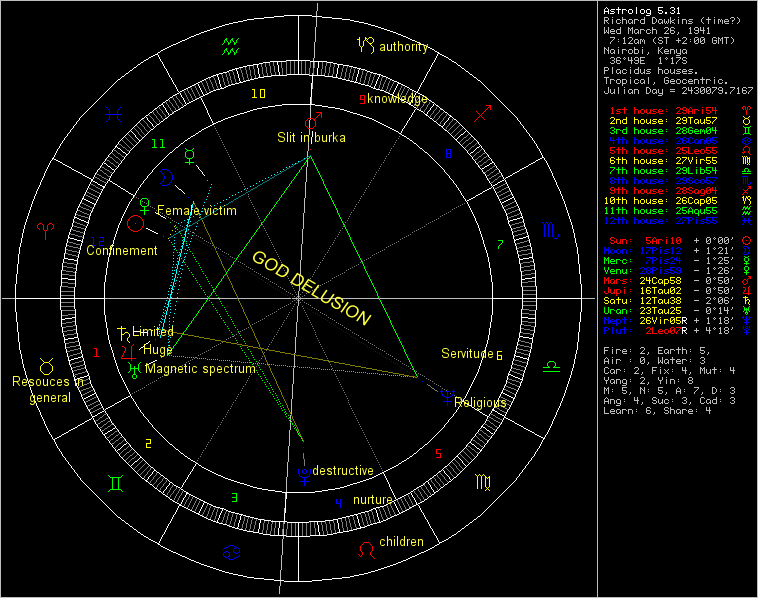
It's always good to receive comments on old posts. As well as being a reminder that these don't just disappear into the ethers, it brings back to mind the topics I've felt were important. I received a couple of such comments recently, on a post from January 2008. I'd been complaining bitterly about Richard Dawkins and his treatment of astrology. As this is an on-going debate - as far as I know he hasn't changed his stance on the topic - I decided to re-air that old post along with some of the comments received. I didn't include a natal chart in the original post, so here's a 12noon version for Dawkins' date of birth, in Nairobi, Kenya - 26 March 1941. I can find no time of birth, so ascendant and exact Moon degree remain a mystery.

Stand-out feature, for me: there are no planets in an Air sign. Unless his ascendant is in Air, it's a missing element in his makeup....which is a bit odd as he fancies himself as such an intellectual. He's certainly not a free-thinker though. Those three stubborn Earthy Taurus planets could present a kind of barrier to his three Pisces planets which, in most cases would indicate someone with at least a passing interest in the paranormal/astrology, maybe even someone who had psychic ability.


POST FROM January 2008:
I tripped over this video of a BBC TV programme in which Richard Dawkins derides and tries to discredit astrology, psychics and belief in the paranormal. I forced myself to watch it to the end, even though it made me angry.

Richard Dawkins claims to be scientifically minded, and a seeker of "the truth", but in investigating astrology he insisted on discussing only the Sun sign variety. If he has done even minimal research, he will know that this isn't the fair and reasonable way to investigate astrology.

Astrologer Neil Spencer was very patient, as shown in the programme, but in my opinion he was far too nice. He reminded me of many American Democrats - no fighting spirit, too passive. But perhaps this programme was edited to exclude anything which could put astrology in a more positive light.

Richard Dawkins is making money from his books and TV shows. In my opinion he's doing so just as fraudulently as some less genuine psychics conduct their businesses. He is not giving viewers the full picture, not presenting sufficient information for them to decide for themselves. He cherry picks those parts which are negative, to support his own skewed opinions.

Why hasn't some brave astrologer stood up and told him that he doesn't know everything about the universe and its workings? Astrologers don't know either, of course. They don't know now, and they didn't know in past centuries. What astrologers could, and can, see is that something is going on. Something, using astrology's main principles, works. Something relies on movements as recorded in an ephemeris.

"Because something is happening here
But you don't know what it is
Do you, Mister Jones?"
(Bob Dylan)

A set of astrological tools has been developed over many centuries, these tools are all there is with which to make any semblance of sense about that elusive something.

I believe the future will reveal the source of that elusive something. Some tools astrologers have used will become redundant, new and more efficient ones will replace them. This is my prediction, and I'm sticking to it. What we now call astrology will, one day, be found to be a small part of the way the universe works. Richard Dawkins and I will not be around by then though. I shall never have the satisfaction of seeing him eat his words.


SOME COMMENTS dated from January 2008 to June 2009
I've omitted most of my own responses to the comments, as they were mainly in thanks and agreement. I've added hyperlinks and an image of the chart that commenter Rog kindly provided via a link.

Out the Comet's Ass said...
Thanks for the video Twilight. If his practice of Science is as superficial as his understanding of Astrology I don't think we need to worry what this guy "thinks." I think he's just a "Pop" scientist. People go for 20 years to a psychotherapist and don't improve at all. I wonder why these guys don't attack the psychologists. That seems much more criminal.

******

January 08, 2008 Adrian Fourie said...
RICHARD DAWKINS IS A STUPID, NAIVE ARIES ON AN ARIES EGO TRIP. HISTORY DOES AND WILL REMEMBER GALILEI, COPERNICUS, KEPLER, BRAHE AND NEWTON, NOT THIS SILLY LITTLE MAN WHO IS THE BIGGEST FRAUDSTER OF ALL.

THE SAD THING IS THAT THE WORLD CURRENTLY REGARDS HIM, CHOMSKY AND ECO AS THE LEADING THINKERS OF OUR TIME. WHAT A JOKE! IT SHOWS YOU HOW WELL OUR CREATOR HAS HIDDEN ESOTERIC SCIENCES FROM IDIOTS FOR OUR OWN PROTECTION.


******

February 01, 2008 Rog said...
The "God Delusion"'s 'mother of all burkas', the dramatized hyperbolic metaphor by Richard Dawkins.

Using the 'artistic expression' of Dawkins as astrological (alchemical) material for chart rectification we get a chart like this:
Click to enlarge


I wonder if he knows when he was born...too bad we'll probably never find out...:)

Rog


******

November 21, 2008 Twilight said...
Interesting, Rog. I get a distinctly Virgo feel to the man, his voice and manner of expression.
But he annoys me so much that it's impossible for me to be objective! ;-)


******

November 22, 2008 Gabriel Pender said...
I have done a bit more detailed natal chart for Richard Dawkins. I discovered to no surprise that he is an Aries with a Moon in Pisces and an Ascendant in Pisces. Goodness Gracious Me!!! It's no wonder people are so damn well swayed by his projected ideals because Aries are very persuasive. They can have very black and white views without seeming arrogant. Because he has a moon and rising in Pisces which notably represents scepticism he achieves success in flaunting his very skewed ideas of astrology to those who bother to listen. Like the main writer of this article stated he didn't confront astrology in full total. I wish some very genuine astrologer would have a good hour talk on that TV show "Ted". I wonder how many people would turn up to listen to it. A Nobel Prize winner once said "If people think as much to astrology as there is, then there would be no need for any other science, yet if it were little as people think it is then it would not have survived for 6000 years". Hopefully the Age of Aquarius will sort everyone out.

******

June 08, 2009 Rog said...

I think that I find comfort in viewing our all-too-human attempts at faithfully describing what-goes-with-what-and-why as basically a 'religious' exercise. So, Science is but part of that mental spectrum--the part with most (if not all) of the truly objective evidence....:) To not concede this 'truth' is itself a kind of unforgivable 'blasphemy', a flaunting of one's weak reasoning skills, and essentially of no service to the greater good.
I never forget that my affection for astrological 'truth' is but an informal membership in a theocratically inclined bunch of radical dogmatists...a political party of sorts...none of who I actually agree with of course...:) Astrology belongs to Art , not Science. Art, itself, is no less than the 'reason' for all of creation. In short, I would rather watch how Dawkins unconsciously expresses his natal chart, and simply enjoy this feeling of having earned, for myself, an holisitic, priviledged, sacred, perspective...rather than trying to imagine the egoistic and unholy task of re-creating that particular man in my own image...:)
Rog

Sunday, May 31, 2009

"Tackling" Astrology?

I'd decided not to post today - then I stumbled upon this.

"What is the best way of tackling astrology", on the Richard Wiseman blog. I arrived there quite by accident.

Why on earth should anyone have to "tackle" astrology? Astronomers and science-oriented skeptics have such arrogance!

A very brief extract from a BBC Radio 5 interview has been embedded on the blog. This doesn't give a very good impression of the astrologer's viewpoint, however. Wiseman keeps badgering her to say which astrological study she relies on to uphold her views. I reckon she should have responded that there has yet been no proper all-encompassing study of the subject in a way that computer technology would now afford. It's a pity that those who are so keen to deride astrology don't put their energy into conducting a wide study of the subject, in cooperation with those who understand it fully and using all available technology.

I haven't heard the whole interview, but the comments on this blog attracted, then repelled me.

The blogger, of course, is singing to a choir of lemming-like commenters. There is one comment from a Richard King (5.27pm on 28 May 2009)which warmed my rapidly freezing heart.

A brief extract
I was not wildly impressed with either side in the interview. Anything other than a dialogue with at least a degree of understanding and mutual respect for alternative views and ways seems rather pointless.
What is the best way of tackling astrology? That depends what is meant by tackling. If it is understanding and investigating, including “scientifically”, then discuss it with people who understand the subject. Similarly, any astrologers who wish to engage with science should discuss the matter with people who understand science.
The problem is that there are, obviously(?), huge differences in levels of understanding and capability on both sides

And from his closing paragraphs, a view which is very close to my own:
On the basis of my knowledge and experience, there is less to astrology than some proponents claim and more than mainstream science claims; though the general tenet of it fits with some rather high level science.

Thank you Mr. King!

Sunday, November 30, 2008

"Something frowsy" you say, Mr. Morrow?

Searching for information on Enrico Caruso (for a post which I later decided to abandon), I hit on an old article in "TIME" written twenty years ago by journalist and author Lance Morrow:
"The Five-and-Dime Charms of Astrology".
He begins:
"Astrology has something frowsy about it. It comes to the door in hair curlers. It looks through the screen with squint-shrewd eyes. The caller who rang the doorbell stares in at crackpot mystery in the half-light, and senses there a kind of disreputable plausibility. The dogs on the porch get restless and slink away. A universe of surreal connections unfolds......."

I expected to feel incensed by the article, but was drawn in to read it from start to finish by the expert and entertaining writing style of Mr. Morrow.

"The American character alternates between Ahab and Starbuck -- the grandiose obsessive and the commonsense skeptic. Astrology plays to the Ahab. It offers a seeing of the unseen, and hears pitches of significance that the ear cannot detect. An elaborate counterworld whispers its order into the human mess."

You were getting a wee bit warm there Mr. Morrow!

I cannot find it in my heart to dislike Morrow in the way I dislike Richard Dawkins or Randi and his clan of skeptics. Mr. Morrow would benefit greatly from having dinner with the likes of Robert Hand, Garry Philipson, and a nap selection of our own astrology bloggers (I'll be serving the wine and listening in to the conversation!) I guarantee that Mr. Morrow would be able, next day, to write an altogether different piece on the subject of astrology. He might even feel inclined to characterize it, rather than as a squint-eyed frowsy, as something crisper, cleverer - more along the lines of Emma Peel or John Steed in "The Avengers": a smart cookie, searching for answers.

A look at Lance Morrow's natal chart could prove interesting. He was born on 21 September 1939, a War Baby like me, but born on the safe side of the Atlantic Ocean. This means he'll have that somewhat grounding Earth Grand Trine in his natal chart - the one which tends to anchor our War Baby feet firmly on Mother Earth, preventing too many flights of fancy. We have been known to hover at low altitude on occasion though!

I can't find Mr. Morrow's place of birth mentioned anywhere, the best information I have is that he was raised in Washington DC. I'm pretty sure he was born somewhere in the eastern states, so using Washington DC and 12 noon to set up a chart, will afford us some accurate and significant planetary positions.


There it is! the Grand Trine in Earth. Mr. Morrow's is more powerful than mine. His draws in Sun, Mercury and Neptune in Virgo trining Uranus and Mars in Taurus and Capricorn respectively. (My own comprises Neptune, Mercury and Uranus). Adding to the Earthy tone of Morrow's chart is Moon in Capricorn, but exact degree is uncertain without a time of birth.

It's no surprise, then, that Lance Morrow looks askance at astrology and New Agey stuff in general. The Earthy circuit provided by his Grand Trine is not conducive to the appreciation of things intangible.

Morrow's Sun, Mercury and Neptune in Virgo, one of the signs ruled by communications planet Mercury is an excellent configuration for the serious career writer that he is. His piece on astrology is not typical subject matter! The inclusion of Neptune in the Virgo cluster ensures just enough imaginative turns of phrase to engage the reader and prevent stagnation and an attack of Attention Deficit Disorder. This is exactly what drew me into reading and enjoying his linked article, in spite of its skeptical attitude.


Lance Morrow has written 14 books, the best known is probably "Evil: An Investigation", about which he chats with my fellow Brit-turned-American, Craig Ferguson, in the video below.


I shall be looking out for an opportunity to read more of this author's writing in future. His opinion of astrology leaves much to be desired, but I do admire his way with words.

Sunday, January 06, 2008

Richard Dawkins' skewed view of astrology

I tripped over this video of a BBC TV programme in which Richard Dawkins derides and tries to discredit astrology, psychics and belief in the paranormal. I forced myself to watch it to the end, even though it made me angry.

Richard Dawkins claims to be scientifically minded, and a seeker of "the truth", but in investigating astrology he insisted on discussing only the Sun sign variety. If he has done even minimal research, he will know that this isn't the fair and reasonable way to investigate astrology.

Astrologer Neil Spencer was very patient, as shown in the programme, but in my opinion he was far too nice. He reminded me of many American Democrats - no fighting spirit, too passive. But perhaps this programme was edited to exclude anything which could put astrology in a more positive light.

Richard Dawkins is making money from his books and TV shows. In my opinion he's doing so just as fraudulently as some less genuine psychics conduct their businesses. He is not giving viewers the full picture, not presenting sufficient information for them to decide for themselves. He cherry picks those parts which are negative, to support his own skewed opinions.

Why hasn't some brave astrologer stood up and told him that he doesn't know everything about the universe and its workings? Astrologers don't know either, of course. They don't know now, and they didn't know in past centuries. What astrologers could, and can, see is that something is going on. Something, using astrology's main principles, works. Something relies on movements as recorded in an ephemeris.

"Because something is happening here
But you don't know what it is
Do you, Mister Jones?"
(Bob Dylan)

A set of astrological tools has been developed over many centuries, these tools are all there is with which to make any semblance of sense about that elusive something.

I believe the future will reveal the source of that elusive something. Some tools astrologers have used will become redundant, new and more efficient ones will replace them. This is my prediction, and I'm sticking to it. What we now call astrology will, one day, be found to be a small part of the way the universe works. Richard Dawkins and I will not be around by then though. I shall never have the satisfaction of seeing him eat his words.

Monday, April 23, 2007

Skeptical questions. Sincere answers.

I stumbled upon a website for astronomy students: "Astronomy 10". In Lecture 4, after information about the history of astronomy, 11 questions are posed, following this statement :

"Ptolemy also codified the pseudoscience of astrology into the form which is still in use today. That just goes to show that great genius is no guarantee against being dead wrong."

Using my own knowledge and experience of astrology, which is limited as compared to that of professional astrologers, I've attempted to test myself by answering these :

Skeptical Questions for Astrology:

1. What is the likelihood that 1/12th of the world's population is having the same kind of day?
There is no likelihood at all. This proposition is based purely on Sun sign astrology. Anyone who had bothered to obtain a bare minimum of astrological knowledge would never pose such a question.

2.Why is the moment of birth and not conception critical?

The moment of birth, the first moment that a human being breathes and encounters the Earth independent of his/her mother has been seen over many centuries to be the significant marker upon which a birth chart can be calculated with reasonable accuracy. The moment of conception, if it could ever be acccurately established (very unlikely) may also have some significance, but there is no way to obtain accurate date and time.

3.If the mother's womb can keep out astrological influences until birth, can we do the same with a cubicle of steak?

No. The baby grows, part of its mother, using the mother's system. A cubicle of steak is a cubicle of steak, nothing more. Silly question - this from a university!

4. If astrologers are as good as they claim, why aren't they richer?

Some are quite rich, some are poor, some practice astrology only as a second occupation. As in all walks of life, it depends how well they do their job, how well they promote themselves, where they live, etc. etc. No different from any other profession. This question hints at an idea that astrologers should be able to predict results in gambling or financial dealings - my personal opinion is that they cannot do so, most do not claim to be able to do so.

5.Are all the horoscopes done before the discovery of the three outermost planets incorrect?
No. The outer planets mainly affect generations rather than individuals, due to the planets' slow rate of movement. Including the outer planets in astrological interpretation adds extra information and depth, but does not render astrological work done without them incorrect.

6.Shouldn't we condemn astrology as a form of bigotry?

Bigotry!? No, but the condemning of astrology as useless superstition, without due investigation, might be categorised as bigotry. The definition of bigotry is "being blindly and obstinately devoted to a party or creed." Those who see astrology working are not blind. Those who refuse to learn more about the subject before expressing an opinion are both obstinate and blind, devoted to their creed of skepticism.

7. Why do different schools of astrology disagree so strongly with each other?

They do not "disagree strongly". They use different approaches, the destination of all approaches is the same, different roads are taken

8. If the astrological influence is carried by a known force, why do the planets dominate?
Astrologers do not claim any "known force". Astrologers do not know how and why astrology "works", there are theories. Astrology is a process, or tool which has been designed to try to disentangle and use a natural phenomenon. That phenomenon has been observed over many centuries, without its source being understood. Observation of planetary cycles, over time, has led to astrologers' theory that these movements and cycles are a predominant factor.

9. If astrological influence is carried by an unknown force, why is it independent of distance?
See previous answer.

10. If astrological influences don't depend on distance, why is there no astrology of stars, galaxies, quasars, etc.?
There is astrology of fixed stars, this is used by some astrologers. Maybe some day galaxies and quasars will be studied in relation to astrology. Not enough is known at present.

11.Why can twins have different fates?

For many reasons. Time of birth is always different, by several minutes. Some twins are fraternal rather than identical, and will therefore carry different gene structure. Astrological factors can manifest in subtly different ways. Astrological factors are not the only thing to consider. The way the twins were raised is an important factor, were they treated absolutely equally by parents and others? Were they both influenced by the same external factors throughout life? No two snowflakes are exactly the same - as with snowflakes, so with humans. The general pattern in the life of twins can often be seen to be similar, however.

*****************************

My own general opinion, for what it's worth: astrological factors are one tiny, but important, strand in the whole web of life. Astrologers make heroic attempts to disentangle astrological factors from the myriad of others. Sometimes they succeed, sometimes they don't. The phenomenon involved isn't even partly understood, it's not surprising that efforts of researchers to find indisputable proof can fail.

Tuesday, February 20, 2007

Will scientists ever say "Hmm... that's funny"?


"The most exciting phrase to hear in science, the one that heralds the most discoveries, is not 'Eureka!' but...... "That's funny."
Isaac Asimov is credited with that quotation. I wonder, will there ever be a "Hmmmm.....that's funny" moment for scientists with regard to astrology?

A word which appears frequently in scientists' arguments about astrology is "artifacts". Artifacts, in the context of cognitive reasoning, are so-called fake effects (in this case astrological effects) which could have ordinary explanations. Whilst I can see how artifacts might account for some seemingly good results in pieces of astrological research, I fail to see how we can continue to be misled by them in astrology generally. Too many brilliant minds, and too many ordinary folk like me can see SOME of astrology working day by day. I check the status of my own beliefs regularly - there's a latent skeptical streak in my nature. Astrology would have been given the heave-ho by me long ago, had I sensed that there was nothing at all in it.

It seems to me that there's a parallel between what has happened regarding herbal medicine and what might happen in the future in relation to astrology. Herbs have been used as medicine, and for recreational purposes, as far back in history as it's possible to see, and almost certainly well beyond that. For example, cannabis is said to have been used in ancient middle-eastern countries, hemlock and belladonna were used as poisons in Greek and Roman times, and some believe that the holy drink of the ancient Aryans mentioned in the Vedas -- soma -- was a concoction involving ("magic"?) mushrooms. "A Brief History of Psychopharmacology"

The Foxglove plant had been used in folk medicines for centuries, some say as far back as the time of the Druids, before more recent pharmacists discovered that it contains digitalis, proven to be effective in treating some heart diseases. Similarly, the plant Feverfew, used in folk medicines, has been found to contain chemicals which do have ingredients which can produce effects observed by our ancestors, namely reducing fever or dealing with some kinds of headaches.

Whether our early ancestors came by their knowledge of the medcinal value of these plants by accident or by careful sampling, or whether specific knowledge had come to them from an unknown source, isn't recorded. We now know that there was validity in some of the ways they were using the plants. We are now able to understand the reasons why these plants proved effective, reasons which our ancestors would have been incapable of understanding or discovering.

A similar line of thought can be applied to astrology, its origins and its future. Scientists might, one day, discover an element as yet unknown, which we are as yet incapable of understanding, and this could validate at least some part of astrological discipline. Astrology continues, and will continue to be used because, as in ancient medicine, observation and experience has shown sufficient positive results to put an indelible mark upon our memory stating "it works!" And to us, it's not funny at all.