Showing posts with label sheep. Show all posts

Wednesday, March 14, 2018

Sheepishly Heading for Easter and Springtime

Easter, and the run up to it, brings to mind a rhyme I used to repeat, long ago and far way near the north-eastern coast of England:
Tid, Mid, Miserai (or Misere)
Carlin, Palm, and Paste egg day.

Reciting it as a child, gobbledegook-wise, I didn't care what it meant, I just wanted to get at those chocolate Easter eggs! I later grasped that it had something to do with the Sundays of Lent, and customs attached.

Carlin(g)s are black peas, eaten on Passion Sunday, On Palm Sunday sometimes dried palm leaves were handed to members of church congregations, and Paste eggs (possibly a corruption of Pasch) eggs were what all the kids eagerly anticipated.

As for the mysterious first line of the rhyme, there are two explanations:
'Tid' was the second Sunday in Lent when, it seems, the Te Deum was sung/chanted in church; Mid could refer to a hymn 'Mi Deus', sung on the third Sunday of Lent; Miserai/misere might be the psalm 'Miserere Mei', sung on the fourth. But there's also a very slight possibility, because the purpose of the rhyme was to count Sundays before Easter, that Tid, Mid was a variation of an ancient Celtic-based method/language once used in the north of England for counting sheep. Exact spelling varies with dialects of northern England, but one, two three, four, five = yan, tan, tithera, mithera, pip. Could 'tithera', 'mithera' equal 'tid' 'mid'? I'm not confident about this, it doesn't really fit snugly. Interesting though. It has been noted that even in parts of the United States the old sheep-counting method is not not unknown, possibly brought across the Atlantic by early immigrants.

The full ancient sheep-counting method went like this, with spelling variations.
(My grandmother and neighbours of her generation always pronounced "one" as "yan", by the way.)

Yan
Tan
Tethera
Methera
Pim
Lethera
Severa
Hovera
Dovera
Dik
Yan-a-dik
Tan-a-dik
Tethera-a-dik
Methera-a-dik
Bumfit
Yan-a-bumfit
Tan-a-bumfit
Tethera-a-bumfit
Methera-a-bumfit
Giggot

The sheep were counted up to twenty, the shepherd then closed one finger and repeated the count until all his fingers of one hand were down = a hundred sheep. Next he would close a finger on his other hand and begin anew. So up to 500 sheep could be counted using this method.

Regarding the mysterious custom of eating black carlin peas during Lent: there's no religious significance, but the tradition is said to be linked to the civil war of 1644. Royalist Newcastle in the north-east of England was under siege from the Scots. People were dying of starvation. The story goes that, either a French ship docked in Newcastle with a cargo of Maple Peas which were distributed to the people out of charity; or that a French ship was wrecked off the coast near Newcastle and containers of peas were washed ashore, much to the relief of starving inhabitants. Either way, a custom was born! Carlin peas are soaked overnight in water, boiled well then fried in butter and served with vinegar and bread and butter. My East Yorkshire grandmother used to prepare carlins that way, each year around Easter time.

Here's the late and much lamented Jake Thackray with one of his self-penned ditties, very appropriate to this post.


When I first posted on this old counting method, 4 years ago, some comments received added more interesting tid-bits:

David: "Hickory, dickory dock the mouse ran up the clock" is from the same counting scheme

Twilight:
Hi! I didn't know that - but now you've mentioned, of course! The rhythm is the same and..."hovera dovera dik" - Wikipedia: Westmorland shepherds in the nineteenth century used the numbers Hevera, Devera and Dick.

JD : Still used by shepherds in Cumbria (it was on the BBC's 'Country File' not so long ago). Base 20 counting system goes way back to the Babylonians, I think, and was used by the Maya.

Twilight: I suppose 5, 10 or 20 counting methods were an inevitable consequence of humans finding themselves with 5 fingers on each hand - and 5 toes on each foot. :-)

Kaleymorris: This reminds me of a 10-based counting method called Chisanbop. Yours seems a bit more efficient.

Twilight: Hmm - I'd never heard of that one - clever stuff!
Looking for generally related information on finger counting, I came across the fact that, well into the Middle Ages, the Greeks and Romans seem to have used fingers for computations. The Homeric term for counting = "pempathai", which means to count by fives. It's interesting that in the sheep-counting language in my post the word for five is "pim", so it could possibly be a left-over derivation from words used by the occupying Roman legions back in the mists of time?
Yan
Tan
Tethera
Methera
Pim

Thursday, February 19, 2015

Year of the Sheep

We're entering
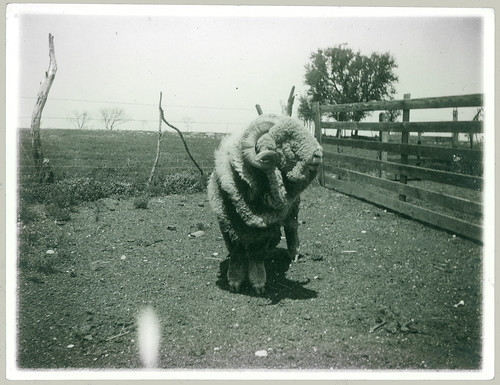
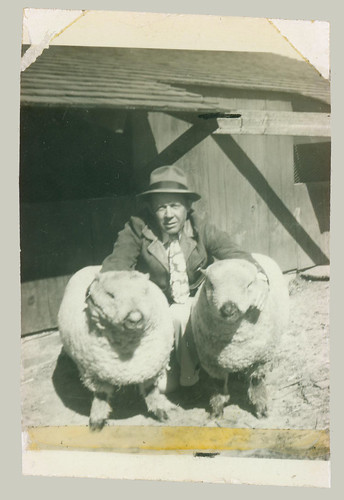
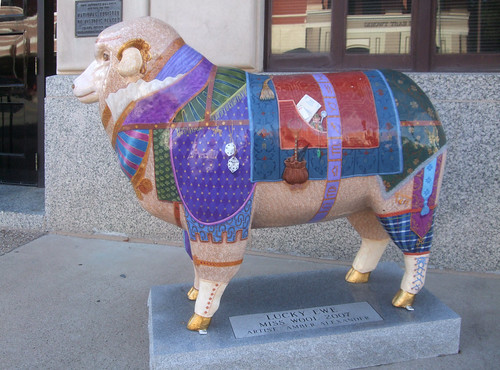
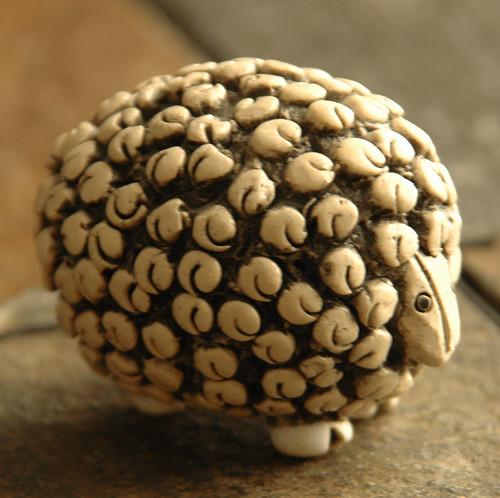
Year of the Sheep. There's plenty of information available about astrological matters related, I'll not add to the clutter. Instead, a couple of sheepish old photographs from husband's vintage stash, others from his camera; then a link and taster to a nice short story concerning a sheep herder's wondrous experience (no, not that famous biblical one).


Disinterested Ram

Man and two sheep

Baa baa, multicolored sheep.
Lucky Ewe


Sheep
  2 from our collection of Artesania Rinconada animal sculptures


Short story. Are y'all siting comfortably? Then I'll begin....

"Lambing Season".

First published in Asimov’s Science Fiction,2002 (nominated for a Hugo Award for Best Short Story and a Nebula Award for Best Short Story), written by Molly Gloss (born November 20, 1944). Ms Gloss is an American writer currently best known for historical fiction and science fiction. The story is re-printed in Clarkesworld magazine, and available to read at the website HERE. There's an audio version available too.

SNIPS

.........She had about 800 ewes, as well as their lambs, many of them twins or triplets. The ferocity of the Churro ewes in defending their offspring was sometimes a problem for the dogs, but in the balance of things she knew it kept her losses small. Many coyotes lived on Joe-Johns, and sometimes a cougar or bear would come up from the salt-pan desert on the north side of the mountain, looking for better country to own. These animals considered the sheep to be fair game, which Delia understood to be their right; and also her right, hers and the dogs, to take the side of the sheep. Sheep were smarter than people commonly believed and the Churros smarter than other sheep she had tended, but by mid-summer the coyotes had passed the word among themselves, buen’ carne, and Delia and the dogs then had a job of work, keeping the sheep out of harm’s way......


..........When she had come about halfway down the hill she lost footing and slid down six or eight feet before she got her heels dug in and found a handful of willow scrub to hang onto. A glimpse of this movement—rocks sliding to the bottom, or the dust she raised—must have startled the dog, for it leaped backward suddenly and then reared up. They looked at each other in silence, Delia and the dog, Delia standing leaning into the steep slope a dozen yards above the bottom of the draw, and the dog standing next to the Sputnik, standing all the way up on its hind legs like a bear or a man and no longer seeming to be a dog but a person with a long narrow muzzle and a narrow chest, turned-out knees, delicate dog-like feet. Its genitals were more cat-like than dog, a male set but very small and neat and contained. Dog’s eyes, though, dark and small and shining below an anxious brow........

Monday, April 21, 2014

Music Monday's Sheepish Segue

The sheep counting mentioned in my previous post segues nicely into Parilia - it's another of those many and varied ancient Roman festivals. The Parilia was a rural custom performed annually on April 21. Its purpose was the cleansing of sheep and shepherds, in acknowledgment of Roman deity Pales, a deity of uncertain gender, patron of shepherds and sheep. From Wikipedia:
"The pastoral structure of the festival is carried out by the shepherd himself. After the sheep pen had been decorated with green branches and a wreath draped on the gate, the remainder of the ceremony took place in sequence. At the first sign of daylight, the shepherd would purify the sheep: by sweeping the pen and then constructing a bonfire of straw, olive branches, laurel, and sulfur. The noises produced by this burning combination were interpreted as a beneficial omen. The shepherd would jump through this flame, dragging his sheep along with him. Offerings of millet, cakes, and milk were then presented before Pales, marking the second segment of the ceremony. After these offerings, the shepherd would wet his hands with dew, face the east, and repeat a prayer four times. Such prayers requested Pales’s assistance in freeing the shepherd and the flock from evils brought about by accidental wrongdoings (e.g. trespassing on sacred grounds and removing water from a sacred water source). The final portion of the rural festival made use of the beverage burranica, a combination of milk and sapa (boiled wine). After consumption of this beverage, the shepherd would leap through the fire three times, bringing an end to the ceremony......"

As it's Music Monday, some sheep-related music is called for. How about Johann Sebastian Bach's Cantata number 208 aka Sheep May Safely Graze ? Here is Eugene Ormandy's orchestral version in a video with some lovely photographs of....guess what...


There's a choral version HERE, and some notes about the origin of the Cantata at a blog HERE.
English translation of the lyrics =
Sheep may safely graze and pasture
Where a shepherd guards them well.
So the nation ruled in wisdom
Knows and shares the many blessings
Which both peace and plenty bring.