Friday, January 30, 2015

Arty Farty Friday ~ Bill Peet & Patrick Caulfield, born 29 January

Two artists with very different styles were born on 29 January: In 1915, American Bill Peet, famous for his work and tempestuous times with Walt Disney, also for his many illustrated children's story books. Born some 21 years later, in the UK, Patrick Caulfield, whose rather different version of 1960s pop-art won him fame.

Briefly:

Bill Peet (January 29, 1915, Grandview Indiana – May 11, 2002), children's book illustrator, and story writer for Disney Studios, 1937-1964. His artistic talent showed up early; he filled the margins of his school books with sketches, later shone as an art student on scholarship at the Herron Art Institute, Indianapolis. Studies completed, he left the midwest for Hollywood, to seek better job opportunities. He was hired as an “in-betweener” to fill in the interstitial cells between the main scenes, for Walt Disney studio’s production of Snow White and the Seven Dwarves, later, with his talent recognised, he climbed the Disney hierachy and worked on films such as Pinocchio, Fantasia, Dumbo , Song of the South, Cinderella, Alice in Wonderland, Peter Pan, Sleeping Beauty, One Hundred and One Dalmatians, The Sword in the Stone, The Jungle Book, and others. He eventually left the Disney Studios after 27 years, following a particularly bitter argument with Walt Disney (one of many throughout his time there) over the story production of The Jungle Book (See this at Blabbing on Arts and Culture blog). He then focused on writing and illustrating books for children, and now has a long list of much-loved children's books to his credit.

An imaginative and stylish storyteller, he would frequently embed messages within his tales. There's an especially good story which I suspect we might all benefit from reading: The Wump World.

Bill Peet married his schooldays sweetheart, Margaret. There's a sweet website created by the Peets' son HERE.


If a passing reader has around 12 minutes to spare, there's a YouTube reading of The Wump World with all his illustrations.


 From his Dumbo story board

More of Bill Peet's Dumbo sketches at Deja View blog HERE.


 From the 1001 Dalmations story board


 From his book The Whingdingdilly


Over the Atlantic and on a different wavelength altogether was Patrick Caulfied, born in Acton, London on 29 January 1936. He died in 2005. A student at the Royal College of Art, 1960-63 along with David Hockney, he developed a unique style characterised by the use of line and depiction of banal, everyday objects saturated in colour and made strangely important. Few human or animal figures grace his artwork, its focus is interiors: office, restaurant, city, decor - all stylised with clean, simple, minimalist flavour. Reviewers of his artwork have pointed out that, though his paintings appeared simple, this was deceptive and rarely the desired effect. By his own admission there were periods when he sought simplicity and others when he sought complexity. The paintings' unity lay in the power of Caulfield's imagination and wry detachment. Resistance to classification meant that Caulfield's work was not as widely known as that of some of his contemporaries.

He is said to have been
"a keen drinker, arriving at his "morning pub" at opening time for Old Speckled Hen, before moving on to double Irish whiskeys. After lunch and work, he went to the evening pub, before returning home to watch television. Glasses of red wine were a frequent motif in his paintings."

"Caulfield was apt to grin sheepishly when making wolfish remarks, especially when declaring his dislike of facile or excessively worthy sorts of painting. He had no time for raw green countryside. Plein air as an excuse for landscape genres enraged him. Interiors for him: places with light switches and engaging artificiality and plentiful refreshments."

Patrick Caulfield married Pauline Jacobs, they had met at Chelsea Art School in 1968; they had three sons. After the marriage was dissolved, in 1999 he married artist Janet Nathan.
(See obituaries at The Telegraph and The Guardian).

After Lunch (1975)
From Tate website HERE
Caulfield's paintings explore alternative ways of picturing the world. After Lunch was one of his earliest works to combine different styles of representation. In this case, what appears to be a photomural of the Château de Chillon hanging in a restaurant is depicted with high-focus realism, contrasting with the cartoon-like black-outlined imagery and fields of saturated colour of its surroundings. Caulfield deliberately makes the relationship between these varying representational methods uneasy and ambiguous, so that the picture appears more real than the everyday world around it.


 Lamp and Pines (1975)


 Tandoori Restaurant


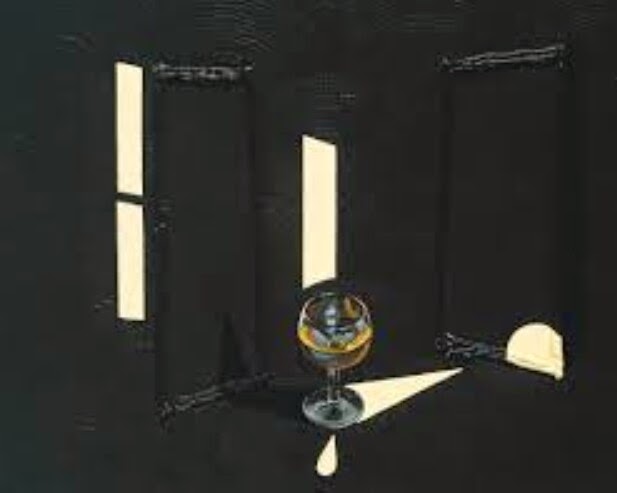
 Second Glass of Whisky (1992)


Entrance (1975)
See Platform 505 HERE
Pictures such as “Entrance” employ a rigorous use of black, with complex arrangements of grids, outlines and trellises. The atmosphere is playful and upbeat yet equivocal. These strange gardens and interiors are recognisable but unfamiliar, a parody of the real thing.
BBC website has a slideshow of some of Caulfield's paintings, HERE.


ASTROLOGY

Bill Peet, born January 29, 1915, Grandview, Indiana. Chart set for 12 noon as no time of birth available.


Patrick Caulfield, born January 29 1936, Acton, London, UK. Chart set for 12 noon as no time of birth available.


The artwork of Bill Peet and Patrick Caultfield was so different in "feel"; will their natal charts reflect this?

I see Peet as being a warmer, softer, more engaged in humanity kind of guy - from his choice of art style and genre. He had the heavier Aquarius input: Sun conjunct modern ruler Uranus, and Mercury conjunct Jupiter all in sign of the Water Bearer. Without a time of birth we can't know where Aquarius was placed house-wise though.

I suspect the warmer, softer feel of Peet's artwork comes via Venus (planet of the arts) in philosophical Sagittarius and a likely Cancer Moon, which could well have been conjunct Neptune(creativity and imagination). Mr Peet's talent for writing stories (for children) to match his artwork is reflected by Mercury (the writer's planet) in helpful sextile to artistic Venus; also significant: Saturn in Mercury-ruled Gemini in harmonious trine to Mercury in Aquarius.


Patrick Caulfield's paintings, though attractive and colourful, have a distinctly distant "feel" to them - detached from the human world, they concentrate on line, precision, design and colour rather than on flesh and blood. Whimsicality is absent, its place taken by what art reviewers see as wry detachment and some embedded humour.

Mr Caulfield was of a different generation from Mr Peet's, born a world away too. He was strongly influenced by art trends of the 1960s. His natal chart spreads rather thinner than Peet's, bringing in, Aquarius Sun and Mercury, with personal planets lying between Aries Moon (whatever his time of birth) to Jupiter in Sagittarius.

Arts planet Venus, in his case, was in Capricorn; this reflects the structural feel, reliant on line, of much of his artwork. Very significantly, too, a close trine between Venus (art) and Uranus (the avant garde) in Venus-ruled Taurus links to his pull towards modernity and an avant garde art style.

Hard-edged Saturn and Mars in Pisces possibly overwhelmed the usual gentle softness of Pisces - as far as his art style was concerned anyway. Jupiter in Sagittarius could be seen as source of the wry humour said to be involved in some of his paintings.

It's a pity no times of birth are known for the two artists - I'd be very surprised if their rising signs didn't contrast quite starkly.

Thursday, January 29, 2015

Getting the hang of Thursdays


“This must be Thursday," said Arthur to himself, sinking low over his beer. "I never could get the hang of Thursdays.”
Thursday was the day that Earth was destroyed for the first time, by the Vogons. It is also the day that Arthur Dent began the most interesting journey of his life. Fenchurch, "a girl sitting on her own in a small cafe in Rickmansworth", discovered secrets of the Universe.
― Douglas Adams, The Hitchhiker's Guide to the Galaxy.


"We'll go because it's Thursday, Pooh said, "and we'll go to wish everybody a Very Happy Thursday. Come on Piglet."
- A.A. Milne,The House at Pooh Corner.


Middle English thur(e)sday
Old English thursdæg
Old Norse thorsdagr "Thor's day"
Old English thunresdæg "thunder's day"
Latin dies Jovis "day of Jupiter"
Ancient Greek hemera Dios "day of Zeus".
(HERE)
Thor is the Norse god of thunder. Jupiter (Jove) is the supreme Roman god and patron of the Roman state, and noted for creating thunder and lightning. Zeus is Greek god of the heavens and the supreme Greek god.

Other tid-bits about Thursday can be found at Wikipedia. .


According to Nostradamus' prediction (Century 1, Quatrain 50), a powerful (but otherwise unidentified) leader who will threaten "the East" will be born of three water signs and takes Thursday as his feast day:

From the three water signs will be born a man
who will celebrate Thursday as his holiday.
His renown, praise, rule and power will grow
on land and sea, bringing trouble to the East.


Has this person appeared yet or has he been and gone? 3 Water signs = Cancer, Scorpio, Pisces - so a man with those signs prominent in his nativity? Some ideas on this have been discussed at an astrology message board HERE.

Wednesday, January 28, 2015

Aquarius Uncluttered

 David Palladini's depiction of Aquarius
I'm as guilty as anyone else of being drawn into astrological cook-book expectations in relation to people with Sun in Aquarius. I've called Aquarius quirky, avant garde, rebellious, unpredictable, cold and aloof....y'all know the rest.

Humanitarian, another commonly stated characteristic of Aquarius can be apt, but fits more nearly with Pisces in reality. People with Sun in Aquarius often have a planet in neighbouring Pisces.

Intelligent? I'll go along with that one, it's the only description common to all Sun Aquarians I've ever met. Intelligent, mind you, not genius or even highly intelligent. They simply possess an innate cleverness irrespective of schooling or higher education, which, in some instances when applied can bring out inventive talent. Aquarius is Fixed Air. Air relates to mental processes, so it's reasonable to expect that all Air signs (Aquarius, Gemini and Libra) will share natural intelligence, honed to sophistication by education, or not, as the case may be.

"Love of groups"? Where did that oft recited keyword for Aquarius come from? It contradicts another Aquarius motif: "aloof, detached and cold". I haven't yet met a Sun Aquarian who loves to join groups. I run from them, as did my Dad, and other Sun Aquarians I've known. We can, arguably, appear a tad aloof and detached/reserved. I prefer to think of that as independence or an intense need for freedom - and those are certainly keywords for Airy Aquarius.

I think many commonly used Aquarius keywords (quirky, avant garde, eccentric, radical, rebel etc) belong more properly with planet Uranus, delegated to replace Saturn as ruler of Aquarius in modern astrology. I continue to suspect that Saturn was more appropriate as ruler of Aquarius; a Saturn in Airy mode, lighter and less tied down; Capricorn hosts a heavier, Earthy Saturn.

Where does Uranus truly belong among the signs? Its accepted characteristics can invade and infect any sign with its presence. The rush to provide outer planets (Uranus, Neptune, Pluto)with a zodiac signs to "rule" seems strange to me. Why was it so necessary? Weren't things working satisfactorily in personal astrology beforehand? The outer planets do seem to relate more to mundane and generational issues.

My old and fragile copy of Llewellyn George's Student Chart Reader (1934), has this to say about Sun in Aquarius:

"In Aquarius the Sun gives a quiet, patient, determined, unobtrisive and faithful nature, as a rule. The Aquarian is refined, pleasant, friendly, generous, charitable, dignified and humanitarian; fond of art, music, scenery and literature; cautious, steady, intelligent, intuitive, discriminative, concentrative, studious, thoughtful and philosophical. Good reasoner, practical as well as theoretical; strong likes and dislikes and often with very radical and advanced ideas; is cheerful, sincere and honest, easily influenced by kindness, slow to anger, but will not be driven; loves liberty and is fond of occult research."

I like that description, even though parts of it are too general to be identifiable as pure Aquarius - eg. pleasant, fond of art, music, scenery. I especially like the the last few phrases (easily influenced by kindness, slow to anger, will not be driven; loves liberty). Interest in the occult applies to this particular inmate of the Sun in Aquarius camp, but I haven't personally met any others with the same leaning. Perhaps this is another facet belonging more properly to Pisces, although there are two Fixed Stars in Aquarius with traditional connection to astrology.

So my own, stripped down, bunch of keywords for Aquarius:
freedom lover, independent, naturally intelligent, quietly determined, loyal, faithful, studious, practical but also theoretical, stubborn, slow to anger, will not be driven.

Radicalism, avant garde, rebellion and quirkiness will, in my view, be a part of the Sun Aquarius-type, or any other sign's makeup only if Uranus is in close aspect, or on a sensitive point in the natal chart. That's my story and I'm sticking to it -'cos I definitely will not be driven!

Tuesday, January 27, 2015

Day Off

I've said it before, I'll say it again: considered logically, there's really no good reason to celebrate birthdays and anniversaries, anymore than we should celebrate every sunrise and sunset. It's custom and practice, an excuse to give and receive, just a personal benchmark on the waves of time. Birthdays give us an excuse to eat cake, have a celebratory drink, or do something completely different.....so no blogging for me on my birthday today. I'll be a day older when I return, not a year older - that's my story.

Monday, January 26, 2015

Netflixing ~ Pitfalls for Actors and Viewers. Top of the Lake; The Fall.

There's a newish pitfall for actors, and for audiences, in these days of unlimited viewing, easy access to just about everything ever created for the TV or silver screen, binge-watching over a short period, series which had taken years to unfold when served in weekly helpings and yearly seasons. The pitfall: an updated version of typecasting. I'll try to outline these tangled thoughts, which apply mainly to actors and audiences of long-running weekly TV drama series, rather than "one-off" movies.

Typecasting, of course, isn't new, actors male and female have been prey to it since early days of the entertainment industry. Back then, though, consumption of entertainment and drama was limited. Access has increased step by step: from theatre to cinema, to TV, to computers with YouTube and various streaming possibilities, and on to Netflix and all similar outlets, extending our easy reach much further and faster. We have opportunity, now, to see some of our favourite actors in a much wider variety of parts, and in quicker succession, than was possible in the past via cable TV packages, DVDs, and occasional trips to the cinema. A side effect of all this will be the occasional accidental "bleed-over" between very different characters portrayed by the same actor.

Two series we've been watching recently have underlined the above ponderings for me. Top of the Lake and The Fall. Both series feature one or more actors better-known for their roles in long-running weekly TV series. Top of the Lake has Elizabeth Moss in the leading part, she also plays "Peggy" an audience favourite in Mad Men. The Fall stars Gillian Anderson, who, as "Dana Scully", shared the lead in The X-Files with David Duchovny for several years.
The Fall also has has Archie Panjabi, well known to us from The Good Wife, where she plays "Kalinda" (see left), in-house investigator assisting a firm of lawyers. In The Fall she plays Dr Reed Smith, pathologist. I read, just the other day, that Archie has resigned from her role in The Good Wife for the very reason I'm mentioning here: characterisitics of "Kalinda" were bleeding through into her acting in the new role, where they were out of place - she realised this herself.

Had we never seen these three actors (all female as it happens) in any other roles, we'd have accepted them in these parts with no qualms whatsoever. As it is, we found it tricky not to continue attributing to them some characteristics well-remembered from their famous, long-running TV roles. I don't see this as a consequence of poor acting on their part - not at all - but it's the kind of hiccup we'll likely to come across more and more.

I had intended simply to write brief reviews of the two series Top of the Lake and The Fall, before wading into that little lot, I'll do that now:


Top of the Lake
Cross Twin Peaks and Justified, set it in the wilds of New Zealand with a female lead, and you'd get a near-relative of Top of the Lake. We watched the mini-series via Netflix, two or three episodes at a sitting. I didn't not like it, but wasn't over-enthusiastic either, husband felt much the same.

The scenery and photography were super, no argument on that. Acting was good to average. Elizabeth Moss, of Mad Men fame in the leading part was good in many ways, though I never quite believed her; the main "baddie" played by Scottish actor Peter Mullan (new to me) stood out as the better characterisation.

 Elizabeth Moss as Detective  Robin Griffin  & Peter Mullan as Matt Mitcham

The drama's theme revolves around a small community living in New Zealand's middle-of-nowhere, with a mini-drug lord and lazy, lackadaisical police department running things. The mini-drug lord has a family of ne'er do well sons. A 12-year old girl in the opening shot appears to be about to commit suicide by drowning in a freezing cold lake. Thereby hang several tales, which meander around various dark alleys for several episodes. The 12-year old, who we discover is pregnant, eventually disappears into the wilderness. A visiting police detective, once a local gal, becomes involved in helping to locate the pregnant child, Tui.

There's a trailer campsite in the area, occupied by a group of abused or mentally damaged females, presided over by a rather odd character known as "GJ" (left, played by Holly Hunter). GJ irritated me no end! Characterisation of the women, though well acted, was overdone almost to the point of comedy - which in these circumstances, ought not to have been the case. I'd blame the writing rather than the acting.

The mini-series was co-written by Jane Campion and Gerald Lee for the BBC and Sundance channel. I found it all a wee bit...I dunno....affected, unnatural...too much trying to be something it wasn't.

We were interested to discover the answers to many questions thrown up in the plotlines, yet disappointed that these answers came, eventually, in rapid succession in a series of almost throw-away lines during the last few minutes of the finale. Some questions remain unanswered or murky - possibly a deliberate ploy by the writers, again, to my mind an affectation.

I'm in the minority in my opinion, most reviews I've seen praise the series highly, and those reviewers might be correct, I simply report it as I found it.


The Fall
This is one of those "cop" stories about efforts to catch a serial killer - we've all seen 'em before. This one was written by Allan Cubitt for the BBC. The Fall attempts to look at its storyline from a quirkily dark and oblique angle (this has also been done before), and uses a fairly unfamiliar setting for its story: Belfast, Northern Ireland. Gillian Anderson of The X-Files fame is cast as leading character: Detective Superintendent (DSI) Stella Gibson, seconded from London's Metropolitan Police Service to head a task force to investigate a series of "set piece" murders of young professional women in the city.

For viewers there's no who-done-it game to play, the answer arrives very early on. The game for viewers is to discover and wonder at the two-sided personalities of the two leading characters: DSI Gibson and Paul Spector the murderer (played by Jamie Dornan), and to perhaps ponder upon that old saying : "it takes one to know one."

 Paul Spector (Jamie Dornan), family man,  grief counsellor & serial killer

DSI Gibson's personality did keep mixing itself with Dana Scully's for us, not a comfortable mix! Gibson should have more in common with Prime Suspect's DCI Jane Tennison (Helen Mirren) than Dana Scully.

 DSI Stella Gibson & Dr Reed Smith (Gillian Anderson & Archie Panjabi)

I worried, initially, about the Belfast setting. Were we were going to be regaled with yet another Catholic versus Protestant theme with sad echoes of 1970s' Troubles? If this had been the case I'd have switched off at once. Those old wounds were well hidden for the most part, other than a distinct air of menace pervading the Shankill district, and a few clunky hints that thugs, presumably of both stripes, do still exist in that once-benighted city.

As with Top of the Lake we were not over-enthusiastic about The Fall, but remained interested enough to keep watching. During the 5 episodes of the first season husband tended to fall asleep after around 20 minutes of each episode. There were truly some turgid stretches and plenty of padding, likely to tax even the keenest viewer's eyelids. Season 2 picked up pace but became more predictable, even more formulaic and clichéd with its introduction of a pedophile priest; a left-over from the Troubles loyalist thug wife-beater; psychology-for-dummies type mumbo-jumbo; a troubled and unbelievably twisted teenager...and so on... throw 'em all in, mix well, then spread to the limits of the mix.

The series ending was, in similar vein to the ending of Top of the Lake, rushed, sudden, not at all satisfactorily tied up. This must be the fashionable thing for writers to do these days - leave things hanging, in the hope that viewers will mentally write their own endings.

The Fall simply wasn't different enough. Our problem could be that we've seen too many episodes of Law and Order SVU, too many cop movies and series during our long lives to be excited by something like this series. We've grown used to seeing women in charge now, once that was a novelty in itself. Such characterisations don't get much better than Mariska Hargitay as Olivia Benson in "SVU". Gillian Anderson's expressionless face and monotone voice, while a tad quirky and stylish at first, soon became boringly phoney. Other members of the cast turned in good enough performances, from material available.

For something police based and different from the usual formula, we both found True Detective, in its 8-part first season, far superior in every way to The Fall. But that's just us.

Saturday, January 24, 2015

Saturday & Sundry

I'm even further out of the loop than I'd imagined - I'm no longer even part of "the older generation" - said to be inhabitants of Facebook (I'm not!) I must be way out there, well past where the buses don't run! From: Why the Modern World Is Bad for Your Brain - How our addiction to technology is making us less efficient, by Daniel J. Levitin (The Guardian)
"Now of course email is approaching obsolescence as a communicative medium. Most people under the age of 30 think of email as an outdated mode of communication used only by “old people”. In its place they text, and some still post to Facebook. They attach documents, photos, videos, and links to their text messages and Facebook posts the way people over 30 do with email. Many people under 20 now see Facebook as a medium for the older generation."

My predicament reminds me of something Douglas Adams once wrote:
1) Everything that’s already in the world when you’re born is just normal;
2) anything that gets invented between then and before you turn thirty is incredibly exciting and creative and with any luck you can make a career out of it;
3) anything that gets invented after you’re thirty is against the natural order of things and the beginning of the end of civilization as we know it until it’s been around for about ten years when it gradually turns out to be alright really.”


26 Pictures Will Make You Re-Evaluate Your Entire Existence

The universe, man… THE UNIVERSE.


Hmmm - and that reminds me of something else Douglas Adams once wrote:
If life is going to exist in a Universe of this size, then the one thing it cannot afford to have is a sense of proportion.


Some "portmanteau" words we might have assumed came fully-fledged from some technical textbook or other are really just a combination of two other words:
In 1969, pixel, a blend of pictures — or rather, the abbreviation pix—and element, only referred to televised images.

According to the Oxford English Dictionary, meld likely came from a combination of melt and weld in the 1930s. Vulcan mind-melding came along some 30 years later.

The concept of the bit, or binary digit, has been around since the late 1940s.

In 1975, the term endorphin was created from the French word endogène and morphine to describe those opiate-like peptides that kick in just when you're about to give up jogging altogether.
More at Mental floss HERE


And...what did Douglas Adams have to say on wordy or alphabetical matters?
The only moral it is possible to draw from this story is that one should never throw the letter Q into a privet bush, but unfortunately there are times when it is unavoidable. -"The Restaurant at the End of the Universe,"


Did you know that Subaru is the Japanese name for the Pleiades star cluster M45, or "The Seven Sisters" (one of which tradition says is invisible - hence only six stars in the car company's Subaru logo), which in turn inspires the logo and alludes to the companies that merged to create Fuji Heavy Industries?

More interesting origins of car company and car model names in this video:


Mr Adams must have had a few words to say about cars?
On Earth - when there had been an Earth, before it was demolished to make way for a hyperspace bypass - the problem had been cars. The disadvantages involved in pulling lots of black sticky slime from out of the ground where it had safely been hidden out of harm's way, turning it into tar to cover the land with, smoke to fill the air with and pouring the rest into the sea, all seemed to outweigh the advantages of being able to get more quickly from one place to another - particularly when the place you arrived at had probably become, as a result of this, very similar to the place you had left, i.e. covered with tar, full of smoke and short of fish.
"The Restaurant at the End of the Universe".


Best one of all!


Concluding words of wisdom from Douglas Adams:

The chances of finding out what’s really going on in the universe are so remote, the only thing to do is hang the sense of it and keep yourself occupied.


Friday, January 23, 2015

Arty Farty Friday ~ Chesley Bonestell, Master of Space Art.

Half a century before the Hubble Space Telescope existed Chesley Bonestell was painting his own vision of what could be waiting for the first human explorers to reach far-flung worlds of outer space.
Born in 1888 in San Francisco, Bonestell had been interested in astronomy from his childhood, and fascinated by telescopic views of Moon and planets. His early training, was in architecture, it ceased when he dropped out of studies in his third year. The precision and detail in his artwork reflects his early training as an architect.

Bonestell found employment with several architectural firms, became part of teams responsible for design of the Golden Gate Bridge and New York's Chrysler Building. He designed posters and illustrations for travel firms and for magazines in the USA and in Britain.


 Poster by Chesley Bonestell

Travel poster by Bonestell from his time in Britain

During the 1940s/50s he also worked as a matte artist to produce special effects and matte paintings for films, including Orson Welles's Citizen Kane , The Horn Blows at Midnight, Destination Moon , When Worlds Collide, War of the Worlds, and Conquest of Space.

In August 1950 Collier's magazine cover illustrated by Bonestell depicted an atomic bomb attack on New York, further illustrations were carried inside in the article titled "Hiroshima U.S.A.".
(See Smithsonian website HERE)


From SF Encyclopedia
"In depicting planetary landscapes and predicted space vehicles, his style was a photographic realism, showing great attention to correctness of perspective and scale in conformity with scientific knowledge, if not always the latest such knowledge: many of his depictions of the planets – from a solid, volcanic surface on Jupiter to canals on Mars – were fairly old-fashioned even at the time he created them, and his craggy, alpine lunar landscapes proved to look nothing at all like the real thing. His paintings of Saturn as seen from the surfaces of its moons are understandably regarded as classics. But, more than that, his work held great beauty and drama in its stillness and depth. Many book lovers of the post-World War Two generation may attribute their fascination with space exploration as much to Bonestell's paintings as to their reading of space fiction or nonfiction, and Gary Westfahl has suggested that his dogged determination to follow scientific principles in his artistic creations was a key influence on the development of Hard SF."


From Outer Space Art Gallery
Along with cosmic landscapes, Bonestell painted scenes of space exploration on the moon, Mars and beyond, as well as spacecraft resembling the multi-stage rockets that would transport man beyond the realm of his own planet.

Wernher von Braun, the German rocketry genius and chief architect of the massive Saturn V booster that catapulted men to the moon, wrote about Bonestell: "My file cabinet is filled with sketches of rocket ships I had prepared to help him in his artwork -- only to have them returned to me with penetrating detailed questions or blistering criticism of some inconsistency or oversight."

Like Merlin the magician of Camelot, Bonestell seemed to be living backwards in time. He had an uncanny sense of what alien landscapes looked like and the design of the vehicles that hadn't been invented yet. Bonestell died in 1987, at the ripe age of 99. But his art and influence continues to delight and inspire.
"Chesley Bonestell's pictures are far more than beautiful, etherial paintings of worlds beyond," praised von Braun. "They present the most accurate portrayal of those faraway heavenly bodies that modern science can offer."


There are some good-sized images of Bonestell's artwork at MELT, here. A brief video about him is available at Chicago Tonight. More book and magazine covers by Bonestell HERE.


ASTROLOGY


Chesley Bonestell was born on 1 January 1888 in San Francisco, California. No time of birth is known, chart is set for 12 noon.


First thought: "The animals went in two by two...." except they're planets - 5 pairs! There's nothing very significant in that observation though.

His Mars conjunct Uranus in Libra are square to his Sun, challenging the "feet on the ground" and scientific solidity of Capricorn. I'm bearing in mind that Mr Bonestell set out initially to become an architect which fits his Sun and Mercury in Capricorn better than a painter of wildly imaginative space paintings, but that square aspect involving Uranus, planet of all that is futuristic and unexpected, makes an important difference. I'm thinking that he was, perhaps, also responding to the pervading astrological Airy "atmosphere" of the 1940s, when Saturn and Uranus transited Gemini, Neptune in Libra.

The Yod is mixing Neptune/Pluto (creativity and hidden things) with Saturn and its relationship to the Capricorn Mercury at the Yod's apex (solidity and science). An input of Neptune's imagination and vision could easily seep through to soften/irritate any remaining architectural aims Bonestell might have had, bringing in a desire to imagine and dream of what's out there and what's to come, rather than simply following his interest in straight astronomy.

His natal Venus (planet of the arts) is conjunct expansive Jupiter in Scorpio, and opposes Neptune in Taurus. There's a push-pull going on between Earthy creativity, straightforward artwork (which he did as well as space art), and portraying something more extreme, something hidden from our everyday eyes.

Any copyrighted material on these pages is included as "fair use", for the purpose of study, review or critical analysis only, and will be removed at the request of copyright owner(s).

Thursday, January 22, 2015

Middle Class Darlings of the SOTU Address

Watching President Obama deliver the State of the Union address on Tuesday evening, two oft-repeated words began to irk me a lot: "middle classes". Tsk. Who are these people?

As I wrote in the first paragraph of a post in 2013 (here):
The USA's version of "middle class" is different from the UK's version. Here the middle class seems to refer to anyone not living in actual poverty, yet not of the 1% of elite bankers, financiers, corporate CEOs, "celebs", multimillionaires and billionaires. In the UK middle class is understood to relate to the professions: doctors, lawyers, professors, scientists - that sort of thing. Ordinary folk, tradespeople, craftsmen, office workers, factory workers, store assistants etc. are the working class.

If the President wants to help a group of people in this country, the poor should be front and centre of his focus, not the "middle classes" who, if I understand the term correctly, are already on their feet and striving, in their dreams, to become part of the 1%, or at least to claw their way into the top 10 or 20%.

A comment elsewhere online made me smile: with regard to the drinking games some like to play to ease their way through SOTU addresses by taking a swig each time a certain word or phrase is mentioned. A commenter observed that on Tuesday evening it'd have been be wise, if someone had chosen the term "middle class" to be the catalyst to imbibe (again... and again) then doing so only on every third mention of "middle class" would be required, if he/she were not to be found completely legless at the intoning of "...and God bless America", or as stated on Tuesday, "God bless the country we love" (I wonder why he didn't say "America" this year?)

Just to get a last bit off my chest: "values", he said...what values? What the heck ARE American values? Oh yes and...far as I can see, neither the USA nor its people are "exceptional". The USA is beautiful - but so are countless other countries, its people, on the whole are pretty nice, but so are the people of most other countries. Dang, but I wish Presidents would disabuse themselves of that notion of exceptionalism!

Wednesday, January 21, 2015

The Look of You

Much as I doubt that astrology/zodiac signs can influence a person's appearance to any great extent, or at all, I have to admit that there are time when I doubt my doubts.

I've noticed a distinct "look" in some people (mainly males) with prominent Capricorn, Aquarius or Gemini in their natal charts. Sun in those signs or those signs rising are most likely to be the culprits I think. Sign similarities are much easier to spot in males. Women tend to alter their appearance in subtle ways via makeup, hairstyle, hair colour, not to mention the more modern stuff: botox, laser treatment and what have you. Males will experiment with facial hair and hair length, but this doesn't seem to
seriously affect the "look" .

What got me onto this subject - again - I've covered the topic before in these posts (see below) - was seeing actor Victor Webster in Continuum (mentioned in last weekend's post). I'd never seen Victor Webster in any show previously. I suspected, from his looks he might have Aquarius emphasised natally, but hadn't bothered to look for his bio online until starting this post - and whaddya know?
Born February 7!

The "look" is hard to describe: kind of classic, kind of symmetric, steady expression, nice eyes. Think a younger Tom Selleck, Clark Gable, Burt Reynolds, John Travolta (when younger), Neil Diamond - for examples known to most of us. For every classic Aquarius look, though, there's another version that's nothing like it; and in women I haven't spotted any distinct Aquarius "look" at all.

In the case of Gemini and Capricorn, more than a distinctive "look" it's often build, attitude and expression giving the sign away initially. Capricorn tends to be craggy, calmly serious-faced; Gemini often lanky to skinny, restless, alert.

A website called Serendipity Astrolovers has a series of pages outlining the author's thoughts on this subject. Much of the Aquarius section doesn't apply to yours truly, but there are a couple of points that do.

Link to a previous post of my own on this topic from 2011, using planets instead of zodiac signs:

Tuesday, January 20, 2015

S O T U

President Obama will deliver his State of the Union address tonight to the first Republican-controlled Congress of his presidency. White House spokesman Dan Pfeiffer has revealed the theme of the speech: "middle-class economics", ways to improve wage stagnation and economic mobility. How much time and emphasis will the President give to climate change? Any bets?


I haven't decided whether to watch the speech or wait until tomorrow and read it and weep.

I opened this blog during the second half of 2006, my first experience, as a blogger, of a State of the Union address was in January 2007 - here's what I wrote about it, the post's title was "State of the Hypocrisy". The address was, of course, by George W. Bush:
I'm a foreigner here in the USA, a legal resident, but until such time as I can apply for US citizenship still a foreigner, a British citizen.

I'm interested and concerned about American politics, so I watched all of last night's State of the Union address, and the discussions which followed. I had to watch alone, because my husband refuses to watch or listen to "his" president, so great is his disgust and dismay at current policies. By the time the proceedings had wound down, I was left with a bad headache! Next year I shall follow my husband's example.

As I watched and listened I was amazed at the obsequiousness of both parties towards the president. Many of these men and women profess to detest the president's policies, yet they leapt to their feet at every opportunity, applauded each proposition he put forward. Few, if any, remained seated throughout, few didn't wish to shake his hand and smarm over him as he entered the hall like some great prize fighter, and left, signing autographs for fawning fans along the way. I realise that all of this is "just for show" - but why? Isn't this hypocrisy? I suppose it's tradition. Traditional hypocrisy.

There are more than enough bloggers giving their opinions about the content of the president's speech, so I'll limit myself to one point only - the one which disappointed me the most, and the one about which even I, as a foreigner here, have some right to voice my opinion. Mr Bush mentioned global warming only once, and almost as an afterthought. After outlining plans to conserve energy, reduce the use of gasoline etc. for the stated purpose of reducing America's dependence on oil ..... then...oh yes, one short sentence acknowledging that these measures would help the environment and global warming. He actually said the words "global warming". No acknowledgement though that global warming IS a serious threat. I wonder what Senator Inhofe, our Oklahoma senator, thought about the mention of global warming - he's been declaring, for the past several years, that it's all a great hoax. I bet he was on his feet applauding with the rest of 'em .

Sigh. Al Gore - come back to politics - PLEASE!!!

I must get back to astrology before I blow a fuse!!
Playing this drinking game tonight would require listening carefully to what's being said, but this way could make it more fun! Maybe I'll watch after all - glass in hand.

 Hat-tip HERE

Monday, January 19, 2015

Cycles Will Be Cycles

Keeping in mind the previous post's main theme: fictional attempt to change history, in particular to prevent a corporate oligarchy from permanently establishing itself in the world, for generations to come. If a reliable time travel device were available today, to what point in American or UK/European history would seem to be the most useful stop-off point in the past? Which individual(s) would be the key to prevention of a headlong gallop into global corporate governance?

I don't know enough US political history to be able to answer that in respect of the USA. A simple, obvious but not complete, answer would be to travel back to 2009/2010 when the Citizens United case was being decided in the Supreme Court. Could time travellers influence a change that would reverse SCOTUS eventual decision?

In the UK I'd head for 1975 to try to stop Margaret Thatcher's rise in Conservative politics. With regard to Europe - I have no clue. Europe has always been a complex bag of tricks.

Alright...(fantasising): say SCOTUS decision on Citizens United had been reversed, due to time-travel related intervention. That would have moved us onto a new timeline. But, cycles must cycle on, nature decrees so, astrology records it. Life, whether individual, communal or global, moves in cycles - or spirals. Something else would take the place of the Citizens United decision, a few steps further ahead. Events themselves might be vulnerable to change by time travellers, but nature is highly unlikely to be vulnerable in the same way.

Imagine a stream or river flowing towards the sea. Something prevents it from following its established course; it doesn't suddenly begin flowing backwards, or simply stop in its tracks and become a stagnant lake, it carves out a different route for itself, to reach the same sea.

Fascinating, entertaining and distracting as time travel themes are in novels and films, tempting as it is to imagine there'd be a way to change things, in reality I doubt there would be. Most novelists and screenwriters hint at this. Detail might be changed, course would remain the same.

We, as a species and as a civilisation, warts an' all are probably at exactly the stage we're supposed to be right now, in our place on the developing spiral. The best we can hope for is a smooth and relatively painless transition from one stage of the spiral to the next, when it becomes time for that to happen. A reasonable aim for which to struggle now, I guess, would be to develop circumstances most likely to lead to smoother transition into natural changes.