Saturday, January 17, 2015

Netflixing & Continuum ...a bit of the old timey-wimey + corpy-worpy!

We're on our first month of Netflixing, and discovering all manner of delights! We've binge-watched the first season of True Detective - a cop series with a difference. Leading actors will change season by season. First season of 8 episodes starred Matthew McConaughey and Woody Harrelson - a wonderful pairing of two superb actors.

We occasionally dip into first season of the long-running medical series, Grey's Anatomy. One episode at a time is quite enough for me of any hospital centred series, this one included. It's just so-so for me, but audiences must have absolutely loved it - it survived for 11 seasons!


My favourite discovery, so far, is Canadian sci-fi series, Continuum. I'd never heard of it, didn't expect much, but it didn't take long to realise that this is an intelligent piece of quality writing. Time travel is the series' main theme, with aspects of politics, friendship, family relationships closely intertwined.

Continuum is good in every respect, but the political slant, in tandem with time travel, is what is fascinating me most. Series creator is Simon Barry, a British born Canadian. A quick look at his noon natal chart (25 September 1966) shows a Libra Sun and Mercury; Venus conjunct Uranus/Pluto in Virgo; and Moon in Aquarius (whatever his time of birth). What a great combination for a science fiction writer!

The story's setting is Vancouver, initially in the year 2077, on November 5 in fact. The city, and presumably the country (maybe also the world, or at least North America), are governed by the corporations. A towering skyscraper housing the corporate congress has been blown-up resulting in many thousands of deaths. Perpetrators were Liber-8, a group of eight freedom fighters - or terrorists - depending on one's point of view. They are caught and ready to be executed in a high-tech communal execution chamber.


One female police officer is detailed to stand close, as guard. Seconds before the execution is carried out a blinding flash... when the screen clears those about to be executed, and the police officer, have disappeared.

We then find ourselves with the police officer, Kiera, as she finds she, and Liber-8 have been hurtled back 65 years to 2012. She looks distinctly out of place in her high-tech police uniform in Vancouver's streets, 2012.

That's how the story begins. After the first couple of episodes we began to wonder if this was going to be our cup of tea after all, or was it a series created for more conservative-leaning viewers who consider a city, country or world world totally run by corporations could be a good thing? After all, it seemed we were being led to see Kiera, avid supporter and defender of a corporate police state, as our heroine, with those painted as bad guys being the ones fighting an oppressive corporate oligarchy. Liber-8 might now have an opportunity to crush 2077's corporate governance in its infancy, if they can steer clear of Kiera.
Kiera manages to infiltrate a local police department to aid her search for the "terrorists", and her equally important aim of returning to 2077, her husband and family.

Simon Barry has said, in interview:
...."Our goal was to create a group of points of view. From our point of view Kiera is the lead because she is driving a lot of the storytelling perspective. That’s not to say Kiera is the emotional or political nexus of the show. Her journey is one of discovery; it is one of change. Therefore this grey area is not designed for Kiera but for the audience. Kiera has entered a world that we’re more familiar with than she is. That’s an advantage because now your main character is coming from a point of view that she’s open to new ideas, to a journey and exploration, and education. The audience is set in their ways in how they see the world that their living in at that moment. If the show can at all change the way people perceive things or force them to experience something through a different perspective then we’ve accomplished something small but important in terms of the themes of the show. We’ve always looked at those grey areas as being something that you define not that we define. We wanted to put everything out there in a way that felt more honest. There’s no all good and all evil. But there are always shades of grey and if you look around the world you’ll know that there is.”
It's this "grey area" that makes the series special, for those interested in politics and history. The corporate society of 2077 is controlled in every aspect of life and strictly policed. A liberated future, in 2035, of which we are given a glimpse later in the series, is a dark and dirty shamble of freedom with widespread horrendous abuse. Neither of those futures would be desirable.

 Rachel Nichols & Eric Knudsen (Kiera & Alec Sadler - the two key characters )

There's lots of other good stuff too, besides the political angle. My single criticsim of the series is that the fight scenes, roughly one per episode, are too long.

Rachel Nichols who plays Kiera said about her part in the series:
"Portraying someone who is unfamiliar with the present day requires playing a mental mind trick on oneself............ We try to find those little areas and nuances where her futureness can come out - whether she doesn’t know what the Bat signal means, , or she can’t drive a car, or she’s amazed by running water, or she has never seen a horse before. We find those moments and keep that thread going throughout the show.”
I don't want to give away more of the themes, twists and surprises, which do increase in complexity as the show develops. One mustn't become distracted from concentrating on the screen for even a few seconds. We have had to re-wind several times to make sure what was going on and why!

This must surely be one show that is far better watched several episodes at a sitting as we are doing. With a week's wait between episodes I'd have probably given up on it quite quickly. Simon Barry has mentioned, in that regard, that writers these days do have to bear in mind that they may be writing for two distinct audiences: those who watch episodes on TV weekly, as aired, and those who watch the series in larger chunks (binge-watching) via Netflix and similar outlets.

We're into season 3 now... and, so far, are feeling thoroughly confused! A layer of complexity is added to the already complex mix. Now, as well as a different timeline unfolding we have Freelancers, an ages old/ages new group or sect whose sole purpose is to act as guardians for the correct (as they see it) unfolding of time. They aim to prevent "glitches" and stop those whose purpose in time travel is likely to cause change and disruption.

In the episode we watched last night a company called Sonmanto was manufacturing, and selling chemical weapons...Sonmanto...re-arrange these letters to make a familiar word or name!

People assume that time is a strict progression of cause to effect, but *actually* from a non-linear, non-subjective viewpoint - it's more like a big ball of wibbly wobbly... timey wimey... stuff.

There's something that doesn't make sense. Let's go and poke it with a stick.

          ~ Steven Moffat (Quotes from Doctor Who)

NOTE: For anyone who'd like more detail on Continuum's themes, there's a good piece with lots of photos and spoilers HERE.
There's also a good review of the opening episode of Season 3 at The Disgruntled Individual blog HERE

Friday, January 16, 2015

Arty Farty Friday ~ Brion Gysin & William S. Burroughs: what you get when the recipe calls for a heaped measure of Aquarius & a scant measure of Cancer

No pretty pictures today...because Brion Gysin and William S. Burroughs. These two didn't produce much that was pretty, though they remain revered in certain circles. They were part of the Beat crowd and 20th century avant garde who weren't known for pretty.

I've already written a post on Burroughs, his artwork and natal chart (SEE HERE). In searching for an artist who had a birthday in late Capricorn I stumbled upon Brion Gysin, who, it turned out was a good friend and close collaborator of Burroughs, who described Gysin as ".. the only man I have ever respected. I have admired many others, esteemed and valued others, but respected only him.”

Gysin was a painter, writer, sound poet, tape composer, lyricist, and performance artist. He was, at one time, proprietor of a Tangier bistro called 1001 Nights; later became artist in residence at the Beat Hotel in Paris. He is the one said to have submitted the recipe for hashish brownies to the Alice B. Toklas cookbook; he introduced Brian Jones of The Rolling Stones to avant-garde sound recordings and the master musicians of Joujouka (Gysin's former house band).

From cover blurb on a biography of Gysin by John Geiger - Nothing is True – Everything is Permitted: The Life of Brion Gysin
Gysin (1916-1986) English-born, Canadian-raised, naturalized American of Swiss descent, who lived most of his life in Morocco and France. He went everywhere when the going was good. He dabbled with surrealism in Paris in the 1930s, lived in the “interzone” of Tangier in the 1950s and traveled the Algerian Sahara with Sheltering Sky author Paul Bowles before moving into the legendary Beat Hotel in Paris.

Gysin’s ideas influenced generations of artists, musicians and writers, among them David Bowie, Keith Haring, Patti Smith, Michael Stipe, Genesis P-Orridge, John Giorno and Brian Jones of the Rolling Stones. None was touched more profoundly than William S. Burroughs, who said admiringly of Gysin: “There was something dangerous about what he was doing.”

Official website for Brion Gysin - images of his artwork are there, along with biographical and other detail.


In addition to their writings and artworks Burroughs and Gysin were deeply interested in magic - not the "rabbit out of top hat" kind - the darker Aleister Crowley kind of "magick". More on that in a piece by Matthew Levi Stevens: The Magical Universe of William S. Burroughs.


I mainly want to compare natal charts of Gysin and Burroughs, but first a brief word about "cut-ups", a technique originated by poet Tristan Tzara in the 1920s, re-introduced by Gysin and appropriated by William S. Burroughs.
From Gysin's official website, linked above:
In the 1950s, Brion Gysin more fully developed the Surrealist cut-up method after accidentally re-discovering it. He had placed layers of newspapers as a mat to protect a tabletop from being scratched while he cut papers with a razor blade. Upon cutting through the newspapers, Gysin noticed that the sliced layers offered interesting juxtapositions of text and image. He began deliberately cutting newspaper articles into sections, which he randomly rearranged. The book Minutes to Go resulted from his initial cut-up experiment: unedited and unchanged cut-ups which emerged as coherent and meaningful prose.

Burroughs explains cut-ups:


In 1959, Gysin invented, with Ian Sommerville, the “Dreamachine,” a device intended to simulate lucid dreaming through the projection of light patterns on users’ eyelids.

So...Burroughs and Gysin were a pair who revelled in being, and producing things, far out of the ordinary. Burroughs in his writing, but also, as shown in my 2009 post, he dabbled in art as well. Gysin dabbled in the far-outer fringes of most of the arts.


Taking a look at their natal charts:

William S. Burroughs, born 5 February 1914 in St. Louis, Missouri at 7.40am (Astrodatabank)


I wrote back in 2009 -
Wowee!! 5 planets and ascendant in Aquarius (including Aquarius' ruler, Uranus); 3 planets in Gemini, two in Cancer. So much Air (Aquarius and Gemini) cannot be good for a body - or a mind! Here's another instance of "too much of a good thing". I've seen it before, but never quite as extreme an example as this. Too much Air blows away anything of substance, literally and metaphorically.

This guy had potential to spare, yet he squandered it. It seems to me almost as though he was born drugged and drunk - from the overdose of Air in his chart. Oh, the literary elite coo over his books with exaggerated praise. Does the average reader, though, see anything praiseworthy, or just a case of the emperor and his new clothes?


Brion Gysin born in Taplow, near Maidenhead, UK on 19 January 1916. Time of birth isn't known so this chart is set for noon.


Well..turns out their charts are quite similar - pity we don't know Gysin's time of birth.

Though Gysin had Sun in late Capricorn he also had plenty of Airy Aquarius going on, with planets conjoining some of Burrough's Aquarius planets; he doesn't have Burrough's additional Gemini, Air though. Instead he has three Cancer planets, including Moon (whatever his time of birth), and Jupiter in Pisces both of which bring in a much softer, more sensitive and intuitive feel to his nature.

Burroughs did have some Cancerian flavour - his Mars and Neptune are both in that sign, whereas the same two planets in Gysin's chart are in Leo. In both cases at least one of the Cancer or Leo planets is striking a balancing opposition with planets in Capricorn or Aquarius. So there is a similarity, even there.

The Aquarius/Cancer mixture they both had in different proportion was, I suspect, what led them in the paths of magick and psychic experimentation. Aquarius alone wouldn't necessarily head in that direction.

It's not difficult to see how these two men, when their paths crossed, would easily become friends. Their work isn't easy to like, unless one is naturally on their far-out wavelength. I'm not. I find their natal charts more interesting than anything they produced, but then, at their levels, even with my own Aquarius solo Sun to assist, I remain a Philistine.

In a conversation at AnOther Magazine website John-Paul Pryor answered the questions:

Do you think that Gysin’s symbiotic relationship with Burroughs may have held him back as an artist?
The two were certainly joined at the cerebellum, but Gysin shines a tremendous light in his own right, especially in the field of visual art. Burroughs was an underground phenomenon and the platform for Gysin’s livelihood, but it’s true that he also shadowed him. One area of contention has to do with who invented the “cut-up.” Burroughs tried his entire life to tell people that Gysin invented the cut-up, but because Burroughs ran with the idea, producing numerous novels, he is the one credited. It’s important to think of Gysin as an idea generator above all.
Do you think they were driven by a desire to be subversive?
Yes, it was a choice for them. They took their energy from being counter, and I think it was enormously important for that generation to be counter to the structure of contemporary culture in every possible way. These were guys who were stateless, gay, psychotropic experimenters (and in the case of Burroughs, also a murderer and a junkie). They used drugs very consciously as tools that supposedly allowed them to get out of where they were. There is a lot of talk about cultural subversion now, but I don’t think anybody could beat these guys at that. Gysin was also interested in the straightforward notion of magic. The calligraphic style he created was a personal glyph that consisted of drawing his initials over and over again; it was, in its way, a spell.
It all fits rather well!

Thursday, January 15, 2015

Breaking the Spell of Enchantment

I have a slim volume titled Dictionary for the Disenchanted, written by Bernard Rosenberg published in 1972. The blurb on the book-jacket flap tells that the book is a "lexicographic landmark for those who see life as infinitely menacing (and amusing) in a world gone mad." The author died in 1996. Rosenberg was editor of Dissent magazine, "rumored to be a professor of sociology at the city University of New York". Had the good professor lived into the 21st century, there's no doubt at all that he could, and perhaps would, have written an updated and much expanded version of his dictionary - there's material aplenty in a world now gone even madder!

I've copied, below, a few of Prof. Rosenberg's definitions I found particularly apt or appealing. The book is nicely illustrated by Rob Powell. I've used a James Thurber cartoon to illustrate the post.

Apocalyptic Vision ~
A clear picture of impending doom best perceived by those who do their utmost to hasten its onset.


Credibility Gap ~
The gnawing suspicion that once in a while the Administration may not be lying.


Ecology ~
The panacea that, if zero population growth fails, may yet be a final solution to the human problem. Its practitioners are so far on the right track that they have already greatly improved the environment by helping to eliminate several merely dangerous pollutants in favour of those that are probably carcinogenic and certainly lethal.


Free Speech ~
1. A bourgeois affectation.
2. Interference with law 'n' order.
3. Further proof of how correct the French are when they assert that les extrêmes se touchent*.

(NOTE: * translates as extremes meet)


Futurologists ~
Twentieth-century astrologers handicapped by tunnel vision who, unable to apprehend the present, helpfully extrapolate it.


Generation Gap ~
A chasm, amorphously situated in time and space, that separates those who have grown up absurd from those who will, with luck, grow up absurd.


Like ~
In current usage, an all-purpose expletive. Along with "you know", "hopefully", "dig", "cool", and "man", it has so enriched American English that we can henceforth do without most of the remaining 600,000 words that still clutter last year's unabridged and out-of-date dictionaries.


Man ~
A biodegradable but non-recyclable animal blessed with opposable thumbs capable of grasping at straws.


Pessimist ~

Same as optimist but better informed.


USA ~
Erroneously decoded by the late e.e. cummings as The Benighted States of Hysterica (E Pluribus Eunuch); actually, the United States of America, one of the few surviving republics where, if you do not first get killed, you can still make a killing.


Wisdom ~

The recognition that things are worse than they were but better than they are going to be.

Wednesday, January 14, 2015

"One's life must seem extremely flat with nothing whatever to grumble at!" ~W.S. Gilbert

I'm not one of those serial complaint makers to manufacturers or retailers - but more power to 'em - I'd join them more often if I could be bothered. How frustrating it is though, when after getting up steam enough to write a detailed complaint to a manufacturer about one of their products, all you get, at best, is a standard format reply with no evidence that they've read what you've written - even if they refund the purchase price.

Back in December we bought a couple of cartons of Dole soup - a new kind not seen before. We thought they'd be handy to have in the cupboard in case of power outages during the winter - it'd be something easily heated on our little camping stove.

"NEW!" the cartons exclaimed - "Dole Garden Soup, all natural. No GMO. No MSG, preservative free, no cholesterol, low in calories and fat". What more could one want?

We chose the Carrot and Ginger flavour and the Tomato and Basil. A few weeks later we decided to try the Tomato and Basil on a lunchtime of a particularly frigid day; if the soup was good we'd buy more for emergencies.

Yikes! The soup was downright nasty! "Something's wrong with this!" we both said, and poured both servings away after first tastes. I detected a taste, and smell similar to chlorine. Husband thought the nasty taste to be more like cardboard (never having eaten cardboard myself I couldn't comment on that!) We decided this carton might have been stored in the supermarket or warehouse too close to a heater, or maybe frozen and wrongly defrosted - or something. Probably a one-off slip-up. A few days later we decided to try the Carrot and Ginger, just to check. The nasty taste and smell were there, exactly the same as before.

Because the soups were not cheap and tasted so wrong I decided it might be a good service to warn Dole about, at least, the consignment from which ours had come. I filled in their online complaint form, with all the detail required: consignment number, other numbers, expiry date from the carton, address of supermarket where purchased, dates, etc. and wrote a note in the available space telling exactly our findings, and explaining that I no longer had one of the cartons so detail given was from the Carrot and Ginger carton only.

A letter arrived this week from Dole - not bad for a complaint response, a cheque for $7 enclosed. Cheque is nice -letter less so. They hadn't paid any attention whatsoever to what I'd said about the strange taste and smell common to both flavours - simply went on about how they beta test flavours and were sorry we didn't like the Carrot and Ginger, so enclosed a recipe leaflet for using carrots!

Ah well...Dole did respond in timely fashion, and did refund, which is more than can be said for my other complaint (two in such quick succession - maybe I'm becoming a serial complainer!) This one happened a couple or three months ago, when my foot problem first began. After buying three compression bandages from an outlet online, to supplement the 20-year old supply I had (from my previous problem back in the UK), I found the new product, now manufactured by a different company (Mölnlycke - previous company was Convatec) to be vastly inferior. The bandages are probably made in China now, though I've found no label to that effect. The bandage didn't seem to me to have the same firm compression value, and it slipped around on my leg, soon became uncomfortable - just quite different - not good at all, yet being sold under the same patented name. The new company must have purchased the patent from the original company in intervening years.

I received no reply at all from the seller website, even though I'd sent a detailed, typed, snail-mail letter and suggested that, at the very least, they might pass my letter on to the manufacturer. What did I receive in return - from anyone? Niente, nada, zilch, or as we'd say in Yorkshire now't! I carried on using 20-year old bandages.

Tuesday, January 13, 2015

Tuneful Tuesday ~ Gershwin and Levant - Their Friendship

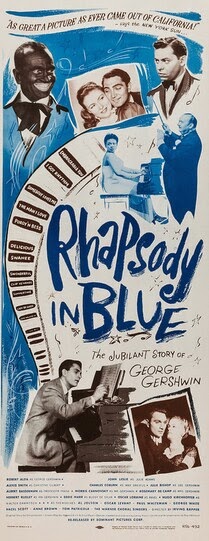
We watched a 1945 movie, Rhapsody in Blue on TCM the other night. It's the story of George Gershwin's rise to fame. Oscar Levant, as himself, played a prominent part in the film, being one of Gershwin's oldest and closest friends. I've written about Oscar Levant already, in this post from 2011. He was, as the post title indicated "an unusual Capricorn type".
SNIP:
Oscar Levant was something of a renaissance man: pianist, composer, author, comedian, wit, and actor. His "shadow side": hypochondriac, neurotic, addicted to prescription drugs, spent time in mental hospitals. He was considered to be near-genius. His own comment on this: "There's a fine line between genius and insanity. I have erased this line."

Levant was a brilliant pianist, his renditions of his long-time friend George Gershwin's compositions are considered second only to Gershwin's own.

I haven't looked at George Gershwin's chart before. A potted bio can be read at Astrodatabank.

It could be an interesting exercise to try to identify why the two became such close friends. The full interpretation of Levant's chart is at my 2011 post linked above, this time I'm looking only for links to the chart of Gershwin.

Oscar Levant, born 27 December 1906 in Pittsburgh, PA at 11:45 PM (Astrodatabank).


George Gershwin, born 26 September 1898, Brooklyn, New York at 11:09 AM (Astrodatabank)


 Oscar Levant

 George Gershwin
The close friendship between the two men doesn't immediately leap out from their charts. Natal Moons are in highly compatible signs, Gemini and Aquarius - that's a start. Levant's Virgo ascendant would understand Gershwin's Mercury in Virgo - both men were perfectionists - when it came to their music and performance. Levant's Venus at 00 Sagittarius is conjunct Gershwin's Uranus at 00 Sagittarius, and Gershwin's Uranus is conjunct Saturn, giving it a Saturnian blend which matches Levant's Capricorn Sun conjunct Uranus - I see this as the most likely key element of their friendship, along with their compatible Moons.

These men are two more examples of genius brought forth from the Pluto in Gemini generation.

Quality of sound in some YouTube offerings of Gershwin/Levant isn't very good. So as to feature Gershwin's longish and wonderful Rhapsody in Blue with something to watch at the same time - do go see and listen to
the Vimeo video HERE,
..it comes from Fantasia 2000, on which artist/cartoonist Al Hirschfeld served as a consultant with his drawings used for the basis of this segment, accompanying Rhapsody in Blue - it captures the highs and lows of depression-era New York.

Monday, January 12, 2015

Je Suis C...oncerned

The "Je suis Charlie" thing must have surely run its course. The issue has been debated, written about, conspiracised and generally chewed to a pulp over past days. There's little more that can be said on the events themselves. I feel a little uneasy (to say the least) about what could spring from them. Millions marching in Paris at the weekend?

There have been reports and commentary about a growing right-wing, fascist-like element in European politics for a while now, long before the Charlie Hebdo killings were international front-page news. I don't know which way Hebdo leaned politically. Those in the know claim it was well to the left. If this were so, though, wouldn't their satire have been more conducive to encouraging rank and file French people to support their Muslim neighbours and workmates? I cannot possibly see how the obscene caricatures of the Muslim religious figure head would help in that regard.

I don't for a moment think Hebdo was an outright fascist outfit, akin to Germany's Der Sturmer in the 1930s, whose anti-Semitic cartoons must have aided acceptance of mass deaths in Germany, and were preceded by the dehumanising of whole groups through caricature. What we've seen recently indicates that Charlie Hebdo has at least been lending a (possibly inadvertent) hand to the growing right's National Front party in France, led by Marine le Pen.

Bearing in mind how the world is now so easily connected, second by second, via internet's social media, it doesn't take much imagination to see how European countries, whose large immigrant Muslim populations are causing some native born individuals and groups to worry about losing their national identity in the future, might jump on the "Je suis Charlie" bandwagon. Their intent could be to infiltrate and use it, not to uphold free speech, but for their own political ends - to de-humanise, mock and pillory immigrant groups, deter further immigration, and in turn foster growth of what would become a fascist following. Things are not the same as events in the 1930s, fears and reasons for them are different. There was no fear of Jewish terrorism then. The "pieces" are different, but the "game" is related. I think the astrology is related also, as it happens - a time of Uranus-Pluto square aspects, the earlier one waning, current one waxing.

Whatever else most of the "Je Suis Charlie" mob with their constant, and no doubt well-meaning, emphasis on free speech want to see, one hopes fervently that they do not inadvertently become caught up in achieving the opposite, slipping into a new version of the Europe of 1937-1945, with Muslims as targets instead of Jews, gypsies, homosexuals and others. A side effect of this would be to see free speech hurtling rapidly down the drain.

Slippery slopes are not always obvious - early on.

Saturday, January 10, 2015

“It ain't what they call you, it's what you answer to.” ~ (W.C. Fields)

Names. Our own special "labels". Husband occasionally draws my attention to names of young people in some team or school class mentioned in the local newspaper. I don't know whether it's a peculiarity of our town or an Oklahoma peculiarity, but some of the names are unusual to our eyes, unusually spelled too. Changing "C" for "K" is a common occurence (Karol, Kora, Karrie-Ann), using a surname as first name comes up frequently, which can be reasonable - or peculiar, crying out for abbreviation. Under a photograph in our local paper not long ago was a list of cheer-leader team names including: Wyatt, Micaila, Ashtyn, Kenzie, Kodee, Kiyana, Ali, Tayor, Rion, Bailey, Sydney, Chyan, Tori, Bailie, Karson, Hailey, Paige.

Names, like fashions in clothing, drop in and out of favour. A fun time for names, I thought, came just after the "love-in" hippie era of the 1960s when babies emerged called River, Leaf, Rain, Apple, Summer and suchlike. Then there'd be a swing to biblical names and many Joshuas, Sarahs, Rebeccas, Elis, Matthews, Marks etc would fill school registers.

Friends and relatives often shorten (or occasionally lengthen) the first names of their...friends and relatives. Why this became a custom is something of a mystery; maybe part laziness (can't be bothered to enunciate the full name), part wanting to appear affectionate or "one of the in-crowd" in respect of said friend or relative. Necessity for clarity is occasionally the reason for short-form names. At around age 14, in my school class, we had three Jennifers. They agreed amongst themselves that they'd be known as #1 Jen, #2 Jenny and #3 Jennifer. Mid-term yet another Jennifer joined us - if memory serves I think she agreed to be known by initials: "JP".

How shortened names such as Richard morphing to Rick came about is easy to understand, but a change to Dick not as easy. Was it due to a bit of rhyming fun, or because a few people found pronunciation of "R" difficult (as children sometimes do)? William becoming Will or Willy/Willie is obvious enough, but...Bill/Billy? Rhyming again, as Rick/Dick... Will/Bill?

I've no idea how John became Jack. My Dad was Kenneth John but nobody ever called him anything but Jack. At this point in my keyboard scribbles I went to look for an answer to the John/Jack question, found an article on this very topic of shortened names at Mentalfloss: The Origins of 10 Nicknames. I wouldn't count shortened names as true nicknames, though I realise these do come within that definition. I'd define a real nickname as something quite apart from one's given name, whether in long or short version; something perhaps related to appearance, or talent, surname or profession (or both): such as "Nobby" once often used as nickname of anyone whose surname was Clark, because clerks in the old days wrote, using pen and ink, for hours on end, causing knuckles and finger joints to become...knobby.

My mother and grandmother used to tell me that in "the bad old days" any female who had the misfortune to work as a servant to a wealthy family was often called Mary by her employers, whether that was her name or not. Marys were sometimes called Polly too (my father's mother was an example of this), possibly via the old (southern) English habit, that still survives: putting 'L' at the end of an abbreviation in place of 'R'. I noticed in an interview between John Cleese and Eric Idle, just the other day, that John Cleese referred to Eric as "El". Terry, already an abbreviation of Terence, is sometimes further adapted to Tel. So: Mary/Mol/Molly/Polly? And Dorothy/Doll/Dolly.

Online, these days, we can choose for ourselves the names we're known by - if the chosen name is not "already taken", and as long as we are willing to make it unusual enough not to be obvious to would-be impersonators. In a fantasy future, either dystopic or utopic, I can imagine the restrictions we now find in choosing online screen names applied in real life - a population where no two people can bear the same first name, and where census takers are faced with recording individuals as Janetx742*/0, Berniee00*017, etc. Census takers, over their morning vitamin and mineral shakes, would tell each other tales of golden "olden days" when people had "real" names like John and William and Mary and Ann.

Friday, January 09, 2015

Arty Farty Friday ~ John August Swanson

Yet another artist new to me, John August Swanson. He'll have a birthday coming up on Sunday.
He was born in Los Angeles on 11 January 1938.

From the artist's own website:

John August Swanson makes his home in Los Angeles, California, where he was born in 1938. He paints in oil, watercolor, acrylic and mixed media, and is an independent printmaker of limited edition serigraphs, lithographs and etchings.

His art reflects the strong heritage of storytelling he inherited from his Mexican mother and Swedish father.

Swanson studied with Corita Kent at Immaculate Heart College. His unique style is influenced by the imagery of Islamic and medieval miniatures, Russian iconography, the color of Latin American folk art, and the tradition of Mexican muralists.

Unlike many contemporary artists, John Swanson works directly on all phases in producing his original prints. His serigraphs (limited-edition screen prints) have from 40 to 89 colors printed, using transparent and opaque inks creating rich and detailed imagery. For each color printed the artist must draw a stencil on Mylar film. This stencil is transferred to the silk screen for printing the color ink on the serigraph edition. The resulting serigraph is a matrix of richly overlaid colors visually striking and technically masterful.

In 1995 Orbis Books published There Is A Season which featured Swanson’s painting, Ecclesiastes. It is a series of meditations in art and words on the famous passage from Ecclesiastes. Joan Chittister, O.S.B. wrote the text. This book won the Catholic Press Association’s 1996 first-place award in spirituality.

Mr Swanson, though a devout Roman Catholic, and many of his paintings are of biblical subjects, has said in interview that he hopes his art will speak to viewers of all religions, or of no religion.

See here
Swanson: I come from a faith that has a rich and broad tradition of thinkers. It's a very complex thing. Some people assume that if you are Catholic you have left your brain behind, but that is such a simple view of this very rich tradition. I have read from many Catholic sources and I try to tap into all of these wonderful thinkers who challenge us to move toward justice, peace, and transformation. I'm not just a painter. I'm not someone who just sits in the pew and prays the rosary. I'm in the world, trying to help us become more human. I don't want to be labeled a "Christian Artist" so much as I want to do good work. I love my faith, but I'm happy when anyone, of any faith or no faith, is inspired by my work. I'm just hoping my art helps others become more compassionate, care about others, and be involved in the world.

In a short video titled An Artist's Perspective on Justice , Mr Swanson comes over as a very gentle gentleman.

Mr Swanson's piece titled Ecclesiastes was what first attracted my attention due to the zodiac images included. The painting was inspired by the Bible passage from Ecclesiastes 3: 1-8. It's a passage read to us many times at school morning assemblies, long long ago and far away in East Yorkshire.

To every thing there is a season, and a time to every purpose under the heaven:
A time to be born, and a time to die; a time to plant, and a time to pluck up that which is planted;
A time to kill, and a time to heal; a time to break down, and a time to build up;
A time to weep, and a time to laugh; a time to mourn, and a time to dance;
A time to cast away stones, and a time to gather stones together; a time to embrace, and a time to refrain from embracing;
A time to get, and a time to lose; a time to keep, and a time to cast away;
A time to rend, and a time to sew; a time to keep silence, and a time to speak;
A time to love, and a time to hate; a time of war, and a time of peace.

 Click on image for larger, clearer version

A series of of narrative scenes and dramatic vignettes combine to illustrate the individual verses of this passage. I'm quite surprised to find inclusion of astrological subject matter here - but glad to see it!

I shall desist from publishing a natal chart for Mr Swanson, as he is still with us, and he might not appreciate its inclusion on a blog open to the public. Suffice to say that his Capricorn Sun forms an harmonious Grand Trine with creative Neptune and Venus (the arts)- and (quite probably) Moon/Uranus. Jupiter is in Aquarius reflecting his open-minded and socially conscious attitudes as related to his religion.

I hesitate to include many images of his work due to copyright reasons - but maybe just another one and one poster format can be allowed. Please visit the artist's own website and look through his catalogue for more and larger illustrations of his work.

Psalm 23


 Click on image to enlarge and clarify it.


I hope my art speaks of the hospitality I have experienced from people of all ethnicities, nationalities and religious backgrounds. The kindness, sharing and community I have felt stays with me and inspires my art. I feel gratitude recalling the care and warmth of a meal, good company, and generosity and kindness given me,often from those who have so little. These experiences of sharing with our immediate family and the guests we welcome to our table help us to feel solidarity with the whole human family around the world".
~ John August Swanson

Any copyrighted material on these pages is included as "fair use", for the purpose of study, review or critical analysis only, and will be removed at the request of copyright owner(s).

Thursday, January 08, 2015

Another Tragedy...

Another year, another tragedy - and within a week! The shocking murders of twelve people, including four well-known cartoonists, at the offices of satirical weekly newspaper Charlie Hebdo in Paris yesterday was horrific and saddening.

From Huffington Post yesterday:
The attackers stormed Charlie Hebdo's Paris newsroom during an editorial meeting and began firing indiscriminately, police and prosecutors said. Witnesses told police that the gunmen shouted "we have avenged the prophet," according to Agence France-Presse. Charlie Hebdo cartoonist Corinne Rey said the gunmen spoke to her in fluent French and claimed to represent Al Qaeda, she told French newspaper l'Humanite.

I'm no great fan of satire when taken to extremes. To my taste satire works best when directed at one's own fads and foibles, or at the fads and foibles of one's own country and culture. When satire reaches beyond that it can rapidly flounder into the realms of questionable or downright bad taste. That was the problem I had with the recent media furor about the movie The Interview. The satirical cartoons featuring Mohammed carried by Charlie Hebdo didn't as much flounder into a similar bad taste realm as march directly into it, with provocation.

I guess I'm in a tiny minority (again) in my opinion on this. I surprise even myself - but I feel as I feel and cannot change it. I found just three comments, out of many hundreds I read yesterday, which aligned with my own feelings:
We live in treacherous times. Even though we have freedoms, it is imperative that we learn to exercise those freedoms with wisdom.
(Minnie Taylor)


You can have freedom of speech but, with that freedom comes responsibility. As the saying goes, if you keep poking the bear.... Condemning all Muslims because of radical extremists is ridiculous. While there is no excuse for such violence, we all know that there are extremists out there, and this type a "humor" provokes. Was the satire worth human lives?
(Isabella Kirchner)


Not at all condoning this violence or these crackpots, but this newspaper has had death threats from them before, because they re-published the inflammatory Danish cartoons and also other comments about Mohammed. Then they hide behind the free speech argument, so surely they have to take at least some responsibility. Its like antagonising fundamentalist Christians by insulting Jesus.
(Robert Forton).

Freedoms - all freedoms - carry with them responsibilities, especially for those with the power to incite and inflame. So what has been gained, at the expense of those 12 lives, and the agony of their families and loved ones? What - exactly? Have extremists been taught any lesson? Would they ever "see the funny side", get the message ? Don't we all know the negatives of fundamentalist religions already without benefit of satire? Maybe some of us don't, but was it worth the cost of human lives to highlight it yet again? Really? I feel very sad for the bereaved. I feel angry at the sheer waste that could have been avoided by the realisation of what can be seen from this event as the extremely serious levels of responsibility that come with free expression.

Wednesday, January 07, 2015

A Hillary Clinton Experiment

A little two-way experimentation today with the natal chart of a woman who (if her husband's association with Jeffrey Epstein doesn't pull the rug from under) could be in the running to be the next president of the USA: Hillary Clinton. There's a question mark over her time of birth: 8 am-ish, 8 pm-ish - or perhaps neither?

Hillary Clinton was born on 26 October, 1947, Chicago, Illinois. Charts below, show her natal planetary positions according to both tropical and sidereal zodiacs, using 8:02 am birth time (as does astro.com). I realise that there are many differences between sidereal and tropical astrology, as used by professional astrologers, but interpretation of the signs remains similar for both zodiacs, as far as I know.

TROPICAL


SIDEREAL


Did I ever see Hillary Clinton as a (tropical) quadruple Scorpio? Not really. Sidereally Ms Clinton would have three planets and ascendant in Libra instead of Scorpio, and Jupiter in Scorpio rather than Sagittarius. Her Saturn, Pluto and Mars in tropical Leo would be in Cancer sidereally. Tropical Pisces Moon becomes Aquarius Moon sidereally.

I like that sidereal Aquarius Moon for her, better than tropical Pisces - but the softness of a Pisces Moon is transferred to the stellium in Cancer - Saturn, Pluto and Mars - three planets with hard reputations. Were this a male's natal chart I'd say the tropical Leo positions fit better. As it is the chart of a female, albeit a female in the spotlight of the public stage, I think the planets in Cancer, softened slightly, may be appropriate. Hillary Clinton can hold her own with the most determined male politician, but her experience as a mother and a daughter has to provide a very different base from that of her male colleagues. I understand that in her past career she has often championed children, and the underprivileged. She fought to improve the health care system in the USA some years ago, long before many politicians saw it as being an important issue. There has to be a deep-seated compassion there, well-hidden by a tough exterior.

Sidereal Libra Sun, ascendant, Mercury and Venus replace the passionate, sexy tropical Scorpio planets. Jupiter in sidereal Scorpio retains passion and determination, but Libra the diplomat takes center stage. Some say that Libra can be a flip-flop, indecisive sign. Hillary Clinton appears to be very decisive, and one who can think on her feet when under attack, but she always remains cool and diplomatic. Aquarius Moon trines Mercury/Venus in Libra, indicating an easy, sharp intelligence, and quick-thinking mind. Whilst not the epitome of charm, as in textbook Libra, she appears to be well-liked by many politicians (of both stripes) who know her personally.

As mere onlookers of her performance on the public stage, we cannot hope to know what kind of a woman she really is in private. I suspect, though, that predominant Libra may be a closer match for her than predominant Scorpio. Would quadruple Scorpio have stayed with a spouse after being famously and publicly humiliated? I'm not sure. Would quadruple Libra? Scorpio is a Fixed sign, and as such would embrace and value loyalty, one's own as well as that of others. Cardinal Libra's tact, taste and diplomacy might want to hold things together for the sake of appearances - and best not forget that Venus, planet of love, is ruler of Libra!

There's food for thought here, not necessarily about Ms Clinton in particular, but about the relative accuracy of the two zodiacs when interpreting a natal chart.

It's easier to make a comparison of the two zodiacs using a chart like Ms Clinton's with heavy emphasis on one sign. Using my own "splashy" chart it's not easy to differentiate, because though some planets move sign, general emphasis on signs remain much the same (through alternative planets).

Image, right, illustrates the difference of roughly 23 degrees, due to precession of the equinoxes, between the sidereal and tropical zodiacs. Click on the image for a sharper version.

(NOTE: In case I've given the impression of being a Clinton fan: if Hillary enters 2016's campaign for the US presidency, and becomes the Democratic nominee, I'll be disappointed, and reluctant to vote for her. Not that my vote, in this reddest of red states Oklahoma, makes one jot or tittle of difference!)

Tuesday, January 06, 2015

Jeffrey Epstein ~ Le Scandale du Jour

I'd never heard of Jeffrey Epstein until reading about the "scandale du jour" at the weekend.
Epstein's Wiki page.

See also:
Salacious new chapter in Florida billionaire’s sex scandal.

And, regarding Prince Andrew's alleged involvement: Prince Andrew to 'move on' after US underage sex claims

It seems the scandal is not exactly new news, but rather re-conditioned news involving some of the not-so-great and not-so-good regularly indulging their lusts with the help of "sex slaves", some of whom are/were under-age. Britain's Prince Andrew's alleged involvement excites the British press, while a few political commentators in the USA are more interested in Bill Clinton's long association/friendship with Jeffrey Epstein. Bill Clinton's own reputation, already besmirched enough from past dalliances could, if he's found to be personally involved in any of the reported orgies etc, affect his wife's possible run for the US presidency next year.

I was interested to see Jeffrey Epstein's natal chart...disappointed to discover what a let-down he is to the Sun in Aquarius brigade - as bad a let down as is Dick Cheney. Dang!

Born 20 January 1953 in Brooklyn, New York. Time of birth not known, so chart set for 12 noon.


Sun just 22 minutes into Aquarius - he must certainly have inherited the mental acuity for which Aquarius is known - and has used it to help in amassing his fortune. Is it going to be possible to identify his other "talent" in his chart though - a talent for sleazy trouble? It's interesting that his natal Mars and Venus (symbolically male and female) are closely conjoined - they are in Pisces, ruled by potentially addictive Neptune. Neptune itself is conjunct Saturn in Libra - I wonder if that might indicate Saturn's limitation on Neptune's addictive tendencies (Epstein has spent time in prison in the past and is a registered sex offender).


Other than that, how about these two Yods? One links the Venus/Mars conjunction to Mercury by sextile then all to Pluto (sex, darkness) by quincunx (150 degree aspects). The other Yod links Pluto to Neptune/Saturn by sextile, then all to the Mars/Venus conjunction. Hmm. All the relevant planets are involved, and tell an accurate story. Another good example of Yods "working"!


UPDATE: See also Jeffrey Epstein - Again

Monday, January 05, 2015

Mystical Monday ~ Jeanne Dixon, 20th Century Psychic.

Jeanne Dixon was born this day, January 5, in 1904. She became one of America's best-known psychics during the twentieth century. She foresaw the assassination of John F. Kennedy. She had written that a Democrat would be elected US president in 1960 but would die in office, possibly by assassination. Before this she had made several successful predictions concerning "celebs" of her day, Russia's launch of Sputnik, plane crash of UN Secretary General Dag Hammerskjöld.

From New World Encyclopedia
" She also predicted that Robert Kennedy would fail in his presidential bid because of a tragedy that would occur in the Ambassador Hotel in Los Angeles, where he was later assassinated. One of her most dramatic prophecies was a 1962 vision of a messianic child who would "unite all warring creeds and sects into one all-embracing faith."

She reached millions through her syndicated newspaper astrology column and a best-selling biography by Ruth Montgomery. She also wrote eight books and appeared in the 1976 TV documentary The Amazing World of Psychic Phenomena.

A devout Roman Catholic, Dixon attributed her prophetic ability to God. She also had numerous critics, who pointed out that many of her most dramatic predictions never came to pass.

Jeane Dixon was born Lydia Emma Pinckert in Medford, Wisconsin and raised in Missouri and California. A Roman Catholic, she was married to James Dixon from 1939 until his death. They had no children."
Jeanne Dixon died in January 1997.

Her prediction of the birth of a "messianic child", in February 1962, when a large assembly of planets lay in Aquarius, might have been a wild guess, taking the astrological phenomenon into consideration (and that's my own wild guess!). We haven't yet seen evidence that her prediction was correct,

Dixon's natal chart from data at astro.com

Born at 2:00 PM on 5 January 1904 in Medford, Wisconsin.


Where was Dixon's psychic ability reflected in her natal chart? She had Sun in Capricorn with three personal planets in Aquarius. Capricorn and Aquarius aren't usually thought to be linked to psychic ability - sometimes Aquarius/Uranus are linked to astrology, and Jeanne Dixon was also an astrologer. The Water sign Pisces and its ruler Neptune, or Cancer, or Scorpio are thought to be part of the more usual psychic tool bag. She had Jupiter in Pisces and Neptune in Cancer, nice placements for a psychic, but the planets were too widely spaced to be in textbook trine aspect.

Dixon's generational Pluto in Gemini in her first house (Pluto well aspected by personal planets = potential for psychic ability) was in trine to Mars in Aquarius, but also square to Jupiter in Pisces and opposing Uranus in Sagittarius.

A bit of a mystery!

How about that Yod (Finger of Fate), shown in the small chart: it links Mercury/Saturn to Venus by sextile, and the sextiled planets to Neptune (favourite planet for psychic ability) via two 150 degree aspects. Such aspects are known as quincunx or inconjunct and individually are thought to be generally unhelpful or "irritable" aspects between planets. Most astrologers aren't very keen on the Yod formation as being helpful either. However, I've noticed many times that when a Yod appears in a natal chart it does seem to indicate a kind of "funnelling" through the Yod's apex planet, and reflects through this the talent or "gift" of the chart's native. It works very well in this case, as a funnel for Mercury (communication) and Venus (planet of the arts) through Neptune's mists, dreams and visions.

Saturday, January 03, 2015

Sundries for Saturday and Sundray

Proverbs to Live By, a little book unearthed by husband, during an unusual tidying attack, threw up three proverbs (from Italy, Japan and Germany respectively) which immediately brought to my mind a news story popular during the festive season just gone (think films - think "The Interview")
A book whose sale's forbidden all men rush to see, and prohibition turns one reader into three.

One dog yelping at nothing will set ten thousand straining at their collars.


A man shows his character by what he laughs at.


What will 2015 have to offer TV and film fans? To my own taste, not a lot, if lists now available are anything to go by. There'll be sequels to three Young Adults in Dystopia series: The Hunger Games, Divergent, The Maze Runner, I'll probably make the effort to see those. A science fiction film, The Martian , based on a novel by Andy Weir has possibilites.

Well away from dystopia and science fiction, a BBC/PBS mini-series Wolf Hall, based on the novel by Hilary Mantel will be a must-see for me, due to inclusion of Damien Lewis in the cast - he's playing Henry VIII - a far cry from his roles in Homeland and Band of Brothers.

Wolf Hall
England in the 1520s is a heartbeat from disaster. If the King dies without a male heir, the country could be destroyed by civil war. Henry VIII wants to annul his marriage of twenty years and marry Anne Boleyn. The Pope and most of Europe oppose him. Into this impass steps Thomas Cromwell: a wholly original man, a charmer, and a bully, both idealist and opportunist, astute in reading people, and implacable in his ambition. But Henry is volatile: one day tender, one day murderous. Cromwell helps him break the opposition, but what will be the price of his triumph?
- Written by mccutcj2
We'll certainly make an effort to see what will be the final seasons of couple of TV series we've followed, on TV or via DVD : Mad Men and Justified. David Letterman is due to retire from The Late Show in May, his last week or so should be worth a look-in, and it'll be interesting to see how Stephen Colbert changes the flavour of the show - or not.


 "Kindly take us to your president!"

 "I remember when the wheel was just in science fiction stories"


Poem by Billy Collins, Poet Laureate of the United States from 2001 to 2003.

Man in Space

All you have to do is listen to the way a man
sometimes talks to his wife at a table of people
and notice how intent he is on making his point
even though her lower lip is beginning to quiver,

and you will know why the women in science
fiction movies who inhabit a planet of their own
are not pictured making a salad or reading a magazine
when the men from earth arrive in their rocket,

why they are always standing in a semicircle
with their arms folded, their bare legs set apart,
their breasts protected by hard metal disks.

Friday, January 02, 2015

Arty Farty Friday ~ Starter People (aka Babies) In Art

Baby art, for me, doesn't bring on a fit of the "aww, oooh, ahhhhs!!" What set me wandering down this, not terribly deep, arty farty rabbit hole was noticing that husband had featured some vintage cover art from The New Yorker on his flickr page. It was a photograph I'd asked him to take when I saw the cover, framed, in an antique store in Texas last February. I used the photo in a weekend bits-and-pieces post HERE. It hadn't been the baby pic attracting me, but the advertising of an article to be found within the magazine, you'll guess which one!


Anyway, husband dug out his photo to use on flickr and had searched for the name of the artist: Dorothy Hope Smith (1895-1955), American illustrator (mainly of babies and for children's books) most famous for a sketch which won Gerber's competition for an illustration of "The Gerber Baby" - now that's a baby everyone recognises, even non-baby-fanciers like me. I'll not go into detail of who that baby was in real life - many others have been there and done that - it's easy enough to find the tale online. Dorothy Hope Smith (she usually signed her pics "DHS", was married to another magazine illustrator with numerous New Yorker covers to his name: Perry Barlow.

 by Bessie Pease Gutmann
Wandering further down the rabbit hole, trying to bring to mind the name of another famous painter of babies I'd once featured (turns out it was Bessie Pease Gutmann...see HERE), I Google searched "baby paintings" and found, on Mashable's website this: 25 Creepy Paintings of Renaissance Babies. Now those really are some creepy baby paintings, irrespective of who they're meant to depict.
There are even more, at Ugly Renaissaince Babies with some fun captions (beware if of religious or delicate sensibilities!)

Sample (click on it for a sharper image):


It's odd, is it not, that renaissance paintings are so revered, capable of commanding HUGE prices? I realise they have value related to their age, yet really and truly, how good are they, as art? It's hardly likely that any art-geek will pass by and stop to let me know the answer. It depends what one means by "good", in any case.

Maybe it takes a woman's eye and hand to paint a baby? Maybe it takes a woman's naturally prejudiced eye to see a baby as beautiful? Or, erm, maybe babies in renaissance times were all ugly or prematurely well-developed in the facial feature department? We can't be absolutely - sure can we?

Thursday, January 01, 2015

HERE'S TO 2015!

"No one ever regarded the First of January with indifference. It is that from which all date their time, and count upon what is left. It is the nativity of our common Adam."
- Charles Lamb


What can be said in New Year rhymes,
That's not been said a thousand times?
The new years come, the old years go,
We know we dream, we dream we know.
We rise up laughing with the light,
We lie down weeping with the night.
We hug the world until it stings,
We curse it then and sigh for wings.
We live, we love, we woo, we wed,
We wreathe our prides, we sheet our dead.
We laugh, we weep, we hope, we fear,
And that's the burden of a year.
- Ella Wheeler Wilcox


"We spend January 1 walking through our lives, room by room, drawing up a list of work to be done, cracks to be patched. Maybe this year, to balance the list, we ought to walk through the rooms of our lives... not looking for flaws, but for potential."
- Ellen Goodman