Friday, March 13, 2015

Arty Farty Friday ~ Norman Bel Geddes Had "Seen the Future"

Norman Bel Geddes (art deco, designer, 1893-1958). The 2.49 minute video below, plus a couple of quotes, put what we need to know neatly into a nutshell, and saves wear and tear on my typing fingers too. While I'd never heard of Norman Bel Geddes until now, his daughter Barbara was a familiar face, as "Miss Ellie" in the TV hit series Dallas , a decade or two back.


Norman Bel Geddes was one of those only-in-America figures, part grandiose visionary, part inspired tinkerer, part exalted entrepreneur, and all self-creation — right down to designing his own name. The Futurama exhibit Bel Geddes created for General Motors at the 1939 New York World’s Fair attracted 5 million visitors, and as they left the building they were handed a button that said “I Have Seen the Future.” Boast and slogan rolled into one, those words were also advertising for Bel Geddes. Seeing the future, and remaking the present in its image, was what he did. (See HERE)


From Harry Ransom Center, University of Texas website
When you drive on an interstate highway, attend a multimedia Broadway show, or watch a football game in an all-weather stadium, you owe a debt of gratitude to Norman Bel Geddes (1893–1958). Bel Geddes was both a visionary and a pragmatist who had a significant role in shaping not only modern America but also the nation's image of itself as leading the way into the future. Bel Geddes was a polymath who had no academic or professional training in the activities he mastered—designing stage sets, costumes, and lighting; creating theater buildings, offices, nightclubs, and houses; and authoring prescient books and articles.

Bel Geddes believed that art, as well as architecture and design, could make people's lives psychologically and emotionally richer. He influenced the behavior of American consumers and helped make industrial and theater design into modern businesses. Believing that communication was key to shaping the modern world, Bel Geddes popularized his vision of the future through drawings, models, and photographs.

He was born in Adrian, Michigan on 27 April 1893. I haven't found any birth time so far, the chart is set for 12 noon.

"I Have Seen the Future"...? There simply has to be some strong Uranus link in his natal chart - or Aquarius, or both.


All but one (Mars) of his natal planets are in degrees 1-10 (first decan) of their signs. Not sure whether that's significant; if anything it means that the signs' attributes will shine through clearly. First 10 degrees of any sign are said to be governed by that sign's ruler.

Sun/Venus/Jupiter form a tight cluster, a stellium, in Venus-ruled Taurus, this underlines Bel Geddes' artistic talent which has manifested through his visionary design skills, in a way rather bigger, grander (Jupiter) than products of yer average artist with paintbrush and canvas.

Natal Moon could be in either detail-oriented Virgo ruled by Mercury, or Venus-ruled Libra; either would be fitting. Saturn in Libra here draws artiness from Libra to modify, but not extinguish, its solidarity and serious intent.

Here it is! Uranus, planet of all that is futuristic, unexpected, a tad eccentric. A generational planet, but in this case closely aspected - in opposition from Scorpio to those three Taurus planets. Uranus is shaking up any traditional feel towards which Earthy Taurus might easily be drawn, instead Uranus injects into the mix a longing for all that could be new and exciting, while Taurus stubbornly retains practicality as a requirement.

Uranus is further emphasised by a Yod formation which links, by helpful sextile, Mercury (communication) to Neptune/Pluto (creativity/transformation) in Mercury-ruled Gemini; then links both to Uranus in Scorpio to form the Yod's apex. This, though a scratchy kind of mix draws out the futuristic from what might otherwise have remained in realms of the mundane.

Thursday, March 12, 2015

Pisces Sign-wise

 From Searle's Zodiac by cartoonist Ronald Searle
The more posts I write, and the more natal charts I inspect, the less I feel able to label anyone with the name of the zodiac sign through which the Sun was travelling as they were born. There are clearly defined labels and characteristics associated with each zodiac sign, available in any astrology text book. These are labels and keywords applying to essences of the signs; they are almost always stated in descriptive terms which are human-related, in order to assist readers wishing to learn how to interpret the natal charts of humans.

Other than for a small number of people who, at birth, had all personal planets and ascendant in just one zodiac sign, text book guidelines for any single zodiac sign, taken as description of a person who was born as the Sun traversed that sign, are going to seem anywhere from a touch off course to miles adrift in a sea of confusion.

Bearing that in mind, a look at Pisces, last of the 12 zodiac signs, through which the Sun now travels. Pisces, like Aquarius, has two potential rulers: its traditional ruler is Jupiter, but modern astrologers hold that Neptune rules Pisces. Jupiter does fit its other sign of rulership, Sagittarius, very well. How did it traditionally fit Pisces? Jupiter's reputation for excess could relate to a potential for addiction associated with Pisces; Jupiter has links to religion and philosophy, the Age of Pisces, through which many astrologers consider we are still wandering, was marked by the start of Christianity.

Neptune as Pisces modern ruler: Neptunian traits can be reflected in any sign if Neptune is strongly placed and aligned in a chart, same thing applies to traits of Uranus, modern ruler of Aquarius. I'd hesitate to apply reputed Neptunian traits (e.g. love of the sea, film/photography, highly creative, dreamy, foggy) automatically to anyone born with a strong showing of Pisces in their natal chart, unless Neptune were linked by aspect to personal planets.

On the whole I find it safer to rely on Pisces' astrological element and quality for guidance: Mutable Water. Translated = gentleness, sensitivity, emotionality, empathy. Once Pisces is thrown into the natal mix, though, it becomes part and parcel of something else.

Let's use a metaphor: natal chart as ...a salad. Lettuce (or any leafy vegetable), the base of many salads, remains lettuce or leafy vegetable whatever else is tossed into the bowl - but its flavor blends differently when taken as a mouthful of lettuce and walnut, or lettuce and olive , or lettuce and strawberry, with a delicate vinaigrette ...or, well, you get the idea. Lettuce is still lettuce, but it takes on a different characteristic depending on accompaniments. Unless you ate a bowl of lettuce, unadorned by dressing, even without salt and pepper, you'd never experience the true flavor and texture of lettuce. Likewise, unless a natal chart is composed purely of personal planets and ascendant in a single sign, you'd never see unadulterated Pisces (or any other sign) in a human personality.

I'd like to write about a purely Pisces person, I'd love to meet one, I don't know one. I know one with Sun at 1 Aries, Mercury at 29 Pisces, and Saturn at 26 Pisces - the husband! He's "cuspy" - but proper astrologers don't often give "cuspiness" much credence. I can "feel" his Pisces parts (he doesn't allow just anyone to do this!) They are, however, always being frog-marched into hiding by Aries, not to mention being occasionally outshone by Moon and ascendant in Leo.

So here we have Pisces manifesting as someone with artistic talent, love of photography; with a rather quieter nature than is often found in Aries Sun + Leo Moon and rising - yet with a background in management; impulsive and spontaneous, but can't remember what day it is or what he had for breakfast, or even if he did in fact have breakfast. It's all rolled up into one....Aries modifies Pisces, Pisces modifies Aries, and Leo modifies both and is, at the same time, itself modified. As it happens, in the husband's chart Neptune trines Jupiter - so the two rulers of Pisces are in harmony with each other, and Neptune semi-sextiles Moon, so Neptune's link to photography is relevant here.

What I'm trying to say, in convoluted fashion, is that although every sign has it's intrinsic meaning, it's unwise to assume that the sign's text book meaning will show up unmodified, or even in an outwardly recognisable form, in a flesh and blood human being.

Wednesday, March 11, 2015

Netflixing & Beyond ~ The Killing & Joel Kinnaman

The Killing, a four season TV series adapted from a Danish series, began in 2011 in the USA, on AMC channel, with a 4th season produced by Netflix. This series has been our staple diet for the past couple of weeks, becoming more addictive by the episode. I'd been wary of watching yet another police detective series, we'd overdosed on 'em already this year. I'm very glad now that we did venture in to it, and were hooked. Plaudits have to go to writers as well as actors, naturally - but without talented actors even the best scripts will sink without trace in audience memory.

There are just one or two familiar faces involved, in secondary or minor roles, the two leading actors, Mireille Enos (Detective Sarah Linden) and Joel Kinnaman (Detective Steven Holder), were completely unknown to us. After a slow start, the pair have impressed us more and more with each episode. In fact, I'm convinced Joel Kinnaman in particular will, before long, become a superstar- Initially on the big screen, but I hope he'll return to TV in another series.

After The Killing, Kinnaman played the leading role in a re-make of Robocop, and has another big screen role coming up later this month, as Liam Neeson's son in Run All Night. We watched the Robocop re-make last week. Kinnaman was good in the role, but it doesn't offer the same kind of scope as The Killing. To be honest, Kinnaman is much too good for the Robocop part, but it has made his name familiar to millions more people.

Rather than rattling on about themes of The Killing, and spoiling someone else's enjoyment of it in the future, I'm going to say simply that its one of the best, top of my list in fact, among shows in the same police detective genre. We've watched, via Netflix, this year Broadchurch, The Fall, Top of the Lake, and Luther, I found The Killing more constantly engaging than any of those. Husband thought it well-acted, well-scripted, but a tad depressing. Ah well...he's a big Blazing Saddles-type fan, so he would, wouldn't he?

I'll concentrate here on Joel Kinneman. As episodes progressed I became intrigued by the character he plays, and plays so well: quirky, flawed, street-wise police detective, Steven Holder. He plays well against his less quirky but equally flawed female detective partner, Sarah Linden. There's that kind of love/hate chemistry and loyalty between them that audiences brought up on shows such as Moonlighting and Law and Order SVU (me) revel in. We'd watched seasons 1 to 3 before I looked for the actor's history in detail, plus his date of birth. He's Swedish born, with dual citizenship Sweden/USA - mother Swedish, descended from Ukrainian Jewish immigrants to Sweden; his father American born.

In a video interview (see below) Kinnaman mentions that he spent a year in high school in Texas as an exchange student. He says that the accent, general style and demeanor he adopted as Steven Holder is largely based on the voices and attitudes of his friends there. He said that the school was quite segregated - redneck types and black & hispanic minorities. He found friendship more easily with the latter two groups, enjoyed their attitudes and quips, drew on his memories of these when playing Holder. It works so well!

The video interview is a must watch for fans of The Killing and for fans of Joel Kinnaman.


There's also a shorter video interview with Jon Stewart - this one about the Robocop role.
See HERE.

Kinnaman comes over as being quite non-starry, down to earth, even a little shy at times, a world away from Steven Holder.

Why was I finding Joel Kinnaman's acting so engaging? I even dreamed about him (as Steven Holder) one night! Cut to the chase: I'd noticed his date of birth was 25 November 1979. In deciding to prepare this post I used my software to calculate a 12 noon natal chart for him - bingo! Moon in Aquarius (whatever time of day/night he was born). My Aqua-astro-anntenna was at it again! On looks and build alone, I'd have guessed on some strong Gemini emphasis - but unless he has Gemini rising I'd be wrong. I'll not post his natal chart - that would seem overly intrusive. I'll say just that he has Uranus conjunct Mercury in Scorpio, Sun, with Neptune conjunct Venus in Sagittarius, Moon in mid-Aquarius (at noon) and three personal planets in Virgo.

I'll be watching Joel Kinnaman's ascent with interest. He has, already, entered what I call my ABBO (always be a bit of) Hall of Fame, along with Bryan Cranston (there's always be a bit of Walter White in Bryan Cranston); Damien Lewis (there'll always be a bit of Brody and Major Winters in Damien Lewis). In Joel Kinnaman, there'll always be a bit of Steven Holder!

Tuesday, March 10, 2015

2010 - 2030 - Yet another cycle?

Five years ago, Patrice Guinard of C.U.R.A. (The International Astrology Research Center), made a "true and wonderful" prediction for the twenty years 2010-2030 . It's brief, read it HERE. (I'm not able to access the noted "provisos" though.)

The prediction doesn't fill me with eager anticipation! It is based on Pluto - say no more!

SNIP
With its high latitude, Pluto cannot easily form aspects, especially the conjunction or opposition, with any planet. But when its latitude is lower, these aspects are possible.

What's this about latitude? I did once get into the declination thing in astrology, but discarded it as being either not useful or "a bridge too far" when combined with the many other variables available. Latitude is another way of describing declination in astrology (I think).

From astrologer Paul Newman's piece Declination for Beginners
In a nutshell, declination is a form of latitude rather than longitude. It is the measurement of planets north or south of the celestial equator, which is the Earth"s equator extended into space. It is worth remembering that when we talk of an exact conjunction of planets in a zodiac sign—for example the Moon and Saturn in Leo—these would not necessarily be conjunct in the sky. They would be conjunct by longitude (maybe appearing one above the other) but not necessarily conjunct by latitude or declination.* Similarly, the Moon and Saturn may be conjunct by declination (parallel to each other) but from different zodiac signs and therefore not conjunct by longitude. Separately either of these types of "conjunction" (longitude conjunction, declination parallel) has an equal force, but the strongest possible conjunction in astrology is when two planets are conjunct by longitude and parallel by declination at the same time. They would then appear to be conjunct in the sky. This may also help to explain why some transits seem stronger than others.

Here's what librarising.com has to say on astrological latitude
The ecliptic or Sun's apparent path is a belt of some 16 degrees thick(8° north and 8° south) where all the planets including our Earth orbit. Only Pluto and the dwarfs(as well as most stars) deviate from this belt. Wheareas east-west on the ecliptic is measured as LONGITUDE(in degrees), north-south of the ecliptic is measured as LATITUDE(in degrees). So planets in longitude and latitude in astrology refer to their position with respect to the sun's plane or ecliptic as seen from Earth. How this all translates to terrestial co-ordinates is another matter.

So then, taking Patrice Guinard's prediction into account, here's yet another potential cyclical pattern in astrology. Is it likely to be as significant as some other, better known cycles though? At least, it needs to be taken into account when considering them. When Pluto is involved in other cyclical patterns - aspect cycles such as the Uranus/Pluto squares we've experienced in the past few years, if any points in that Uranus/Pluto cycle coincided with Pluto's low latitude cycle (they all did), results could prove to be more intense, more clearly defined. What we need to be doing is looking for any other cyclical patterns involving Pluto, from now until around 2030, and marking 'em with an asterisk!


Staying on CURA's website, a piece titled Astrological Cycles in History by Palden Jenkins is well worth a good long read. There's a lot to digest there, but as a taster, maybe try starting part-way through the piece at the section headed Uranus-Pluto cycles and the storms of history.

Penultimate paragraphs of the piece (it was written in 2002 by the way):
At present, many prophecy buffs look toward the year 2012 as a time of drastic change. Though end-of-the-world type anticipations might turn out to be exaggerated, there nevertheless is a Uranus-Pluto square from 2012-15. At a square, new impulses arising from a conjunction are put to the test - there is a manifestation crisis. The astrologically-logical likelihood for 2012 is that the paradigm-shift issues of the 1960s will be forced by circumstance to deliver their goods: ecological ideas, women's power and techno-globalism, to name but three bundles of issues, will probably have to handle an emergency. War, institutions and boundaries (Aries-Capricorn) are predictable front-runners for likely trouble. Knowing how things are nowadays, this aspect is likely actually to bring a hailstorm of major issues.

But the choices now are fundamental. We need to realise, for example, that war no longer resolves conflicts as once it did. This is now a pragmatic issue, not solely a moral one or the domain of lettuce-eating pacifists. In the twelve years up to this aspect, we possess the choice to make major proactive forward-steps, or to continue delaying and avoiding such challenges as long as possible. As in 1930, on the previous square, when economic and social crisis demanded drastic action, so around 2012 we tread perilous paths along which the choices we make might have enormous and rapid outcomes. Ten years after 1930 the world was at war. What will the world be like in the decade following 2012?

Monday, March 09, 2015

Music Monday ~ John Denver

Harrison Ford's plane crash last week brought to mind the tragic flying accident that took John Denver from us some 18 years ago, in 1997. Happily it seems Harrison Ford's injuries are not fatal.

In booklet accompanying a double CD of John Denver's songs, Rocky Mountain Collection reviewer Colin Escott wrote:

"John Denver always offered more than music. Once he caught your ear with a melody, he had something he wanted to share with you. Taken together, his songs come close to offering an integrated version of how life can be lived, as well as an invitation to get concerned about our world, and see beyond ourselves. His work was, and still is,an unfailingly upbeat celebration of life and its possibilities. He has never shied away from sharing what he felt and what he knew, nor has he shied away from exposing his tender and vulnerable side, no matter the cost."


Astrologer Zipporah (Zip) Dobyns wrote about John's chart in 1997, John Denver Flies On , after the tragic flying accident in which cost him his life. I'll not even try to match her long, scholarly assessment, but will include a copy of John's natal chart here, and make a very brief note of what stood out for me.

Ms Dobyns had access to birth certificate data from Lois Rodden of AstroDatabank.


John was born on December 31, 1943 at 15:55 MWT in Roswell, NM. He died on October 12, 1997 when his private plane crashed into Monterey Bay, California.


Pluto lay, exactly, on North node of the Moon. I wonder if, for him, that was an ill-omen?
He was always going to be a communicator - Gemini rising with Uranus/Mars right on the ascendant, a forward-thinking communicator too, whose life could well be punctuated by the unexpected. Sun in solid, reliable Capricorn was in sextile to his gentle Pisces Moon this is a good blend for someone whose business is music. His Venus, planet of the arts, in Scorpio reflected the soft yet intense and sometimes melancholy flavour of his songs.

Among the several patterns in his natal chart this Yod stood out for me. It links natal Sun to Uranus (the unexpected) and Pluto (death, darkness) by quincunx (an uncomfortable aspect).


John travelled to China, Russia and Africa on missions of detente and mercy - his concerns covered nuclear power, nuclear arms and world hunger. He probably, quietly, did much more good than many of today's "celebrities" frequently lauded for their efforts. He was a man we could ill-afford to lose. His message, in this song of his, Rhymes and Reasons, remains timely:-


Some of the lyrics:

And you wonder where we're going
Where's the rhyme and where's the reason
And it's you cannot accept
It is here we must begin
To seek the wisdom of the children
And the graceful way of flowers in the wind

Though the cities start to crumble
And the towers fall around us
The sun is slowly fading
And its colder than the sea

And the song that I am singing
Is a prayer to non believers
Come and stand beside us
We can find a better way.

(Words and music by John Denver)

Saturday, March 07, 2015

Pedestals Not Required - Human Nature Past and Present, Heroes and Flaws.

If you can, please spare a few minutes to watch
"Ballad of Billy John" :


The song is probably fictional in its detail, but exploring any comment thread just about anywhere on the net will reveal content not far from that described.

Ironically enough, I watched the video straight after having read an essay by Dan Falk at Salon. The essay contains, as a kind of side issue, some theories that we humans are now more moral, sympathetic, empathetic, ethical than we were in the past. Hmmm.

You would’ve hated your heroes: Why history’s great people seem so morally deficient. Winston Churchill was racist. Albert Einstein was a chauvinist. And that's not even the half of it!

The title tells enough about the essay's content for the moment. We've all, at one time or another, come across similar discoveries about our "heroes", even about our friends and families - and ourselves: i.e. we and they are simply humans with human flaws. With regard to those who lived in a different era from us, they were humans living in a world with different cultural mores and norms, it's not logical to compare their mindsets and values with ours...it just isn't!

Snips from the essay:

It is tempting to dismiss such examples of jerkdom by noting that “times were different” back then. But why were they different? Why are they better today? One bold hypothesis is that we have become, objectively, increasingly moral over the course of time. Several prominent thinkers, including Harvard psychologist Steven Pinker and Princeton philosopher Peter Singer, have argued in favor of this idea. Singer in particular spoke of an “expanding moral circle”: While we once only cared for those in our immediate tribe, we now interact with (or at least, are aware of) people from around the world, from many different backgrounds. We have come to care about those who are outside our group, to feel their pain, to object to their suffering. (This is, arguably, the territory that Shakespeare was exploring with Shylock’s “Hath not a Jew eyes” speech in “The Merchant of Venice.”)

In Pinker’s 2012 book, “The Better Angels of Our Nature: Why Violence had Declined,” the focus is on the decline of violence over the course of history. But running in parallel to this decline in violence, he argues, has been a rise in moral virtue: Pinker suggests there may be a “moral Flynn effect,” akin to the rise in global IQ scores over the last century described by James Flynn. The two effects, incidentally, could be linked: As we get smarter, Pinker argues, we’re better able to imagine ourselves in the positions of others, and thus more likely to sympathize with them, and recognize their right to well-being.

Oh my! We feel their pain and object to their suffering do we? That's questionable! I suspect Iraqi civilians and Afghan peasants will feel differently, as will the loved ones of those in countries caught in US drones' "collateral damage". I agree with commenter "happyhaze" ~
I don't see the point of rooting around in the past to find SOB's that were not all of a piece, considering that we got a peace prize winner living in the here and now who believes it is fine to kill by remote control anyone deemed enemy, along with whoever is in range of the drone blast. Might makes right is one hell of a foundation for ethical conduct.
As for Churchill, he was a racist, a reactionary conservative, true enough, and the British people booted him out after World War II ended - they had the good sense to realise that it was time for a different approach. "Horses for courses". A brilliant wartime leader and orator is a brilliant idea for the people, but only in times of war. He remains a hero to me and thousands of others for what he achieved. A comment among the many following the essay:
"Even a-holes can be heroes when we need them."

As to the question of whether we humans are more moral, ethical, empathetic now than humans were in the past, I think not. In a small way, think again of those cruel comments appearing online day by day -with no cause other than mean, negative intent...and worst of all, they are contagious

We look at the past, and present, through our own lens, that's all we possess, and that lens must inevitably colour our view. Our education, experiences, lifestyles have formed us, and our lens; the people of the past, their education, experiences and lifestyles formed them and provided the lens through which to view their their present, and past. We are on different turns of the spiral of time/space, the view varies with each turn. I suppose "deep thinkers" and authors such as Messrs Singer and Pinker are wearing glasses with rose-coloured lenses, with sincere intent to make us feel better among the ongoing chaotic idiocy and calamity of this world.

Friday, March 06, 2015

Arty Farty Friday - Michelangelo - A Question

The man considered by many to be the greatest sculptor and artist of all, Michelangelo, was born, according to AstroDatabank, while the Sun rolled through zodiac sign Pisces in the year 1475. Why, I'm wondering, have I never featured Michelangelo in these Arty Farty Friday posts before? Ah yes - the old Julian/Gregorian calendar question - as it relates to astrological calculations. I've questioned this in the past (here), but without finding clarification. I do understand the calendar change-over and reasons for it in general. In astrological matters the accurate translation of dates from one calendar to t'other is going to be of extra importance.


"Moses" by Michelangelo
For Michelangelo, born in Italy, on (Julian style) 6 March 1474 - which becomes 1475 Gregorian Calendar because 1 January, not 25 March was turn of year by Gregorian. Several sources for this date, and a time of birth, are quoted in AstroDatabank's page. The change to Gregorian calendar would also transfer 6 March (Julian) to 15 March 1475.
AstroDatabank confirms this, yet proceeds to calculate the natal chart using 6 March. The sources quoted mention that Michelangelo's birth was on a Monday (6 March was a Monday Julian-style), but that would not be the case using Gregorian calendar when 6 March becomes 15 March. I have to suppose that Gregorian calculations are used by today's astrology software, so to find out where the planets were situated on the zodiac at the time Michelangelo was born, wouldn't we have to look at a chart for 15 March ?
I'm puzzled! AstroDatabank's compilers are experts - I'm not arguing with them, but seeking explanation.

For comparison with the chart at AstroDatabank, and out of curiosity, here's a chart set for 15 March 1475, in Caprese, Italy at 1.45AM (data as at AstroDatabank, apart from the day.)


The charts for 6 March and 15 March 1475, throw up what some would consider a crucial difference - Sun in early Aries on 15th rather than Pisces on 6th. I don't see that as any great problem though - Michelangelo was everything Aries is cracked up to be wasn't he? His natal Moon would have been in Cancer rather than Pisces - I'm sure astrologers could live with that - the emotional sensitivity of Water is still there - and in a Cardinal rather than mutable sign. There are still Grand trines linking personal planets to Neptune and/or Uranus.

His rising sign using 15 March would have been Capricorn rather than Sagittarius. I don't see this as a stumbling block, especially as in this chart Moon was very close to Saturn, Capricorn's ruler. I've always considered Capricorn and Saturn emphasis to be very relevant to artists who are drawn towards sculpture, first and foremost - the solidity, strength and hard work involved - as against simply wielding a brush full of paint. Michelangelo shone brightly in paintbrush wielding mode too, of course (Sistine Chapel ceiling etc), but sculpture does seem to have been his true love, and a far rarer skill - to his high standard anyway.

I'd still be interested to know the thinking behind AstroDatabank's choice of dates from which to calculate position of planets in Michelangelo's natal chart. The celestial bodies would surely have been situated in the positions known to us, in later centuries with Gregorian calendar, as 15 March - aren't those the planetary positions we need to be looking at?

I haven't yet come across any astrology-driven blog or website with interpretation of a Michelangelo's natal chart for 15 March (Gregorian). There's mention of Michelangelo's natal chart in an article in a book I have (Best of National Astrological Journal 1933-35). I've mentioned the article before, in different context (see HERE.) What's stated doesn't tie in completely with AstroDatabank's version, or the 15 March chart.
"Michelangelo had Capricorn on the ascendant with the Moon three degrees away. His heavy stone-work, massive sculpture, his diligence in his work and the great length of life all show the influence of Saturn. It is true that he had the Sun and Mars in Pisces in the second house. Manly Hall says that Pisces rules Catholicism, and the Roman Catholic church was certainly Michelangelo's strong outlet."

For me, the plot thickens!

Wandering through some comments/reviews of a Michelangelo biography by Miles J. Unger, published last year, Michelangelo: A Life in Six Masterpieces, I noticed this comment by David Wineberg who had read the biography (I trust he will not mind my using his comment/review here), it might help to throw light on the comparative accuracy of charts for 6 and 15 March...or not.

His life was a constant controversy. He made enemies, he dodged (metaphorical) bullets, and he made art. He was an unpleasant misogynist who ironically adored nothing more than portraying the human body. He was universally recognized as the greatest, within his own lifetime. He lied and embellished, but his art speaks for itself. It all makes for a great read.

He was doubly cursed; he lived in interesting times, and was an interesting character. Michelangelo's greatest achievement was to fuse the artist and his work. That is a huge transition point, centered on Michelangelo in this warts and all biography. Because in addition to taking art in a whole new direction, complementing rather than being subservient to religion, Michelangelo turns out to be arrogant, obnoxious, self-centered, narcissistic, antisocial, overbearing and uncaring about any of it. Despite it all, he was the first superstar of art.

He never married, and there were of course questions about his sexual preferences, what with all those nude males he clearly preferred. He deflected them all by saying his art was all the wife he could handle. Later in life, he risked having close relationships with younger men. He was a drama queen; his favorite tactic was to threaten to quit unless he got everything he wanted. And he quit often anyway. He was a notorious abandoner, starting projects and never completing them. There are far more of them than completed works.

Despite abusing his body with little food, minimal rest, and zero care, he lived into his eighties. He outlived nine popes, and worked with five of them. They were often personal friends of his from childhood, which allowed him to be even more arrogant and petulant than he would otherwise. He seemed to have written it all down in letters and poems, and it is juicily reproduced here. This biography is as flesh and blood as Michelangelo's sculptures and paintings, a fitting framework if ever there was one. (David Wineberg)

I guess it matters not a jot, really, which natal chart is more accurate, as far as Michelangelo's genius is concerned, that's a given. Astrologers (and annoyances like me) are the only set of people who will care about position of the planets as this seminal artistic genius was released into the world.

 Rachel and Leah by Michelangelo

Thursday, March 05, 2015

Cartoon Appreciation

I like the cartoons by John Atkinson at a blog called Wrong Hands - they have a flavour and style I enjoy, but don't find too often. Three examples, from previous years follow - but do, please, go spend a few minutes trawling through current and older offerings - lots of good stuff there.


Wednesday, March 04, 2015

Memorable Movie Moments

Oscar season may be over for another year, but here's a thought: at awards ceremonies prizes are presented for entire films or entire ingredients of, and contributions to, a film. Whatever the overall quality of a movie, of its ingredients and contributors as a whole, there's usually one scene, one moment even, that stands out in memorable excellence, even in movies never nominated for awards. I decided to make a list of the top half dozen scenes/moments which stand out, for me, as classic, from the hundreds or thousands of films I've seen during my life. These scenes needed no struggle at all to remember, even though the movies come from decades past.

My nominations for best moments (in no particular order):

FROM

Ben Hur - Out of all the drama and dozens of memorable scenes, the one I always recall first is a quiet moment, when Judah Ben-Hur (Charlton Heston) takes his leave of Esther (Haya Harareet)-
"If you were not a bride, I would kiss you goodbye." She responds with:"If I were not a bride, there would be no goodbyes to be said". What makes the scene so extra special is Miklós Rózsa's wonderful
Love Theme playing in the background....
this is it
.


The Victors - The scene nobody who ever saw this movie will ever forget: Christmastime, snow on the ground, no dialogue - it's described by Wikipedia like this"
" ...the detour of one truckload of GIs out of a convoy, for the express purpose of supplying witnesses to the execution by firing squad of a GI deserter (a scene inspired by the real-life 1945 execution of Pvt. Eddie Slovik). Depicted in a huge, otherwise empty, snow-covered field near a chateau at Sainte-Marie-aux-Mines on Christmas Eve, while the film audience first hears Frank Sinatra singing "Have Yourself a Merry Little Christmas" and then a chorus of "Hark the Herald Angels Sing", after the fatal shots are fired. This scene is remarkable for its stark, visually extreme imagery, and the non-combat stress and anguish foisted on GIs during a lull in combat.... The whole film is shot in black and white, and so the black regimented figures of the firing squad and witnesses face the lone man bound to a stake in the midst of a snow-covered plain."


Bridges of Madison County - The scene with Francesca (Meryl Streep) and her husband in their truck, it's raining; they are stopped at traffic lights, Robert Kincaid (Clint Eastwood) is in the vehicle ahead of them. Francesca is struggling with the temptation to leap out of the truck and go with Kincaid as he leaves.


Prince of Tides - The scene towards the end of the film where Tom (Nick Nolte) is driving home. He approaches a long bridge; we hear him narrate as follows:
"At the end of every day, I drive through the city of Charleston and I cross the bridge that will take me home. I feel the words building inside me, I can't stop them, or tell you why I say them, but as I reach the top of the bridge, these words come to me in a whisper.
I say these words as a prayer, as regret, as praise, I say: Lowenstein, Lowenstein"
.


Cool Hand Luke - Not the famous "failure to communicate" scene, but the scene where Luke (Paul Newman) sings "Get Yourself a Plastic Jesus."


From Here to Eternity - Not that famous beach scene, but the scene where Prewitt (Montgomery Clift) plays "Taps" after the death of Maggio (Frank Sinatra).


Any especially memorable movie moments for readers passing by?


Tuesday, March 03, 2015

Stringing Along - Intuitively

What to write...what to write? When straining for inspiration some recommend following William Blake's "golden String":
"I give you the end of a golden string
Only wind it into a ball.
It will let you in at Heaven's gate
Built in Jerusalem's wall."

(Beginning Chapter 4 of Jerusalem (Erdman 231)

Over the years, all manner of interpretation has been proposed for these lines of Blake - religious, spiritual and non-religious. This may or may not have been the poet's intention, though on the face of it it wasn't - or was it?

Some say the poet and mystic was seeking to provide a golden string to help guide the reader through the labyrinth of experience - or perhaps through Blake's own poetry? Artists of all stripes, writers, poets, musicians have used these lines as advice on how best to navigate towards their individual "Heaven's gates" - creation of a piece of music, literature or artwork from inspiration arrived at by following the golden string of - what...intuition perhaps?

My own method of finding something to write about often favours stumbling down an internet "rabbit-hole". Blake's golden string is a more appealing metaphor, I guess - a lot prettier too, and less frequented by Mad Hatters!

Intuition - it does lend itself easily to the metaphor of a golden string. Wikipedia's definition of intuition -
Intuition (Mind), a phenomenon of the mind described as the ability to acquire knowledge without inference or the use of reason.

From WEB MD
Intuition, or a sixth sense, is something many of us rely on for snap judgments and often life-altering decisions. But what exactly is it? A 2008 study in the British Journal of Psychology defined intuition as what happens when the brain draws on past experiences and external cues to make a decision -- but it happens so fast that the reaction is at an unconscious level. But that's only part of it, says Judith Orloff, MD, assistant clinical professor of psychiatry at UCLA and author of Guide to Intuitive Healing: Five Steps to Physical, Emotional, and Sexual Wellness. "Just like the brain, there are neurotransmitters in the gut that can respond to environmental stimuli and emotions in the now -- it's not just about past experiences," she says. When those neurotransmitters fire, you may feel the sensation of "butterflies" or uneasiness in your stomach. Researchers theorize that "gut instinct," which sends signals to your brain, plays a large role in intuition.

My own thoughts (extracted from an archived post)
I suspect that there are various levels of intuition, ranging from a quite rational but rapid analysis of a situation or person, based on minute details subconsciously perceived by extremely sharp observation, processed in a nanosecond. That'd be at one end of the scale. At the other end of the scale, truly psychic insights arising from exceptional, almost clairvoyant skills. [Astrologically] Both levels, and all those inbetween, will involve Mercury, that's for sure. A strongly placed Mercury, challenged by few or no difficult aspects must surely be a basic requirement. After that, I'd say a lot depends on the sign/element placements of Sun and Moon, maybe ascendant too. Water or Air are going to be the easiest elements in which intuition can blossom well. Earth and Fire seem too direct and outwardly active. Yet the analytical skills of Virgo might be instrumental in that first level of intuition, the kind arising from minute, almost unrealised observations.

Chatting about this subject with husband brought the comment that females are generally more intuitive than males. He thinks this stems from a male dislike of being thought "limp-wristed" or overly-feminine. Intuitive ability can be masculine too, I pointed out. Think of jazz musicians improvising, they intuit what others in the group will play and how to complement it. And any sportsman in a sport involving others can, and probably does, gain considerable advantage by using intuition. Perhaps these men just don't call their intuition...intuition.

It's more than likely that we all have the potential within us to be intuitive, but some don't accept this, so fail to use it.

An old friend to this blog, Gian Paul, who lives in Brazil commented, back in 2010, as follows:
Intuition, be it in business or astrological consultation or sports (an excellent, earthbound comment you make) or religion and meditation is, I believe, always linked to destiny. Given that all is related to destiny, closely or not so closely, depending mostly on ones perception.

I state here my personal beliefs, tested so to say out of necessity. In no way can I today imagine that astrology could "function" without the reality of destiny or the small building blocks like intuition or faith or hope which make this all up.

Taking hope as an example: if it's illusionary, or totally unrealistic, it deserves not to lead to success (the "Tower" in the language of the Tarot). If on the contrary hope is linked to some intuition (your Halliburton post, Twilight), it can be a mighty energy leading to the fulfillment of somebody's destiny. This, easily with hindsight, may then be explained by astrological interpretation....................

Instinct - Intuition: If the frontiers there appear sometimes blurred, it's that our level of perception, or of consciousness is often quite low.

Instinct is "animal", serves survival. Physical and not much more than that.
Intuition and insight, both are related, have an inward orientation, non-material. A difficulty arises here for whom believes that Heaven is "up-there". Not so for whom conceives that Heaven might be within ourselves.

The astrological element of a given sign, under this perspective, has in my view little importance, other then to influence the way intuition may be recognized and expressed.

If Water appears more intuitive, it's that being more sensitive, it recognizes intuition probably in it's finer stages.

Earth (have to think of Moon in Virgo or Mercury in Taurus) may have very penetrating intuition/insights, much firmer than a water oriented person.

Fire no doubt has as many intuitions as the others, only it might "burn the signposts" instead of following them, particularly Aries (me).

Air oriented: Needs to listen to his/her intuitions and believe in them. Too much thinking or analysis is obstructive.


A favourite American poet, William Stafford (1914-1993) wrote this - I wonder, was he inspired by Blake's golden string?

The Way It Is

There’s a thread you follow. It goes among
things that change. But it doesn’t change.
People wonder about what you are pursuing.
You have to explain about the thread.
But it is hard for others to see.
While you hold it you can’t get lost.
Tragedies happen; people get hurt
or die; and you suffer and get old.
Nothing you do can stop time’s unfolding.
You don’t ever let go of the thread.


Monday, March 02, 2015

SCOTUS, ACA, King v Burwell ...Here we go again...

This week, on Wednesday, the Supreme Court is to consider the case known as King v. Burwell — a challenge to that part of the Affordable Care Act (aka Obamacare & ACA) which deals with subsidies.

The ACA created a subsidy system for low and some middle income families to help in the purchase of health insurance through insurance exchanges "established by the state". The law sets a cap on the amount of insurance premium that individuals and families will have to pay for the second cheapest Silver plan based upon that person/family's income in relation to the Federal Poverty Level.

States were given the option of establishing their own exchanges or allowing the Health and Human Services Department to run a state marketplace for them. The administration would argue that both types of exchange count as having been "established by the state" (i.e. a state with a federally run exchange having made their choice to "establish" that exchange in their state.) Lawyers will argue day and night on this point, I dare say!

The case turns, I think, on just those four words of the Act: "established by the state".

Plaintiffs attest that subsidies should be available only to people buying coverage on exchanges “established by the state,” i.e. state-run marketplaces. 34 states don’t have their own exchanges. Residents rely on federally run marketplaces - the course opted for by their state representatives. If the court rules in favor of the plaintiffs, subsidies in the form of tax credits would end in those 34 states. Subsidies have made insurance affordable for millions of people who would otherwise have remained uninsured.

The whole point of ACA was to make health care affordable to everybody, not simply to those in states where the state had opted to run their own exchange. If this had not been so, wording would have been clear on this point (or ought to have been!)

There's a somewhat dodgy argument by some lawyers that proposes the real reason for not making the subsidy available in relation to both types of exchange was a way of forcing reluctant states to get on board and establish their own exchanges - or lose availability of subsidies for residents of their state. I can easily imagine that some states would not have wished to get into the exchange/marketplace thing because of the extra worries and risks involved - so much easier to let the government deal with it all! The option and the decision on this did remain with each individual state. States' rights an' all that.

It doesn't seem likely, to me, that there was ever an intention to lock people out of subsidies depending on their type of health exchange. That would have been counterproductive. The aim was to bring in as many insured people as possible, to make the system work as intended.

If SCOTUS finds for the plaintiffs, outlaws subsidies in states with federally run exchanges, the people of those states who become unable to afford health insurance will be rightly incensed. Governors of such states should be under immediate pressure to establish state run exchanges tout de suite! Would they though? Would the people rise up and demand? Would the state representatives comply? Oh.... hmm...and could this possibly be a ploy to force states into running their own exchanges? No, that doesn't feel right....a bit conspiracy-ish for me.

I doubt that those potential eventualities will come about, unless the Justices are feeling particularly obtuse and bloody-minded, with intent to bring down the whole caboodle. Couldn't they have done that on the last opportunity - that time in 2012 when Chief Justice Roberts, for once, saved the day for ACA?(SEE HERE)

Saturday, February 28, 2015

Mercedes de Acosta - Writer, Lesbian, Lover of the Stars.

While searching for, perhaps, a poet to feature on this February/March cuspy weekend, I came across mention of one Mercedes de Acosta. I'd never heard the name before, but read through a little of what's available about her on the net. Well...poet she was, and author of books of prose, and scriptwriter - but her gifts in those spheres must have paled in comparison to her sexual attraction - and to her own gender. She's remembered, these days, for her many passionate love affairs with some of the most celebrated and beautiful women of her generation, including Isadora Duncan, Marlene Dietrich, Eva Le Gallienne, and Greta Garbo. She was openly bisexual years before what has become known as the sexual revolution . In 1920, she married painter Abram Poole, the marriage survived for 15 years, though perhaps with husband and wife living apart for much of that time.

It is reported to have been a boast of Mercedes de Acosta that she could "get any woman from any man." I guess it could be said that Mercedes' sexual prowess was aided by her hot Latino bloodline. She was born into an affluent New York family , youngest of eight children, on 1 March 1893 in New York City. Her father, Ricardo de Acosta, was of Cuban and Spanish descent; her mother, Micaela Hernández de Alba y de Alba, was Spanish and reportedly a descendant of the Spanish Dukes of Alba. The family lived in a wealthy area of the city; the good and the great of those times were often entertained as family guests. Her sister, Rita Lydig, became a well-known, fashionable socialite.

During the 1920s, Mercedes was a well-known figure in New York's high society circles, but also in some of its lower dives - drag clubs and speakeasies. In her own words: “These were years guided by the spirit of the New. We were on fire with fire, with a passion to create and a daring to achieve.” She became a student of eastern religions, a strict vegetarian and an early feminist. Mercedes would have none of the era's uncomfortable female fashions - she quite often favoured trousers.

According to a source :
As a young child, Mercedes firmly believed she was a boy. She was raised Roman Catholic and tended toward the extremes. Mercedes played with boys, believing she was just like them, until age seven, when she realized her anatomy differed from her friends'. According to Hugo Victors, author of Loving Garbo, de Acosta recalled of that moment, "[E]verything in my young soul turned monstrous and terrible and dark." She was sent to a convent to adopt more feminine ways. She often ran away, claiming she could not be defined as either boy or girl but perhaps as both. This flexibility extended to her spirituality, whereby she proclaimed to have no belief or faith in dogma, but rather is reported as saying, "I believe in taking the essence from all religions and arriving at your own creed." Unfortunately, her confusion often led to bouts of depression.

Robert A. Schanke, Mercedes' most recent biographer, after extensive research, acknowledged that Mercedes was "flawed and imperfect, a complex woman who impaired several of her relationships and failed to achieve her professional and romantic aspirations." But the author also reveals her to have been an exceptionally lively, intelligent, and dynamic person who had many devoted friends. She was, he argues, a brave lesbian of her times and a person of integrity who remained kind and loyal to most everyone with whom she crossed paths. He suggests that the many denigrating portrayals of her may derive from the deep homophobia of her generation. (See here)

Mercedes spent her last years poor and lonely. Paying many medical bills resulting from various illnesses and surgeries, had impoverished her to the point where she'd even had to sell her diamonds. Her 1960 autobiography, Here Lies the Heart, alienated many of her friends, who claimed the book to be wildly exaggerated and even blatantly untrue.

Mercedes de Acosta died in May 1968, aged 75.

A very good website of biographer Robert Schanke has lots more detail in several sections, and many photographs.


ASTROLOGY

Born on 1 March 1893 in New York City. No time of birth is known, chart is set for 12 noon.


Pisces Sun (self) was in harmonious trine to Uranus (avant garde) in Scorpio (sex, eroticism) - a clue!

Sun also sextile Mars (the masculine), with both planets linking via quincunx (150*) to Saturn - possibly indicates an innate but scratchy relationship of a female/masculine self funnelled through Saturn (work - her writing)? Saturn in Libra, the apex of that Yod, also links harmoniously to the generational Pluto/Neptune conjunction in Gemini, combining creativity and sexiness/darkness.

What else? We can't know Moon's position without a time of birth - was it Leo or Virgo? Leo seems most fitting, but Virgo is ruled by Mercury and Mercedes was a writer. So - take your pick!

Venus, planet of love and art in Aquarius links to her avant garde nature and Venus lay in helpful sextile to Jupiter in Aries, which, being translated = a whole lot(Jupiter) of love (Venus).

Friday, February 27, 2015

Arty Farty Friday ~ John Tenniel, Alice & Political Cartooning

 Self-portrait
(Sir)John Tenniel was born in Bayswater, London, England on 28 February in 1820. His father was a dance teacher, the family lived in what has been described by a biographer as "genteel poverty", a state which afforded John a minimum of early formal education. Aided by his father's tuition he learned and polished some athletic skills - fencing, dancing and riding. His fencing practice resulted in an accidental blinding of his right eye. He attended the Royal Academy but soon removed himself, unimpressed by the quality of teaching there. Some of his artwork was exhibited when John was about 16 years old, which led to early recognition of his talent. Commissions began to arrive, a significant one was to create a fresco for the House of Lords (a division of the British Parliament).

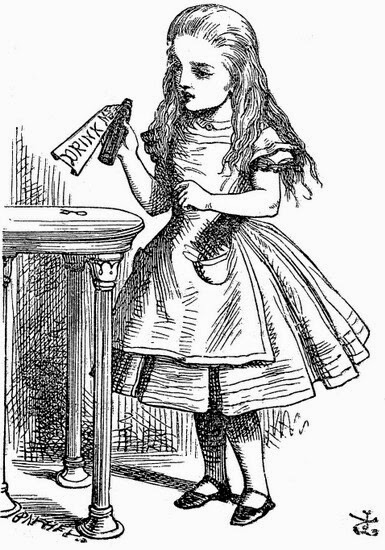
In 1850 Tenniel joined the staff of Punch magazine as principal political cartoonist, he held that post for some 50 years. His work drew the attention of Charles Dodgson (aka Lewis Carroll) who approached the artist with a request that he should illustrate a book, Alice's Adventures Under Ground. The book was published, in 1865, as Alice's Adventures in Wonderland, it contained 34 beautifully engraved line drawings, by John Tenniel, and became a classic. Tenniel later provided illustrations for Through the Looking-Glass(1872).

John Tenniel's work as cartoonist was always his natural preference, though his fame to this day, some 145 years later, stems from his "Alice" book illustrations. The reason being, I guess, that his political cartoons were "of that moment", and soon lost much of their relevance. They remain interesting, as pieces of history, though.

John Tenniel died on 25 February 1914.

A few examples of his cartoons, along with some of his best known illustrations.

In an arena formed of cotton bales, President Lincoln (still shown as clean-shaven) and the newly-elected President of the Confederate States, Jefferson Davis, square off as gladiators before an audience comprised of black slaves, one of whom sits in imperial state [cf. April 29, 1865]. The caption’s reference to “Emperor Caesar” may be ironically intended, as Caesar was a popular slave name.

The two combatants are armed with Bowie knives rather than the Roman gladius short swords. Each also has a pistol tucked into his belt, reflecting European perceptions about American violence and lawlessness (in many countries it was illegal for ordinary citizens to carry firearms). Lincoln holds a shield emblazoned with a representation of the national flag of the United States, while Davis’ shield bears the “Stars and Bars” flag. (See HERE)

  Widespread sympathy was felt in Britain for the grief  of the United States after Lincoln's assassination

 Father Neptune: Look here, my lass! You used to "Rule the Waves" but if you mis-rule 'em, as you've done lately, by jingo there'll be a row!!!
Britannia I'm sure I don't know who's to blame Papa dear!
Father Neptune: Don't know !!!  Then pipe all hands and find out!!!


ASTROLOGY

Born in London on 28 February 1820. No time of birth available, chart set for 12 noon.


Sir John Tenniel had a natal Pisces/Aries blend - not as easy-going a blend as Pisces/Aquarius I'd have thought. Creative dreamer blended with enthusiastic initiator. His Aries bits must have felt like a regular alarm bell constantly waking him from dreaminess. In his early years he did train, under his father's tuition, in a variety of athletic activities - this relates well to the Aries flavour in his chart. I haven't read much about the kind of man he was - or was perceived to be. From his artwork we have to assume he had a continuing sharp interest in political matters, and put this to use via his undeniable talent for drawing. His "Alice" book illustrations, though they brought him fame, were not really what he was about. Cartooning and politics seem to have been his first loves.

Sun, Mercury and Jupiter lay in Pisces, sign ruled by Neptune, and reflect his creativity, whether via his drawings of Alice's adventures, or illustrating the vagaries of political life in 19th century Britain and elsewhere.

Natal Saturn (law, authorities etc.) at 0 Aries, degree known as The Aries Point, a powerful degree, might offer a clue to his keen interest in political matters and interpretation of them in satirical fashion. Neptune conjunct Uranus on the Capricorn/Sagittarius cusp, though in itself a generational aspect, because the conjunction lay in helpful sextile to Tenniel's natal Jupiter, which conjoined his Sun/Mercury, adds a touch of the unexpected (Uranus) to this artist's creative (Neptune) gifts.

Without a time of birth Moon's exact position isn't known, other than that it would have been in Leo or Virgo as he was born. I don't have a reasonable guess to offer!

Thursday, February 26, 2015

Mysterious movie turned out to be subtle but sneaky propaganda.

We chose, at random, the other night, to watch Doonby, a 2011 independently produced film available via Netflix. From the very brief outline of its theme it sounded to be a wee bit mysterious, and unlikely to be filled with the slam-bang element we both dislike.

If anyone is likely to want to watch Doonby, do stop reading this now, because spoilers will follow.


The film's theme is focused on a drifter, a guy probably in his late thirties or early forties (played by John Schneider, best known for his role in Dukes of Hazzard). He arrives in a small town in Texas, looks for work and finds it in the local bar. As the story unfolds the drifter, Doonby, becomes a popular member of the local community, manages to save the day on a few occasions when calamity or tragedy could well have been the result had he not been present. He displays a fine talent for guitar playing and blues singing, which adds to his popularity - and a wee bit of jealously from certain quarters. He falls in love with the town's wealthiest guy's daughter who is, what's commonly termed in these parts, "a piece of work".

An air of mystery hangs around Doonby. His background is vague, misty. Flashbacks to his childhood are interspersed showing him as son of a single mother, whom he adored, even though she left him to an orphanage so's she could run away with her lover.

A turning point in the building mysterious atmosphere of the film comes as Doonby meets his girl friend's father, a doctor, for the first time. Doonby reels away in horror from the guy, for no apparent reason - very strange, and seemingly out of character.

Okay, I'll cut to the chase now.

All those flashbacks depicting his mother, ending in her leaving him to an orphanage while she ran off, they dissolve. In their place, more than halfway through the film, we see a different flashback of an alternative past (or not) for Doonby. His mother, a pregnant teenager who has a chance to run off with a guy who will not countenance a child as part of their lives, seeks and finds a doctor to perform an abortion. Guess who that young doctor was ? He's now the father of Doonby's girlfriend!

Is the mist clearing? It did for me at the moment Doonby's girlfriend fell out of love with him and repeated again and again in answer his plea "What do you want me to be?"

"I don't want you to be. I don't want you to be.
I. don't. want. you. to. be", she screamed.

The penny dropped.

Doonby magically disappeared, the room where the couple had been conversing changed back to an empty dirty old barn (it had been painted, furnished and made homey by Doonby ). The child Doonby had saved from being killed was dead. The bar he had brought to life with his good humour and his playing and singing was now empty, the staff miserable, the bar's owner, an old blues singer was dead because Doonby had not been there to save him from a bullet.

Get it?

The film was little more than propaganda for the pro-life people. It was clever - sneaky, though. Only thing... what if Doonby (anagram of Nobody) had turned out to be a serial killer, or a dirty brutal cop, or Dick Cheney, or an abusive husband? The idea the film peddles doesn't hold up to scrutiny.

Note: I'm not pro-abortion, but I'm also not pro- anyone telling or even suggesting to other people what they should do with their bodies and their lives. It's nobody's business but those few directly involved in any decision.