Thursday, August 10, 2017

North Korea; Rex Tillerson, Secretary of State, & Astrology.

Angry words have been flying hither and thither on the North Korea issue. Should we worry? This from the BBC website yesterday is only vaguely reassuring, bearing in mind that a solar eclipse, mentioned in Tuesday's post, will occur on 21 August, and will, unusually, be visible across the USA, and has links to President Trump's natal chart.

North Korea-US tensions: How worried should you be?

For further reading (if any passing reader has the stomach for it) I'd recommend the posts dated 8th and 9th August, (Is the Korean war scare real? and Reviewing the Unthinkable) at a blog called Sic Semper Tyrannis, written by a retired military colonel:
Colonel W. Patrick Lang is a retired senior officer of U.S. Military Intelligence and U.S. Army Special Forces (The Green Berets). He served in the Department of Defense both as a serving officer and then as a member of the Defense Senior Executive Service for many years.

I'm re-posting, here, my February blog about Secretary of State, Rex Tillerson. He was briefly in the news this week, commenting on the North Korea situation. I decided to do a re-post after using Google search to find out if and where my February post had landed, after being mangled and spat out by that mysterious Google algorithm. I searched "Rex Tillerson, astrology". It didn't show up at all on first try, in the 14 or so pages, but when I clicked on the link available the end of the last page, it led to a fuller list including posts omitted as being "similar" to those listed; my old post then came up on page 2. Perhaps because my post received too few hits and no comments it didn't warrant initial inclusion - but how the heck are readers ever going to find the post if it's not there?

Anyway, this seems like a reasonable time to re-post it - here it is again:


A look at the natal chart of the USA's new Secretary of State: Rex Tillerson, noting a few pointers from online sources as to the kind of guy he is, as perceived by those who know him.

Two key factors routinely mentioned by commentators are Tillerson's long career in ExxonMobil - at retirement at the end of last year he was the company's CEO; and that, via his Exxon career, he has crafted close ties with Russia's President Putin. Neither factor is seen as being beneficial by many Democrats. He does consider that climate change is real - that's an improvement on the ideas of some of his colleagues in President Trump's cabinet. However, he qualifies his belief: “The increase in greenhouse gas in the atmosphere is having an effect. Our ability to predict that effect is very limited,” he answered to a question posed in his confirmation hearing.

What little I've gleaned about Secretary Tillerson's personality from a handful of articles online tells of a man who quietly projects power, discipline and control (NPR). Those who know Tillerson consistently describe a disciplined and effective communicator with an engineer’s logical approach to solving problems and the ethical compass of a Boy Scout. “What you see is what you get,” said John Stuart, a longtime Dallas banking executive who has known Tillerson for a decade. “He’s a straightforward, honest, honorable person.”

Tillerson is an Eagle Scout himself, and a longtime booster and national leader of the Boy Scouts organisation. He helped to engineer a recent change allowing gays to join the Boy Scouts.

From Dallas News:
SNIPS
More than 40 years after Rynd and Tillerson met, the memories that stand out for Rynd surrounding his former housemate revolve around one central concept: work. The Tejas Club was an old house that needed many repairs, and Tillerson would organize the projects, then complete them.

“He wasn’t just a delegator. This sounds corny, but he led by example. There was no project that was beneath him or too hard for him,” Rynd said. “He was busy -- if not busier than the rest of us. ... If it needed to be done, Rex signed up and got it done.”

Tillerson graduated in 1975 and weighed a higher-paying offer at a steel company. But in Exxon, he found a company whose highly regimented approach mirrored his own.

“It’s very demanding and competitive,” said Coll, the author. “It’s a very rule-driven institution. But it also requires something on the dealmaking side, a little bit of a sense of subtlety and resilience because most of these places where they work, these things don’t come easily.”

Tillerson worked for Exxon’s upstream division -- the rough-and-tumble business of exploring and developing new resources. His early days found him in East Texas, a time he later described as “sheer joy” in solving complex problems out on the oilfield.

He steadily rose through the ranks and by the 1990s, he landed career-defining assignments in places like Yemen and post-collapse Russia.

Well....in theory that all sounds like good news! Does his natal chart reflect the above?

Born on 23 March 1952 in Wichita Falls, Texas. No time of birth known, chart is set for 12 noon.
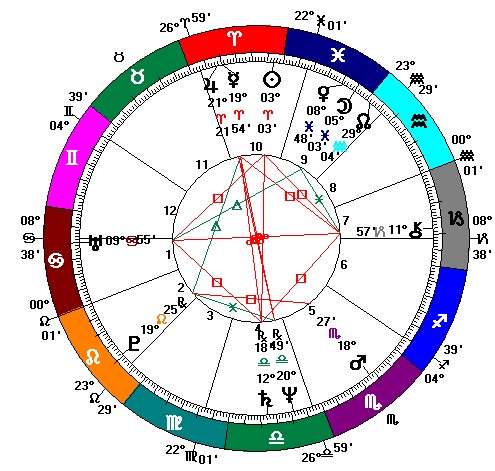


Without knowing his time of birth only a sketchy outline is possible, Moon's exact position and rising sign cannot be established. First thing I noticed - no planets in Earth signs, I found that surprising. The unknown rising sign might provide an Earthy footing.

His lifetime career closely connected to oil is nicely represented by Saturn and Neptune close together, close enough to be termed conjunct, in Libra. Saturn links to career, Neptune links (among other things) to oil.

His natal Sun, Mercury and Jupiter are all in Aries, sign known as the initiator, with the Saturn/Neptune conjunction opposite, providing a balancing, steadying factor to any native Aries impulsiveness. Mercury conjunct Jupiter in Aries reflects the important part international travel (Jupiter) has always played in his career, and will continue to do so as Secretary of State.

I see that, in his natal chart, there are two challenging square aspects to Uranus, planet of the unexpected and eccentricity - in Secretary Tillerson's case this is no bad thing. We have quite enough eccentricity and unexpectedness emanating from President Trump - we need no more, and especially not from the Secretary of State! It's interesting, though, to note that transiting Uranus, at 21 Aries, is currently conjunct Tillerson's natal Mercury/Jupiter. Change is, indeed, visiting his life, both planet-wise and in reality!

At 12 noon on Secretary Tillerson's date of birth Moon was at 5 Pisces; for natal Moon to have been in Aquarius his time of birth would need to have been in the very early hours - not a lot later than 1 AM; it seems most likely that natal Moon was in early Pisces, reflecting a more gentle and imaginative inner-self than his dynamic Aries core-self.

Due to comments on his personality quoted above, I'd bet on a solid Earthy rising sign (Capricorn, Virgo or Taurus), alternatively Saturn in Libra sitting on the ascendant with Neptune close by.

Wednesday, August 09, 2017

Facing F-Book

"The inexorable growth of Google, Facebook, and Amazon has raised fears these giants are becoming too powerful. Here's everything you need to know":

THE NEW MONOPOLIES

The piece is reasonably brief yet informative on issues which are only recently starting to be addressed.

With reference to just one of the three entities discussed in the piece linked above, Facebook, and its burgeoning power, this problem has more, and even more dangerous, tentacles than simply making outside competition difficult or impossible. Below is a single paragraph from another piece, long but well worth the time:
You Are the Product by John Lanchester at London Review of Books.
(My highlighting)
....What this means is that even more than it is in the advertising business, Facebook is in the surveillance business. Facebook, in fact, is the biggest surveillance-based enterprise in the history of mankind. It knows far, far more about you than the most intrusive government has ever known about its citizens. It’s amazing that people haven’t really understood this about the company. I’ve spent time thinking about Facebook, and the thing I keep coming back to is that its users don’t realise what it is the company does. What Facebook does is watch you, and then use what it knows about you and your behaviour to sell ads. I’m not sure there has ever been a more complete disconnect between what a company says it does – ‘connect’, ‘build communities’ – and the commercial reality. Note that the company’s knowledge about its users isn’t used merely to target ads but to shape the flow of news to them. Since there is so much content posted on the site, the algorithms used to filter and direct that content are the thing that determines what you see: people think their news feed is largely to do with their friends and interests, and it sort of is, with the crucial proviso that it is their friends and interests as mediated by the commercial interests of Facebook. Your eyes are directed towards the place where they are most valuable for Facebook.
That highlighted phrase is, or should be, chilling. It doesn't take much imagination to understand what could be possible, stemming from it, at some time in the near future. It's also not too comforting to read that Facebook's creator, Mark Zuckerberg has further aspirations - of becoming US President, there's some evidence that he is considering becoming a candidate in 2020's presidential campaign.

Tuesday, August 08, 2017

Temporary Darkness

There was a lunar eclipse yesterday, at around 15 Aquarius. A more interesting eclipse, solar, will occur on 21 August, at around 29 Leo, and will be visible across the USA - something that doesn't often happen. What makes the 21 August eclipse interesting is that it "hits" the position of Regulus, the "Royal Star" on President Donald Trump's Leo ascendant. Astrologers are quite clear that they are expecting...well...something; if not immediately then within coming months; some say perhaps as long as a couple of years hence. That latter prediction seems a bit of a cop out though. Anyone, without benefit of astrology, could confidently foresee that something of importance affecting President Trump will happen between now and mid-2019. Heck, the way things have been trending, something happens affecting the Prez in each 24-hour period! He himself sees to that!

This piece is a good read, it's by by Max Kuttner (not an astrologer, but he quotes several):

The Solar Eclipse Could Mean Disaster for Trump, According to Astrologers


I'm not generally a fan of astrological predictions based on eclipses, they seldom bear as much fruit as expected. I suspect astrologers try to be too precise - looking for trees instead of forest, but even so, I'll be watching to discover if this particular eclipse, on 21st, with its specific features seeming to relate to the USA, and to President Trump, provides some kind of evidence - maybe it'll change my mind! We're already plodding through a pretty deep forest, politics-wise, perhaps once the eclipse has passed lighter days will emerge. Oh dear - was that my inner Pollyanna peeping out? Maybe so. There's a poem titled "Eclipse" by Azubuogu chinwendu chukwudi (HERE), and it begins with a similar thought:
The eclipse does not become endless night
The reappearance of light is the same as the survival of soul
The eclipse
Such indeed a character of the historic hour through which
the world was passing

Monday, August 07, 2017

Music Monday ~ Nimrod : Word, Music, Why We Cry

Nimrod, the classical piece, part of Elgar's Enigma Variations, used in countless movies, most recently in the final scenes of Christopher Nolan's Dunkirk, raising lumps in many throats. The piece is also played every year on Remembrance Sunday at the London Cenotaph, and is often heard during funeral services.

Who or what is, or was, Nimrod?

Once upon an Old Testament Time Nimrod was a mighty hunter, leader, founder of the city and tower of Babel and, rebel "against the Lord". He was son of Cush; grandson of Ham, and great-grandson of Noah. There's a good read about him, written by Shaul Wolf in a lighthearted style: The Life and Times of Nimrod the Biblical Hunter. I've mentioned Nimrod myself in an archived post about Sir Edward Elgar HERE.


In more recent times the name Nimrod has been given to ships and a fighter plane; but has also, overtime
gathered moss and become somewhat less "mighty". In modern American English the term nimrod has come to be used to describe a dimwit or stupid person, thanks in great part to cartoon character Bugs Bunny. Bugs ironically refers to hunter Elmer Fudd as "nimrod", as being an incompetent hunter (I guess!) Personally I have never heard the term used in this way exactly....except, perhaps, that a very dear one of mine, now long gone, did occasionally, and I should add affectionately, call me "Nimrod" as a nickname. I was unaware, at the time, of the name's origins and - I'm guessing - so was he!


Back to Nimrod the music. It's a piece that evokes emotion, not only because of the circumstances of its use, but due to something within the form of the music itself. I found partial explanation on the internet via "Guardian Answers". I hope I'm not overstepping fair use regarding copyright rules by including here two answers, from newspaper readers, to the question: Why do some tunes, like Nimrod from Elgar's Enigma Variations, make you want to cry?

SOME music arouses sad or happy emotions because of past events that we associate with it (the 'Listen, darling, they're playing our tune' syndrome) but this doesn't account for the fact that some tunes seem to have the power to affect different individuals' emotions in an apparently similar way, even when the people concerned have no shared history of experience to account for this reaction. Music scholars and philosophers have long disputed whether or not music actually 'means' anything, and if so, what. The late Deryck Cooke comes closest, in my view, to explaining this contentious area of musical aesthetics. In his book, The Language of Music (OUP, 1959), Cooke suggests that all composers of tonal music from the Middle Ages to the mid-20th century have used the same 'language' of melodic phrases, harmonies and rhythms to evoke the same emotions in the listener. If true, this could account for the fact that Nimrod seems to communicate the same feeling of melancholy to different people. This is a hideous oversimplification of Cooke's complex theory. He argues that it should be possible to compile a dictionary of musical idioms and their corresponding 'meanings' to identify which sequences of notes convey joy, grief, innocence, erotic love, etc. (Linda Barlow, Reading, Berks.)

IT IS a very rare tune which would cause a listener to want to cry. But a harmonised piece of music can very easily do so. Music often depends for its interest on creating and resolving tension. Tension is given to a passage by, for instance, moving away from the key in which the piece started. When the 'home' key is returned to it comes with a feeling of resolution. The classical sonata form is basically an exercise in waiting for the return of the tonic key. Composers started to use devices such as a long dominant pedal (signalling that we are about to return to the home key) and then delaying the final resolution longer than expected, giving added weight to the home key when it is finally reached.

Another way of creating and resolving tension is through dissonance. Two or more notes that do not sound pleasant together are changed for some that do. The more dissonant the interval, the more it can make you physically tense up (I find my neck and shoulders tightening). And probably the simplest trick of all is like a rhetorical device much loved by Hitler - start quietly and get louder. If you're really out to milk the emotions you are more subtle and reach the loudest point about nine-tenths of the way through and subside back to peacefulness.

Nimrod uses all of these tricks. The theme itself is harmonised using dissonances (some of which resolve into further dissonance, heightening the effect); it starts quietly and gradually builds up; just before the final statement of the theme there is a long roll on a timp while the brass extend the feeling of 'here we go back to the tonic key' by waffling in the dominant, and after the loudest bit of all it recedes to a quiet conclusion. Music can also make you cry if it is crap.
(P S Lucas, Birmingham 18.)
And so...here's the version of Nimrod used in the movie Dunkirk, now doing the rounds, and which I blogged about last week HERE. The movie's full original score was composed by Hans Zimmer, who arranged Elgar's iconic piece to fit in seamlessly for the final scenes.


Friday, August 04, 2017

Arte Farte Friday, Saturday & Sundry Evidence that Commedia dell'arte Lives on in the White House!

Searching for an artist to feature for Arty Farty Friday, I noticed among early August birthdays the name of Douglas Lionel Mays. Not a household name by any means, but I decided to take a look. He was a British illustrator with a goodly collection of book covers, magazine covers and vacation posters to his name. One of the latter, showed a Punch and Judy puppet show on a British beach, and took me down one of those pesky, winding, internet roads.

 Hat-tip HERE


I don't know how well Punch and Judy shows are known in the USA, but this particular style of mobile puppet show has been part of British, and particularly English, tradition since at least the 17th century. Samuel Pepys, we are told, noted seeing such a show in Covent Garden, London, performed by the puppet showman Pietro Gimonde from Bologna, Italy. Punch and Judy, for centuries a British favourite, isn't British in origin, but Italian. The show's characters' earliest ancestors derive from commedia dell' arte, as does another British tradition: pantomime.

For anyone unfamiliar with Punch and Judy, do take a look at a couple of brief videos from THIS website.

The photograph below was taken in 2004, by my husband during the year or so he stayed with me in England, at my home on the East Yorkshire coast. We regularly walked several miles along the cliff tops outside of town. One one summer afternoon we came upon a Punch and Judy show.


Back to Punch's ancestral line: Commedia dell' arte - humorous theatrical presentations performed by professional actors who travelled in troupes throughout Italy in the 16th century, possibly even before that, for I suspected some more ancient tradition is embedded in the concept. Encyclopedia Britannica does tell of Fabula Atellana, the earliest native Italian farce, presumably rustic improvisational comedy featuring masked stock characters, known to have existed during 1st century BC.

Performances of commedia dell'arte took place on temporary stages, mostly on city streets, but occasionally even in royal court venues. Music, dance, witty dialogue, and all kinds of trickery contributed to the comic effects. Subsequently the art form spread throughout Europe, with many of its elements persisting into present-day theatre.

If any passing reader saw and can recall a movie from the 1950s, Kiss Me Kate (a version of Shakespeare's Taming of the Shrew), the group of travelling players depicted within that plot was part of commedia dell' arte.


A troupe of strolling players are we,
Not stars like L.B. Mayer's are we,
But just a simple band
Who roams about the land
Dispensing fol-de-rol frivolity.
Mere folk who give distraction are we,
No Theater Guild attraction are we,
But just a crazy group
That never ceases to troop
Around the map of little Italy.

We open in Venice,
We next play Verona,
Then on to Cremona.
Lotsa laughs in Cremona.
Our next jump is Parma,
That dopey, mopey menace,
Then Mantua, then Padua,
Then we open again, where?


How does any of that relate to Punch and Judy? Well, Punch is a character based on one of the stock characters of commedia dell' arte. Originally the name was Pulcinella, which over time became anglicised to Punch. Commedia dell' arte's stock-in-trade was a package of archetypal groups and characters, for instance: The Servants (zani), The Masters (vecchi), The Lovers (innamorati). Within those groups were individual stereotypical figures such as
Snipped from HERE
The Doctor (il Dottore, Graziano): No, (probably) not that Doctor. Often an Absent-Minded Professor type; often the father of one of the innamorati. ....A parody of the Bolognese laureate intellectual (Bologna has one of the world's oldest universities). .....
Pantalone: Often the father of the other innamorato/a. Rich and miserly.... the Dirty Old Man. Sometimes an Unsympathetic Comedy Protagonist. Based primarily on the stereotype of the rich Venetian merchant. Has a peculiar, shuffling walk, because he's always wearing Turkish sandals.
The Captain (il Capitano): Blowhard, thinks he's God's gift to women, will turn out to have Feet of Clay. Often serves as the Romantic False Lead. If the innamorato's biggest rival for the innamorata's hand isn't his own father, it's this guy. Typically a disliked foreigner, often from Spain (as Spain, the superpower of the time, held political sway over Italy). Usually has an Overly Long Name (very common in Spanish nobility). A variant is Scaramuccia.

Erm...did anyone catch that reference to Scaramuccia? Thought so! We've been there, done that though, last week. He's been and gone has our Scaramuccia!


Moving on...a piece, by Scott Parker HERE, weaves in another character we know, and do not love:


A Real Life Capitano
The spirit of Commedia is embedded in the way we critique and question society and now more than ever we need this in our contemporary theatre, film and comedy. Let me be clear, Commedia is not a protest form, it doesn’t demand, but in a grotesque way it holds the mirror up to life. Commedia stock characters persist continue to give us this reflection of real life. As far as stock characters go history repeats on an endless cycle. Today we see a Zanni in the office worker walking around our CBD. Politicians in Canberra are as bombastic as a Dottore. Pantalone emerges from Gina Rinehart and Donald Trump gives us a real life Capitano.
Trump is a boaster and braggart. He’s never wrong except when he’s wrong and then he pretends it never happened. He plasters his name on everything, tells outlandish stories that are so excessive they’re stupid. He obtains his power by worming his way into positions of influence. He likes to believe his power gives him free access to women, but they will always get the better of him. He feigns bravery and blusteringly threatens those who oppose him, but really he is a notorious coward.
I, of course, am giving you a stock character breakdown of Il Capitano, the imposter from Commedia dell’Arte but for all purposes here I describe The Donald himself. Here Commedia plays out again on a global scale.

That winding road I wandered onto at the top of the blog took me from a 20th century British illustrator's work, to a 21st century, real-life American Capitano, via English beaches and Italian theatres...quite a scenic and interesting trip!

Wednesday, August 02, 2017

Enter John F. Kelly, White House Chief of Staff

A quick look at the natal chart of President Donald Trump's new Chief of Staff, John F. Kelly, a retired 4-star General in the US Marine Corps, and had previously served as United States Secretary of Homeland Security.

The new Chief of Staff faces a somewhat shambolic White House, after a string of firings or resignations of prominent figures. The former General's new boss, whose other title is Commander in Chief, has not always portrayed his own best side (if he does, in fact, have a best side). President Trump does appear to respect Generals though, so perhaps that offers a gleam of hope for calmer days ahead.

I know nothing of Secretary Kelly's reputation, or his personality, save what little I've read about him, and what might be revealed by his natal chart. Adjectives I've encountered in descriptions of the retired General include "firm but benevolent", and "solid". His natal chart does indicate those attributes. Sun and Mercury in steadfast, stoic but stubborn Taurus, with Mars (planet of energy and aggression) in harmonious trine to his natal Sun, from meticulous, critical Virgo; Saturn, planet of discipline and framework is also in Virgo. I think Kelly definitely has the skill set needed for the tricky job he has been handed.


Without a time of birth Moon's position can't be pinpointed exactly. At noon Moon was at 21 Pisces - if J.F. Kelly were born very, very late in the day I guess Moon could have been close to the Pisces/Aries cusp; otherwise it would have been somewhere in mid-Pisces. Jupiter, anyway, is in early Pisces (conjunct my own natal Jupiter as it happens - but that signifies nothing at all). If Kelly's Moon were to be natally in Pisces, along with Jupiter, that would signify a softer more emotional or philosophical side to his nature, as contrast to his practical, no-nonsense Earthy side from Sun, Mercury and Mars. His natal Venus in Aries adds a touch of astrological Fire to the mix. I'd say this dose of Aries underlines, in a slightly different tone, due to Aries' naturally straightforward attitudes, Kelly's no-nonsense, no "ass-licking", potentially blunt, but potentially fair approach indicated by Taurus/Virgo. At least, that's what most lookers-on will be hoping for!

Kelly's rising sign remains unknown without a time of birth. Guessing, in this case isn't easy, but considering the greater part of his adult life has been spent in the military, perhaps Mars close to the ascendant - which would give Virgo rising. Not willing to bet on that!

President Trump and his Chief of Staff are in no way alike - that's needless to say, for even without benefit of astrology it has to be obvious. It'll take all the former General's skills and tactics, honed in war, to bring order out of 2017's White House chaos, without risking being one of the next group of those being shown the door.

Tuesday, August 01, 2017

Dunkirk - Nolan-style

We saw the new movie directed by Christopher Nolan, Dunkirk, at the weekend. I'd wavered, and wondered, and tossed up whether or not to put ourselves through 1 hour and 47 minutes of cinematic tension and chaos which, from the couple of reviews I'd read seemed to describe what was on offer. Eventually, the chance to exchange the computer screen for a cinema screen, for a while, and to swap home air conditioning for a place even cooler (cold in fact) won the toss. We were two of just eight audience members in a late afternoon showing of the film. Movies about British war efforts are obviously not a big draw in semi-rural Oklahoma, at least not with so many super-hero tales, ape wars, and Despicable Me as alternative options.

My immediate reactions on leaving the theatre, into the car park and 90 degree heat:
"It was flippin' cold in there."
"They had turned the sound up so loud that I [English-born though I am] couldn't understand much of the dialogue."
And, my major criticism - of the movie, rather than of the surrounding discomforts was this:
The key element to the story of Dunkirk, as I have always known it, was the amazing rescue and evacuation effort, a major part of which was carried out by small vessels, fishing boats, yachts, pleasure boats, ferry-type craft, manned by non-military people who sailed into those very dangerous waters. Yes I know this is, obviously, part of the film's story - it has to be. However, the movie's rather "arthouse" arty farty Nolan feel features what I suppose are simply representative examples of the story's components, told in an interwoven, three-strand style, to show how the rescue played out on land, in the air, and by sea. I found that the scale of the soldiers' plight was much better represented than the scale of the small boat-aided rescue. The "sea" segment of the film concentrated on just one small boat and its crew, and those it rescued (on just a single trip). We see just one screen shot of the veritable armada of small boats and ships approaching the beach - from a great distance; later a shot of just a few small boats arriving is included - an almost throw-away shot at that! I came away with the feeling that when the film is seen by those who do not know the full story of Dunkirk - most of the generations much younger than me, and quite a few from all generations in the USA - that they could come away from the film with an unbalanced idea of exactly what went on.

There's plenty of information on the internet as to exact statistics, and detail of the events of the Dunkirk evacuation, what led up to it, and what came after. I shall not repeat such detail here, except to copy this paragraph from Wikipedia's page:
On the first day of the evacuation, only 7,669 men were evacuated, but by the end of the eighth day, 338,226 soldiers had been rescued by a hastily assembled fleet of over 800 boats. Many of the troops were able to embark from the harbour's protective mole [a kind of pier] onto 39 British destroyers of the Royal Navy and civilian merchant ships, while others had to wade out from the beaches, waiting for hours in the shoulder-deep water. Some were ferried from the beaches to the larger ships by what came to be known as the little ships of Dunkirk, a flotilla of hundreds of merchant marine boats, fishing boats, pleasure craft, yachts, and lifeboats called into service from Britain for the emergency. The B[ritish]E[xpeditionary]F[orce] lost 68,000 soldiers during the French campaign and had to abandon nearly all of its tanks, vehicles, and other equipment.

There are countless reviews of the movie online now. I read through several after seeing the film. They mostly repeat the same points, but fighting my way through multiple sliding and very annoying adverts, into the farther reaches of Google, I found what I consider to be one of the most insightful reviews of Dunkirk, it was written by "Darren" at The Movie Blog. If a passing reader has already seen the movie, or is planning to do so, I'd highly recommend a look at that review.

We were glad to have seen Dunkirk, even though it appeared to me, and to my American husband, who was aware of the events told of in Dunkirk, to be an unbalanced style of telling one of World War 2's most iconic British stories. What was shown was wonderfully atmospheric, affecting and scary, even other-worldly at times. I've read that the best way of seeing this movie is via IMAX huge screen - but our local cinema's screen was quite big enough for our taste, and even its level of sound proved too loud for our delicate ears!

POSTSCRIPT (for any interested in astrology)

Dunkirk's director, Christopher Nolan, was astrologically investigated in my post from 2012 HERE (scroll down to the post's second half).

Monday, July 31, 2017

Music Monday ~ Picking Pockets, Russia and.....who?

What do these two songs have in common, other than a passing relevance to, erm...well, current news stories - need I say more?

From Russia With Love


Gotta Pick a Pocket or Two


Both were written by Lionel Bart, whose birthday would have been tomorrow,
1 August, he was born in 1930, died in 1999.

SNIPS from an obituary, by Tom Vallance, in The Independent:
The piece begins:
IF HE had written only Oliver!, the composer Lionel Bart would have earned an honoured place in the history of British musicals, but he was far from a one-show wonder. His other work included shows such as Fings Ain't Wot They Used T'Be and Maggie May, plus many pop songs including "Living Doll" (Cliff Richard's first No 1 hit), Tommy Steele's "A Handful of Songs", Anthony Newley's "Do You Mind?" and Matt Monro's "From Russia With Love".

He epitomised the start of the Sixties in Britain, which he uniquely captured in song and spirit, and he was one of the few composers to deal uncondescendingly with the working classes, transposing their life styles and vernacular to the musical stage. "Nobody tries to be la-de-da or uppity, there's a cuppa tea for all," sings the Artful Dodger to Oliver, while Fings Ain't Wot They Used T'Be remains a time capsule of a world in which folk talked of their "birds" amd their "manor" and dreamed of being able to afford furniture that was "contempery"......
 Lionel Bart with John Lennon

Bart also epitomised the Sixties in a less happy way - like many who flourished in that era he was seduced by sudden success into a world of drink, drugs and hedonism, squandering his money and his youth.

Bart was one of the 11 children of an East End tailor. He was born Lionel Begleiter, in 1930, and he had no formal musical training. He displayed a flair for drawing, however, which brought him at the age of 16 a scholarship to the St Martin's School of Art in London....He worked in a silk-screen printing works and commercial art studios before an attraction to the theatre brought him work at the left-wing Unity Theatre, where he worked as a set painter. He started writing songs in response to a sign asking for musical material for one of the theatre's productions. Unable to write music, he would tap out the melody with one finger and someone else would orchestrate it.

The rest of the obituary is an interesting tour through Bart's career, ending with:

Of all the people I know in this business who have had ups and downs, Lionel is the least bitter man I have ever come across. He regrets it but, considering that everyone else has made millions out of his creations, he's never been sour, never been vindictive.

Andrew Lloyd Webber said, "Lionel's genius has in my view never been fully recognised by the British establishment. The loss to British musical theatre caused by his untimely death is incalculable."

Lionel Begleiter (Lionel Bart), composer, lyricist and playwright: born London 1 August 1930; died London 3 April 1999.

Friday, July 28, 2017

A Serving of Friday, Saturday & Sundries

A couple of slivers of arty-farty:


Meet painter Pollyanna Pickering, an internationally renowned wildlife artist and environmentalist. Her birthday is this weekend, she was born on 30 July in 1942.


And (with Hat-tip to Avedon's Sideshow)
If Norman Rockwell painted African-American culture today. -
By Jake Johnson [9 pictures by Sam Spratt]


A pouring of politics:


Jon Walker has written about an interesting plan to rectify US's failing health insurance system:
Here’s A National Single-Payer Health Care Plan That Would Work.


A soupçon of astrology:


Back in 2008, just for fun, I Just for fun, I coined twelve collective nouns (you know, similar to "a murder of crows", "an exaltation of larks"), for each zodiac sign, for possible descriptive use in a natal chart where a cluster of planets appear in one zodiac sign, alternatively, for those attached to Sun sign astrology, to describe a group of people who share the same Sun sign.

A rush of Aries
An affluence of Taurus
A chatter of Gemini
A nest of Cancer
A parade of Leo
A proficiency of Virgo
An arbitration of Libra
A collusion of Scorpio
A magnification of Sagittarius
An institution of Capricorn
A metamorphosis of Aquarius (I did write that in 2008, but now prefer An innovation of Aquarius)
A mirage of Pisces

And to pull together the whole caboodle:
A cadence of zodiac signs!


A whiff of words: at The Bureau of Linguistical Reality


A trickle of TV:
We've lately been watching the 10-part series Ozark, starring Jason Bateman (who also co-directs), and Laura Linney, plus a cast of interesting character actors.

Most reviewers compare Ozark to Breaking Bad, I can see why, but for me it felt more akin to Justified, due to its rural, mid-America, background location with lots of attendant quirkiness as well as criminality in local residents. Bateman plays Marty Byrde a cool-headed wheeler-dealer financier from Chicago who, with his early-on murdered partner, had been laundering (and skimming) drug money through their business. He escapes, with his family, to an area of Missouri around Lake of the Ozarks, in the hope that supposedly less-sophisticated (in the ways of finance) locals with be easy to entangle in the money laundering lark away from the FBI's gaze. The laundering must carry on, in order to protect Byrde's own life and those of his (cheating) wife and two (fairly obnixious) teen-ish offspring. He'd thought Ozark locals were going to be unsophisticated in the ways of crime - he had some fast lessons to learn. Some locals could give him a run for his money - quite literally too!

While Ozarks isn't quite up to Breaking Bad or Justified standards, all in all it's not bad, and better than many other offerings available at present. The series could have used a wee bit of lightness to contrast so much darkness, the odd joke or touch of wit, a one-liner or two would have helped anchor the tale in viewers' memories.


The dish garnished with ~

A pinch or two of Pratchett
Most of the great triumphs and tragedies of history are caused not by people being fundamentally good or fundamentally evil, but by people being fundamentally people.


Some humans would do anything to see if it was possible to do it. If you put a large switch in some cave somewhere, with a sign on it saying 'End-of-the-World Switch. PLEASE DO NOT TOUCH', the paint wouldn't even have time to dry.
~ Sir Terry Pratchett.

Wednesday, July 26, 2017

Mid-week Movie ~ Desierto and Jeffrey Dean Morgan

Around a couple of weeks ago (HERE) I was scribbling about allegory and mentioning how it is often used in movies - sometimes without simple-minds like mine being aware of that intention, until prompted. I, all unknowingly, happened upon this circumstance again last week. As a change from undiluted Netflix we decided to rent a handful of DVDs from our local video store. One of these, chosen purely due to its leading man, Jeffrey Dean Morgan, turned out to have been ...yep...an allegory.

We first came across Jeffrey Dean Morgan (hereafter referred to as JDM) in his part in the later seasons of The Good Wife when he joined the cast to play an investigator, and a new love interest for leading lady Julianna Margulies. Very engaging, thought I! He'll go far! He has, but in what I consider the wrong direction - but then, I'm old, what do I know?

I backtracked in JDM's career and found on Netflix (or maybe Amazon?) a series in which he had played the lead in 2012/3: Magic City. We watched both seasons of that - not bad! He was sans beard back then, and a tad heavier I think. I also read that he had a minor part in Grey's Anatomy (season 9) but so far we've not caught that one, not being big fans of hospital series. However, though JDM has said, in interview, that he could probably have spent his career playing romantic-comedy-type roles, when he was offered a change he gladly took the opportunity to widen his range. He has now played, and quite unromantically I guess, The Comedian in Watchmen and Negan in The Walking Dead. In Desierto, the movie I began to write about earlier, before falling down the JDM rabbit hole, JDM is the arch-villain.

I wasn't expecting to actually enjoy Desierto or admire the character JDM depicted, but decided I ought to sample this one to catch up with the arc of his career, as my stomach would probably not take kindly to either Watchmen or The Walking Dead.

In a nutshell, and basically that's what the theme of Desierto amounts to - a nutshell's worth of plot, with a very nasty nut in the lead! "Sam" [Uncle?] is a seriously obsessed murdering vigilate-type who lives near, or stalks around, the US/Mexico border, with a beautiful dog called Tracker, who has been cruelly trained (I blame not dogs - ever!) Tracker will, by the way, before the film ends, comply with my "Rule of Dog in Film".

David Sims' review in The Atlantic: Desierto Is a Horror Movie for the Age of Trump is a good and, for me, an enlightening read as to the film's allegorical intention. Maybe the heat is getting to me, but I hadn't connected the vigilante's name, Sam, to the US iconic avuncularity thing.

Jonas Cuarón’s film sees a racist vigilante stalking and murdering Mexican migrants as they cross the border. Sims' review begins:
The premise of Desierto is simple, and blunt. A truck full of Mexican migrants, attempting to cross the U.S. border illegally, is attacked in the desert by a lone gunman. For the next 90 minutes, the truck’s occupants are hunted by this demented figure toting a sniper rifle, a horror-movie villain who mumbles to his dog about keeping his country safe. If the metaphor seems obvious, well, it’s supposed to be — the Mexican director Jonas Cuarón has manifested a villain out of recent anti-immigrant sentiment, and is terrorizing viewers with it.

Desierto is not a good movie, but it’s an interesting pop-cultural footnote, especially given its release in the final weeks leading up to a U.S. presidential election in which Donald Trump seized the Republican nomination partly on the back of his extreme anti-immigrant rhetoric. It’s a horror movie first and foremost, although not a particularly original one.
Later in the piece:
Perhaps that’s Cuarón’s larger point — that viewers can reconcile themselves to this awful violence, especially when it’s presented in a genre format via an action thriller playing out in the landscape of a wide-open desert. But the film’s battle lines are drawn so quickly, and its point made so unsubtly, that it’s hard to go much deeper. Yes, the rhetoric of politicians like Trump, who tar Mexican immigrants as monstrous rapists and murderers, is worth investigating, and Cuarón’s obvious anger over it is both palpable and understandable.

But because of its one-note message, this film isn’t likely to change anyone’s mind about anything. Desierto succeeds in portraying the savagery of racism, but in the end, it’s completely cold.
Without at first being aware of the wider, allegorical, intention of the movie, I hated Sam anyway, which was the whole simple point of this movie. I suspect that JDM was offered the part of Sam due to the rather unromantic reputation he has been gathering from Watchmen and Walking Dead - obviously not from his yummy, and rather believable character in The Good Wife! Sadly, it seems that JDM could go the way of another of my early romantic favourites, Bruce Willis, with whom I fell in love aeons ago in Moonlighting; then fell out of love with a clatter after seeing him in his Die Hard evolution - as well as discovering that, politically, he's a Republican supporter. I don't know whether a similar fate awaits JDM, but I shall be watching for clues and evidence!

Monday, July 24, 2017

Enter Anthony Scaramucci (And Exit Scaramucci -see update below)

By now most people in the USA will have become aware of the name Anthony Scaramucci, President Trump's newest addition (at the time of writing!) to his team. Scaramucci is to be the new Communications Director for the Trump administration.

I spent some time reading around to get an idea about the kind of guy Scaramucci is - or is seen to be by those who've met him. By all accounts he's charismatic, practical and charming - and that alone makes a change! He's a smooth talker, Harvard educated wealthy financier and entrepreneur, hedge fund manager, but did come from a Long Island working class background of Italian immigrants.


With new WH  Press Secretary, Sarah  Huckabee Sanders
A few other boxes ticked in his favour: several of his political opinions do not chime with others in Trump's administration. Some of his old Tweets show that he has embraced several liberal-leaning policy stances during recent years, just as President Trump did before he committed to running as a Republican. "I am not a partisan just practical. I voted for Clinton and Obama", Scaramucci wrote on Twitter in November 2011. He has also supported gun control, gay marriage, and unlike his new boss, Scaramucci believes the climate is changing. "You can take steps to combat climate change without crippling the economy. The fact many people still believe CC is a hoax is disheartening", he wrote in March 2016, weeks after the GOP primaries started. (See Washington Examiner, HERE).

I had to chuckle at the astrology reference while reading these paragraphs from a piece by Jessica Pressler, Long on Trump

SNIP

When, to everyone’s disbelief, Donald Trump actually won the presidency and became someone to take seriously, so did Scaramucci. Since the election, Mooch’s stock has been way up: Yahoo Finance named him its “Wall Streeter of the Year,” despite the fact that his flagship fund had been performing poorly over the past two years. He has been a constant presence at Trump Tower, squiring bigwigs to meetings with the president-in-waiting. When I found him mixing a margarita for himself in an empty bar downstairs at the Hunt and Fish Club, his face still waxen with makeup after a day on TV, he told me it’s about to go even higher.

“Scaramucci, Exploring Government Post, Weighs Sale of SkyBridge,” he said triumphantly, reading a headline from Bloomberg off his iPhone. Then he launched into a sequence of stories about the first time he saw The Godfather (he was 8) and his uncle Orlando’s Perry Como impression, before returning to the subject of his new position.

“So I said to Vice-President Pence, who was here tonight,” he went on, “I said, ‘I’ll do whatever the hell you guys want.’ I know you probably think that’s, like, me being passive-aggressive,” he said to me, “but it’s not, it’s me being even-keeled. My best service to him is acting as a fair broker for the situation, because what happens in Washington is they will stab you right in the chest with a smile on their face. It’s like the Game of Thrones and the Hunger Games screenwriters got together with the writers of House of Cards and they made a story. And the other thing I have learned about these people in Washington, Nelson,” he said, turning to his partner, who had settled in at the bar, “is they have no money. So what happens when they have no fucking money is they fight about what seat they are in and what the title is. Fucking congressmen act like that. They are fucking jackasses. Do you know how many congressional liaisons we are going to have? I don’t either, but I told Pence, it should be four times whatever Obama had. I don’t know how many he had, but I’m telling you that didn’t work out. I’m telling him if you want to decrease the government, you gotta increase it in certain ways. Pence was great, right, you met him, Nelson, he was great.”

He suddenly stopped and squinted at me. “How old are you?” he asked. “You look good. No lines on your face. What are you, a Sagittarius?”

I told him I’m a Leo.

Scaramucci nodded approvingly. “Fucking king of the jungle!” he said, lifting his drink.

Which leads me neatly into Anthony Scaramucci's own natal chart - it has to be set for 12 noon as I haven't, yet, found any time of birth for him. He was born on 6 January 1964 in Long Island, NY.


He's a triple Earthy Capricorn (Sun, Mercury and Mars) - that's not at all surprising with his business and Wall Street background. His natal Venus and Saturn are next door in Aquarius, fairly close together, close enough to be termed conjunct in fact. Bear in mind here that Saturn is the traditional ruler of Aquarius, and also rules Capricorn. Therefore his Earthy Sun's ruler, in the Airy sign of Aquarius will modify, somewhat, both traditional Capricorn attributes and traditional Aquarian attributes.

Scaramucci's Moon in mid-Libra, at noon, means that whatever time he was born, Moon would have to be somewhere in charming Libra. I see this reflected in his facial characteristics - he's an attractive guy with, by all accounts, an attractive personality. I'm surprised not to find any Gemini planets in his chart, as he seems to be a good communicator (he'd better be - in this new position in the White House!) Perhaps he has either Gemini or Virgo rising.

Natal Jupiter (planet of expansion and publication) is in Aries, and in a helpful sextile aspect to Venus in Aquarius; interestingly these two sextiled planets also link by 150 degree aspects (quincunx) to conjoined generational outer planets Uranus and Pluto in Virgo. Bearing in mind that Uranus is modern ruler of Aquarius, the usual scratchiness of the quincunx, with Venus, could be somewhat softened by this sextile with Jupiter. I'm not sure, though, exactly what to make of this Yod formation, with its apex at Pluto/Uranus in Virgo. The Uranus/Pluto conjunction was signature of many of the born-in 1960s generation.

I'm guardedly optimistic about President Trump's latest addition to his team. It will be interesting to watch Mr Scaramucci's progress, or lack of same. I've read that both Steve Bannon and Reince Priebus were against his appointment - and Sean Spicer appeared to resign because of it. Perhaps their reasons were related to a dislike of the socially liberal attitudes Scaramucci has hinted - or maybe they are simply jealous of his good looks and charisma!


Hey - but it's Music Monday!

I forgot to mention, above, that Anthony Scaramucci's nickname among his friends is "The Mooch" - there's a jazz number with the same name (+ an "e"):

The Mooche - Duke Ellington


*****************************************************************

UPDATE 31 July 2017

EXIT Scaramucci!


Well, well, well...that didn't last long! I'm quite disappointed.

From Variety.com (and we certainly are seeing plenty of variety!)

President Donald Trump is removing Anthony Scaramucci as communications director, just 11 days after he was announced for the job.

“Anthony Scaramucci will be leaving his role as White House Communications Director,” said White House Press Secretary Sarah Huckabee Sanders. “Mr. Scaramucci felt it was best to give Chief of Staff John Kelly a clean slate and the ability to build his own team. We wish him all the best.”
Scaramucci was under fire after the New Yorker published an expletive-filled conversation he had with one of its writers, Ryan Lizza.

Sanders told reporters that Trump felt that Scaramucci’s comments were “inappropriate.” She said that Trump did not want to “burden” Kelly with a communications director who reported to the president, not the chief of staff.

Scaramucci was not scheduled to officially begin his job until Aug. 15.


Saturday, July 22, 2017

Taking the 5th (House, that is!)

 Leo by Ronald Searle
The Sun is about to leave zodiac sign Cancer and begin its transit through the sign of Leo. Leo is associated with astrology's 5th house. 5th house represents, among other things, childhood and child-like activity.

We all, no matter how sophisticated or knowledgeable, retain remnants of childhood/child-like fantasies within our nature. As this summer progresses and nothing at all in current news cycles has much ability to improve a dismal mood, it might be wise to simply "5th-house-it", at least for a short interval, before heading back into the gloom.

Authors of books intended for children often had timeless wise advice to offer, for us all, whatever stage of maturity we have or haven't reached. The following wee snippets always cheer me during times of worry, and wondering about what could possibly come next:


Think (laterally) about A.A. Milne's Winnie the Pooh ~~~


'Supposing a tree fell down, Pooh, when we were underneath it?'
'Supposing it didn't,' said Pooh.
After careful thought Piglet was comforted by this.


It's snowing still," said Eeyore gloomily.
"So it is."
"And freezing."
"Is it?"
"Yes," said Eeyore. "However," he said, brightening up a little, "we haven't had an earthquake lately."


The old gray donkey, Eeyore stood by himself in a thistly corner of the Forest, his front feet well apart, his head on one side, and thought about things. Sometimes he thought sadly to himself, "Why?" and sometimes he thought, "Wherefore?" and sometimes he thought, "Inasmuch as which?" and sometimes he didn't quite know what he was thinking about.


Then think about the Sesame Street story:

There's a Monster at the End of This Book by Jon Stone


Grover is horrified to learn that there is a monster at the end of the book, and begs the reader not to finish the book, so as to avoid the monster.
Fearful of reaching the end of the book, Grover constructs a series of obstacles, such as attempting to tie pages together and laying brick walls, to prevent the reader from advancing. Increasingly frightened (and also in awe of the reader's strength at overcoming the obstacles), Grover pleads with the reader to stop reading as the book nears its conclusion. However, the monster turns out to be Grover himself, making the story self-referential.


OR: the Harry Potter tales~~~


"Happiness can be found even in the darkest times if one only remembers to turn on the light." - Albus Dumbledore.


HOWEVER...

If You Give a Moose a Muffin, by Laura Joffe Numeroff ~~~

If a big hungry moose comes to visit, you might give him a muffin to make him feel at home. If you give him a muffin, he'll want some jam to go with it. When he's eaten all your muffins, he'll want to go to the store to get some more muffin mix.

Hmmmm.....yeah!


But, it's always good to remember that:


Friday, July 21, 2017

Arty Farty Friday ~ From Hopper House to McMansions to Rapunzel & Pringles

The Sun will soon leave zodiac sign Cancer, for this year, but before it does I notice there'll be an important American painter's birthday anniversary tomorrow, that of Edward Hopper. I've blogged about this artist on three past occasions: HERE, HERE and HERE, between 2007 and 2013. Today I'm drawing attention, again, to just one of his works:

The House by the Railroad (1925)


Edward Hirsch wrote a poem about that painting, it begins:

The House by the Railroad

Out here in the exact middle of the day,
This strange, gawky house has the expression
Of someone being stared at, someone holding
His breath underwater, hushed and expectant;

This house is ashamed of itself, ashamed
Of its fantastic mansard rooftop
And its pseudo-Gothic porch, ashamed
of its shoulders and large, awkward hands......

Full poem can be read HERE

It ends:

...This man will paint other abandoned mansions,
And faded cafeteria windows, and poorly lettered
Storefronts on the edges of small towns.
Always they will have this same expression,

The utterly naked look of someone
Being stared at, someone American and gawky.
Someone who is about to be left alone
Again, and can no longer stand it.


I was reminded of this particular Hopper painting after spending much time nodding and chuckling though a website/blog McMansion Hell. There's a section devoted to the 50 States of McMansion Hell, where the author, Kate Wagner, has begun taking readers through the architectural horrors and decor mis-demeanors of high-priced modern mansions in each US state. There are also sections devoted to architecture, McMansions 101, history, as well as some of general arty-farty type interest. A visit is highly recommended. From the home page, to access heading links to all the good stuff available, just click on the three little lines in the very top left-hand corner of the screen.

Edward Hopper's House by the Railroad wasn't, of course, a McMansion, but many of today's over-priced, piles, filled with pretensions to opulence and historical relevance do owe a lot to similar styles from decades past - it's just that they their designers didn't know when to stop - or where!

I've wondered if, in decades long past, builders used a common catalogue of styles available as "sets" - a bit like a Lego set. The customer would pick one from the "menu" and could also order from a list of "sides" - as happens in restaurants. Perhaps the same things happen today, in the case of McMansions, but menus now have a wider variety of sides, and McMansion customers have bigger appetites and fatter wallets.
 "Rapunzel Towers"

 McMansion "Pringle Can of Shame"
As we drive around, just through some of our neighbouring "fly-over" states, we often spy much older houses, either left unoccupied, or currently owned by people of fairly modest means, sporting what we've come to call "Rapunzel Towers"; Ms Wagner calls these "Pringles Cans of Shame". Kansans, especially, during past decades, seem to have had a liking for this "side" of architectural kitsch.

Thursday, July 20, 2017

Doggedly Plodding through the...

Dog Days. The Old Farmer's Almanac, a venerated publication first on the streets of the USA in 1792, tells that we in the Northern hemisphere are currently experiencing "the dog days" of summer - summer's hottest, most sultry days, spanning dates between mid to late July and mid to late August, depending on source, but generally around a 40-day span. Whichever dates are involved there's a link to the heliacal (at sunrise) rising of Sirius, known as the the Dog Star from its Latin name, Canis (=dog) Major.

Movements of the star Sirius have been noted by inhabitants of planet earth from as long ago as records exist - and probably long before. Sirius is a binary star system composed of Sirius A and Sirius B; there's supposition of a third star involved, but no proof of this. Sirius shines brightest of all bodies in the night sky. In case of difficulty pinpointing Sirius just look for the three stars in a row, forming Orion's belt, extend the line southeastward - there it is.

For some lucky people the dog days of summer are welcome - like a friendly cuddly puppy, eager to be taken for walks. For others (we in south-west Oklahoma included) the dog days come on, often in triple digits, more like a snarling, angry guard dog, ready to adversely affect any who dare cross the line. But, as Jonathan Swift once wrote/said:
"Every dog must have his day."