Showing posts with label Gemini. Show all posts

Wednesday, September 05, 2018

Investigating Mercury, Ruler of Virgo and Gemini.

To write his book, titled simply Astrology, Irish poet and playwright Louis MacNeice must have spent many hours of painstaking research, as befits his own natal Virgo Sun/Mercury/Venus. He cites much material from ancient sources which can serve, in many cases, to clarify how we got to where we are in interpreting the planets and signs. For me, this is part of the fascination of astrology. The Kalendar of Shepherds, from which he quotes below was published in 1507, translated from (I think) a French version of some years earlier.

Here's part of what Louis MacNeice discovered about Mercury.

"The fair planet Mercury", says the Kalendar of Shepherds is "very full and dry of nature and is lord of speech, as the Sun is lord of light......Who is born under Mercury shall be subtle of wit....(that is and always has been Mercury's first characteristic) and shall be very crafty in many sciences....He shall ever follow and resort to them that be of good manners, and shall be fortunate on the sea to use the course of good merchandise."

Mercury is the traditional patron not only of intellectuals but of merchants. He is also the patron planet of transport. The illustration below, borrowed from Astrology shows a French Bank advertisement for travellers' cheques. In both astrology and mythology Mercury is considered to be the patron of commerce and transport.


But the Mercury man, according to the Kalendar, will not have it all his own way.

"He shall be very gracious, and he shall have harm by women, and when he is married, men shall not set so much by him as they did before." All the same, "he will have great love to ladies and gentlewomen, but yet they shall not be masters over him. He will be a very good man of the church or a religious man, and he shall not love to go to a warfare...He shall love well to preach and to speak fair rhetoric language, and to talk of philosophy and geometry."
The Kalendar details other intellectual, artistic and commercial activities and ends:

"He shall be servant to some great lord or else a receiver of his money." (The original god Mercury himself had been something of a lackey on Olympus, always running errands for the greater gods.) "He shall have a high forehead, a long visage, black eyes, and a thin beard. He shall be a great pleader in the law and will meddle with other men's deeds if they do not well and say against it."

There has been general agreement that Mercury stands for the intellect and for most types of communication, whether mental or physical. Not surprisingly, however, he is undependable; astrologers have named him "the chameleon among planets" (compare the adjective "mercurial") and have explained that he is neutral because, in the aspects, he takes color from other planets but does not give color in return. This idea goes back to Ptolemy, who says that Mercury is "generally speaking in nature like whatever of the planets may be associated with him." By Ptolemy's time he was also firmly established as the ruler of two signs, Gemini and Virgo. Astrologer Rupert Gleadow, who called him a "sexless planet", points out that both these signs are "somewhat lacking in emotion".

Mercury can make you a genius; he can also make you a crook. The original god had been both, as is shown by the early Homeric "Hymn to Hermes" in which he is described (in Shelley's translation) as

A schemer subtle beyond all belief;
A shepherd of thin dreams, a cow-stealing,
A night-watching and door-waylaying thief
who yet, while still an infant, went on to invent the lyre, killing a tortoise to use its shell for the purpose.

The planet Mercury, like Venus, owing to its actual nearness to the Sun, is always seen from earth as lying in a sign near the Sun. Consequently Mercury and Venus are comparatively often found in conjunction."

As for aspects, it is generally considered that Saturn, having such a different and therefore complementary nature, is the best influence on Mercury.


Some of my own thoughts on planet Mercury. As ruler of mental processes, Mercury really does have influence over everything in human life. It travels so fast, no time to make its individual transits felt, but it very frequently touches everything in the charts of all of us. Mercury's journey around the Sun takes 88 days, whereas Saturn's takes over 29 years.

Everything we humans do is initiated in the brain, even what seem like emotional responses, though colored by Moon and the Watery element, actually do begin in the mental realm. As I see it we ought to pay more attention to Mercury in the natal chart - equally as much as to Sun, Moon and ascendant.

Mercury's rulership of Gemini seems obvious - Gemini, the consummate communicator, teacher, the all-round information collector. As ruler of Earthy Virgo, Mercury must be reflected as less abstract, more tangible. Virgo seeks and usually achieves near perfection in just about anything undertaken. Gemini roves around in the world of words and ideas, gathering them together, regurgitating them, sometimes in light-weight haphazard fashion, offering them back to an enthusiasic audience. Virgo is quite capable of doing this too, but with a far greater emphasis on accuracy and presentation, and a serious approach.

Tuesday, May 23, 2017

Mercurial Ponderings

I've often wondered why Mercury doesn't "rule" or govern all the Air signs - Gemini, Aquarius and Libra. The Air element is thought to be the most mentally related of the four astrological elements: Earth, Water, Fire and Air.

In an obtuse version of astrological rulerships, Saturn would rule Earth signs: Taurus, Virgo, Capricorn. Fire signs - Aries, Leo, Sagittarius - would be ruled by Mars. Water signs - Cancer, Scorpio and Pisces - by Venus. But then, what would be left for Jupiter to do? Jupiter would have to rule over-all, in true Jupiterian expansionist fashion. It would be acceptable for Sun and Moon not to have rulerships, they are different from the planets. The outer planets, Uranus Neptune and Pluto, are too far away to rule anything, they simply make themselves felt in transit.

Everything we humans do is initiated in the brain, even what seem like emotional responses, though colored by Moon and the Watery element, actually do begin in the mental realm. We ought to pay more attention to Mercury in the natal chart, in fact as much attention as is paid to Sun, Moon and ascendant. (My personal opinion).

Planet Mercury, ruler of mental processes, really does have influence over everything in human life. It travels so fast, no time to make its individual transits felt, but it very frequently touches everything in the charts of all of us. Mercury's journey around the Sun takes 88 days, whereas Saturn's takes over 29 years.

Mercury's rulership of Gemini could hardly be more fitting. Gemini is known as the consummate communicator, teacher, the all-round information collector. Mercury's rulership of Virgo initially seems to be a rather strange pairing. Strict, structure-loving Saturn would seem more compatible with perfection-seeking Virgo. However, as ruler of Virgo, another side of Mercury is reflected, a less abstract, more tangible side. Virgo seeks and usually achieves near perfection in just about anything undertaken. Gemini roves around in the world of words and ideas, gathering them together, regurgitating them, sometimes in light-weight easily accessible fashion, offering them to an enthusiastic audience. Virgo is quite capable of doing this too, but with a far greater emphasis on extreme accuracy and careful presentation - a serious, in depth, approach.


Friday, June 03, 2016

Arty Farty Friday ~ William Roberts - Against-Type Gemini Sun

William Roberts, born 5 June 1895, died 20 January 1980. He was a British painter of, mainly, groups of figures and portraits. He was also a war artist in both World War I and World War II.

I was unaware of Mr Roberts' paintings, but having wandered among those available via Google Image have been duly impressed.

From a piece by Michael Spens HERE with added images of paintings mentioned.
Roberts, always himself a most independent figure, carved a special niche from an early age. Very much a man of the people, from the simplest East London beginnings (his father was a carpenter), he remained all through his life a man who chose not to communicate with people. Yet, he provided us through his oeuvre with a broad yet spectral insight into the social characteristics of society as he saw it and of its changing nature as the 20th century wore on...........
Roberts' dramatic set-piece, entitled 'The Cinema' (1920)
The film being a silent cowboy saga, the female musical accompanist is glimpsed through curtains below the screen and the monochromatic expression of the silent movie is represented in toned sepia, as a maelstrom of feverish activity. By contrast, the audience, mainly male, is shown enthralled in sombre, darkening colours, not without cubist or even futurist influence. It is interesting to be able to see, in the same exhibition, Roberts' 'TV' (1960).
 TV
Here, a similar engrossment with the screen, now contained within a living room for a family grouping is revealed, yet all is at a private scale of activity. Privacy was a permanent necessity for William Roberts himself in his career and in his closely guarded family life.

Roberts had a highly proactive start to his career, following his scholarship to the Slade at the age of 15. By the time he was 20, he had signed the Vorticist manifesto with other colleagues, together with Wyndham Lewis and the poet Ezra Pound. Did active service as a young war artist in World War I ever expand Roberts's enthusiasm for the mechanistic surge and thrust of the compelling machine age? There is no evidence of this. Indeed, a degree of revulsion now turned Roberts towards full-blown figurative art, developing human forms that were well rounded and upright, generic in a language all his own. Roberts, from his working class background (which he never foresook) was able to provide a genuine social documentation throughout his career, of ordinariness and light together, of his fellow Londoners and Eastenders. He suffered after the war, for his apparent lack of charisma, buying, too, a simple home in Camden, becoming something of a recluse - always with his wife discouraging art critics. He taught at the Central School of Art, but even with students and staff maintained a 'Trappist' lack of verbal exchange, just drawing on his students' work, and in all human contacts painfully shy and less than amiable. His work, and family, became his entirety. Yet Roberts was also an exceptional portrait painter and was persuaded to complete portraits of such luminaries of the pre-war period as TE Lawrence and JM Keynes. His self-portrait shows a cloth-capped, warily reticent, red-faced individual.

Roberts's countervailing sense of humour is apparent in many paintings, such as 'Rush Hour' (1971), one of the best depictions of the almost-disappeared and much-lamented London bus.

Rush Hour

He distrusted critics for the most part and took strenuous measures to avoid them. What speaks out from his work is a self-explanatory integrity, both visual and of technique. He had developed and mastered his personal style from a young age, maintaining and developing it all his life.

Unfortunately, his typical rejection of the entire gallery system (with the proud exception of the Royal Academy, which had perceptively elected him an RA in later life) had long-term shortcomings for his estate. A most important collection of his work, comprising some 70 paintings, numerous drawings and other documentation, still lies in the Tate Gallery cellars, inaccessible as long as the Treasury Solicitors' Department takes to decide as to the best manner of its disposal. Roberts had, typically, died intestate aged 85 in 1980. Neither his family, nor indeed the William Roberts Society, have been able to advance this situation at present.

Many of Roberts' paintings can be seen via Google Image, his subjects encompass a wide variety of everyday activities. From HERE:
Painter, William Roberts, started out as a poster designer and studied at the Slade; leaving the school in 1913 he travelled in France and Italy and fought in the trenches during WWI, the sheer horror of the experience, as with many other artists who went to fight, significantly changing the direction of his work. Roberts was one of the signatories to the first issue of BLAST, the short-lived literary magazine of the Vorticist movement in Britain.

The Vorticists at the Restaurant de la Tour Eiffel: Spring, 1915.
He developed an interest for representing and interpreting the predominantly working class elements of metropolitan London’s everyday life and events – visits to the cinema, the dance hall but treating them with dignity and humour.

 Cantering to the Post
 The Palms Foretell
The Wimpy Bar

 The Dressmakers
 The Barber's Shop


ASTROLOGY

Born on 5 June 1895 in London, UK. time of birth unknown, chart set for 12 noon.


Mentioned often in descriptions of the artist is Roberts' need for privacy - from Wikipedia, for instance:
Roberts was often described as reclusive, and he was very wary about interviewers – especially after an Observer journalist who visited him produced an article that Roberts felt was concerned more with his rather spartan lifestyle than with his work. 'What kind of art critic is this, who sets out to criticise my pictures, but criticises my gas stove and kitchen table instead?' he asked. One admirer of his work has told how she saw him getting on to a number 74 bus and 'Fascinated to gain a sighting of the octogenarian recluse, she followed him to the top deck. Aided by "the chutzpah of youthful inexperience", she respectfully asked him if she were addressing Mr William Roberts. After what felt like an interminable pause, and with his gaze defiantly averted, he replied: "I really do not know."

That reclusiveness is reflection of four personal planets in Cancer: Venus conjunct Mars and Jupiter conjunct Mercury. Cancer, a sign said to indicate, when prominent in a natal chart, a propensity for feelings of vulnerability and need for self-protection - the sign's symbol - the crab displays these tendencies. From snips quoted above: His work, and family, became his entirety. That clearly signals Cancerian!

Elementally, Roberts' chart has a preponderance of intuitive, sensitive Water, with only Sun and two outer planets in Air, and no Earth or Fire at all - unless rising sign added one of those elements to the mix.

Roberts' Gemini Sun, closely flanked by Neptune on one side and Pluto on the other, seems a tad beseiged. This, in tandem with four Cancer personal planets could well account for a Gemini Sun person turning out to be against-type, and rather unsociable - at least on the surface. Roberts' underlying affection for ordinary people, though, is evident from his paintings - his way of communicating without making himself vulnerable.

Saturn, from secretive Scorpio trines Mercury, further adding to some feeling of inner restriction or limitation. Also in Scorpio are Uranus and, quite possibly Moon, with one or both in trine to some of the Cancer planets - still more reflection of Roberts' need for privacy - a known Scorpio trait.

Uranus' links to personal planets also relates to Roberts' modernistic quasi-cubist art style, and his connection with the avant-garde Vorticists.

Wednesday, May 25, 2016

Bernie's Cool Choices

Seizing Chance, Sanders Makes Bold Progressive Picks to Shape DNC Platform. Though compromised allotment falls short of Sanders' suggestion, Vermont Senator doesn't waste opportunity to make progressive choices.
Seizing on the Democratic National Committee's (DNC) reluctant concession allowing him to appoint five members to the committee that writes the party platform, Bernie Sanders on Monday announced a suite of picks that included activists across the progressive sphere.

Sanders' appointees to the 15-member Platform Drafting Committee include: racial justice activist and scholar Dr. Cornel West, 350.org co-founder and noted environmentalist Bill McKibben, Native American activist Deborah Parker, Progressive Caucus co-chair Rep. Keith Ellison (D-Minn.), and James Zogby, a pro-Palestinian scholar as well as founder and president of the Arab American Institute (AAI).

Senator Sanders has picked wisely and well! I'm especially pleased about Dr West's inclusion. I've been a fan of his since I first saw him as a guest on Bill Maher's TV show, back in 2008. Below is the post I wrote then - it's relevant also, with regard to yesterday's post, because Dr West has natal Sun+ in Gemini.


Drive-by Astrology # 1 - Dr. Cornel West

More often than not "drive-by" is used in connection with shootings. I'm going to put the term to use in a more peaceful context: "drive-by astrology". Whenever I come across an individual whose natal chart proves, on first sight, to be an exact fit for the person I perceive, I'll post the chart with very brief reasons why it fits its owner so clearly. I hope this will provide a chance to see astrology working "before your very eyes" !

First up in the drive-by series: Dr. Cornel West, author, lecturer, public speaker, social activist, democratic socialist and major figure in African American academia, including the illustrious Princeton and Harvard. I've seen Dr. West on several occasions as a guest on Bill Maher's "Real Time". Each time I've been impressed by his eloquence, charm and ability to hold my interest, whatever the subject under discussion. He obviously has a brilliant mind, yet his approach is straightforward and lacking in all the scholarly affectation so often encountered among the egg-head community.
A descriptive paragraph from here:

"...... an eloquent lecturer, whose lithe and energetic body was
totally involved in the torrent of words and ideas that tumbled from his mouth. He asked his listeners not only to hear what he said, but to enter into his thought processes and share his enthusiasms or generate their own thoughts and enthusiasms. His speaking style was symbolic of his convictions, which rejected the divorce of body from mind, of emotion from intellect, characteristic of much philosophy since Descartes. In a time when many philosophers would be horrified to be called preachers, West (although not an ordained minister) was not embarrassed to preach an occasional sermon. For him a passion for social justice was as intellectually respectable and demanding as the most rigorous intellectual analysis of propositions, and the two were never far apart in his philosophy."


ASTROLOGICALLY DRIVING BY:

Born on 2 June 1953 in Tulsa, Oklahoma (I didn't have him down as an Okie!)Birthtime unknown.


Sun and 3 planets in Gemini (the sign of mental process, communication, a quick mind). Good start! Two of the Gemini planets are conjoined, Mercury and Mars at 22 degrees. Mercury is at home in its own sign, Gemini, therefore unadulterated by other influence, though strengthened and energised by Mars.

Saturn and Neptune are conjoined in Libra (diplomacy and justice), Moon is in Aquarius between 9 and 22 degrees (social awareness). So, Air, the mental element, rules - Gemini, Libra and Aquarius predominate. Gemini and Libra planets in close trine, and the Moon is very likely in trine to both, though how close we can't be sure. What a circuit, enabling all kinds of mental acrobatics!

One more point - in January 2002 Dr. West underwent surgery for prostate cancer. Saturn (restriction, limitation) visited Gemini from May 2001 to Dec 2002, hitting his 4 Gemini planets one by one along its journey, reflecting what must have been a very worrying and restricting time for Dr. West.

Tuesday, May 24, 2016

Gemini Considered

 Gemini by David Palladini


In his book, Astrology (pub.1964) Louis MacNeice, not an astrologer, but a poet and scholar, gathered together much of interest from a variety of sources, ancient and modern. On zodiac sign Gemini, through which the Sun now travels, he wrote the paragraphs below, quoting from a variety of professional astrologers. This extract was copy-typed by my own fair fingers, by the way, not copied and pasted from elsewhere. As some of the astrologers mentioned may be unfamiliar, at the end of the extract I've added some links to relevant websites for each named astrologer.


A mutable, airy sign, Gemini is ruled (easy to guess) by Mercury. The word "dialectical" might be applied here too, but more in the original Greek sense where "dialectic" meant conversation - a quick and most argumentative conversation, full of twists and traps and contradictions. all astrologers agree that the Gemini type enjoys argument; after all, this comes naturally to a double man, born under a double sign. Barbault stresses this "bipolarity" and points out that Gemini rules the lungs with their double process of breathing in and breathing out. He adds that if Aries symbolizes the original fire at the source of life, and Taurus the condensation of this life in a material form (as it were, an egg), it is when the process arrives at the stage of Gemini that this egg is polarized and we meet the differentiation into the masculine and feminine principles.

Morrish, in a not altogether dissimilar way, having equated Aries with the male creative impulse and Taurus with the matrix, takes Gemini to stand for that "self-conscious entity which is the result" (being the third and last sign in his phase of unit germination). And in a discussion of "astro-symbolism" in which Aries represents motion and Taurus inertia, he makes Gemini represent "rhythmic balance or oscillation." Also, Morrish finds in the hieroglyph of his sign two pillars, one light and one dark, a "portal through which every human being must pass."
Alternatively, he suggests that the two uprights of  the hieroglyph, traditionally equated with the "heavenly twins" Castor and Pollux, could as well be equated with two apes - the divine ape of intelligence and the chattering ape of imitation. This last piece of symbolism brings us back to dialectic or, we might as well say, to the good and the bad sides of Mercury.

Being both mutable and airy, Gemini is intellectual but fickle. (Pearce describes the Gemini type as having "disposition fickle, understanding good.") Ingrid Lind writes that he goes to "extremes of rationality" and possesses the "ability to live a double life." It has often been claimed by astrologers that many intellectuals are born under this sign. But, as indeed is often the case with intellectuals, the Gemini person is often emotionally cold. His congenial signs are Aquarius and Libra; he would not get on with cosy old Taurus. When we are told by Gleadow that Gemini is "pure intellect" and that no one is more mobile (a word frequently used of this sign), it is surprising to find him quoting Queen Victoria as someone who was born with Gemini rising...........

As regards the minor characteristics of Gemini people, Tucker notes that, if this is your Sun-sign, you may be inclined to vegetarianism. Barbault observes that Gemini women prefer two-piece suits and checkered materials. The physiognomist John Varley writes: "Gemini, though a beautiful and human sign, yet occasionally gives to persons born when it is rising [note that he is concerned with the ascendant, not the Sun-sign] a strong resemblance in the head and neck to the characteristic forms of goats, kid and deer."

This sign stands for nervous energy; the United States is said to be very much under its influence. among people born with Gemini rising many astrologers include Dante, Kepler, Wagner, Bernard Shaw, and Clemenceau. Barbault includes Conan Doyle in his list of Gemini types; he adds that Sherlock Holmes is a "popular Gemini hero." On the debit side, apart from producing madmen, it can (like its ruler Mercury) produce crooks and very selfish people.
Once again, in moving from this sign to the next, we find a complete change of atmosphere.
Astrologers mentioned:
André Barbault
A.J. Pearce
Dr. W.J. Tucker
Rupert Gleadow
Ingrid Lind
I, with airy Aquarius Sun, usually find instant easy rapport with Gemini-types ( not necessarily those with Sun in Gemini) and, something I find strange, much easier with Gemini-types than with Libra-types (Libra is the other airy zodiac sign) with whom I often have had problems. I've come up with several possible reasons, none of which are a really good fit. The obvious one has to be that it's not a good idea to rely on Sun sign only - nor even on Sun, ascendant and Moon signs combined. Digging deeper is essential - that, or forgetting astrology altogether and going along with one's intuition - which has been known to work out better at times!

Friday, June 12, 2015

Arty Farty Fri: Gemini Twins: Christo & Jeanne-Claude

A pair of artists with Sun in Gemini who were astrological twins, and married too: Christo & Jean-Claude, creators of environmental art. Full names: Christo Vladimirov Javacheff and Jeanne-Claude Denat de Guillebon.


Jean-Claude sadly died in 2009. Both were born on 13 June 1935, he in Bulgaria, she in Morocco. A matched pair. Their story is told, briefly in an obituary for Jeanne-Claude, by Christopher Turner in The Guardian, here

SNIP
Their relationship lasted 51 years, and they did everything together, Jeanne-Claude said, except three things: "We never fly on the same airplane… I do not draw. Christo is the one who puts on paper our ideas… And I have always deprived him of the joy of working with our accountant." She described their union as passionate and volatile. "We are terribly argumentative and scream and criticise each other non-stop," she admitted. "It is very helpful. It makes us think. Christo is right 75% of the time."

Samples of their work~
The Wrapping of the Reichstag (former German parliament building)


Valley Curtain, Rifle, Colorado.


Video showing some of their work from the air -

In an interview, fully detailed at a website here the pair explained to the interviewer the thinking/philosophy behind the fleeting nature of their huge works of art which take so long to plan and bring to fruition but remain in view for such a short time. I found this interesting:

SNIP:

Mantegna: Can you tell me more about the element of time in your projects?

Christo: ..... I and Jeanne-Claude would like our projects to challenge and question the people's notion of art. The temporal character of the project challenges the immortality of art. Is art immortal? Is art forever? Is building things in gold and silver and stones to be remembered forever? It is a kind of naiveté and arrogance to think that this thing stays forever, for eternity. It probably takes greater courage to go away than to stay.

All these projects have this strong dimension of missing, of self-effacement, that they will go away, like our childhood. our life. They create a tremendous intensity when they are there for a few days. When they are there for 14 days, they create an urgency and sympathy because they are going to go away, they will disappear. All this is translated into a nomadic quality, like the tribes in the Sahara and Tibet. It is translated by the biggest amount of material in this project. This project has fabric, ropes, steel, aluminum, but the biggest amount is the fabric, the cloth. The cloth is the principal element to translate the vulnerability, the temporariness and the fragility of the work, very much like a nomadic tribe that moves through the desert. They fold their tents and overnight they could build an entire village and the next day they would be gone. This is why this project is prepared off-site for several months, but the final installation is a very fast, very fresh operation. It happens at once, like the Umbrellas that opened in a matter of a few hours and the whole project was completed. But, at the very bottom, immortality is linked with a very essential part of this project.

All these projects are about freedom. They happen not because some president of the country liked them, some minister of culture, or some corporate executive or some major of a city; these project happened because the artist liked to have them and, of course, they have this incredible proportion and presence. Nobody can own this project, nobody can buy the project, nobody can possess the project, or charge tickets. This project is a demonstration of freedom. A demonstration of absolute freedom and total irrationality. The world can live without Umbrellas, without Valley Curtain or Running Fence. They have no other reason to be there except poetical creativity, total creativity. That freedom is the most important part of this project and this is why they cannot stay, because freedom is the enemy of possession and possession is equal to permanence …

Jeanne-Claude: … Possession is equal to permanence, so freedom is the enemy of permanence.

Christo: Of course, to keep that freedom to exist absolute, we pay for our projects. No strings attached, no bowing to anybody, no sponsors, no compromises …

Jeanne-Claude: It is very expensive to be free …
Jeanne-Claude: Did we explain that we recycle all the material used in every project? We don't reuse it, of course, but is reused by other people for other purposes, industrial, agricultural , or ecological use, like in sandbags to contain the floods of a river. For instance, the aluminum of the Umbrellas, which was a big part of the cost of the project, today has been melted, there are no Umbrellas and the aluminum is probably part of an airplane flying in the sky, or a can of Ginger Ale.


ASTROLOGY

Christo, born 13 June 1935 in Gabrovo, Bulgaria, at 10.00 pm (data from astro.com)


Jeanne-Claude born 13 June 1935 in Casablanca, Morocco, at 6.00 pm (data from astro.com)


Hmmm - it's hard to know what to say about this! But it's nice to know that two individuals so similar in nature managed to sustain such a long and loving relationship. It's often the differences that cause a spark between two people, here any difference relies on rising sign and house position. That indicates Christo's Capricorn rising reflected a somewhat steadier, businesslike nature, while Jeanne-Claude's Sagittarius rising was more adventurous, risk-taking and lively overall. Another factor could be that their charts are of the "splash pattern" variety - no excess of emphasis anywhere, leaving lots of leeway for a variety of moods, interests and ideas. Two people with "bundle" charts with planets squeezed into just three or four signs - the same three or four signs, might not fare so well together - just a thought.

As for the unusual style they were drawn to in their artworks - where's an indication of that in the charts? I look first to Uranus (eccentricity, the unusual) and find it in challenging square to Venus planet of the arts - Uranus could be seen to be saying to Venus, "Come on....do something different!" There's Neptune (imagination, creativity) opposing Saturn - here Neptune's imagination was itching to do something to solid traditional Saturn - like wrapping it in oodles of coloured fabric?

Their natal Moon conjunct expansive Jupiter in Scorpio speaks of big ideas involving some kind of transformation.


Friday, June 05, 2015

Arty Farty Friday ~ The Gemini Package

I set out to feature Spain's famous painter, Diego Velazquez but found his date of birth isn't available - only his date of baptism: 6 June 1599. Moved on to Paul Gauguin, born 7 June 1848 but remembered I'd been there done that, in 2010..
see HERE.


Alrighty then, how about a few bits and pieces to typify various facets of Gemini the zodiac sign?

Two arty representations of Gemini's duality? (Click on links) ~~
http://safeshare.tv/w/LxQvcdsoYs


http://io9.com/this-isnt-a-chameleon-its-two-women-expertly-covered-i-1696527184


This one says....mutable:


This one says Air:


Finally, something Gemini does very well: talkin', and here's Clint - a Gemini Sun character doing what he doesn't do best, but doing it anyway:


Wednesday, June 03, 2015

Fixed Stars Now in Gemini

Continuing a series of monthly posts on Fixed Stars in each tropical zodiac sign.

Data for Gemini from Astroweb (HERE), showing star positions in 1900 in the left-hand column and in 2000 on the right.

Astrological interpretation for most of those stars, when found tightly conjunct a natal personal planet, or important point, will be available online - a good, all-encompassing website is Constellation of Words.

 Hat-tip here for illustration
I'll scribble on a bit about Aldebaran, the bright rose coloured star which marks the Taurus Bull's right eye. The star's name derives from Al Dabaran, the Follower - that is, following the Pleiades (a group of stars in Taurus), or perhaps the star was so named because it marked the 2nd Arabic Moon Mansion - following the first.

Aldebaran, now lies at around 9.47 degrees of Gemini. It is one of the four "Royal" stars.

Why were four Fixed Stars considered "royal"? Aldebaran, Regulus, Antares and Fomalhaut retain their status as Royal Stars to this day among western astrologers. The tradition stems from Arabic astrology/astronomy which some see as our modern astrology's closest relation. Arabic astrology filtered through to Europe from Persia, today's Iran, thousands of years ago.

These stars were accorded high stellar office by ancient astrologers and astronomers. In ancient times, in the Age of Taurus, their positions marked the four cardinal points, the equinoxes and solstices. The four stars were referred to as Watchers of the Heavens, looked on as guardians of the Vernal and Autumnal equinoxes, and the Summer and Winter solstices. Aldebaran, the "Eye of the Bull", was the Watcher of the East, conjunct the Sun at Spring Equinox – at the Aries Point.

These bright "Royal" stars formed a huge astrological cross, involving the zodiac's four Fixed signs: Taurus, Leo, Scorpio and Aquarius long before the cross became a symbol of Christianity.

The symbolism of the four Royal Stars in ancient times is easy to account for. However, it isn't as easy to accept that astrological interpretation of these stars in later centuries, should retain the same flavour, when their positions have changed. The four Royals have moved on from their very early sites. Their approximate positions today: Aldebaran has moved from Taurus to 9 Gemini. Regulus has been in early Virgo since 2011. Antares has moved from Scorpio to 9 Sagittarius, and finally Formalhout moved from Aquarius to 3 Pisces. All four now occupy the Mutable signs - far different in interpretation from their Fixed neighbours.

Many astrologers still see the four Royal Stars as powerful when they appear in very close major aspect to a planet or sensitive point in a natal chart or mundane chart. The reason for this, I guess, harks back to the stars' early important status. Perhaps there is a question mark here. As the stars moved on over the centuries, ought they to have shed their royal reputation? It was their position, not their intrinsic properties, I suppose, which had originally defined them as highly fortunate.

There's a nice piece at Librarising.com on the Royal Stars and their progression:

Snip:

..........All four royal stars have since moved from the fixed to the mutable signs at different times during the last 700 years or so beginning with the Aldebaran-Antares half of the cross around 1300 AD. The move from Taurus-Scorpio into Gemini-Sagittarius may have been the driving force behind the birth of the Renaissance movement as well as the colonization to the Americas. The printing press(Gemini) and the spread of the scriptures(Sagittarius) were also outcomes of this. Alderbaran is currently at about 10° Gemini tropical and Antares at about 10° Sagittarius tropical.

Beginning in 1725, the other half of the cross began asserting itself as Fomalhaut moved from Aquarius to Pisces, ushering in Great Britain as a dominant sea power, steam power, the Victorian era, secret societies, and mystical religions. It may also be behind the more modern developments of oil, chemicals, film, photography, psychology, and collectivism, and will no doubt continue to spawn even further developments. Fomalhaut is currently at 4° of tropical Pisces.

Lagging behind the other three is Regulus which moves permanently from Leo to Virgo on November 29th, 2011 AD. Finally, all four stars will be in the same mode again, balancing each other out, and officially ushering in the mutable era or epoch of humanity where learning, communicating, and adapting will be central or pivotal to our existence.....................

Astrologers' interpretation for Aldebaran when found within a degree or so of a personal planet or significant point in a natal chart include such keywords as eloquence, high honors, integrity, popularity, courage, agitation; danger, loss....etc etc. for an entertaining read on this see a piece at Darkstar Astrology; alternatively Kenneth Johnson Astrology has this interpretation:


Aldebaran (10 Gemini) Ptolemy merely remarks[xiv] that Aldebaran is of the nature of Mars – which is unusual, since stars are almost always described in terms of two planets rather than one. It is certainly true that Mars should be a factor here, since Aldebaran is a red star. Anonymous of 379 and the Liber Hermetis both list this important fixed star as being of the nature of Venus and Mars combined.[xv] It is said to render its natives fortunate and wealthy, with a talent for administration. It lends courage, eloquence, integrity and popularity to a horoscope. In keeping with its Mars-Venus association, the longitude of Aldebaran is listed by Anonymous of 379 as being among those “degrees which cause licentiousness.”[xvi] The same author also declares that those born under its influence are “hot-headed” when it comes to their desires, as well as being “versatile in respect of sexual pleasures.” [xvii]

In the Hindu nakshatras, this star is known as Rohini, the Red Goddess, the literal dancing girl in the sky. In 3000 BCE, her rising would have marked the vernal equinox; she is the goddess in the springtime of her youth. As in the Hellenistic tradition, the Hindus recognize Aldebaran as an indicator of fortune, wealth, and administrative talent, and they retain a strong sense of this star’s erotic power. It is interesting to note that Sigmund Freud was born with the Moon close to Aldebaran, while Marilyn Monroe’s Sun was almost exactly conjunct this important star.

Tuesday, May 26, 2015

Airy Ideas: Gemini etc.

By David Palladini
We're into Airy Gemini times once again. There are a few posts on Gemini stashed in the archive, accessible by clicking on "Gemini" in the label cloud in the sidebar. Apart from what's written in those posts, what more to say?

Louis MacNeice, in his book titled simply, Astrology, writes:
"All astrologers agree that the Gemini type enjoys argument; after all this comes naturally to a double man, born under a double sign.
[André] Barbault stresses this "bipolarity" and points out that Gemini rules the lungs with their double process of breathing in and breathing out. He adds that if Aries symbolizes the original fire at the source of life, and Taurus the condensation of this life in a material form (as it were, an egg) it is when the process arrives at the stage of Gemini that this egg is polarized and we meet the differentiation into the masculine and feminine principles."

Carrying the idea of a process of development through the signs, one could assess development of the zodiac's three mentally-oriented Air signs, Gemini, Libra and Aquarius in that way. Gemini could be seen as youthful Air - an impulsive, exuberant and flexible mentality. Libra, having learned a few lessons during the onward journey, matures to emerge in a more careful, deeply thoughtful state of mind. Aquarius has matured still further, to become more determined and stringently analytical and logical - in some ways mirroring its traditional ruler, Saturn.

So... the light gusty, playful winds of springtime Air, become the sweet, warm languid breezes of late summer, then finally, the more demanding chill winds of winter.

Ivy Goldstein-Jacobson, in Here and There in Astrology, wrote this:
In Air Signs, the Sun develops the individuality through logic, reason and keen insight into basic or underlying principles. It is therefore the most impersonal approach to the most personal development. In Libra, judiciously and calmly, sure of the laws and regulations he leans upon; in Gemini, with an open and inquiring mind, probing for what is factual; and in Aquarius, by depending on universal principles that he knows can ultimately be proven scientifically: an individuality at once remarkably human and godlike.

Back to Gemini!
Liz Greene, in her Mythic Astrology:
"Gemini is a fascinating sign, it presents a profound insight into life's diversity. In Gemini's world no truth is the whole truth, and nothing exists without its opposite...........For those with a strongly Geminian nature, there is often a sense of being several different people. Walt Whitman, the 19th century American poet, was born with Sun in Gemini, and wrote that he contained "multitudes".

Wednesday, June 11, 2014

Gemini and Planet "Z"


Carl Payne Tobey (1902-1980) was one of the few astrologers who strove to validate his astrological claims via dedicated research. Today's post relates to something I noticed when glancing through what he had to say about zodiac sign Gemini in his book Astrology of Inner Space. He was also a mathematician, and sometimes described as an iconoclast - a person who criticizes or opposes widely accepted beliefs and practices. That characteristic originally drew me to his writings. One of his proposals, or speculations, was that, because the ancient system of two "rulers" per zodiac sign didn't sit well with him, in his estimation two planets beyond Pluto - he called them "Y" and "Z" - could provide single "rulerships" for Taurus and Gemini, the two zodiac signs still sharing "rulers", with Libra and Virgo respectively. I'm putting inverted commas around "ruler" because I'm not sure it gives us the exact idea we ought to have. I think it was Robert Hand who once wrote that "ruler" in this context has more to do with the foot-rule kind of ruler than a king or dictator.

Tobey's feelings about "Z" and Gemini began to surface when he noticed that some clients he refers to as "Gemini people" were often mistaken by him as "Pisces people". He kept noticing a definite "compassionate side" in them, something he didn't easily associate with the sign Gemini. I assume he was referring to Sun signs Gemini and Pisces, which leads to my initial wariness of his proposal.

The author goes into too much detail to copy here, but suffice to say that he came to the conclusion that perhaps the true "ruler" or "co-ruler" of Gemini is "Z" - out there in the far distant reaches of our galaxy. He speculated that "Z" could have been in the Watery sign of Pisces at the time he and most of his clients with this puzzling Gemini/Pisces flavour came into the world. "Geminis of my own age seemed very definitely to have the necessary Pisces characteristics."

Tobey then proceeded to take notes about persons born in different years and deduced that by the mid 1960s "Z" must have been close to the end of Pisces, about to enter Aries. He had worked on his file of notes for 30 years, but hadn't mentioned his work on it to others. He then began seeing things in his client "Gemini people" he didn't recognise - again : a restlessness professionally, in marriage, and in many areas of life.
As he ends the chapter :
"The data suggests the possibility that "Z" is not too far into Aries as this is written (early 1970s), and that it will be in Aries for the rest of most people's lives. If so, all the new Geminis born after the late 1960s will be an entirely different breed, will be pioneers, and will use their talents in an entirely new way.
This is highly speculative but will give students something to study and test........."
I half like Carl Payne Tobey's theory, and most of his writings in general, yet as already said, I balk at this "Geminis" label. What immediately sprang to mind as I read chapter XIII was that many people with Sun in Gemini have planets (especially Mercury and/or Venus) in the adjoining sign, Cancer. Cancer, with its emotional sensitivities could be mistaken for a "Pisces feel" could it not? Perhaps Mr Tobey cross-checked the natal charts of his clients for this possibility, and others, such as Moon in a Water sign or Water sign rising or a cluster of planets in a Water sign - but if so, it isn't mentioned in his book.

I'm not sure what to think about "rulerships", there's a recent related post, Ruling Principles, on the topic. Although the two signs per "ruler" thing seemed rather too convenient, it did work most of the time, possibly due to the elemental factor: Aries the Fire/Cardinal side of Mars, Scorpio the Water/Fixed side; Taurus the Earth/Fixed side of Venus, Libra the Airy/Cardinal side, Capricorn the Earth/Cardinal side of Saturn, Aquarius the Airy/Fixed side...etc etc etc. If planets discovered in more modern times were interpreted only when in aspect to personal planets (any of them), things might have remained somewhat clearer, and possibly more reliable. Astrologers will be astrologers, they do love to play around with the pieces, and that's not always a bad thing.


Illustration of astrologer is by Scott Gustafson


(References to Carl Payne Tobey in past posts can be accessed via clicking on his name in my sidebar.)


Any copyrighted material on these pages is included as "fair use", for the purpose of study, review or critical analysis only, and will be removed at the request of copyright owner(s).

Sunday, October 27, 2013

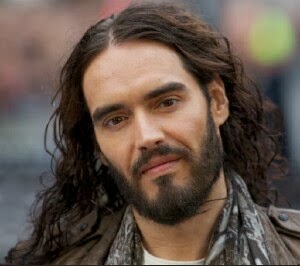
RUSSELL BRAND ~ "he's a darling, he's a demon, he's a lamb"

When I read him I'm confused
Out of focus and bemused
And I never know exactly where I am
Unpredictable as weather
He's as flighty as a feather
He's a darling! He's a demon! He's a lamb!

He'd outpester any pest
Drive a hornet from its nest
He could throw a whirling dervish out of whirl
He is gentle! He is wild!
He's a riddle! He's a child!
He's a headache! He's an angel!
He's............... Russell Brand


As I read the New Statesman piece, carried at Common Dreams on Friday, written by British actor/comedian Russell Brand the words of a song from "The Sound of Music" kept floating into my head. I've parodied them above, with apologies to Oscar Hammerstein II .

It's a l-o-n-g piece for ADD-afflicted internet inhabitants, but it's one I couldn't stop reading halfway, as I do so many others. Brand's piece at Common Dreams is headed: "Before We Change the World, We Need to Change the Way We Think.......On revolution: 'We no longer have the luxury of tradition'".

Before I go any further, I'm leaving a link to an antidote for any hint of Brandish hero-worship a passing reader might detect: Douglas Valentine's piece at Counterpunch is a knock-down, drag-out put-down of Russell. I don't agree with Mr Valentine, though do admit that there's an occasional whisper of sense in what he writes as, I feel pretty sure (and this is important) that Russell Brand would too.

Russell Brand: the guy is Gemini incarnate....really! The Trickster, brilliantly fluent, ridiculously talented, flawed mouth-on-a stick. But make no mistake, in this piece Brand is making more sense than any dozen of mealy mouthed pundits you'd care to bundle together. And he's funny with it....that is very hard to do for most of us struggling non-Gemini mortals. Several commenters have described his piece as "stream of consciousness stuff". I've never been reliably sure what "stream of consciousness" looks like until now!

I've chosen a few quotes from the piece to share its flavour, and to spice up this post. It was hard to choose, there are so many quotable chunks. I highly recommend reading the article in full. Sometimes the piece relates to British political figures, but mostly his remarks apply to the USA also, and the rest of the world for that matter.

To give some idea of the subject matter, some random paragraphs - not always chronological:

The serious side:
First, he excuses his wealth:
I should qualify my right to even pontificate on such a topic and in so doing untangle another of revolution’s inherent problems. Hypocrisy. How dare I, from my velvet chaise longue, in my Hollywood home like Kubla Khan, drag my limbs from my harem to moan about the system? A system that has posited me on a lilo made of thighs in an ocean filled with honey and foie gras’d my Essex arse with undue praise and money..............

.......The right has all the advantages, just as the devil has all the best tunes. Conservatism appeals to our selfishness and fear, our desire and self-interest; they neatly nurture and then harvest the inherent and incubating individualism.

I imagine that neurologically the pathway travelled by a fearful or selfish impulse is more expedient and well travelled than the route of the altruistic pang. In simple terms of circuitry I suspect it is easier to connect these selfish inclinations.

These problems that threaten to bring on global destruction are the result of legitimate human instincts gone awry, exploited by a dead ideology derived from dead desert myths. Fear and desire are the twin engines of human survival but with most of our basic needs met these instincts are being engaged to imprison us in an obsolete fragment of our consciousness. Our materialistic consumer culture relentlessly stimulates our desire. Our media ceaselessly engages our fear, our government triangulates and administrates, ensuring there are no obstacles to the agendas of these slow-thighed beasts, slouching towards Bethlehem.


(After a visit to African slums, seeing emaciated children there, and on return home attending a fashion show with stick thin models who deliberately starve themselves):

...I could not wrench the phantom of those children from my mind......I felt the integration; that the price of this decadence was their degradation. That these are not dislocated ideas but the two extremes are absolutely interdependent. The price of privilege is poverty. .....To have such suffering adjacent to such excess is akin to marvelling at an incomparable beauty, whose face is the radiant epitome of celestial symmetry, and ignoring, half a yard lower down, her abdomen, cancerous, weeping and carbuncled. “Keep looking at the face, put a handbag over those tumours. Strike a pose. Come on, Vogue.”

Suffering of this magnitude affects us all. We have become prisoners of comfort in the absence of meaning.

The "spiritual" side:
For me the solution has to be primarily spiritual and secondarily political. This, too, is difficult terrain when the natural tribal leaders of the left are atheists, when Marxism is inveterately Godless. When the lumbering monotheistic faiths have given us millennia of grief for a handful of prayers and some sparkly rituals.

The only systems we can afford to employ are those that rationally serve the planet first, then all humanity. Not out of some woolly, bullshit tree-hugging piffle but because we live on it, currently without alternatives. This is why I believe we need a unifying and in - clusive spiritual ideology: atheism and materialism atomise us and anchor us to one frequency of consciousness and inhibit necessary co-operation.

In 2013 (another made-up imaginary concept) we cannot afford to giggle, drivel and burp like giant, pube-covered babies about quaint, old-fashioned notions like nation, capitalism and consumerism simply because it’s convenient for the tiny, greedy, myopic sliver of the population that those outmoded ideas serve...........

We British seem to be a bit embarrassed about revolution, like the passion is uncouth or that some tea might get spilled on our cuffs in the uprising. That revolution is a bit French or worse still American. Well, the alternative is extinction so now might be a good time to re-evaluate. The apathy is in fact a transmission problem, when we are given the correct information in an engaging fashion, we will stir.


Now there is an opportunity for the left to return to its vital, virile, vigorous origins. A movement for the people, by the people, in the service of the land. Socialism’s historical connection with spiritual principles is deep. Sharing is a spiritual principle, respecting our land is a spiritual principle. May the first, May Day, is a pagan holiday where we acknowledge our essential relationship with our land. I bet the Tolpuddle martyrs, who marched for fair pay for agricultural workers, whose legacy is the right for us to have social solidarity, were a right bunch of herberts if you knew them. “Thugs, yobs, hooligans,” the Daily Mail would’ve called them. Our young people need to know there is a culture, a strong, broad union, that they can belong to, that is potent, virile and alive.

(My highlight)
But we are far from apathetic, we are far from impotent. I take great courage from the groaning effort required to keep us down, the institutions that have to be fastidiously kept in place to maintain this duplicitous order. Propaganda, police, media, lies. Now is the time to continue the great legacy of the left, in harmony with its implicit spiritual principles. Time may only be a human concept and therefore ultimately unreal, but what is irrefutably real is that this is the time for us to wake up.

The revolution of consciousness is a decision, decisions take a moment. In my mind the revolution has already begun.

If I believed in spiritualism I'd suspect that the spirit of comedian Bill Hicks, who left us much, much too soon, had been in contact with Russell Brand....or maybe Bill Hicks and George Carlin got together in the ethers and decided enough was enough, something simply had to be done, a new messenger had to be appointed.


ASTROLOGY


I made a point of describing Russell Brand as "Trickster" at the beginning of the post; astrologically he is. Sun and Mercury in Gemini. I've posted a 12 noon version of his natal chart, no time of birth is known. I'll link, at the end of the post, to two websites where interpretation has already been done. For me, other than his "mouth-on-a-stick" Sun and Mercury in Gemini, I'd focus on the three planets in Aries, (Moon would have been in Aries, whatever time he was born), and on the fact that he's "unearthed" - no planet in an Earth sign unless an Earth sign (Taurus, Virgo or Capricorn) was on the ascendant as he was born....chances of that, I'd say, are slim!

The three Aries planets bring a fresh child-like streak into his nature, enthusiasm for his subject, whether nefarious, sexy, or serious. I like the freshness and a rather strangely innocent feel to him- don't know how else to describe it, but have recognised it in those with Aries strong in their natal charts - a lot, love it! That's not to say he's always all that's wonderful. He's not - far from it. I was disgusted by reports of a mean prank he'd played on a fellow-actor some time ago. Aries childlike-ness can, and does, go right over-the top at times. Because of his writing though, he's forgiven - not forgetting the interview in the video below, from British TV. Interviewer, Jeremy Paxman, well known in the UK for his penetrating interview style when dealing with politicians, took on Russell Brand. I suspect Jeremy has a warm spot for Russell and his views, though it didn't seem so at times.


For more on Brand's astrology:
See Adam Sommer's article at Reality Sandwich
and
My Encounter with Russell Brand  by British psychic Michelle Knight.  

Friday, June 08, 2012

Arty Farty Friday ~ Happy 91st to LeRoy Neiman!

LeRoy Neiman. Today is his 91st birthday - born 8 June 1921.

I was unfamiliar with this American artist, I suspect his work appeals more to male art fanciers than to females. A glance through a page of his work on Google Image indicated to me that he is a painter of similar type to last Friday's subject, Raoul Dufy: a happy artist. Neiman's art portrays more dynamic energy than the serene atmosphere which was Dufy's signature, but his colours are equally arresting, and Neiman has credited Dufy as having been an early influence.

There's no gloom in Neiman's paintings. His art speaks of action, good times, enjoyment, people at sport and at leisure; not forgetting several animal studies.


More examples below.

As in Dufy's case, art critics have not been kind to Neiman. I doubt that he cares -he's successful, with a long (50+ years) marriage, happy and wealthy. He and his wife live in New York. Their penthouse home overlooks Central Park. It was owned at one time by Norman Rockwell, at another by Rudolph Valentino. The penthouse has double-height ceilings with wonderful views of Central Park.

LeRoy Neiman was born in St Paul, Minnesota, into a working class family of Turkish/Swedish background; abandoned by his father early on he took the surname of a later stepfather. His natural artistic talent was honed at the School of The Art Institute of Chicago on the G.I. Bill after his military service in World War II. He then taught for 10 years while exhibiting his work.

A long-running asscoiation with Hugh Hefner and Playboy magazine was what brought Neiman's talent to a much wider public. Hefner saw his paintings of people in pursuit of pleasure, sport, nightlife, gambling and was hooked.

From a 1995/6 article by Nancy Wolfson
...Thus began a personal and professional association with Hefner and his soon-to-be-empire. In 1958, Neiman began a monthly feature for Playboy called "Man At His Leisure." It would expose him to a style of living a world apart from the struggle-to-survive, street-gang life that he was raised in. For the next 15 years he globe-trotted, observing the rich at play in the world's most glamorous watering holes and sporting spots, delivering to Playboy his impressions of what he saw. Whether it was the Grand Prix auto race in Monaco, the Regatta of the Gondoliers in Venice, or the Super Bowl in Miami, Neiman was there. Gambling at Baden-Baden, sipping brandy at Claridge's and sketching at Fouquet's--always with a long cigar--Neiman not only painted the dream life; he began living it as well.
And the tide has never turned! He has become one of the 20th century's most successful illustrators. He has met and mingled with most sports luminaries of the 20th century, as well as celebrities in other spheres. His work has been exhibited in galleries and museums throughout the world, including the Smithsonian Institution in Washington, D.C., and the Hermitage in Leningrad.

A piece by Corey Kilgannon in the New York Times from July last year indicated that Neiman "still paints and draws daily in the same bright, bold style, and in the spacious studio in his longtime Central Park West apartment.......is finishing up his autobiography, which he promises is chock full of his personal encounters with athletes, and their reactions to him."


ASTROLOGY


I can find no time of birth, the chart above is set for 12 noon. Rising sign will not be as shown. Moon would be between middle and end degrees of Cancer whatever the time of birth.

Once again the key to this artist's style is easy to see: Sun conjunct Mars. Mars represents energy, dynamism.... and sport. Venus, planet of the arts is in its sign of rulership, Taurus: his natural talent for drawing and painting.

The other stand-out piece of this natal chart is what astrologers call a T-square. A 180* opposition (here it's from Jupiter in Virgo to Uranus in Pisces, both planets form 90* square angles to Sun in Gemini. This configuration is thought to represent an inner tension, not necessarily negative though, it can, and in Neiman's case I think does, represent the dynamic tension which manifests in his work. His T-square involves mutable signs: Gemini at the apex, with Virgo and Pisces in opposition. Virgo and Gemini are both ruled by communications planet Mercury, so are not as contradictary as might be expected, they can sometimes complement one another in fact, I think it is so in this case. Virgo's perfectionism and Gemini's quick mind combine, while Uranus adds an unexpected quirky edge. I can see his art style reflected here.

I'd suspected I might find his natal Moon to be in show-bizzy Leo, but it just doesn't make it into that sign. Instead Moon is in its own sign of rulership, Cancer: sensitive and intuitive. In researching this post I recall seeing a remark about Neiman's aim to always paint any portrait subject in the most flattering way he could, as opposed to 19th century impressionists who enjoyed painting women's portraits, especially, au naturel - without makeup or adornment. This kind of sensitivity from Neiman to the feelings of his subjects reflects his Moon in Cancer.


Gabriela Sabatini


The Catch


The Beatles


Frank Sinatra


Stud Poker


Belmont Stakes


LINK to The Official LeRoy Neiman Website
Copyrighted material on these pages is included as "fair use", for the purpose of study, review or critical analysis only, and will be removed at the request of copyright owner.