The image shown on this postage stamp will be a familiar sight to any Brit, or anyone who visited the fair shores of the land of my birth during the 20th century, and beyond. Not quite as familiar to most of us is the name of its designer: Giles Gilbert Scott, architect. He was born in Hampstead, London on this day in 1880,
9 November, into a family of successful architects, both his father and grandfather were of that profession. He died in 1960.
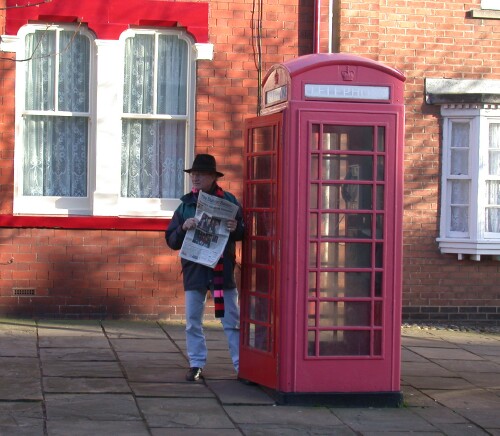
Below: a photograph I took back in the UK, must have been in 2004. Husband appears to be holding up the local newspaper of his (now our) US hometown. I think he sent it for publication. At the time both his daughter and son-in-law worked on that newspaper, which occasionally carried pics of residents carrying the paper "in foreign parts". I also can see that he had my long striped scarf dangling, and the big black hat: Dr. Who? The box is wrong in colour and purpose though. Tardis is a Police Box, and blue - but y'all knew that.
Wikipedia
Scott's most ubiquitous design was for the General Post Office. He was one of three architects invited by the Royal Fine Arts Commission to submit designs for new telephone kiosks.The invitation came at the time Scott was made a trustee of Sir John Soane's Museum. His design was in the classical style, topped with a dome reminiscent of the mausoleum Soane designed for himself in St Pancras Old Churchyard, London. It was the chosen design and was put into production in cast iron as the GPO's "Kiosk no. 2" or "K2". Later designs adapted the same general look for mass production: the Jubilee kiosk, introduced for King George V's silver jubilee in 1935 and known as the "K6" eventually became a fixture in almost every town and village.
A related aside:
At Christmas, not long after I'd emigrated here to be with my husband, his son "AJ", who has inherited a goodly amount of creativity from his Dad, made this model for me from scrap copper - no doubt to help prevent me from feeling homesick.
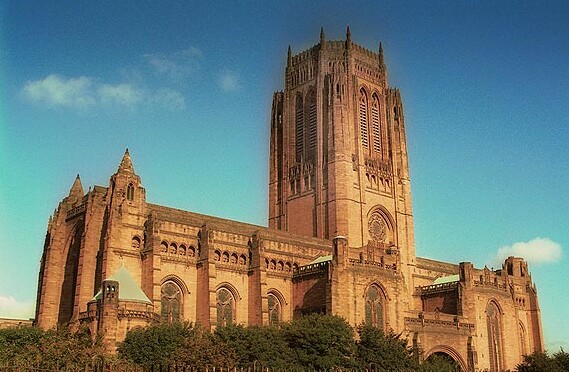
Some of G.G. Scott's other designs are equally familiar sights in the UK: Liverpool's Anglican Cathedral and Battersea Power Station, for instance.
See more detail of Giles Gilbert Scott's life and work at
Wikipedia.
A quick look at his natal chart, or at least one set for 12 noon. Information on his time of birth can't be found.
Two things stand out for me, especially in relation to that telephone kiosk!
1. The harmonious trine between Mercury (communication) at 9 Sagittarius (expansion) and Jupiter(expansion) at 10 Aries (initiation).
2. The Yod (Finger of Fate) linking a sextile between Sun/Mars in Scorpio to Uranus in Virgo, then 150* quincunx links from both to
again, Jupiter in Aries. Translated as the energy and passions of Scorpio linked to the meticulous planning of something new and forward-looking channelled through Jupiter, planet of expansion in Aries sign of initiation.