Monday, May 21, 2012

Music Monday :“There is geometry in the humming of the strings, there is music in the spacing of the spheres.”(Pythagoras)

With regard to humming...from time to time I've come across articles about "The Hum", a mysterious sound heard by many people in different parts of the world, intermittently over many years. One example:

From Humdingers a 2004 article in The Guardian, by Mark Pilkington

It's described as a low, modulated drone that sounds like an idling diesel engine or a distant aircraft. It starts and stops abruptly and is sometimes accompanied by headaches, nausea or other physical discomfort.

It has been heard in Bristol, Birmingham, Hertfordshire and Strathclyde; in Taos, New Mexico and Kokomo, Indiana; as well as in Canada, Germany, Sweden and Denmark. Typically, fewer than 5% of people can hear it; older women seem most likely to be affected. As well as innumerable sleepless nights, hums have been linked to at least three suicides in the UK.

The most frequently blamed sources are the extremely low frequency (ELF) signals used to communicate with submarines, typically at about 76Hz. There are ELF transmitters in Michigan and Wisconsin in the US, and on Russia's Kola Peninsula. The first hum reports, however, predate ELF technology: in the 1940s, residents in Belgravia, London, blamed a hum on a radio transmitter in the Russian embassy basement.

Other hums have been attributed to gas pipes, seismic activity, mating fish and underground military bases. Only one has been conclusively identified: in 2003, a low hum in Kokomo, Indiana was traced to industrial fans in a factory..............

As this post is headed "Music Monday" one might ask what does the mysterious and rather unmusical Hum have to do with music? Answer: not a lot, but I thought it interesting, and though unconnected to the rest of this post, the air of mystery continues....

In searching for information on The Hum I stumbled on something else, more or less musical:
The Devil's Chord or Devil's Interval. It's a musical phenomenon thought dangerous enough to have been supressed by the Church in the Middle Ages. It consists of a musical interval spanning three whole tones, like the diminished fifth or augmented fourth. This interval, the gap between two notes played in succession or simultaneously, was branded Diabolus in Musica or the Devil's Interval by medieval musicians.
From BBC website
On the surface there might appear to be no link between Black Sabbath, Wagner's Gotterdammerung, West Side Story and the theme tune to the Simpsons. But all of them rely heavily on tritones, a musical interval that spans three whole tones, like the diminished fifth or augmented fourth. This interval, the gap between two notes played in succession or simultaneously, was branded Diabolus in Musica or the Devil's Interval by medieval musicians. A rich mythology has grown up around it. Many believe that the Church wanted to eradicate the sounds from its music because it invoked sexual feelings, or that it was genuinely the work of the Devil.

Rock producer Bob Ezrin: "It apparently was the sound used to call up the beast. There is something very sexual about the tritone. In the Middle Ages when people were ignorant and scared, when they heard something like that and felt that reaction in their body they thought 'uh oh, here come the Devil'."

It all sounds a little like the plot of a far-fetched Da Vinci Code sequel. But Professor John Deathridge, King Edward professor of music at King's College London, says the tritone had been consistently linked to evil. "In medieval theology you have to have some way of presenting the devil. Or if someone in the Roman Catholic Church wanted to portray the crucifixion, it is sometimes used there."
A 10 minute video explanation is embedded below. Being a music theory numbskull I found this confusing at times. Interest was sparked mainly because the guys explain that tones opposite one another when the 12 tones are placed in a circle are the most dissonant - as in astrological oppositions? Almost, but in astrology oppositions can be balancing too. The explanation, generally, kept reminding me of astrological aspects.....music of the spheres and all that?


For more interesting detail on this astrological link see Don Robertson's website DoveSong.com, and in particular his piece: "The Duochord", where diagrams help explain the astrological link I've clumsily described. I'm wary of copyright, so will not risk borrowing the images.
Mr Robertson writes:
One day I was reading a book by Corinne Heline about music and its spiritual effects when I noticed that there was a diagram in the book that explained how the twelve notes of the musical chromatic scale corresponded with the twelve signs of the astrological zodiac. At that time I was interested in astrology and I thought this was an interesting concept. The way she explained it, the notes were placed counter-clockwise on the circle of the zodiac as follows: C, D, E, F, G, A, B, C#, D#, F#, G#, A#. I don’t know where she learned this, but it was very interesting. It was the 7-note major scale (the white keys of the keyboard), followed by the 5-note pentatonic scale (the black keys of the keyboard): the two most powerful scales in the music.
He goes on to describe how he drew trines and squares and discovered that their harmonious or dissonant relationship in music and in astrology are very similar.


More examples of how the Devil's Chord sounds, on guitar:


“Maria”, the song in West Side Story contains the tritone interval in the syllables “Ma-ri” at the beginning of the song.


Sunday, May 20, 2012

SOLAR ECLIPSE

There's a solar eclipse coming up - or it has happened already - depending on where you are and when you're reading this. For details see HERE.
We're unlikely to have a view of the eclipse here in Oklahoma, we have thunderstorms this morning with more forecast.

Astrological prediction of events relating to eclipses occasionally prove to be partially, or even wholly accurate, but sometimes they don't. If ever I feel depressed after reading eclipse predictions I dilute that feeling by remembering that eclipses are a regular part of life on Earth. It's a bit like the slight feeling of risk involved in flying (by plane, not broomstick!). If ever I felt nervous I'd think of the number of flights in a day, all over the world, of the staff on board all those planes - the stewardesses or whatever they are called these days. They fly many times a week, month in, month out, without problem. Why would anyone feel nervous about one single flight - or one single eclipse?

Eclipses of the Sun are dramatic events, can't argue with that. They feature in several novels and films - there's a list of some of them at Wikipedia HERE. The only one from that list I can recall is "A Connecticut Yankee in King Arthur's Court", in which Bing Crosby (playing a time traveller to the past) convinced adversaries of his power by using knowledge that a solar eclipse was due to take place.

There's another story involving an eclipse of the Sun in Borodin's opera "Prince Igor", set in Russia. The synopsis goes something like this:

The Prince is mobilizing his army against the Polovtsians (a nomadic people) who have been attacking and raiding the Russians' territory and carrying away their people into slavery. There is an eclipse of the Sun and the sky grows dark.


The people see this as a bad omen and plead with Prince Igor to abandon his mission. Igor sees it as an omen - but whether good or bad is yet to be seen. His wife, Yaroslavna, begs him to stay home but he is not persuaded. He must defend his and Russia's honor. Things go badly, Igor's brother plans to depose him in his absence, Igor and his son are taken captive by the Polovtsians. In the end though, Igor escapes and returns to his wife and to defend his city. There's a sub-plot involving his son's love affair with the daughter of the Polovtsian leader.

So....there was bad news, and there was good news, after that eclipse.

I understand that Igor's story is based on historical events. See HERE -
"There was apparently opposition to this campaign among members of Igor's retinue. On May 1, 1185, there was an eclipse of the sun, which the Nikonovskaya Chronicle describes: "A Portent. That same year, in the month of May, on the fist day, there was a portent in the sun; it was very dark, and this was for more than an hour, so that the stars could be seen, and to men's eyes it was green, and the sun became as the [crescent] moon, and from its horns flaming fire was emitted; and it was a portent terrible to see and full of horror." Although the Russians interpreted this phenomenon as an evil omen, Igor insisted that the campaign continue, saying, "No one knows the mysteries of God. God is the maker of this sign and of the whole world. And whether that which God does to us is for good or for ill, this too we shall see."
Regarding outcome of the current eclipse, as Prince Igor said..... "this too we shall see".

Saturday, May 19, 2012

Weekend TV Gossip, Astro-sprinkled.

Several TV shows we've been watching through the winter and spring have been finale-ing this week. I guess we'll soon be relying on our store of used VCR tapes and old DVDs for entertainment.


The Voice has completed its second season. I struggle to remember the winner, even now. Google refreshed an overloaded memorybank: winner was Jermaine Paul, a former background vocalist with Alicia Keys, Mary J. Blige, Joss Stone.

What I remember most about the show is being seriously irritated by the female judge/coach, Christina Aguilera - always trying to claim the audience's attention, either by wearing ridiculously revealing or silly outfits, or by her sometimes antagonistic exchanges with one of the other judges. Christina A's astrology: born 18 December 1980 Sun and 3 planets in Sagittarius, Moon in Taurus, late-Aquarius rising.
Quadruple Sagittarius may be just too much of a good thing! Astrodatabank chart.

The show's confusing format doesn't help. Audience focus is too much on the judge/coaches, too little on the contestants. The band has been far, far too loud (aka bandzilla), drowning out voices - ironic considering the show's title.


Fringe~ The intriguing sci-fi drama series with a premise that an alternative universe exists. Its inhabitants are "doubles" of us all. Our doubles have slightly different life patterns and personalities. Fringe's current season finished on a good note after some really muddled episodes mid-stream.
John Noble deserves an award of some kind for his consistently excellent performances as Walter Bishop, the scientist responsible for much of the 2-universe mayhem, and playing two completely different versions of his character.

John Noble's astrology: born 20 August 1948 in South Australia: Sun conjunct Saturn in Leo with Pluto also in Leo. Mercury in perfectionist Virgo. If born before 10:00 AM his natal Moon would have been in Aquarius (which I suspect), otherwise in Pisces, also appropriate given his talent for roles not only in sci-fi but also fantasy (Pisces stock-in-trade). In the Lord of the Rings trilogy he was Denethor.
Astrotheme chart.


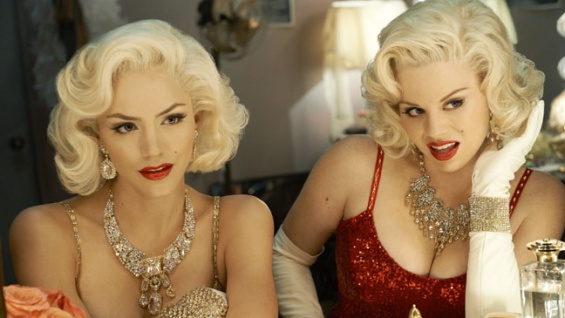
Smash finished its first season on a high note (pun intended). The underdog won, and took the lead in the fictional musical show around which the series is written, Bombshell, about Marilyn Monroe. Bombshell is supposedly heading for Broadway in its planned second season.
Soapy storylines, some good singing and dancing, with plenty of hate between opposing fan brigades for the two potential Marilyns played by Megan Hilty (right) and American Idol alumna Katharine McPhee. I thought the young women were equally good.

Interesting performance from Angelica Houston as the show's producer - shame about her hairstyle though - Cleopatra she ain't! The only vaguely fanciable male was her beau, a bar-owner with mob (ish) connections.

Note of astro interest: Megan Hilty born 29 March 1981 Katharine McPhee born 25 March 1984, two Sun in Aries in a head-to-head to play the part of a Sun Gemini.


The Mentalist reached its season finale Thursday evening. Simon Baker, the show's leading man is easiest on the eye of all current TV leading men, and seems to me to be a really nice guy too. Must be his Aquarius Moon doing it for me! Scriptwriters had him down and a wee bit dirty for the finale - nice to see another side of his abilities. I lurve his always rumpled look in those 3-piece suits. A post about Simon Baker and his natal chart from the archives at this link.


Mad Men plods on through season 5, which is proving to be nowhere near as engaging as seasons 1 to 4 which we watched on DVD. The scriptwriters seem to have misplaced their mojo. Scene is now 1966, perhaps it was a boring year in the USA. 1968, when they get there, should liven things up, but not in a good way!
Previous post on Mad Men with a bit of astrology HERE.


America's Got Talent began its new season, as other shows reached the end of their runs. AGT now takes over The Voice's slot. New judge Howard Stern made it worthwhile tuning in. My husband, who knows more about him than I do, feared Stern would be a dreadful mistake and bad addition to the show, but I suspect he'll change his mind on that score.

Stern is already proving to be preferable to Piers Morgan who sat in the same "bad-cop" seat during previous seasons. I've never heard Stern's radio shows, said to be filled with vulgarity and nastiness, but he's been reined in tight for AGT. He displayed quick wit, humour and an admirable ability to sum things up on the fly, coming up with useful insights, and even showing a rather sappy side - which I'm not sure is entirely genuine, but it's good business!

Stern astrology: Sun + 3 planets in Capricorn, Moon in Taurus, Gemini rising.
Earthy base with his talent for communication coming from a Gemini ascendant and Jupiter in Gemini. Mars and Saturn in Scorpio - source of his darker side?
Astrodatabank chart.

Friday, May 18, 2012

Arty Farty Friday ~ Astrid Kirchherr, Photographer of The Beatles

On Sunday, 20 May, Astrid Kirchherr will celebrate her birthday ...."Who' she?" I hear a passing reader mumble. Now in her 70s, she's the photographer who first embedded a vision of The Beatles into the consciousness of a world much wider than Liverpool and Hamburg.
(Photo above from DPA.)


(Right: 1960s self-portrait by Astrid Kirchherr).
A photographer and former art student originally heading for a career in fashion design in Hamburg of the early 1960s. She was introduced to Beatles' music by her then boyfriend Klaus Voormann. The Beatles at that time had moved to Germany seeking engagements, were playing night-long (and I do mean l-o-n-g) in clubs in Hamburg's notorious Reeperbahn, surviving on alcohol and drugs to fuel their marathon sessions.


Ms Kirchherr was immediately drawn to the lads and their rock and roll music, especially to their then bass player arty Stuart Sutcliffe. The attraction was mutual.....she found him somehow different from local young males, he saw in her, with her all-black clothes and beat sensibilities "the real bohemian". She soon became fast friends with the band and, eventually, fiancée to Stuart Sutcliffe. She was the first photographer to treat the Beatles phenomenon as something iconic - her photographs retain this feel 50 years later.

Ms Kirchherr is often credited with designing the Beatles' famous "mop-top" hair styles. She admits to persuading Sutcliffe to exchange his Brylcremed quiff for the style then favoured by her ex-boyfriend Klaus and many of his German contemporaries, the "mop-top". The other Beatles followed eventually, Paul and John needing the most persuading.

Stuart Sutcliffe died befor he and Kirchherr could marry, his death came tragically early from a brain hemorrhage, thought to have been brought about by a head injury sustained some time before.

Astrid Kirchherr's other photographs didn't similarly enthuse the public, but her studies of The Beatles are still exhibited all over the world. She abandoned photography as a career around 1967. She has had three books of photographs published; a movie, Backbeat, tells the story of her emotional association with Sutcliffe.

Not wanting to fall foul of copyright regulations I'm wary of posting images of Ms Kirchherr's photographs, but hope that I'll be allowed just one example here (if not I shall remove it post haste upon being asked to do so). More can be seen via Google Image.


I found a couple of related videos, the first is an interview with Astrid Kirchherr herself, the second composed by a fan.


Getting to astrology - at last - I'm interested to see how Astrid Kirchherr's and Stuart Sutcliffe's natal charts relate to one another, bearing in mind the couple's instant attraction.....so 12 noon charts follow:


It's not possible to calculate exact charts without birth times, but these planetary positions at 12 noon will be accurate, apart from Moon's degree.

The immediate and strongest link I see is that both their natal Moons were in Aquarius, unless Ms Kirchherr were born in the first hour of 20 May....Moons could quite easily turn out to have been conjoined, in fact.

His Uranus conjoins her natal Sun, her Mercury conjoins his Jupiter and Saturn in Taurus.

A potentially dark shadow falls on the zodiac circle at around 25/26 Taurus where unfortunate Fixed Stars Algol and Capulus are found. As both charts have planets in this vicinity I'm wondering whether the tragedy and heartbreak involved in their love affair echo this.

Ms Kirchherr has Jupiter (publication) in Pisces, the sign ruled by Neptune, planet linked to photography, and along with her Sun/Mercury/Uranus in Venus-ruled Taurus this reflects her natural artistic bent. Sutcliffe, also artistically inclined, had three planets in Taurus too. Actually, many of the Uranus in Taurus generation turned out to have interest or talent in arty directions. I'm one of that generation and though I've no talent for drawing or painting I've always been interested in, and attracted to anything/anyone a wee bit arty.

Thursday, May 17, 2012

A Whisper of Astrology in Herman Melville's Moby Dick

Second mate Stubb is speaking as he gazes at a golden coin, a doubloon with the zodiac engraved on its face. He's not an educated man, remarkably articulate, during whale hunts keeps up an imaginative patter reminiscent of that of some characters in Shakespeare. Scholarly portrayals range from that of an optimistic simpleton to a paragon of lived philosophic wisdom. (Wiki.)
Cover art by Tony Millionaire.


"I'll try my hand at raising a meaning out of these queer curvicues here with the Massachusetts calendar.

Here's the book. Let's see now. Signs and wonders; and the sun, he's always among 'em. Hem, hem, hem; here they are - here they go - all alive: - Aries, or the Ram; Taurus, or the Bull and Jimimi! here's Gemini himself, or the Twins. Well; the sun he wheels among 'em. Aye, here on the coin he's just crossing the threshold between two of twelve sitting-rooms all in a ring.

Book! you lie there; the fact is, you books must know your places. You'll do to give us the bare words and facts, but we come in to supply the thoughts. That's my small experience, so far as the Massachusetts calendar, and Bowditch's navigator, and Daboll's arithmetic go.

Signs and wonders, eh? Pity if there is nothing wonderful in signs, and significant in wonders! There's a clue somewhere; wait a bit; hist - hark!

By Jove, I have it! Look you, Doubloon, your zodiac here is the life of man in one round chapter; and now I'll read it off, straight out of the book. Come, Almanack!

To begin: there's Aries, or the Ram - lecherous dog, he begets us; then, Taurus, or the Bull - he bumps us the first thing; then Gemini, or the Twins - that is, Virtue and Vice; we try to reach Virtue, when lo! comes Cancer the Crab, and drags us back; and here, going from Virtue, Leo, a roaring Lion, lies in the path - he gives a few fierce bites and surly dabs with his paw; we escape, and hail Virgo, the Virgin! that's our first love; we marry and think to be happy for aye, when pop comes Libra, or the Scales - happiness weighed and found wanting; and while we are very sad about that, Lord! how we suddenly jump, as Scorpio, or the Scorpion, stings us in rear; we are curing the wound, when whang come the arrows all round; Sagittarius, or the Archer, is amusing himself. As we pluck out the shafts, stand aside; here's the battering-ram, Capricornus, or the Goat; full tilt, he comes rushing, and headlong we are tossed; when Aquarius, or the Water- bearer, pours out his whole deluge and drowns us; and to wind up with Pisces, or the Fishes, we sleep.

There's a sermon now, writ in high heaven, and the sun goes through it every year, and yet comes out of it all alive and hearty. Jollily he, aloft there, wheels through toil and trouble; and so, alow here, does jolly Stubb. Oh, jolly's the word for aye! Adieu, Doubloon!"

Wednesday, May 16, 2012

Earth: "This Godawful mess"

To give this post an astrological flavour I'll invite passing visitors, before reading on, to crank up their inner Virgo (responsible, careful, health conscious), and their inner Saturn (self-discipline, thrift).......then continue:
And Man created the plastic bag and the tin and aluminum can and the cellophane wrapper and the paper plate, and this was good because Man could then take his automobile and buy all his food in one place and He could save that which was good to eat in the refrigerator and throw away that which had no further use. And soon the earth was covered with plastic bags and aluminum cans and paper plates and disposable bottles and there was nowhere to sit down or walk, and Man shook his head and cried: "Look at this Godawful mess." ~ Art Buchwald, humorist
By the time I left its fair shores in 2004, recycling had become way of life in England. Local authorities provided separate garbage bins for our newspapers. Centres for collection of other items, such as glass and aluminium cans, were plentiful in most neighbourhoods. Here in Oklahoma it's a different story. Few facilities to encourage recycling exist, and whenever some do emerge they are short-lived.

For a few years we ferried our collection of newspapers and aluminium cans the 35 miles to a recycling collection centre in a neighbouring city. Then the military base in that city, whose staff collected recycling materials from several centres, was prevented, by Department of Defense financial constraints, from continuing the collections. Later a few, smaller, re-cycling bins were replaced in school locations.

Then, about a year ago, Power Shop, an organisation which helps to provide jobs for people with disabilities set up a re-cycling centre in our town. We were able to deposit paper, cans, cardboard, and plastic bottles there regularly. The centre seemed to be doing good business, but last week, when we visited to deposit some newspapers, we were told that the centre is closing, is now closed in fact, for re-cycling, but will continue to accept donations of aluminium cans. Reason: it hasn't made a profit. “We had a grand idea that we believed would provide jobs for people with disabilities, help the community, save the earth and make money,” the executive director said in a statement. “Unfortunately, it did everything except make money.”

Ye gods!!! Surely the state or city or federal government could subsidise something as important as this, so that profit need not be paramount? I should send a letter or a copy of this post, perhaps, to the state's governor, Mary Fallin - but it's a lost cause. A standard letter would be the response, as it was when I wrote to our Senator Tom Coburn about health care reform. They. Don't. Care. In this as in many spheres Oklahoma lags behind the rest of the US. I should not tar the whole of the US with the same brush. The following is from Encyclopedia of Earth's Recycling section

.....In particular, the culture of consumption of post-World War II America re-enforced carelessness, waste, and a drive for newness. Environmental concerns contributed to a new "ethic" within American culture that began to value restraint, re-use, and living within limits. This ethic of restraint, fed by over-used landfills and excessive litter, gave communities a new mandate in maintaining the waste of their population. Re-using products or creating useful byproducts from waste offered application of this new ethic while also offering new opportunity for economic profit and development.

Non-profit recycling centers began opening around the country, followed by municipal recycling programs. Today, most U.S. communities have such programs. A typical program asks people to separate their recyclables from their trash before placing them at the curb for collection. To encourage recycling, some communities also charge residents for the quantity of trash put out for collection. The most commonly recycled household items are paper and cardboard; metal, glass, and plastic containers and packaging; and yard waste. Recycling the recovered materials is simple for metals and glass; they can be melted down, reformed, and reused. Yard waste can be composted with little or no equipment. Paper, the most important recycled material, must be mixed with water, and sometimes de-inked, to form a pulp that can be used in papermaking. Plastics recycling requires an expensive process of separation of different resins.

In the US, plastics are all numerically coded according to type, including: polyethylene terphthalate (PETE or PET; 1) an example of these plastics are virtually all soft drink bottles, high density polyethylene (HDPE; 2) an example would be detergent bottles, polyvinyl chloride (PVC; 3), sometimes used for water or oil bottles but now rare in food beverage packaging, due to concerns about its environmental hazards; low density polyethylene (LDPE; 4) often used for plastic bags, polypropylene (PP; 5) examples are some yogurt containers and bottle caps, and polystyrene (PS; 6) used to make Styrofoam containers. Number 7 seen on some packaging, refers to all plastics other than these six. It is not a single plastic material.
Lessons are being learned - somewhere - if not in Oklahoma. Because of the horrendous growth of the "plastic garbage island" in the North Pacific, grown 100-fold in the past 40 years, several Californian city authorities have placed a ban on the use of plastic bags in grocery stores. That's a start! The use of styrofoam/plastic cups, cutlery and plates in motels and fast-food places ought to be next on the list.


Photograph from ambiental.

The huge patch (some say the size of Texas, but calculation is difficult because much of the broken down material remains below the surface) of 80% plastic garbage has been created by waste swept into the North Pacific Subtropical Convergence Zone by circulating ocean currents known as a gyre. Eventually the plastics are broken down by wind and waves and become small particles which will, someday, enter the food chain.
"Your descendants shall gather your fruits." ~ Virgil
(Note: I'd add to Virgil's ancient wisdom, and no doubt it was implied anyway: "whether the fruits be nourishing or poisoned is up to you.")

Tuesday, May 15, 2012

McDonald's born today in 1940 - Propelled To Fame under Ray Kroc's Leadership

I noticed in Wikipedia's list of notable events for this day, 15 May, that on 15 May 1940 – "McDonald's opens its first restaurant in San Bernardino, California".

My feelings about MacDonald's were neutral when I first arrived on these shores. I'd sampled their wares, a BigMac, one time only, when Mac's first opened a store in the town where my parents lived. Mum and Dad were keen to try this new delicacy. Before that, the only hamburger joints I'd seen in England were Wimpy Bars where the only choice used to be "with or without onions". Upon association with my now husband I soon became educated in what he sees as the evil of MacDonald's. Now we enter their doors for one main reason - to use the restrooms/toilets when travelling. I've been known to partake of the odd smoothie or iced coffee on occasion, and - oh yes - once, when overnighting in a tiny town with no other cafe open at breakfast time we had to rely on MacDonald's for a couple of Egg MacMuffins. We survived! I secretly suspect that husband is a tad unfair to the Golden Arches.

As today is the original MacDonald's birthday, I'll put up again some details from a 2007 post as to the history of what became the giant corporation we know today.

Ray Kroc was the man who developed the juggernaut we now know as McDonald's. He didn't invent the hamburger, nor the idea of fast food per se - what he did was market these things so brilliantly that what started as that 1940 fast food restaurant, developed and owned by the McDonald brothers, Dick and Mac in California, became one of the world's biggest international corporations.

A good on-line biography HERE starts thus:
"In 1954, a fifty-two-year-old milk-shake machine salesman saw a hamburger stand in San Bernardino, California, and envisioned a massive new industry: fast food. In what should have been his golden years, Raymond Kroc, the founder and builder of McDonald's Corporation, proved himself an industrial pioneer no less capable than Henry Ford. He revolutionized the American restaurant industry by imposing discipline on the production of hamburgers, french fries, and milk shakes. By developing a sophisticated operating and delivery system, he insured that the french fries customers bought in Topeka would be the same as the ones purchased in New York City. Such consistency made McDonald's the brand name that defined American fast food."

Here's Ray Kroc's natal chart (drawn up for 12 noon as no birth time is available). He was born on 5 October 1902 in Oak Park, Illinois. Generationally he's one of that brilliant Pluto in Gemini generation who helped in giving birth to what became known as "The American Dream". Also extracted from the link above, this snippet is intriguing:
"Kroc's father had taken four-year-old Raymond to see a phrenologist -- a practitioner of a nineteenth century "medicine" that divined insights into a person's character and capabilities from the skull's shape and size. After groping and probing the bumps on the youngster's head, the phrenologist pronounced that the child would work in the food-service industry. "


Without birth time we can't know what his 10th house of career contained, but I'd bet that Saturn would lie on or close to one of the angles. With a birth time of around 6pm Saturn would be in 10th, Sun and Venus in 6th and Aries rising - that would fit particularly well!

His chart is well-balanced element-wise. There's an Air Grand Trine - Sun/Jupiter/Pluto, all linked by 120* harmonious trine aspects. This is significant for an entrepreneur whose brilliance and success relies strongly on mental processes.

Another chart pattern here is what astrologers call a Yod (or Finger of Fate) - made up of two planets forming a sextile aspect both also forming quincunx (150*) aspects to another planet, making up in an arrow-like configuration. In Kroc's case the sextile is between Pluto and Mars, with arrow's apex at Saturn in Capricorn. If I had to pinpoint the most significant factor in this man's chart, it would be this! Saturn in Capricorn, the businessman's planet in it's own sign, hooked up to powerful and energetic Pluto and Mars - the configuration is quite tight too, making it more intense.

Saturn trines Venus in Virgo - here is the attention to detail which must have been so important in setting up a chain of fast food restaurants, all serving the same food prepared in the same way, so that the result is consistent and reliable. Another extract from the link mentioned above:
"Espousing the idea that "there is a science to making and serving a hamburger," Kroc endowed his beef patties with exacting specifications -- fat content: below 19 percent; weight: 1.6 ounces; diameter: 3.875 inches; onions: 1/4 ounce. Kroc even built a laboratory in suburban Chicago to devise a method for making the perfect fried potato in the late 1950s".

Mars in Leo, trining Uranus in Sagittarius provided the spark which helped turn an ordinary salesman with good business sense into a world-class entrepreneur. Sun in Libra trining Jupiter in Aquarius provided the tact, quick thinking and diplomacy needed to clinch deals. The deal Kroc eventually made with the McDonald brothers is legendary:
"It was not an easy time for Ray Kroc. He was suffering from diabetes and arthritis. His gall bladder and thyroid gland had already been surgically removed. But the desire to succeed burnt throughout his body. In a final act of refined salesmanship Ray Kroc managed to convince the brothers (McDonald) to sell the company to him. He asked them to name their price. The $2.7 million that Ray Kroc paid in 1961 for the McDonalds Corporation is considered to be one of the greatest acts of salesmanship of all time."(From HERE)
The juggernaut had started to roll!


Monday, May 14, 2012

Music Monday ~ Wild & Wonderful: Sydney Bechet

On this day in 1897, to a Creole shoemaker and his wife in New Orleans, Sydney Bechet was born. He was surrounded by the music of New Orleans from his first breath. He began playing clarinet around age 6. By the time he was 17 he'd played in many well-known local bands. He later swapped clarinet for soprano-saxophone....he was to become, along with Louis Armstrong first of the great American jazz soloists. When Bechet and Armstrong arrived on the scene jazz was still in its infancy, far from the soloists' artform it was set to become. Bechet and Armstrong were the avant garde.

A snip from Ken Burns' excellent TV/DVD series "Jazz"
By the 1920’s jazz had become truly a national music, dominated by great personalities who lived life with a vengeance. The details are often astonishing. New Orleans saxophonist Sidney Bechet was a musical genius, a megalomaniac, and a man with a violent temper. Before 1925, Marsalis tells us, only Bechet could share the bandstand with Armstrong without embarrassing himself. By age 22 he had served a prison term in England for a violent altercation with a prostitute.

When he came to Harlem he confronted saxophonist Coleman Hawkins for his disparaging remarks about New Orleans musicians. He played so fiercely in Hawkins’ direction that Hawkins ran off the bandstand, out of the building and down the street with Bechet right behind him, blowing his soprano saxophone all the while. Years later while touring Europe Bechet pulled a pistol on a French piano player who had disputed Bechet’s reading of a chord change. “Sidney Bechet does not make mistakes,” he told him, and challenged him to a gunfight. The result was a shoot out in the streets of Paris at rush hour. Bechet wounded three people, none of them his adversary, and went to prison for his deed, though he was released and deported less than a year later.
I'm interested to see whether his antagonistic temperament shows up in his natal chart. The version below is set for 12 noon as birth time isn't known.


I don't have far to seek! Saturn and Uranus exactly conjoined at 27 Scorpio harmoniously trine (120*) Mars at 27 Cancer and directly oppose his natal Sun at 24 Taurus. How to best describe this minus astro-jargon? Cat and dog fighting both see a bird and while continuing to brawl between themselves, chase it too.

If born after 4:00 PM Moon would have been in Mars-ruled Scorpio adding a further helping of intensity to his nature. If born earlier in the day, Moon in Libra (ruled by Venus as is his Taurus Sun) would feed into his early gravitation to music.

Gershwin's Summertime played by Sydney Bechet


Woody Allen's recent movie Midnight in Paris begins with a series of shots of scenic Paris set to Sidney Bechet’s lovely “Si Tu Vois Ma Mere.” Bechet’s connection to Paris began in the 1920s, when the city was a magnet for Western culture and home to many, now famous, expatriate black Americans fleeing from their county's toxic racism.

Si Tu Vois Ma Mere (translation:”If You See My Mother”…aka “I Remember When”) was composed by Bechet, reportedly after the death of his mother.


Another of Bechet's own compositions Petite Fleur


Saturday, May 12, 2012

USA's Man on Horseback?

I've no idea how I came to land on a 7 May post at Ian Welsh's eponymous blog, but having done so was immediately drawn in by the subject matter and a thread of 70+ very good comments. Post heading: Will a man on horseback come to rule America?"

Early on, among the comments, Mr Welsh explains that "man on horseback", here relates to a “heroic right wing figure, usually military."
"The archetypical man on horseback was Napoleon. The man on horseback promises to cut through all the bullshit, to make things work again. Mussolini is another one – make the trains run on time. When people get tired of a society that doesn’t work, they will turn to a strong man (or someone they think is strong), to just make society work again."
For the USA such a situation could easily come to pass, sooner or later - later rather than sooner I think, in the absence of dire catastrophe. It's a vision of the future I'd prefer not to entertain, but then, men on horses could, occasionally, be of a different ilk. Real life examples of genuinely benign men on horseback have been few and far between, mythical or fictional ones are easier to come by.

Among comments the name of General David Petraeus, current Director of the CIA, is mentioned more than once as a possible "man on horseback" for the USA. Does he have the astro-credentials for such a position? Without a time of birth for him it's not possible to calculate an exact natal chart, but here's a 12 noon version for 7 November 1952 when he was born, in Cornwall-on-the-Hudson, NY.


A quick note about the man himself: well-integrated, nicely balanced personality; as far as I can tell he's no megalomaniac, though Scorpio Sun indicates a passionate and determined individual. There are several planetary configurations, one standing out clearly for me is known by astrologers as a Mystic Rectangle (though not mystic, just evidence of fine integration). This links Sun/Mars/Jupiter/Uranus in a configuration involving harmonious trines and sextiles together with 2 balancing oppositions. Planets involved relate to self(Sun), energy/dynamism/war (Mars), philosophy/expansion/excess (Jupiter), and rebellion/revolt/change (Uranus).

Now, here's General Petraeus's chart in centre of a bi-wheel with the USA birthchart - the version I use - in the outside ring, (chart for the day the die was cast for the birth of the USA, 2 July 1776.)


Petraeus's Uranus (unexpected change) is, at 18 Cancer, within orb to be considered conjunct the USA's Sun at 11 Cancer.

At noon the natal moons are opposing one another across Cancer-Capricorn....cardinal signs, his Moon likely conjunct Uranus, US Moon conjunct Pluto.

His Venus in Sagittarius is opposed by US Mars in Gemini.

Although there are astrological links here, I am not confident that it all amounts to a hill of beans. But it is another interesting theory upon which to keep a wary eye.

Friday, May 11, 2012

Arty Farty Friday ~ 3 Photo-realist Painters with Taurean and Other Astro-similarities: Richard Estes, Robert Bechtle, Ralph Goings.

Social and political changes happening in the USA from the mid-1960s into the 1970s affected artists in different ways. One group challenged abstract art and modernism by going in an exactly opposite direction - a return to realism. It wasn't simple realism though, but sharp, highly detailed photo realism or hyper-realism. These artists looked to the ordinary for their subjects, to everyday motifs and common experiences of "the man/woman in the street"....seeking, finding and opening the viewer's eyes to beauty in the mundane.
(Left: a still life study by Ralph Goings)

It isn't surprising to me to find that three leading American photorealist painters, all still with us as far as I know, have natal Suns in Taurus, two were born on the same day of the same year!

Richard Estes, born 14 May 1932, Kewanee, Illinois.
Robert Bechtle, also born 14 May 1932, San Francisco, Ca.
Ralph Goings, born 9 May 1928, Corning, Ca.

(Richard Estes has already been featured individually in an archived post.)

I'm interested, here, to compare the three natal charts first, then offer a couple of examples the work of each. Charts set for 12 noon - times of birth unknwn.


RICHARD ESTES


ROBERT BECHTLE


RALPH GOINGS


Could this common attraction to realism be seen in their natal charts?

Sun in Earthy, feet-on-the-ground Taurus, ruled by arty Venus is a start, but not enough. Estes and Bechtle have Mars in Taurus too, and rebellious Uranus in semi-sextile to Sun. This mild streak of the rebel in them could have facilitated the turning away from abstract art and modernism, so beloved of art critics at that time.

Both would have Moon in Virgo whatever time they were born - here is the urge for meticulous perfection so apparent in their work.

In both charts there's a Yod (Finger of Fate) linking Venus in Cancer (art and beauty) to Neptune in Virgo (creativity and meticulousness) in a helpful sextile, with both linked to realistic, structured Saturn in Aquarius by quincunx aspect. I read that as an almost perfect description of what Richard Estes and Robert Bechtle produce in their artwork. Artistic, meticulous and creative skills chanelled through a structured (Saturn) and somewhat intellectual (Aquarius) medium. Neptune's involvement has a double significance too - as Neptune connects closely to photography.

The first two charts are almost identical - main difference would be in the rising sign, which we cannot know without times of birth.

Ralph Goings, though born 4 years and 5 days years earlier than the previous pair has certain similarities chart-wise.

Sun Venus and Mercury all in Venus-ruled arty but Earthy and reality-centered Taurus, with - here again - Uranus the rebel planet in semi-sextile to a personal planet - this time it's arty Venus.

Moon would have been in Earthy Capricorn whatever his time of birth - another link to realism - Capricorn is nothing if not realistic. Capricorn's ruler, Saturn is at the apex of a Yod here also, not the same Yod as in the case of Estes and Goings though. Here Saturn at the Yod's apex links to Sun and Pluto, the key is realistic and disciplined Saturn at its apex.

So....there are strong similarities in the three charts. It's time for me to say, once again:"Something is going on here, but we don't know what it is, do we, Mr. Jones?"

2 by Richard Estes


2 by Robert Bechtle


2 by Ralph Goings


Further examples of their work can be found via Google Image. Ralph Goings' own website is HERE.