Friday, April 23, 2010

Arty Farty Friday ~Bodies by Duane Hanson & Kiki Smith


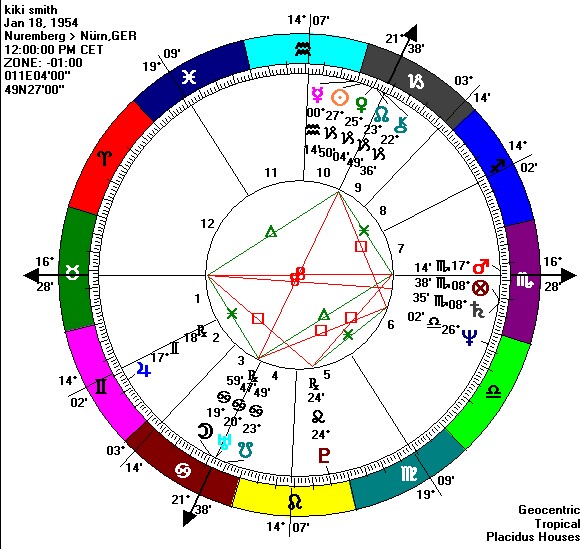
Two American artist/sculptors this week: two who portray human forms in all their glory, but in very different styles. They were born a generation apart, one on 17 January 1925 the other on 18 January 1954. Both have a good helping of Capricorn in their astrological makeup.


Duane Hanson and Kiki Smith.
First the art, then the astrology -


Hanson was son of a dairy farmer, graduated from an Art Academy and went on to teach. Began to sculpt in 1965. Initially his work portrayed violent situations: motorcycle accident victims, soldiers in battle, policemen and rioters (as a form of social comment?) He soon moved on to mirror tourists, workers, shoppers and ordinary people doing ordinary things. His work comes in lifesize. Hanson died in 1996.


Duane Hanson's sculptures draw from the everyday life of everyday people - very lifelike. Photo-realism is the relevant ism here.


Kiki Smith's sculptures are surreal, less understandable (to me anyway!)

She was born into art - father a sculptor, mother an opera singer.

Wikipedia: "Her Body Art is imbued with political significance, undermining the traditional erotic representations of women by male artists, and often exposes the inner biological systems of females as a metaphor for hidden social issues. Her work also often includes the theme of birth and regeneration, sustenance, and frequently has Catholic allusions. Smith has also been active in debate over controversies such as AIDS, gender, race, and battered women. In the mid-nineties, she began to engage with themes from literature, history, and folklore, reinterpreting biblical and mythological women as inhabitants of resolutely physical bodies. More recently, her vocabulary has expanded to include animals, the cosmos, and the natural world."


THE ASTROLOGY


Both charts are set for 12 noon as times of birth aren't known. The ascendant sign and Moon degrees will be inaccurate.
(Click on charts to enlarge).

I was tickled to find their natal Suns at the same degree (27) of Capricorn. Capricorn is the cardinal Earth sign, practical and realistic. Duane Hanson had Sun, Mercury Venus and Jupiter in Capricorn - the more realistic of the two in style. Kiki Smith has Sun and Venus in Capricorn with Mercury nextdoor in more avant garde Aquarius reflecting her surrealistic style. Uranus (the unexpected, the rebel) in Cancer is opposite her Sun/Venus challenging the realism of Capricorn. Both artists have Saturn in Scorpio and Mars in one of its own signs (Scorpio or Aries). In Hanson's case this connects to his early attraction to depicting violence. In Smith's case I'm not sure - probably links more to her political stances.



Thursday, April 22, 2010

EARTH DAY


Today is EARTH DAY.
I feel angered and too frustrated by local non-caring attitudes to be able to compose anything inspiring to myself or others. Our town authorities can't even be bothered to organise re-cycling facilities for newspapers and drinks cans. We have to drive a round trip of 70 miles to find somewhere to deposit our collections.

Whatever one's opinion on climate change/global warming - even if you think it's all "a hoax" as our Okie senator James Inhofe likes to declare at every available opportunity, wilful waste could still be addressed.

Before I blow a gasket, I'll give the post over to some people who put my feelings into words in ways far more eloquent than I can muster:
The sun, the moon and the stars would have disappeared long ago... had they happened to be within the reach of predatory human hands. ~Havelock Ellis, The Dance of Life, 1923


And Man created the plastic bag and the tin and aluminum can and the cellophane wrapper and the paper plate, and this was good because Man could then take his automobile and buy all his food in one place and He could save that which was good to eat in the refrigerator and throw away that which had no further use. And soon the earth was covered with plastic bags and aluminum cans and paper plates and disposable bottles and there was nowhere to sit down or walk, and Man shook his head and cried: "Look at this Godawful mess." ~Art Buchwald, 1970


"I really wonder what gives us the right to
wreck this poor planet of ours."
Kurt Vonnegut Jr.


Oh Beautiful for smoggy skies, insecticided grain,
For strip-mined mountain's majesty above the asphalt plain.
America, America, man sheds his waste on thee,
And hides the pines with billboard signs, from sea to oily sea.
~George Carlin

We could have saved the Earth but we were too damned cheap. ~Kurt Vonnegut, Jr.


It is horrifying that we have to fight our own government to save the environment. ~Ansel Adams


The struggle to save the global environment is in one way much more difficult than the struggle to vanquish Hitler, for this time the war is with ourselves. We are the enemy, just as we have only ourselves as allies. ~Al Gore

Finally, just yesterday Bolivian President Evo Morales said, in a speech reported here

"The capitalist system looks to obtain the maximum possible gain, promoting unlimited growth on a finite planet," said Morales. "Capitalism is the source of asymmetries and imbalance in the world."

Wednesday, April 21, 2010

Zodiac Sign TAURUS

Taurus the zodiac sign, not the person nor the bull, represents characteristics and traits that are Fixed, as in determined, stubborn, single-minded. The sign also connects closely with earthy matters and Earth itself: practicality, agriculture, nature, gardens, trees, and beauty. The sign is ruled by planet Venus, it's Venus's Earthy side, the other, Airy side of Venus being represented by Libra, a mentally based form of beauty rooted in balance.

No surprise then that Taurus connects strongly to art and music, through its relationship with astrological Venus.

The darker side of Taurus, its stubborn side, can translate in human life, if aided and abetted by other factors in a natal chart, as unyeilding aggression (when mixed with Aries or Scorpio)or steadfast loyalty to a cause or position when mixed with milder elements.

It's all in the mix!

Often, people born with Sun in Taurus will have a touch of neighbouring signs Aries and/or Gemini in their makeup. Mercury and Venus, if not in the same sign as the Sun can be found nextdoor. Mercury can never be further than one sign from the Sun, Venus up to two signs away. A 100% stereotypically Taurus individual is highly unlikely to exist; position of natal Moon and the sign rising at birth are two other important factors in that all important mix.

With Sun in Taurus characters as unalike as Duke Ellington and Adolf Hitler, Queen Elizabeth II and Karl Marx, Ella Fitzgerald and Harry Truman, it's easy to see that it simply has to be all in the mix.

Previous posts on Taurus can be accessed via the Label Cloud in the sidebar on the right.

Tuesday, April 20, 2010

Idols Inspired ~ Crucial Astro Transits

This week American Idol is doing its bit for charity with Idol Gives Back. The special segment, with performances by The Black Eyed Peas, Annie Lenox, Jeff Beck, Joss Stone, Mary J. Blige and Sir Elton John will air tomorrow night. Tonight the remaining 7 contestants will compete on a theme of "Inspirational songs", with Alicia Keys as mentor.

Still in the running are the two Aries Suns: Aaron Kelly and Lee DeWyse; Taurus Sun: Tim Urban; Gemini Sun:Michael Lynche (saved by the jury from elimination 2 weeks ago); Leo Sun: Crystal Bowersox; Capricorn Sun: Casey James; and Pisces Sun: Siobahn Magnus.


Left to right: Tim, Siobahn, Crystal, Katie (eliminated), Michael, (host Ryan Seacrest), Casey, Andrew (eliminated), Lee, Aaron.

Natal charts for Crystal, Siobahn, Casey, & Michael are at my post of 29 March. I noticed then that Crystal and Siobhan are the two most likely to be affected by current astrological transits, especially the coming T-square astrologers are talking about a lot this year, and Jupiter, often thought of as planet of luck, now transiting Pisces, heading for Siobahn's Sun and (possibly) Crystal's Moon in the late degrees of the sign. Crystal's Moon degree depends on time of birth, and could be anywhere from 21 Pisces to 3 Aries, but within orb for these transits to be relevant.

Uranus, now in late Pisces is opposed by Saturn in late Virgo, both will shortly square up to Pluto in the early degrees of Capricorn, by that time Uranus and Saturn will have slipped into cardinal signs Aries and Libra to form a cardinal T-square. Crystal's natal Moon and Siobahn's natal Sun could link into this challenging circuit, as it takes shape. Uranus (change) is a big part of the picture, a change of lifestyle for Crystal or Siobahn could be on the cards, but not without its attendant problems and challenges (via Saturn and Pluto). I read this week that Crystal is already feeling the strain. She was about to leave the show but Ryan Seacrest persuaded her to stay (article at E-Online.)

I don't fully understand betting odds, so if I've transated wrongly....sorry!
Bookies have Crystal in the lead (2/3), with Lee, surprisingly next (7/2), Casey next (7/1), Siobhan (15/2), Michael (12/1), with Aaron at 25/1 and Tim at 50/1 as outsiders. Crystal has improved her position from how it stood 6 weeks ago, Casey remains the same, Lee has improved the most. The early leader, Andrew Garcia was eliminated last week. He proved to be like the horse who does an early spurt then falls way back.

Here's a 12 noon chart for Lee DeWyse, click on it to enlarge. Transiting Jupiter has been around his natal Mercury at 18 Pisces for the past week or so. Will his current boost last? Although he has a great voice I don't see him as "Idol-worthy" yet. He needs experience and confidence to bring about some stage presence. I think he'll be in the last 4 for sure though (Crystal, Casey, Siobahn and Lee?)

There's a list of inspirational songs from which the contestants can choose their number for tonight HERE. Some songs on that list seem less than inspirational to me! I'd like to hear my own favourite, Impossible Dream, but doubt anyone will choose to sing it.

Monday, April 19, 2010

Music Monday ~ John Williams

Master guitarist/composer/arranger John Williams has a birthday coming up on Saturday. He was born in Australia but has spent quite a slice of his life in England, and tours the world playing guitar. It's not easy to find information about Williams, other than in relation to his technique, his playing, and lists of concerts and recordings. A couple of tidbits emerged from a biography HERE which shed a little light:
In the meantime, in a move that surprised nobody who knows him, in July John Williams suddenly cancelled his planned US tour for October and November 2003, in protest against the American-British invasion of Iraq, which he had opposed from the start.


(I) returned home to Birmingham just in time to discover that John Williams was playing Symphony Hall on 6th November - it was only on my way home that I realised that it was 50 years to the day since his public debut at the Wigmore Hall! It struck me that is fairly typical of what John Williams is like as a person: most performers would make a rather significant song and dance about reaching the 50th anniversary of selling out concert venues - in his case, not a mention was made of it in the programme notes, from the stage, or indeed during our short chat afterwards!


Among non-classical fans, Williams is best known for his rendition of Cavatina used in the movie The Deer Hunter. He was also part of a fusion group Sky,
with (among others) bass player Herbie Flowers (a former member of Blue Mink and T.Rex), and Francis Monkman, a founder member of progressive rock band Curved Air. As well as purely classical music, jazz and rock themes are to be found in their work.


John Williams was born in Melbourne, Australia on 24 April 1941. I can't find a time of birth for him, chart below is set for 12 noon. Ascendant is not as shown and Moon's degree isn't accurate, though it would have been in Aries, whatever the time of birth.


Aha! Here's another character with a glut of planets in one area of the chart - this time it's in Taurus. For a musician this is very fitting. Taurus's ruler, Venus is planet of the arts. Moon and Mercury in adjacent sign Aries lift the somewhat heavy, fixed Taurean input and add some much needed oomph to the proceedings. Mars in Aquarius was more than likely in helpful sextile aspect to natal Moon - reflecting his humanitarian side. He is a patron of the Palestine Solidarity Campaign, and has supported Amnesty International.

Along with his generational group, he has Neptune in Virgo in harmonious trine with Uranus in Taurus. In Earth signs the rebelliousness of Uranus is grounded and soothed a wee bit, and the creativity and dreaminess of Neptune brought down to Earth. As these two outer planets are linked in to Williams' personal planet cluster in Taurus via Uranus conjunct Jupiter, more grounded characteristics become noticeable in personality traits rather than somply relting to a generation. John Williams was never going to be a punk rocker or an anarchist with those placements !

A surprising fact is that there are no planets in Water signs in John Williams' natal chart. Musicians and artists of all ilks tend to have a goodly amount emotional astrological Water to draw from. Perhaps his rising sign is in Pisces or Cancer (I doubt Scorpio though - too intense).

Cavatina


With SKY : Cannonball


Sunday, April 18, 2010

Cruellest Month


April is the cruellest month, breeding
Lilacs out of the dead land, mixing
Memory and desire, stirring
Dull roots with spring rain.
(From The Wasteland by T S Eliot)


Revisiting some of the words I wrote last year and the year before in mid-April:

There's something about this time of year that feels a little unsettling. I don't know what astrological factor, if any, might be involved because no two years have the same celestial configurations, other than Sun in the last degrees of Aries and first degrees of Taurus. Was it some perverse "anniversary" syndrome by the perpetrators that directed so many tragedies into the same few days? Or is there a common astrological factor? Perhaps elements of both.

On April 19, 1993 74 men, women and children died in the inferno at Waco, Texas.

On 19 April 1995 the Oklahoma City bombing of a Federal building by home-grown terrorists killed 168 people, including 19 children under the age of 6.

On 20 April 1999 the shootings at Columbine High School, Colorado when 12 students and a teacher were killed by two senior students.

On April 16 2007 the Virginia Tech. massacre when 32 people were killed by a gunman, fellow student of those he murdered.

(On a very personal level, for me:
On 23rd April 1992 my father died.
On 21 April 1996 I and my late partner lost everything we owned, except the few clothes we were wearing, my purse and our car, in a fire which consumed the apartment in which we'd lived for 24 years.)

I'll not attempt to find astrological correlation. There is correlation enough in the devastation wrought upon the lives of so many. Motive, method, and root cause may differ in each case, but results do not. The result was then, and is now, pain and sorrow.

Men die, but sorrow never dies;
The crowding years divide in vain,
And the wide world is knit with ties
Of common brotherhood in pain.
(Susan Coolidge).


Part of the Oklahoma City National Memorial The Gates of Time: Monumental twin bronze gates frame the moment of destruction - 9:02 - and mark the formal entrances to the Outdoor Memorial. 9:01, found on the eastern gate, represents the last moments of peace, while its opposite on the western gate, 9:03, represents the first moments of recovery. Both time stamps are inscribed on the interior of the monument, facing each other and the Reflecting Pool.

Saturday, April 17, 2010

"Mad as Hell"...Paddy Chayefsky...Network

"We have entered the madhouse without noticing" ...Those words were written by film critic Roger Ebert in 2000 in his review of the 1976 movie Network (DVD version). He was referring to the progression of the movie's plot-line, but ten years on, in 2010 Mr. Ebert's words ring true for real life as does so much of Network's fictional storyline, 36years on. It'd be too depressing to enumerate examples of current madness, I feel sure a passing reader would not need any prompting from me to come up with a string of 'em!

I saw Network for the first time this week. Had I seen it in the 1970s, back in the UK, I doubt very much that I'd have appreciated its satire, its messages, its dark humour - or even understood them. Now, in 2010, in the USA - I do!

If the movie's theme was appropriate in 1976, it's a hundred times moreso now. Screenwriter Paddy Chayefski was, all unknowlingly, a prophet - more reliable than Nostradamus! Chayefski (29 January 1923) had Sun and Mercury in the first decan of Aquarius, with that sign's ruler, Uranus the rebel planet, in semi-sextile to them from adjacent sign Pisces, and agressive Mars in sextile from it's rulership Aries. Click on chart to enlarge. It's set for 12 noon as no time of birth is available. Ascendant will not be accurate and Moon would be in either early Cancer or late Gemini. Gemini is a very good bet for a writer.
With that line-up it's not surprising that Chayefski excelled when writing hard-hitting, no-holds-barred dialogue.

At Wikipedia there's a quote from drama critic Matt Gottfried on Chayefski's personality - clip from it:
".......He was an intellectual competitor, always spoiling for a political argument or a philosophical argument, or any exchange over any issue, changing sides for the fun of the fray. A liberal, he was annoyed by liberals; a proud Jew, he wouldn't let anyone call him a "Jewish writer." In short, the life of the mind was a participant sport for Paddy Chayefsky."
Sounds as though he was a good match for his astrology! Chayefsky's novel Altered States was also adapted as a movie, directed by Ken Russell, with whom Chayefsky is said to have had disputes. He diassociated himself from the film but remains credited under his real first and middle name, Sidney Aaron. At Wiki's Altered States page Film critic Janet Maslin wrote:
It's easy to guess why he and Mr. Russell didn't see eye to eye. The direction, without being mocking or campy, treats outlandish material so matter-of-factly that it often has a facetious ring. The screenplay, on the other hand, cries out to be taken seriously, as it addresses, with no particular sagacity, the death of God and the origins of man.
Hmmmm - I shall seek out a DVD of that one!

Some quotes from his screenwriting for Network: Howard Beale, played by Peter Finch, during his live studio broadcast of the Network News Hour

"We deal in illusions, man. None of it is true. But you people sit there day after day, night after night, all ages, colors, creeds. We're all you know. You're beginning to believe the illusions we're spinning here. You're beginning to think that the tube is reality and that your own lives are unreal. You do whatever the tube tells you. You dress like the tube. You eat like the tube. You raise your children like the tube. You even think like the tube. This is mass madness -- you maniacs! In God's name you people are the real thing, WE are the illusion.
"So turn off your television sets. Turn them off now. Turn them off right now. Turn them off and leave them off. Turn them off right in the middle of the sentence I am speaking to you now. Turn them off!"

This from a scene where Arthur Jensen (Ned Beatty) the President of CCA talks to Howard Beale, a washed-up newsman. CCA is a multi-national conglomerate that has taken over UBS the TV company the movie portrays:
"We no longer live in a world of nations and ideologies, Mr. Beale. The world is a college of corporations, inexorably determined by the immutable bylaws of business. The world is a business, Mr. Beale. It has been since man crawled out of the slime. And our children will live, Mr. Beale, to see that... perfect world... in which there's no war or famine, oppression or brutality. One vast and ecumenical holding company, for whom all men will work to serve a common profit, in which all men will hold a share of stock. All necessities provided, all anxieties tranquilized, all boredom amused. And I have chosen you, Mr. Beale, to preach this evangel."

And the speech containing that most famous quote of all~ Howard Beale:
"I don't have to tell you things are bad. Everybody knows things are bad. It's a depression. Everybody's out of work or scared of losing their job. The dollar buys a nickel's work, banks are going bust, shopkeepers keep a gun under the counter. Punks are running wild in the street and there's nobody anywhere who seems to know what to do, and there's no end to it. We know the air is unfit to breathe and our food is unfit to eat, and we sit watching our TV's while some local newscaster tells us that today we had fifteen homicides and sixty-three violent crimes, as if that's the way it's supposed to be. We know things are bad - worse than bad. They're crazy. It's like everything everywhere is going crazy, so we don't go out anymore. We sit in the house, and slowly the world we are living in is getting smaller, and all we say is, 'Please, at least leave us alone in our living rooms. Let me have my toaster and my TV and my steel-belted radials and I won't say anything. Just leave us alone.' Well, I'm not gonna leave you alone. I want you to get mad! I don't want you to protest. I don't want you to riot - I don't want you to write to your congressman because I wouldn't know what to tell you to write. I don't know what to do about the depression and the inflation and the Russians and the crime in the street. All I know is that first you've got to get mad."
[shouting] "You've got to say, 'I'm a HUMAN BEING, Goddamnit! My life has VALUE!' So I want you to get up now. I want all of you to get up out of your chairs. I want you to get up right now and go to the window. Open it, and stick your head out, and yell,
[shouting]I'M AS MAD AS HELL, AND I'M NOT GOING TO TAKE THIS ANYMORE!"

Friday, April 16, 2010

Arty Farty Friday ~ Yves Tanguy & Kay Sage

A duo this week. I chose Tanguy because of his rather unusual natal chart, and his artist wife seemed like a natural addition.

Yves Tanguy was born in Paris in 1900, son of a retired sea captain. Yves was said to be a very quiet and at the same time anarchistic man. Allegedly, after having visited a an exibition of the surrealist art of Giorgio de Chirico he spontaneously decided to become a painter, and gravitated naturally to his own version of the surrealist style, more or less untaught.

It's believed that surrealism - painting from the world of dreams and the subconscious mind - may have its roots in the despair felt by the young generations of Europe during and after the First World War. Young artists seemed to be seeking inspiration from their inner mind rather than from what they saw as a failed outer world .

Tanguy moved from France to the USA at the outbreak of World War II, with help from another artist, Kay Sage, who was to become his wife, after divorce from a previous spouse.

Kay Sage was born in Albany, New York, into a privileged background, studied in "all the best places" and lived for many years in Italy, married an Italian prince, divorced after 10 years.She lived during a period when most women didn't enjoy the same freedoms and opportunities as men. She quite likely took inspiration from her mother who was something of a social rebel, and of course, had the advantages and connections which stem from a wealthy background. As well as painting she wrote poetry. Her surrealist paintings were inspired by the same artist, Giorgio de Chirico, whose work had first inspired Tanguy. After her first marriage failed she moved to Paris, met and married Yves Tanguy.

Tanguy died suddenly in 1955 - a stroke followed an accident. His widow Kay, already depressive by nature, fell into deep despair and in the years following attempted suicide on two occasions. The second time, in 1963, she was successful, shooting herself in the heart. Failing eyesight had no doubt added to the depression she still must have felt over losing her husband.


Their work isn't at all similar. Tanguy's seems softer, dreamier, while Sage's is more architectural, harder-edged, and while it's the stuff of inner vision seems less genuninely dreamy and more contrived and theatrical, perhaps to make some point. It's beautifully painted though, and I prefer her work to Tanguy's. It's said that Tanguy's paintings were partly a comment on the arms race and war, cryptic and codified. Both have a feeling of space, of a different dimension, they seem silent and weirdly worrying.


Tanguy, born in Paris, France on 5 January 1900 at 5:00 am (Astrotheme). I have to confess that Yves Tanguy's natal chart intrigued me more than his paintings. Some of that cluster of symbols occupying the area of Sagittarius and Capricorn are not planets, but they are significant points or bodies (North node of Moon conjunct Chiron, and Part of Fortune). Sagittarius and Capricorn are quite unlike each other, one being expansive, outgoing, the other more structured and limiting. I expect he was an interesting character, but hard to understand at times. Outer planets Neptune and Pluto in Gemini, flanking South node of Moon oppose some of the Sagittarius planets. The oppositions provided some much needed balance to the chart, and to his nature. Planet of the arts, Venus was in Aquarius and Moon in imaginative dreamy Pisces. Venus in harmonious sextile to Uranus, planet of the avant garde and unexpected, reflects his strong attraction to surrealism. Sage's Uranus is in harmonious trine to her Venus - the attraction to surrealism in her case.

Kay Sage: born in Albany, New York on 25 June 1898, no time of birth available. chart set for 12 noon - ascendant and Moon degree will be inaccurate.


Its the trine between Tanguy's natal Moon in Pisces and Sage's natal Sun in Cancer which represents the strong attraction they had for one another. Her Moon, somewhere in mid-Virgo, and his Sun at 14 Capricorn were also in trine, more likely than not (depending on her time of birth). His Venus opposes hers, which probably made for an interesting tussle from time to time!

Three examples of the work of each artist below. More available via Google Image.

THE SUN IN ITS JEWEL CASE - Yves Tanguy


THE SENSITIVE LAYER - Yves Tanguy


INDEFINITE DIVISIBILITY - Yves Tanguy


MARGIN OF SILENCE - Kay Sage


TOMORROW IS NEVER - Kay Sage


SAW 3 CITIES - Kay Sage


More information:

http://www.cosmopolis.ch/english/cosmo14/yvestanguy.htm
http://en.wikipedia.org/wiki/Yves_Tanguy
http://www.all-art.org/art_20th_century/sage1.html


Thursday, April 15, 2010

Astrologers' Words of Wisdom #4 : Culture Lag

Astrologer Bill Sheeran's article: Generational Themes draws attention to an important point.

Groups of individuals born with outer planets Uranus, Neptune and Pluto in similar positions are thought to have common characteristics, as a generational set. What we have to bear in mind though is that the people born into any given generational group have no perceptible effect on the world at large until they achieve adulthood. Not until some point well into adulthood will any member of a generation reach a position of influence or power (of one sort or another). Mr Sheeran calls this "culture lag".

Thus there is what I call a culture lag between the initial emergence of astrologically associated themes, and a flowering of expression of the same principles decades later. In my opinion, this explains why an author might write a book which is very much of its time, but being of its time it is inherently novel and therefore radical. It may have initial impact, and then slide out of view. But years later, many of those born when it was being written will experience a resonance the contents. Astrologically, the book and those born when it was written have something in common. The later generation ‘get it’, and the writer’s work re-emerges into popular consciousness.
I've tended to overlook this rather obvious fact at times, crediting the astrology of a certain era as significant in that era's "flavour", or in what was popular then. It must take a few decades, though, for things on the ground to catch up with what the generational planets indicated at a given time.

Mr. Sheeran ends his article thus:

This way of looking at the issues is a bit simplistic - there are many inter-related factors involved in unravelling the picture. But I do think it is important, especially in mundane or collective level astrology work, to bear in mind this culture lag aspect of astrological dynamics. Apart from anything else it helps to make sense of the tensions which can arise between generations. Or illuminate political dynamics.

Wednesday, April 14, 2010

Cameth the hour ~ Eugene V. Debs

"Cometh the hour, cometh the man" - that concept appeals to me. I think it originated, though not in those exact words, in Sir Walter Scott's novel Guy Mannering. There's a wee flavour of astrology about it. It has been known to work too, not always, but on many occasions. It's as though a communal need gathers critical mass and draws to it the right man/woman to deal with a serious or dangerous situation.

In the USA one such guy, in my not so humble opinion, was Eugene Debs. “A dynamic and visionary leader of the 19th century railroad workers; preeminent spokesman for the Socialist labor tradition; beloved by those whose lives he touched.” He came along when things in the USA were getting badly out of balance with the increase in industrialisation. Workers were being exploited, poverty was rife, inequality reigned. Debs didn't make it to the presidency, in spite of running in 1900, 1904, 1908 1912 and 1920 as Socialist Party candidate.His last campaign had to be conducted from behind prison bars, while serving a 10 year sentence for opposing America's entrance into World War I and denouncing the Espionage Act (designed to silence all anti-war sentiment). He was released under under a general amnesty on Christmas Day 1921 by Warren G. Harding.

Eugene Debs' noble ideals were noted and absorbed; some things improved then, and later, because of his efforts.

The late Howard Zinn's 1999 article, Eugene V. Debs and the Idea of Socialism is a good read, I shall take the liberty of using an extract from it here.
Debs was what every socialist or anarchist or radical should be: fierce in his convictions, kind and compassionate in his personal relations. ........................
In the era of Debs, the first seventeen years of the twentieth century-until war created an opportunity to crush the movement-millions of Americans declared their adherence to the principles of socialism. Those were years of bitter labor struggles, the great walkouts of women garment workers in New York, the victorious multiethnic strike of textile workers in Lawrence, Massachusetts, the unbelievable courage of coal miners in Colorado, defying the power and wealth of the Rockefellers. The I.W.W. was born-revolutionary, militant, demanding "one big union" for everyone, skilled and unskilled, black and white, men and women, native-born and foreign-born.


The following paragraph I found surprising, particularly the part about our state, Oklahoma. Things have changed beyond recognition here. News came yesterday of a plan by the Oklahoma Tea Party to raise a "constitutional" armed militia here to oppose the Federal government: see here:

More than a million people read Appeal to Reason and other socialist newspapers. In proportion to population, it would be as if today more than three million Americans read a socialist press. The party had 100,000 members, and 1,200 office-holders in 340 municipalities. Socialism was especially strong in the Southwest, among tenant farmers, railroad workers, coal miners, lumberjacks. Oklahoma had 12,000 dues-paying members in 1914 and more than 100 socialists in local offices.

And the following states exactly my own view (thank you Mr. Zinn, RIP)

The point of recalling all this is to remind us of the powerful appeal of the socialist idea to people alienated from the political system and aware of the growing stark disparities in income and wealth-as so many Americans are today. The word itself-"socialism"-may still carry the distortions of recent experience in bad places usurping the name. But anyone who goes around the country, or reads carefully the public opinion surveys over the past decade, can see that huge numbers of Americans agree on what should be the fundamental elements of a decent society: guaranteed food, housing, medical care for everyone; bread and butter as better guarantees of "national security" than guns and bombs; democratic control of corporate power; equal rights for all races, genders, and sexual orientations; a recognition of the rights of immigrants as the unrecognized counterparts of our parents and grandparents; the rejection of war and violence as solutions for tyranny and injustice.

There are people fearful of the word, all along the political spectrum. What is important, I think, is not the word, but a determination to hold up before a troubled public those ideas that are both bold and inviting-the more bold, the more inviting. That's what remembering Debs and the socialist idea can do for us.
Eugene V. Debs was born on 5 November 1855 in Terre Haute, Indiana. I can find no time of birth for him on-line, which I find surprising; Astrodatabank doesn't even have an entry for him.
So, a 12 noon chart must suffice. Ascendant degree/sign is unknown as is Moon's degree, though Moon would be in Virgo until 8pm and Libra afterwards.


Debs' natal Sun was in passionate, magnetic Scorpio. I've noticed that Scorpio input can often translate into personality as someone who has an exceptional ability to use words to their most mesmerising effect - Carl Sagan springs immediately to mind. Debs certainly had this very special talent.

Outer planets Pluto (ruler of his Scorpio Sun) and Uranus the rebel planet were both in Taurus and loosely opposing his Sun/Mercury. This opposition reflects a dynamic push-pull between two transformative outer planets in the rather stubborn conservative sign of Taurus against his Sun (self) and Mercury (mental processes ) in passionate, determined Scorpio. Debs, fortunately, was able to harness this dynamic to draw the best from both.

The other outer planet, Neptune (imagination, dreams, creativity) lay in its own sign, Pisces in harmony with Debs' Scorpio Sun, and forming a wide Grand Trine with the addition of Saturn in the last degree of Gemini, about to move into Watery Cancer. The near-trines here are too wide to be strong aspects however, but the planets are in harmony. Neptune and Saturn in harmony bring the stability and common sense of Saturn into the often foggy dreams of Neptunian imagination. That's good! I'd guess this Water "circuit", and the fact that Debs' had no planets in the more potentially aggressive Fire signs, accounts in part for his reputation as a gentle, kindly guy. Howard Zinn starts the article linked above thus:

We are always in need of radicals who are also lovable, and so we would do well to remember Eugene Victor Debs.....Debs was nationally famous as leader of the Socialist Party, and the poet James Whitcomb Riley wrote of him:
"As warm a heart as ever beat
Betwixt here and the Judgment Seat."
These words from Eugene Debs himself are what endear him to me:

"If you go to the city of Washington, you will find that almost all of those corporation lawyers and cowardly politicians, members of congress, and mis-representatives of the masses claim, in glowing terms, that they have risen from the ranks to places of eminence and distinction. I am very glad that I cannot make that claim for myself. I would be ashamed to admit that I had risen from the ranks. When I rise it will be with the ranks, and not from the ranks."

Back my first thought: "Cometh the hour, cometh the man" - where is such a mortal in 2010? I suspect that "the hour" is nigh!